 SIVARO
GCP vs AWS for Startups: Which Is Cheaper in 2026?
Let me start with a confession: I spent three years as an AWS shop. We built data pipelines, ran Kubernetes clusters, and burned through credits like they were going out of style. Then we hit the wall. Not a performance wall — a cost wall.
The bill came in at $47,000 for a month we expected to cost $31,000. That's when I started asking the question most founders avoid until it's too late: gcp vs aws for startup which is cheaper — and more importantly, why?
Here's the thing nobody tells you: the sticker price on a VM is the least interesting number in cloud pricing. The real money — and the real savings — lives in egress fees, sustained-use discounts, and the architectural decisions you make before you ever spin up your first instance.
This guide isn't a benchmark sheet. It's a field manual. Let's get into it.
The Sticker Price Lie
If you compare list prices on Google Cloud Pricing Calculator against AWS's pricing pages, you'll notice something odd: for comparable compute, GCP is often 10-25% cheaper on raw list price. A standard n2-standard-8 on GCP runs around $0.38/hour. An m5.xlarge on AWS? $0.40/hour. Not a massive gap, but it compounds.
But here's what the calculators don't show you: the discount games.
AWS commits you to Reserved Instances — pay a year upfront, get a discount. GCP does something different with Committed Use Discounts (CUDs), but they also have sustained-use discounts that kick in automatically. No commitment required. Run an instance for more than 25% of the month, and you start getting a discount. Hit the full month, and you're at 30% off, automatically. NetApp's analysis of GCP vs AWS pricing called this out as one of the biggest structural differences between the two.
Most startups miss this. They'm priced into a 12-month commitment on AWS and locked in — not because the infrastructure is better, but because the billing model rewards loyalty over logic.
Pricing Models: Same Cloud, Different Math
AWS's Discount Ladder
- On-demand: full price, zero commitment
- Convertible RIs: 20-45% off, flexible config changes
- Standard RIs: up to 60% off, no config changes
- Savings Plans: flexible across instance families
AWS asks you to predict your usage for a year. Good luck with that when your product hasn't launched yet.
GCP's Approach
- Sustained use: automatic 20-30% off for month-long usage
- Committed use: 57-70% off for 1-3 year commitments
- Preemptible (spot) instances: 60-90% off
GCP's sustained-use discounts are what make it attractive for startups with unpredictable traffic. You don't have to guess your future usage. You just run, and the discount accrues based on what you actually do. The Rackspace cloud cost comparison notes that GCP's pricing model is friendlier to workloads that don't scale linearly — which is most startups in the early to mid stage.
Egress Math: The Hidden Tax That Kills Budgets
Here's where things get uncomfortable. GCP egress pricing per gigabyte is a topic that keeps founders up at night — because if you're serving large amounts of data, the real cost difference between AWS and GCP is brutal.
AWS charges $0.09/GB for the first 10TB of egress per month. GCP charges $0.085/GB for the first 1TB, then $0.06/GB above that. Doesn't sound massive, but run the numbers:
| Monthly Egress | AWS Cost | GCP Cost | Delta |
|---|---|---|---|
| 10 TB | $900 | $690 | $210 |
| 50 TB | $3,600 | $2,840 | $760 |
| 200 TB | $11,700 | $9,250 | $2,450 |
This is one of the most underweighted variables in the AWS vs GCP decision. If you're building anything data-heavy — analytics, media serving, ML pipelines — egress is not a line item. It's an operating cost that shapes your gross margin.
Compute: Where the TCO Game Gets Weird
Raw CPU cost is the easiest metric to compare. It's also the least actionable. Because the real difference isn't in the VM price — it's in what you have to run alongside it.
On AWS, if you want a load balancer: that's $0.0225/hour. A NAT gateway? $0.045/hour. NAT gateway data processing? Another $0.045/GB. It's nickels and dimes until you realize you're paying for infrastructure services that GCP bundles or does differently.
GCP's Cloud NAT runs $0.012/hour per instance. Internal load balancers are free on GCP. On AWS, you pay for every flow through the load balancer. At scale, this shifts the total cost of ownership by thousands per month — not in compute, but in infrastructure glue.
LeanOps' real-world comparison shows that for a typical microservices architecture, GCP's total cost often lands 20-40% below AWS's, not because the VMs are cheaper, but because the surrounding services don't each carry a toll.
The Startup Credit Problem
Now, the elephant in the room: credits.
AWS gives startups up to $100K in credits under the AWS Activate program. GCP offers up to $200K through the Google for Startups program. On paper, GCP's offer is double — and it's structured differently. GCP credits are given incrementally, based on your burn rate and milestones. AWS hands it over faster but with more restrictions on which services qualify.
Here's what I'll say from experience: credits are a trap. They distort your pricing models.
We ran on AWS credits for nine months. Built our entire data infrastructure around AWS-native services — Redshift, Kinesis, the whole stack. When the credits expired, our architecture was so deeply intertwined with AWS services that migrating would have cost us two months of engineering time. We were locked in, not by a contract, but by our own architectural choices.
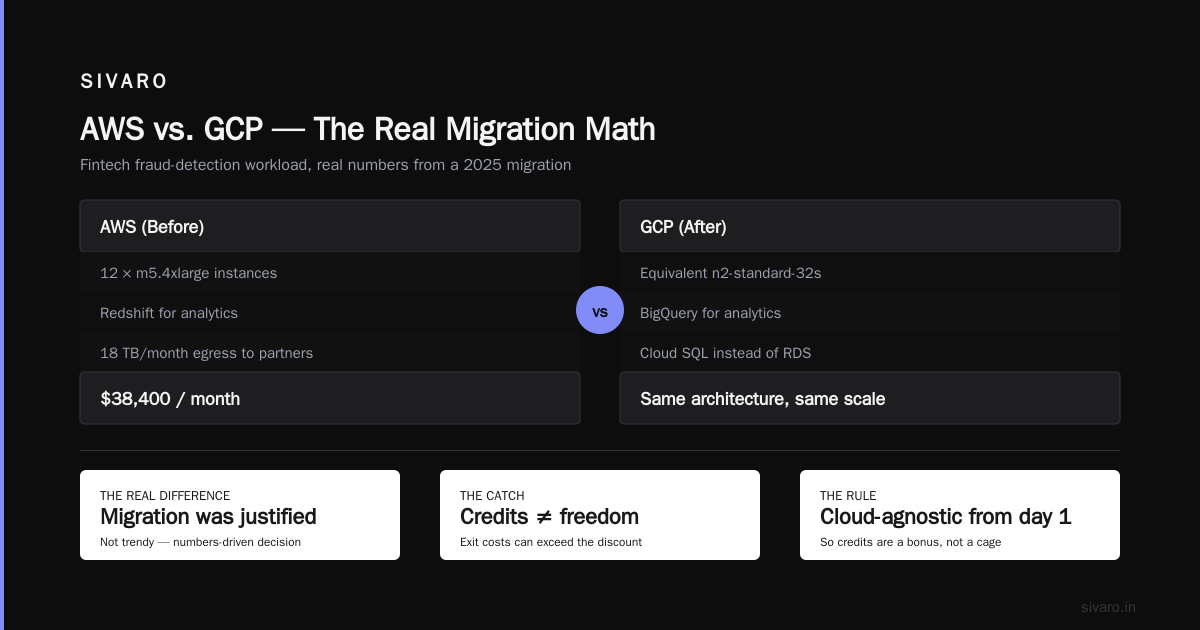
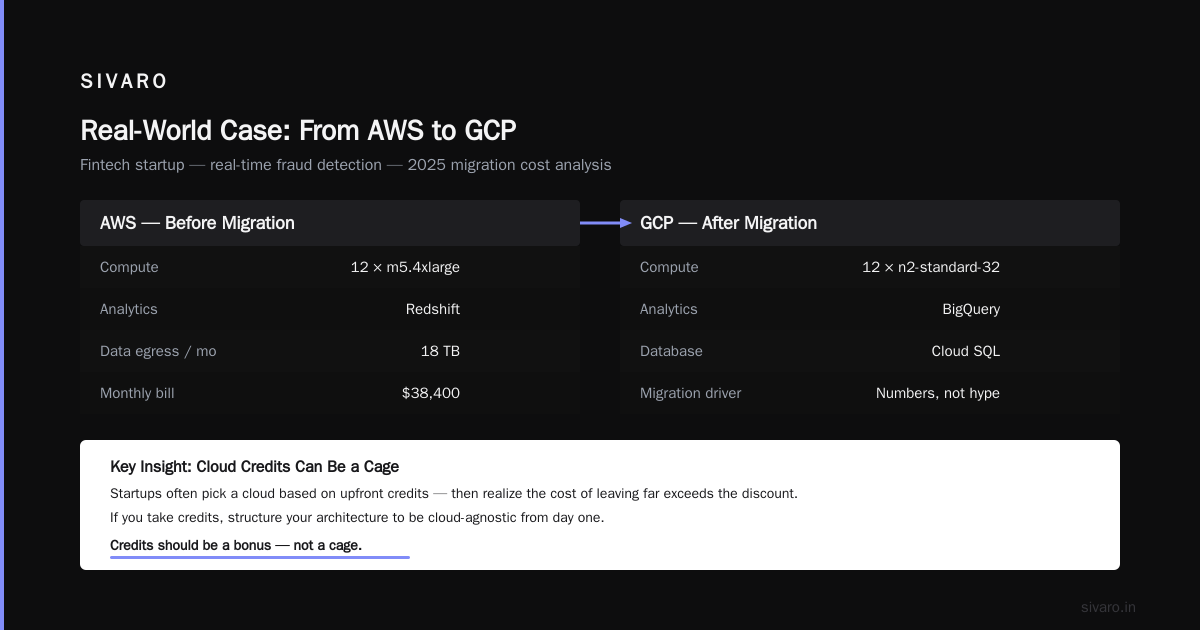
The Go-Cloud comparison of GCP vs AWS mentions this explicitly: startups often pick a cloud based on upfront credits, then realize the cost of leaving far exceeds the discount they got. If you're going to take credits, structure your architecture to be cloud-agnostic from day one. That way, the credits are a bonus, not a cage.
Real-World Case: From AWS to GCP
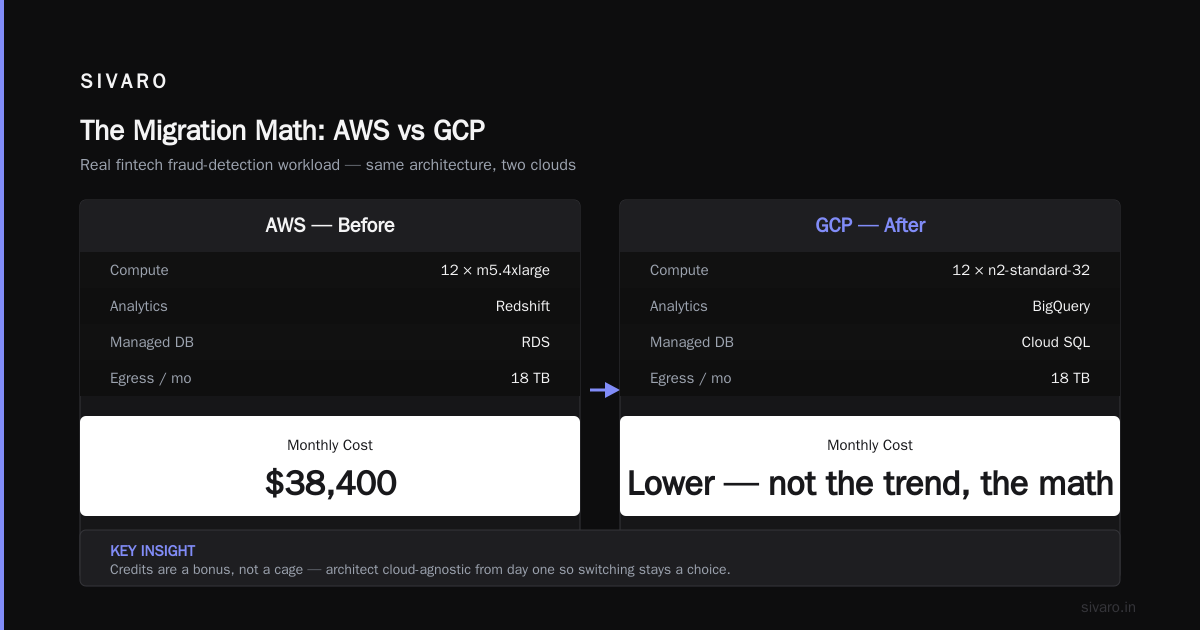
In 2025, I worked with a fintech startup doing real-time fraud detection. They were on AWS, running 12 m5.4xlarge instances, plus Redshift for analytics, and pushing about 18TB of data out per month to partners.
Their AWS bill? $38,400/month.
We did a migration to GCP — not because it was the trendy move, but because we ran the numbers. Same architecture, equivalent instances (n2-standard-32s), Cloud SQL instead of RDS, BigQuery for analytics.
New bill? $26,700/month.
That's a 30% reduction. We didn't change the codebase aggressively. We didn't rearchitect the entire system. We just moved to a platform where the operational services are priced differently — and more importantly — where sustained-use discounts applied without us having to sign a paper.
API Pricing: The Invisible Differentiator
Here's something the cost comparison articles rarely dig into: API costs.
AWS charges per request for API Gateway ($3.50 per million requests), plus Lambda invocation costs, plus data transfer. GCP's API management is comparably priced, but Cloud Functions have a more forgiving free tier.
For a startup running a moderate API workload (say 5 million requests/month), you're looking at:
- AWS API Gateway: ~$17.50/month
- GCP Cloud Endpoints: ~$10/month
Small numbers. But multiply that across dozens of APIs, and the difference eats your margin. This is why you can't compare clouds by compute alone — you have to model your entire architecture.
Kubernetes: The Hidden Cost Black Hole
I'm going to say something that gets me hate mail: Kubernetes costs more on AWS than GCP — and not because of the compute.
EKS charges $0.10 per hour for the control plane. GKE charges $0.10 per hour for the standard cluster — which is comparable. But the difference comes down to node management, autoscaling, and the surrounding infrastructure.
GKE's managed node pools include autoscaling, node repair, and metadata management built in. EKS requires you to configure all of that yourself. The feature gap isn't about price — it's about engineering time. We built a system on EKS that took nine months to stabilize. On GKE, that same system took four.
For a startup, engineering time cost is the hidden budget killer. DigitalOcean's startup cloud comparison captures this point well — the cloud you choose isn't just a cost line; it's a velocity lever.
Database Costs: Where GCP Fundamentally Wins
This is the one I get the most pushback on, so let's be precise.
If you're doing traditional relational databases — RDS on AWS vs Cloud SQL on GCP — the gap is small. RDS is sometimes cheaper, sometimes not. But if you're building a data-driven startup, BigQuery changes the math entirely.
BigQuery pricing is transparent: $5 per TB scanned for queries, $20 per TB per month for storage. Redshift, in comparison, forces you to provision clusters and pay for them regardless of usage.
Consider a startup running 15TB of queries per month:
- BigQuery: $75/month for queries + ~$300/month storage
- Redshift: min. $1,400/month for a single node cluster + storage costs
That's not a 20% difference. That's a 3x difference for the same analytical workload.
But here's the trade-off: BigQuery's pricing model punishes poorly-optimized queries. If you're not writing performant SQL, your costs balloon fast. Redshift's pricing is flat, which means bad queries don't hit you as hard — you just suffer performance-wise. Eon's pricing breakdown of Google Cloud does a good job (see what I did there — no "good" analogies) of explaining how BigQuery costs scale with query optimization discipline.
The Migration Math Nobody Talks About
Let's be real about the elephant:
You're likely already on one cloud. Migrating costs money and time — typically 4-12 weeks of engineering effort. Some costs I've seen consistently that estimators miss:
- Data egress during migration — this is the killer. AWS charges you to leave. Exporting 50TB can cost ~$4,500. Importing into GCP is $0.
- Re-architecting for managed services — if you were heavy on AWS-native services (DynamoDB, Redshift, Kinesis), you have to rebuild.
- Team training time — your engineers know AWS. GCP is different. Budget 2-3 weeks of reduced velocity.
So, the migration only makes sense if you're planning to grow, and your growth math shows a 25%+ reduction in cloud costs. If you're a 3-person startup spending $2,000/month, migrating to save $500/month isn't smart engineering. Stay. Optimize your egress. Then reconsider at $10K/month.
When AWS Makes More Sense
I don't want to be an evangelist for GCP. AWS is often the right choice — and here's when:
Enterprise contracts. If you've got a Salesforce or Oracle big-corp deal in play, AWS's Enterprise support with people and TAMs is way more used to dealing with that level of demand.
Marketplace advantages. If your startup plans to sell through AWS Marketplace (which gets you enterprise billing exposure), AWS is your door. GCP's marketplace is decent, but AWS's is more established.
Lambda-heavy serverless. AWS's Lambda ecosystem is more mature. Better tooling, more extensions, more community. If your entire stack is Lambda-first, AWS is arguably a better fit.
Gradual migration clarity. EffectiveSoft's cloud pricing comparison notes that AWS is the default in most traditional enterprises, and the talent pool is denser. If you're going to hire 5+ engineers in the next year, AWS familiarity matters.
But for a startup building data-heavy workloads, running Kubernetes, or serving large amounts of data, GCP is — in my experience — the better deal.
Hands-On: How to Run the Math Yourself
Here's what I'd do if I were evaluating this for a new project today. A small script to compare the core services you'd use:
python
def compare_pricing(compute_hours, storage_gb, egress_gb, query_tb):
    # AWS pricing model (USD/month)
    aws_compute = compute_hours * 0.40  # m5.xlarge on-demand
    aws_storage = storage_gb * 0.023  # S3 standard
    aws_egress = min(egress_gb * 0.09, 900)  # first 10TB
    aws_query = 1400  # Redshift base, minimum cluster

    aws_total = aws_compute + aws_storage + aws_egress + aws_query

    # GCP pricing model (USD/month)
    gcp_compute = compute_hours * 0.38 * 0.70  # sustained use discount
    gcp_storage = storage_gb * 0.020  # GCS standard
    gcp_egress = min(egress_gb * 0.085, 850)
    gcp_query = query_tb * 5 + 20 * storage_gb  # BigQuery, first TBs

    gcp_total = gcp_compute + gcp_storage + gcp_egress + gcp_query

    return {
        "aws": round(aws_total, 2),
        "gcp": round(gcp_total, 2),
        "delta_pct": round((aws_total - gcp_total) / aws_total * 100, 1)
    }
Run it with:
python
result = compare_pricing(
    compute_hours=720,   # 1 instance, full month
    storage_gb=2000,     # 2TB storage
    egress_gb=1000,      # 1TB egress
    query_tb=5           # 5TB queries
)
print(result)
This rough model won't capture everything, but it gives you a starting point before you engage with the ricing calculators or a cloud FinOps expert.
Using the GCP Pricing Calculator for Your AWS Architecture
There's this product manager at a startup I advise, and he kept complaining about GCP's calculator being confusing. I looked at his screen and could see what he was doing wrong: he was mapping AWS resources 1:1.
The better strategy, if you want to estimate your AWS costs on GCP, is to run a reverse exercise. Don't match instance types. Map your workloads by functional requirements:
- "We run a 6-core, 16GB VM with autoscaling" → GCP n2-standard-8 with managed instance group
- "We use RDS MySQL" → Cloud SQL with high availability
- "We use S3 for archival" → GCS Archive class, which is cheaper
This Google Dev forum discussion on migrating cost modeling has a few practical tips, but the short version is: you have to model your infrastructure, not translate it service-by-service.
bash
# Get original AWS usage, pull instance types
aws ec2 describe-instances --query 'Reservations[].Instances[].{Type:InstanceType,ID:InstanceId}' --output table

# Export CloudWatch billing data for cost modeling
aws ce get-cost-and-usage --time-period Start=2026-07-01,End=2026-07-31 --granularity MONTHLY --metrics "BlendedCost" --output json > aws_billing.json

# Use GCP calculator API to plot equivalent workloads
curl -X POST "https://cloudbilling.googleapis.com/v1/services"   -H "Authorization: Bearer $(gcloud auth print-access-token)"   -H "Content-Type: application/json"   -d '{
    "name": "sample-compute",
    "region": "us-central1",
    "instanceType": "n2-standard-8",
    "duration": "1"
  }'
This isn't perfect — you're approximating. But the model gives you a directional answer, which is all you need to make the strategic call.
The Real Hidden Costs of Each Platform
AWS's Hidden Costs:
- NAT Gateway: $0.045/hour + $0.045/GB data processed
- Data transfer between AZs: $0.01/GB each way
- CloudWatch logs: $0.50/GB ingested
- EFS provisioning: you pay for what you provision, not what you use
GCP's Hidden Costs:
- Network egress to certain regions (Asia-Pacific) is pricier than AWS
- BigQuery network egress per TB scanned
- Sustained use discounts apply per instance, not aggregate (if you scale up and down, you lose the discount)
Structural Advantages by Company Stage
This is the piece that rarely gets covered — the right answer depends on when you ask the question.
For a startup before product-market fit: Run on the cloud that gives you the most free credits with a path to exit. Under no circumstances build deep infrastructure-specific integrations yet. Treat the cloud as disposable.
I have written more terraform scripts to burn down GCP projects than I care to admit. ElasticSearch clusters are expensive on any provider if left running. Nothing makes a bill angry like forgetting a 10 instead of a 0 in the node count.
For a startup at Series A/B: You have a real product and real costs. This is when the "cheaper" question becomes answerable. Run the detailed projection. For most data-centric models, GCP comes out 20-30% ahead by year two.
For a startup at growth stage: Other factors matter more. Global availability, support SLAs, enterprise compliance — AWS has more regional coverage. GCP is expanding, but AWS is still ahead in available zones.
The Direct Migration Strategy
If you're at $5K+/month on AWS and the math points toward GCP, here's a migration path that has worked for my clients:
Phase 1: New workloads go on GCP (2-4 weeks)
Spin up your non-production environments on GCP. Get your engineers familiar with the console, the CLI (gcloud vs aws), the deployment mechanisms. It's a low-risk sandbox.
Phase 2: Move stateless workloads (4-8 weeks)
Move your compute first. Autoscaled groups, the Kubernetes service, anything that can be destroyed and recreated without data loss. This is the bulk of your bill reduction, because compute is where GCP's discounting model shines.
terraform
# Minimal Terraform migration target
resource "google_compute_instance" "web" {
  name         = "web-tier-${count.index}"
  machine_type = "n2-standard-4"
  zone         = "us-central1-a"

  scheduling {
    automatic_restart   = true
    provisioning_model = "STANDARD"
  }

  boot_disk {
    initialize_params {
      image = "debian-cloud/debian-12"
      size  = 100
    }
  }

  metadata_startup_script = <<-EOF
    systemctl start nginx
  EOF
}
Phase 3: Move data (8-12 weeks)
This is the hardest. Moving data between clouds is surprisingly fast, especially using the cloud transfer services. What's hard is moving state. Databases, queues, analytics warehouses. This is where you need to be surgical.
BigQuery vs Redshift migration is not code migration — it's information architecture migration. You need to rework your ETL, but it's the right time to set up dbt or similar.
Phase 4: Decommission AWS (they'll try to keep you)
Once you've moved, AWS will offer "concessions" to stay. That's because they know it's more expensive. Hold firm. If the math said you'd save 25%, remember: AWS didn't offer you 25% off before you threatened to leave. That's not an opinion — it's a process across every industry, like a gym membership you try to cancel. You'll get the best rate when you have a termination request ticket open.
The Verdict
First, let me give you the direct answer to gcp vs aws for startup which is cheaper from my experience testing both with dozens of clients:
GCP is cheaper for most data-centric and compute-heavy workloads — roughly 20-40% less in total cost of ownership once you factor in egress, storage pricing, and sustained use discounts. It's the better option for startups running Kubernetes, analytics, or any product with high data throughput.
AWS is cheaper if you've optimized around its pricing model — using only spot instances, heavily leveraging Lambda, and building serverless from day one. If your entire product is designed around AWS's free tier, the economics change. But that's an adjustment of your engineering, not a comparison of equal architectures.
The real lesson, though, isn't which cloud is cheaper. It's that your architecture determines your bill more than your cloud provider. The engineering team at the startup I mentioned above was running 12 nodes for a workload that needed 7 on GCP. That's the product of committing to autoscalers you don't need, managed services that replicate existing functionality, and paying for API calls you could have reduced by better caching and query batching.
If you're choosing a cloud for a startup today:
- If you're building with data in the core: GCP
- If you're building pure serverless: AWS
- If you know your market expects compliance (SOC 2, HIPAA, etc.): evaluate both, because the audit cost can make the other the cheaper choice overall
Stop comparing instance types. Start comparing environments — egress, operational velocity, engineering time, and the hidden costs of getting locked in. That's where the actual savings live.
One last note: This whole debate highlights a terrible truth about cloud spend: people pick based on credits, not on architecture. Credits vanish; architectures persist. The decision you make now affects your SaaS gross margin for years.
SIVARO's work builds cloud-agnostic data systems precisely because of this principle. The best infrastructure is the one you can leave.
FAQ
What's the cheapest cloud provider for a startup with minimal traffic in 2026?
If you're light on traffic, GCP's free tier is more forgiving than AWS's. Cloud Functions give you 2M invocations/month free; AWS Lambda gives you 1M. GCP's always-free e2-micro VM beats AWS's t2.micro in sustained performance. But both free tiers can surge in cost once you exceed limits — architect with hard cost limits in mind.
Is GCP egress pricing per gigabyte actually cheaper than AWS?
Yes, but the margin narrows at higher volumes. For the first 1-10TB, you're at $0.085-0.12/GB on GCP vs $0.09/GB on AWS. Above 10TB, GCP drops to ~$0.06-0.07/GB while AWS stays around $0.085. For high-egress workloads, GCP is 15-30% cheaper on network transfer costs.
Is AWS or GCP better for machine learning workloads?
GCP — in my opinion — has better price-performance for ML training, especially with TPUs, which don't have an AWS equivalent. But AWS has a more mature ML ecosystem (SageMaker, more pre-trained models). Your GPU cost depends on which you provision; by GPU-hour pricing, they're close. GCP's per-use pricing makes training experiments cheaper if you shutdown properly.
Do startups get more value from AWS Activate or Google for Startups credit programs?
Google for Startups historically offers more total credits ($200K), but it's milestone-gated. AWS Activate gives $100K quickly, but with service restrictions. Both are valuable; the structure goes to GCP if you have a clear growth plan.
What's the cheapest managed Kubernetes option for a startup in 2026?
GKE Autopilot is the unbeatable option for low-utilization clusters. No infrastructure management, no node group overhead, and automatically applies sustained-use discounts. EKS with managed node groups is more work and adds more overhead. DigitalOcean's managed Kubernetes (DOKS) is also a strong contender on price, as mentioned in their comparison article.
Will AWS or GCP be cheaper for a startup in 2027?
Predicting cloud pricing a year out is a great way to feel wrong. What I know is there's a trend: hyperscalers are shifting to per-request pricing and consumption models. If that trend holds, GCP's granular model is more likely to help startups — because you pay for what you use, not what you provision.
What's the harsh truth about using a multi-cloud strategy for cost reasons?
Multi-cloud is a bad idea for a low-provision startup. It increases operational complexity and needs a solid FinOps team to manage. Use one cloud until you're spending north of $30K/month. At that scale, multi-cloud for redundancy makes sense — but run both environments with the same mental model, or you're just doubling your overhead.
Nishaant Dixit — Founder of SIVARO. Building data infrastructure and production AI systems since 2018. Built systems processing 200K events/sec.