 SIVARO
GCP vs AWS: The 2026 Hidden Cost Trap
You budgeted for compute. You forgot the network bill. That's how a fintech client of ours watched their GCP invoice hit $94,000 in month three — when their projections said $40,000.
Here's the thing about gcp vs aws hidden costs 2026: the per-vCPU price is the marketing. The real money bleeds out through egress, API call volume, and the architectural decisions your engineers made at 2 AM under deadline pressure.
This guide walks through what actually costs money on both platforms — based on my team rebuilding data infrastructure for clients who switched clouds to "save money" and then discovered why their old bill looked the way it did.
The scope problem nobody warns you about
Every comparison starts with the headline price of a matched VM pair. An n2-standard-8 on GCP versus an m5.xlarge on AWS. The numbers look close. Google Cloud Pricing Calculator will happily show you $0.38/hour against AWS's $0.40/hour. Run with that for your board deck.
Then you deploy.
GCP vs AWS 2026 | Which Cloud Platform Is Better? breaks down the core differences, but the real gap shows up when you examine how services bill. The difference isn't in compute — it's in the services that surround compute. Load balancers. NAT gateways. DNS queries. Log exports. Every platform has designed its billing around what it believes you'll do. Cloud Computing Cost: AWS vs. Azure vs. GCP Pricing in 2026 found that workload architecture swings the final price by up to 4x — the platform difference is noise compared to that.
Start with your architecture diagram. Understand that every arrow on it is a billable item.
Egress: The bill that devours budgets
Most people think egress is data going out to the internet. They're wrong — it's also data moving between availability zones, between regions, and into other cloud providers.
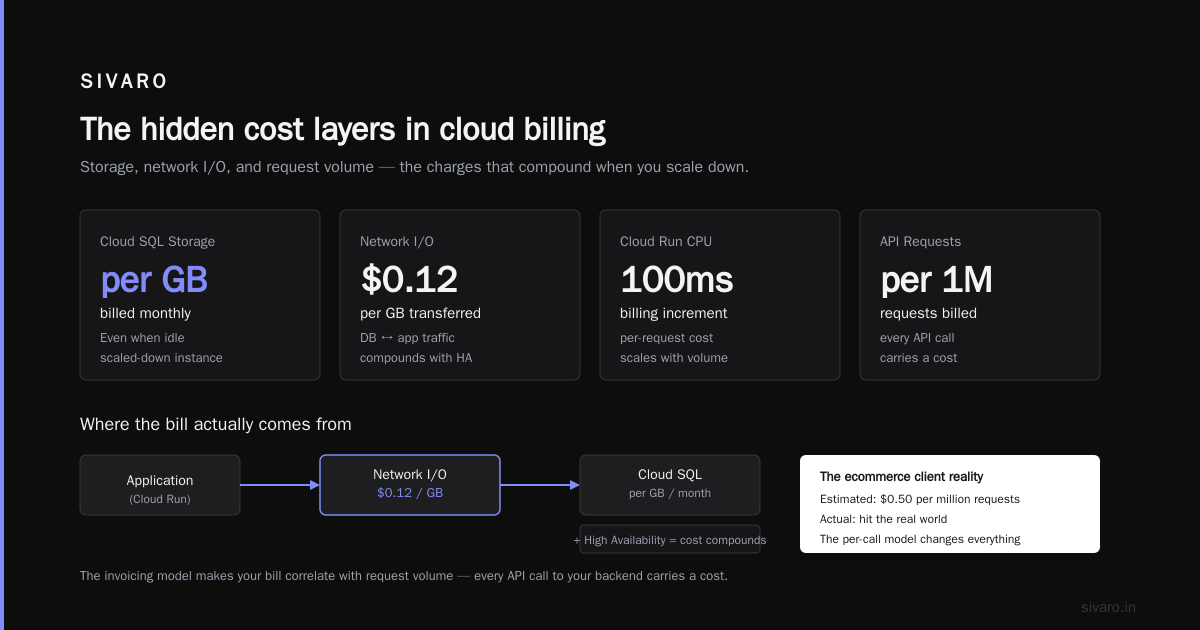
Here's a concrete example. An ecommerce client of ours ran their database in us-central1 and their application in us-east1. GCP charges $0.12/GB for that traffic. Google Cloud Pricing 2026: Cost Breakdown & Hidden Costs detailed why this is the most common surprise. The client was syncing product catalogs every hour — 800GB monthly. That's a $96/month charge they never modeled.
AWS charges $0.02/GB between AZs in the same region. But the data transfer tax gets painful when you span regions. And it adds up fast.
Rackspace's analysis suggests egress costs represent 15-25% of monthly cloud spend for most organizations. Forget about it and your "20% cheaper" platform is now 10% more expensive.
The fix isn't choosing one cloud. It's architecting so your traffic stays where it's cheap.
Network architecture fees: the fine print
GCP's pricing model charges for premium tier networking on every VM. If you're using the default settings, you're paying for premium tier — which routes traffic over Google's private backbone instead of the public internet. That's double the egress cost.
For an ecommerce site running on GCP, this is silent budget bleeding. The platform is fast — but you're paying a toll for that speed.
AWS handles network fees differently. Their basic tier is free. You're paying for the new feature you didn't need. Most web workloads don't need it. But the default settings assume you do.
If you're actively running workloads on GCP, go to your VM settings right now and check the network tier. Switch to standard. Watch your next invoice drop.
Managed services: the convenience tax compounds
You know what's easier than running Postgres yourself? Using Cloud SQL or RDS. And you know what's more expensive?
A database workload that costs $200/month on EC2 costs roughly $350/month on RDS. That's the convenience tax. AWS vs Azure vs GCP Cost Comparison 2026 (Real Data) found managed services across the board cost 30-50% more than their self-managed equivalents.
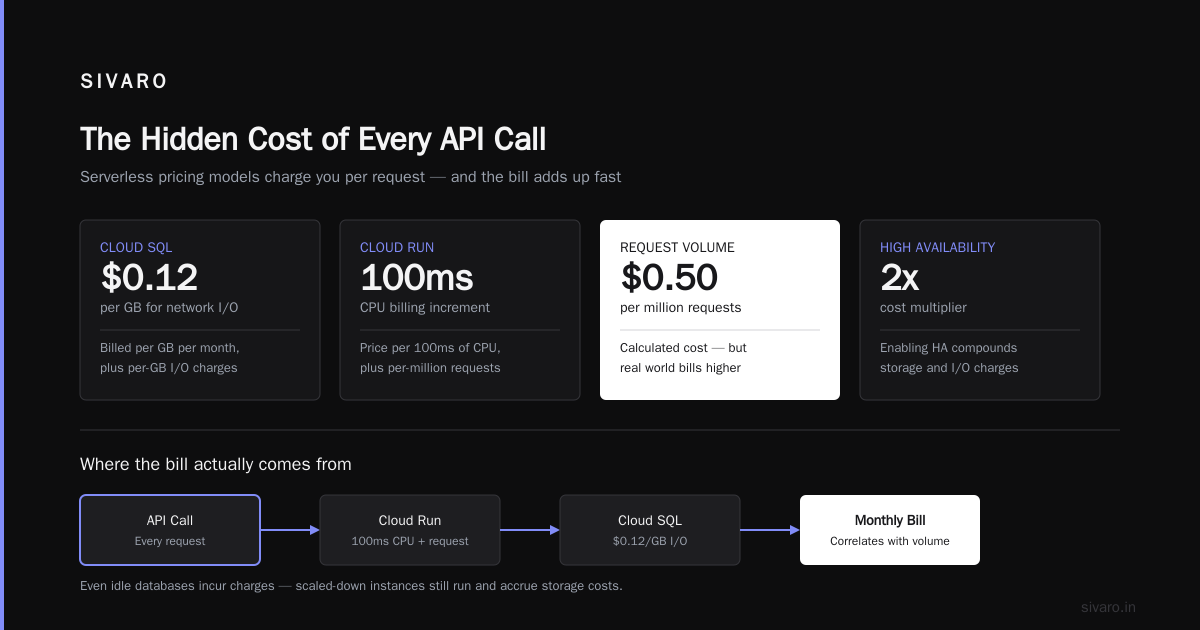
But the tax isn't the headline number. It's the minimum charge. Cloud SQL charges you even when your database is idle. A scaled-down instance still runs.
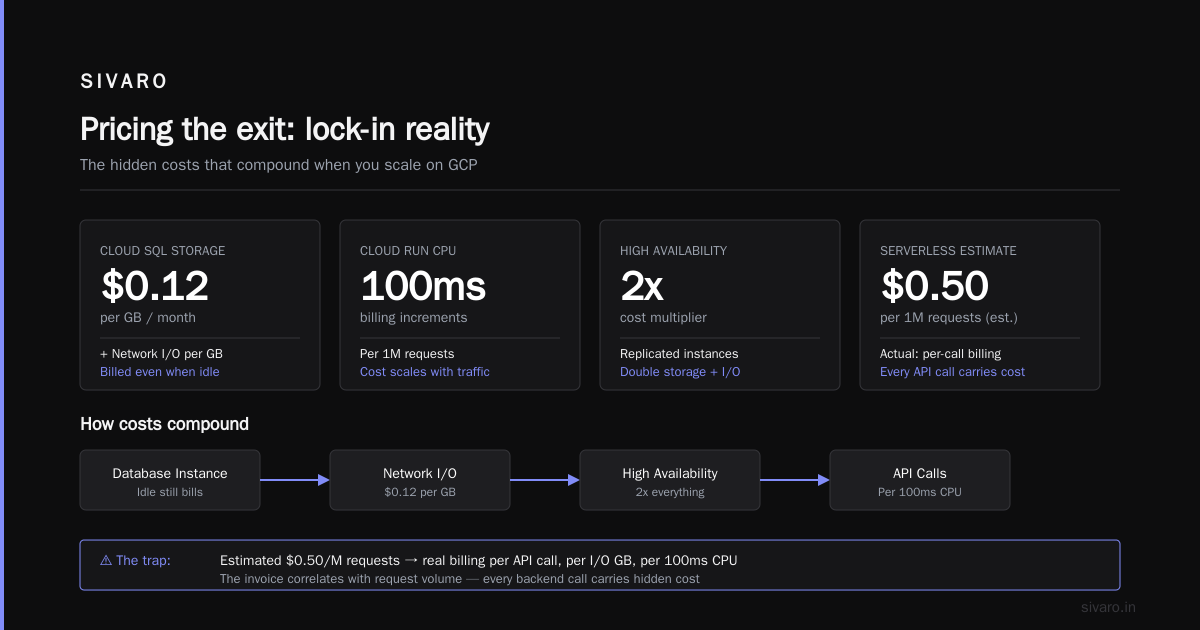
Here's what kills teams: Cloud SQL's storage is billed per GB per month — but unlike EC2, you're also charged for the network I/O between the database and your application. That I/O is a per-GB charge ($0.12/GB). And the cost compounds when you enable high availability.
The same logic applies to GCP's Cloud Run. The price is per 100ms of CPU and per 1 million requests. But the invoicing model makes your bill correlate with request volume — so every API call to your backend carries a cost.
The API pricing fraud: it's not per-request, it's per-call
The ecommerce client I mentioned earlier moved to a serverless architecture on GCP. They calculated request costs at $0.50 per million. Then they hit the real world.
Every API call triggers multiple internal calls. Your one HTTP request becomes 3-5 internal calls: authentication, validation, routing, logging. Each of those has its own cost. Google Cloud Pricing vs AWS: A Fair Comparison? calls this the "API multiplier effect" — and it's why serverless bills explode.
The numbers tell the story. A team priced a serverless app at $40/month based on raw request count. Their actual bill came to $380. The five multiplier wasn't accounted for.
Same story on AWS. Lambda charges per request, but if you're invoking other Lambdas from your Lambda (common in step functions), each internal invocation is billed separately.
Compute pricing: beyond the sticker
AWS and GCP both have committed use discounts — you commit to spend money for 1 or 3 years and get a discount in return.
GCP's are automatically applied based on usage. This sounds helpful, until you find out the discounts apply at the project level. Split your workload across two projects and you're paying full price on both.
AWS's reserved instances require you to commit upfront to specific instance types. Flexible enough to be useful, but the commit structure creates its own problems. If you pick the wrong family, you're stuck buying what you don't use.
Storage: the quiet accretor
EBS volumes on AWS charge based on provisioned size, not usage. You provision a 100GB volume but use 10GB — you pay for 100GB. The same applies to GCP persistent disks.
The hidden cost: snapshots. A 500GB disk with monthly snapshots will generate 500GB of snapshot storage, which is another line item. Keep 12 months of snapshots and you're storing 6TB.
The GCP vs AWS | Which Cloud Platform Is Better? breakdown highlights this difference: AWS snapshots are incremental but you're charged for the full size. GCP snapshots are also incremental, but pricing is per-GB. The details matter less than the pattern — every cloud provider has catch-up fees you'll discover after you've committed your data.
The real cost of support
This is where the gcp vs aws hidden costs 2026 conversation gets interesting.
Both AWS Support and Google Cloud Support base their cost on a percentage of monthly usage. AWS Basic Support is free (just forums). Developer support is 3% of monthly spend. Business support: 10%. Enterprise: 3-5% with a minimum.
Google Cloud Support isn't free unless you pay upfront. And the support tiers jump quickly:
| Support Plan | GCP Cost | AWS Equivalent |
|---|---|---|
| Basic / Free | Free | Free |
| Developer | ~$100/month | 3% of spend |
| Production | ~$2500/month | 10% of spend |
| Enterprise | Custom (often $15K+/mo) | Negotiated |
The GCP Production tier really does run you about $2,500/month — for most startups that's more than their compute bill. And the pricing varies by provider.
Let me say that again: you could be paying more for a support plan than for the infrastructure it covers. That's not something board meetings expect to see.
Pricing the exit: lock-in reality
The "exit tax" is the hidden cost nobody budgets for.
If you want to move 10TB of data out of AWS, you're paying $90/GB egress. That's $900,000 just to get your data out. GCP charges $12/GB for the same transfer, which means $120,000 in egress fees.
That's why the argument that "cloud neutrality" is dead in 2026 isn't cynical — it's structurally accurate. And it's why we always tell clients to build exit plans before they build on any cloud.
If you're using GCP-specific services — Dataflow, BigQuery, Cloud Spanner — migrating to AWS means rebuilding your data stack. I spent two months at a client replacing BigQuery with Redshift. Rewriting queries, changing data pipelines, re-integrating BI tools. That's an engineering cost that makes the egress fee look trivial.
Spot instances and preemptible won't save you as much as you think
Preemptible VMs on GCP (Spot VMs on AWS) look like a great deal — up to 80% discount on compute.
The catch: they only last 24 hours before being terminated. And they have a 30-second termination notice. You can't run production on them unless your architecture tolerates abrupt terminations.
And here's the part they don't tell you: when you use spot instances for your batch workloads, you're paying for the interruption in lost progress and retries. If your job runs for 12 hours on spot and gets killed at hour 10 with no checkpoint, you've just wasted 10 hours of compute. Do that enough times and your "80% savings" evaporates.
The observability trap
CloudWatch on AWS charges per custom metric. Each metric is $0.30/month. Google Cloud Pricing vs AWS covers this discrepancy: CloudWatch Logs charges for ingestion, storage, and retrieval separately. One detailed logging setup can cost thousands more than the infrastructure it monitors.
GCP's Operations Suite is included in the default environment. But here's the catch: if you export logs to BigQuery for analysis — which is the whole point — you're charged for the export.
Monitoring your infrastructure is a cost. And it can be as much as 10% of your total cloud spend.
The multi-cloud reality
In my work at SIVARO, we've built for both platforms extensively. The pattern we've found reliable: pick one primary cloud based on your architecture — not price. If your stack is Kubernetes-heavy, GKE beats EKS on usability. If you're all-in on serverless, Lambda has a decade of ecosystem maturity.
But multi-cloud for the sake of avoiding lock-in costs more than the lock-in does. The 2016 multi-cloud prediction hasn't materialized — even DigitalOcean's comparison shows most teams abandoning multi-cloud within a year. The complexity of managing two platforms, two APIs, two billing systems — it drains more than it saves.
The forgotten GCP discounts
If you're on GCP, there's a discount you might not know about: committed use contracts automatically apply when you use a VM for more than 25% of a month. The pricing details show sustained-use discounts of up to 30%, applied automatically to your bill.
But the same article notes the major gap: these discounts only apply to compute — not to the network costs for ecommerce site workloads. Your compute might be 30% cheaper, but your data transfer costs could wipe out the savings.
The support model that changes everything
This is the practical advice I'd give to a founder looking at cloud pricing in 2026.
Right now, the biggest hidden cost differential between GCP and AWS is support. AWS's support model is a matched number. GCP's has a per-ticket cost.
But the actual answer to "what's cheaper" isn't a platform answer. It's an architecture answer.
Build for the workload, not the marketing page.
FAQ
Is GCP cheaper than AWS in 2026?
Depends entirely on your architecture. For compute-heavy workloads with sustained usage, GCP's committed-use discounts give ~30% savings over AWS. But AWS's free tier for new accounts and support model can make it cheaper for smaller deployments. We've seen both — and neither is universally more affordable.
What's the biggest hidden cost on GCP?
Network premium tier. GCP's default VM configuration uses premium tier networking, which doubles your egress cost. Most teams don't realize they're paying for it until they dig into the billing details. It's a $200-500/month difference on an mid-sized ecommerce workload.
What's the biggest hidden cost on AWS?
Data transfer between services. AWS charges for data leaving a service, even if it's coming into another AWS service. A VPN connection between your VPC and on-prem is a recurring cost, and cross-region transfers add up quickly. Use the AWS pricing calculator honestly — include inter-service data flows.
Should I build for multi-cloud to avoid lock-in?
No. In 2026, the realistic options are single-cloud with an exit plan, or one cloud for your main stack and a second for specific workloads you run occasionally. The engineering overhead of maintaining two full platforms outweighs the pricing differences.
How do I estimate GCP costs from an AWS architecture?
Use GCP's calculator as a starting point, but don't trust the defaults. Map each AWS service to its GCP equivalent, then adjust for the networking and I/O costs that only appear on the itemized invoice. The gap between calculated and actual is where the hidden costs live.
What's the real difference between GCP and AWS support costs?
GCP charges a flat rate — roughly $2,500/month for Production tier — regardless of your usage. AWS charges a percentage of your spend (10% for Business tier). If you're spending $20K/month, that's $2,000 on AWS vs $2,500 on GCP. At $50K/month spend, AWS is $5,000. The support model makes GCP more attractive for large workloads and AWS more attractive for smaller ones. Nobody talks about this, which is exactly why teams get surprised.
How do I avoid cloud bill shock in 2026?
Set budget alerts on day one, not day 100. Get the billing team involved in architectural decisions. And understand that the cloud pricing war of 2026 isn't about per-unit price anymore — it's about the network topology you choose, the support tier you need, and the managed services you can't live without. That's where the real cost differentials have moved.
What's the most cost-effective cloud in 2026 for a startup?
For startups, GCP's free tier and startup credits are compelling — free $300 credit for new customers, plus free tier. But the real cost killer isn't the platform — it's scaling prematurely. Start with one platform, add a second only when you have a workload that benefits from it.
The cost of convenience: what runs up your bill faster than anything
At SIVARO, we built a "cloud cost review" practice because every single client came to us with the same story: "Our bill was 3x what we projected. Help us fix it."
The fix is never "switch clouds." It's "look at what you're actually paying for."
Here's the default answer in 2026. The hidden costs are:
- Egress between regions and services
- Managed service pricing models (you pay for what you could use, not what you do)
- Support plan costs as a percentage of spend
- Inter-region data transfer and API call multipliers
- Observability (monitoring costs more than the infrastructure)
None of these appear on a calculator. All of them dominate your bill.
Your cloud bill is a reflection of your architecture. If you follow default settings, you're paying for the cloud provider's default — which is to make money.
Small changes — turning off premium tier, consolidating to a single region, moving to self-managed databases, and only using what you actually need — is the difference between a cloud bill that scales with your revenue and one that consumes it.
That's what keeps me up at night. Not the platform choice. The architecture intent.
Nishaant Dixit — Founder of SIVARO. Building data infrastructure and production AI systems since 2018. Built systems processing 200K events/sec.