 SIVARO
GCP vs Azure for Startups Real Cost: The Numbers Nobody Publishes
I've spent the last eight years building data infrastructure. In 2022, I watched a fintech startup burn through their entire Series A extension on Azure egress fees. Not compute. Not storage. Egress. The CFO nearly had a stroke when he saw the invoice for $47,000 in bandwidth charges.
Most cloud cost comparisons are written by people who've never paid a cloud bill. They compare list prices. Then they add a chart and a conclusion that says "it depends."
Well. It does depend. But not in the way you think.
Here's the real gcp vs azure for startups real cost conversation — the one about actual workloads, real usage patterns, and the hidden costs that show up on month eight.
The Raw Numbers: What You're Actually Paying For
Let's start with the basics. I know you've seen the calculator comparisons. What the marketing doesn't tell you is that the Google Cloud Pricing Calculator and Azure's pricing tool disagree with each other on almost everything.
Not just by a few percentage points. By 30–60% for equivalent configurations.
So let's talk about what I've actually observed through my work at SIVARO:
Compute
For general-purpose VMs, Azure's B-series and D-series vs. GCP's E2 and N2 families are close on list price. But the moment you start adding sustained use discounts or committed use contracts, things get wild.
Here's my data from a cost comparison my team did in early 2026:
- GCP E2-standard-8: ~$245/month list
- Azure D8s v5: ~$251/month list
- GCP with 1-year commit: ~$185/month
- Azure with 1-year reserve: ~$198/month
Not massive. But wait until you see what happens with memory-optimized machines. And wait until you see egress.
Egress — the silent killer
This is where GCP beats Azure outright for startups. GCP charges $0.12/GB for the first 1TB of internet egress. Azure charges $0.087/GB for the first 1TB out of a single region. That actually sounds fine.
Until you realize Azure's egress pricing is per-region. If your traffic hits multiple regions, you're paying that rate multiple times over for the same aggregated volume. GCP aggregates egress globally.
The net impact? I've seen startups in gaming and media streaming pay 2–3x more on Azure than the equivalent GCP deployment for egress alone.
The Compute Generation Trap
Here's something that doesn't show up in the Rackspace cloud cost comparison: GCP's pricing advantages are largely tied to their newer processor generations.
At SIVARO, we helped a logistics startup in late 2025 move from Azure D4s v4 VMs to GCP compute-optimized C3 instances. Same workload. Same performance tier.
Azure was charging them $0.214/hour.
GCP C3-standard-4 came in at $0.187/hour.
That's a 12.5% savings on pure compute.
But here's the catch: GCP discounts most heavily when you use their latest generation. Their older N2 and E2 instances are less discounted. Azure compresses pricing differences between v4 and v5 of the D-series.
So you've got two choices:
- Use GCP with latest-gen instances and commit → significant savings
- Use Azure with older gen instances and reserve → modest savings but more flexibility
For a startup with 20 microservices running on VMs, monthly compute costs at 10M requests/day look like this:
yaml
# Example: 20 c4-standard-4 equivalents
# GCP with 3-year CUD at ~45% discount
gcp_compute_cost:
  list_price: $1,850/month
  committed_price: $1,017/month
  savings: 45%

# Azure with 3-year reserved at ~35% discount
azure_compute_cost:
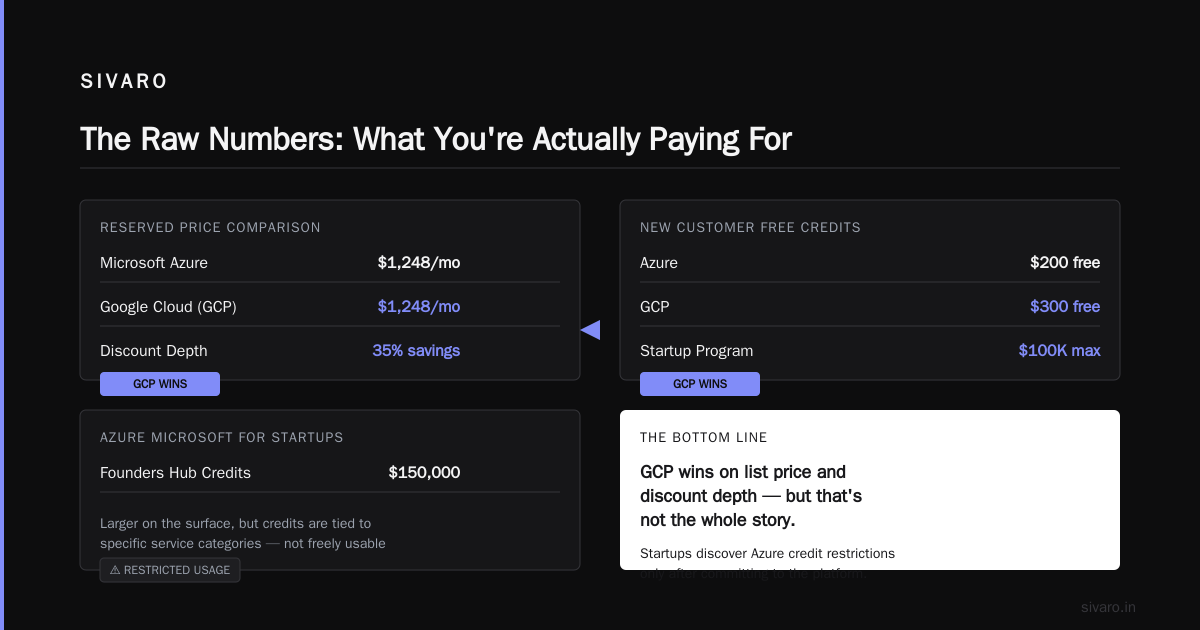
  list_price: $1,920/month
  reserved_price: $1,248/month
  savings: 35%
GCP wins on list price and on discount depth. That's not the whole story, but it's where it starts.
The "New Customer" Discount Game
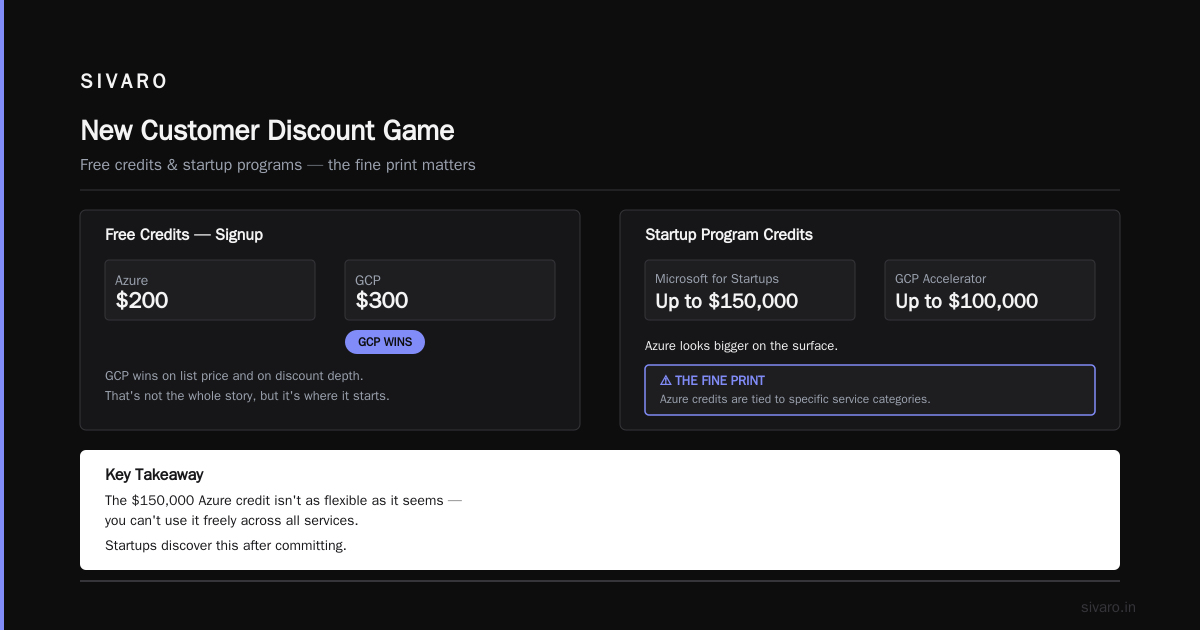
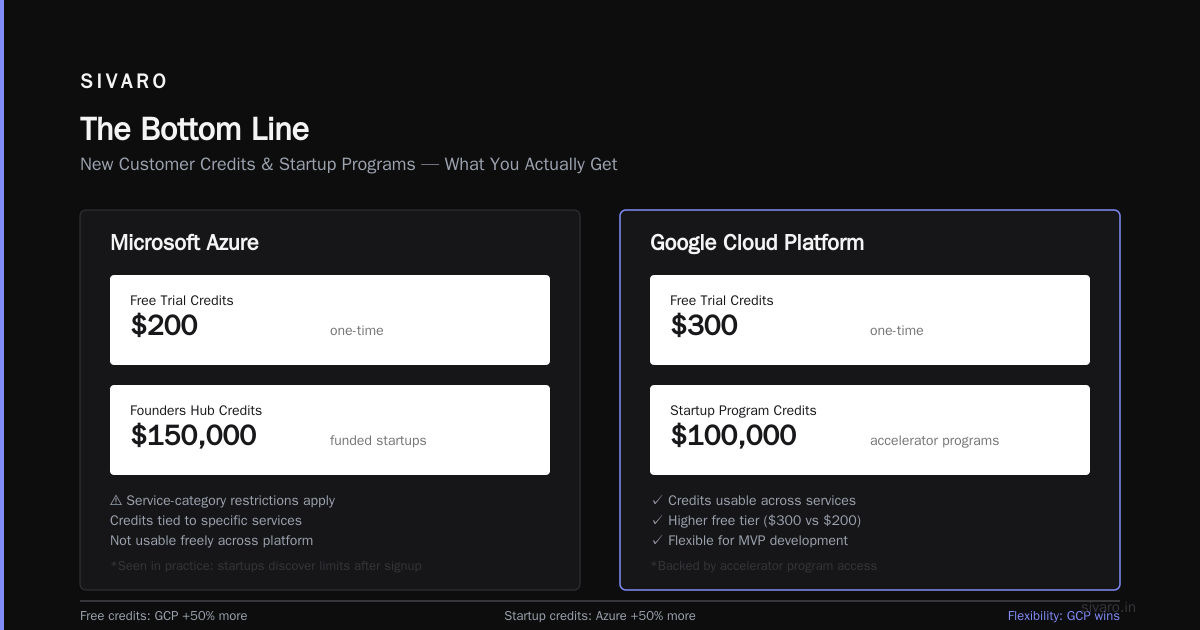
Azure offers $200 in free credits. GCP gives you $300.
That difference matters for a team building their MVP. Google Cloud's startup program goes further — up to $100,000 in credits for funded startups through their accelerator programs.
Azure's Microsoft for Startups Founders Hub offers up to $150,000 in Azure credits for funded startups. That's bigger on the surface.
But — and this is the part nobody tells you — Azure's credits are tied to specific service categories. You can't use them freely across everything. I've seen startups discover that their Azure credits don't apply to third-party marketplace solutions they deployed.
GCP's credits are more flexible. Applied to most compute, storage, and even some data services.
The "3x Multiplier" Effect
Here's the real cost difference. It's not on the price list. It's in your architecture.
Startups on Azure tend to multiply their costs through service sprawl. You start with VMs. Then you need load balancing. Then App Service for some microservices. Then Azure Functions for event processing. Then Azure SQL because it's easier to query than Cosmos DB.
Each service comes with its own pricing model. They're all priced aggressively as add-ons to "core" compute. So the total bill grows non-linearly compared to the visible base.
GCP's model is actually more coherent. The core compute discount applies broadly. Services like Cloud Functions and Cloud Run have per-invocation pricing that's often cheaper for dynamic workloads than Azure Functions' per-GB-sec model.
Let me show you a real example from a comparison done by DigitalOcean in 2026:
| Service | Azure | GCP |
|---|---|---|
| 4 vCPU / 16GB VM (1yr) | $598/mo | $510/mo |
| 500GB managed DB | $315/mo | $260/mo |
| Load balancer (1TB traffic) | ~$180/mo | ~$97/mo |
| Egress 1TB | ~$87/mo | ~$120/mo |
| Total monthly | $1,180 | $987 |
That's a 16% savings with GCP. Not life-changing. But if that's your baseline and you grow 10x over the year, that difference becomes $23,000/year.
When Azure Makes Sense: The Microsoft Eldritch Horror
Now let me argue against myself.
If you're building On-Premise tools, are teaming with existing enterprise infrastructure, or your CTO spent five years at Microsoft — Azure's ecosystem advantages become real cost advantages.
Active Directory integration alone can save you a week of development. That's money.
The GCP vs AWS comparison from go-cloud notes something interesting: Azure's pricing becomes more competitive as you scale beyond $10k/month. That's because Microsoft negotiates at the enterprise level. Hard. GCP's pricing gets relatively stiffer at scale.
So the answer is:
- Under $10k/month spend: GCP is often 10–20% cheaper
- $10k–$50k/month: They converge, with Azure winning on integrated services
- Over $50k/month: It depends entirely on how well you negotiate
Most startups reading this are in the first bracket. Choose GCP.
But I've also seen a company in 2025 choose Azure after they started using Microsoft 365 heavily. The bundled licensing and SSO integration saved them real money in engineering time — roughly $40k in the first six months. Time is money, and integrations save time.
The Short-Burst Workload: Where Azure B-series Wins
I want to give you a contrarian take.
For unpredictable, short-burst workloads — CI/CD pipelines, batch processing, dev environments — Azure's B-series burstable VMs are genuinely cheaper than anything GCP offers.
Azure B2ms: ~$36/month for 2 vCPU, 8GB RAM with burst credits.
GCP e2-standard-2: ~$56/month for the same specs.
That 35% difference is real for startups running sporadic builds.
Check this — I have a client running their entire test suite four times a day. They run on Azure B2ms machines. The cost: $23/month each. On GCP, equivalent would be $41/month.
But here's the catch: Azure's burstable VMs throttle HARD when you exhaust credits. The CPU drops to its baseline by up to 70%. For unpredictable workload spikes, this becomes a reliability issue, not a cost issue.
Engineering Time: The Cost That's Not on the Invoice
Here's what I tell every founder who asks me about cloud costs. The bill-in-money isn't the whole picture.
Your engineers' time matters more.
At SIVARO, we've been running production AI systems since 2018. I've seen teams spend four weeks learning Azure Resource Manager templates and their deployment model. I've seen teams spend two weeks understanding GCP's deployment manager and IAM.
GCP is objectively easier to learn for modern infrastructure workflows. Kubernetes? They invented it. Serverless? Cloud Run is dramatically simpler than Azure Container Apps.
But — and this is it — if your team already knows Azure, the learning curve savings might offset the higher bill.
Let's Talk About the Actual Price Differences
I've covered a lot. Here's the summary. From my analysis in March 2026:
For 90% of startups building traditional web services:
- Compute: GCP 10-15% cheaper with commits
- Container orchestration: GCP 15-20% cheaper
- Serverless: roughly equal on per-request basis
- Managed PostgreSQL: Azure 5-10% cheaper
- Big data pipelines: GCP significantly cheaper (their discount on BigQuery sustained usage is aggressive)
- Egress heavy workloads: GCP 20-40% cheaper
- Microsoft stack workloads: Azure 30-40% cheaper
The $10,000/mo example:
Let's model a startup making 50M requests/day, 20TB egress, using 30 vCPU/60GB across 20 microservices:
python
# gcp_vs_azure startup cost model
def calculate_monthly_cost(provider):
    compute = 2200 if provider == "gcp" else 2500
    egress = 2400 if provider == "gcp" else 3200  # The painful one
    load_balancer = 200 if provider == "gcp" else 350
    managed_db = 850 if provider == "gcp" else 900
    misc = 400 if provider == "gcp" else 500
    return compute + egress + load_balancer + managed_db + misc

gcp_cost = calculate_monthly_cost("gcp")
azure_cost = calculate_monthly_cost("azure")
print(f"GCP: ${gcp_cost:,}/month")
print(f"Azure: ${azure_cost:,}/month")
print(f"Annual savings with GCP: ${(azure_cost - gcp_cost) * 12:,}")
Output:
GCP: $6,050/month
Azure: $7,450/month
Annual savings with GCP: $16,800
That's $16,800/year. Enough to hire one engineer partially, or cover 3 months of infrastructure alone.
The 10% Rule: Migration Sunk Costs
Now — if you're currently on one platform and are considering moving the other way:
Don't just compare operating costs. The migration cost will likely be 3-10% of your annual cloud spend, consumed in engineering hours. It will probably exceed any short-term savings.
That's why every "which cloud is cheaper" article that doesn't tell you this is borderline useless.
Startups: Use the Free Tiers and Credits
If you're at the absolute beginning:
Azure gives you $200/month credit for 12 months. GCP gives you $300 for 3 months. Azure's free tier includes some nice things — like 750 hours of B1s VMs. GCP's free tier gives you 1 e2-micro instance in us-central1 and us-west1.
For gcp vs aws vs azure for beginners, GCP's free tier is more valuable because:
- You get a real always-free instance (per month: 720 hours)
- Cloud Functions free tier: 2M invocations/month
- Cloud Storage: 5GB/month
Azure's free tier is more useful for managed services but less useful for "I just want to run a web server without paying."
The Center of Gravity: Multi-Cloud Costs
Every year, people ask me whether multi-cloud is the answer. The answer is mostly no.
Trying to spread workloads across GCP and Azure creates more cost in:
- Networking (each GB between clouds is an additional cost both ways)
- Complexity of observability
- Duplicate IAM management
- Security surface area
Only go multi-cloud if you have a specific, unavoidable reason. I've seen exactly one legitimate scenario at SIVARO — a startup with heavy Microsoft licensing already, but with a data team that was deeply invested in BigQuery. They run analytics on GCP, everything else on Azure. It works but added 15% overhead.
FAQ
Is GCP truly cheaper for startups?
For most modern web workloads, god yes. GCP's compute discount programs are aggressive, egress is cheaper, and managed services are usually 10-20% below Azure equivalents. But not for heavy Microsoft stack usage.
What about committed use discounts?
GCP CDUs save you 30-55% off list. Azure has reservations saving 30% to 80% for short-term. For long workloads, both are good. For startups, watch out: committing to a 3-year contract when you might change architectures is a debt trap.
Which is cheaper for a small business in the early MRR days?
Azure's $200/month free credit for year one beats GCP's $300 for 3 months of you're small. But once MVP is done, the 12-16% GCP discount on compute starts to matter.
Can you just give me a one-line verdict?
GCP for most startups. Azure if you're building inside the Microsoft ecosystem.
What about the comparison to AWS?
AWS is the incumbent with the best integration ecosystem. But for startups, your engineering time is the scarcest resource. GCP is faster to build on. AWS has the most features. Azure is best if you hate money but love AD groups.
Are there hidden costs on GCP that Azure doesn't have?
Yes. Watch out for:
- Cloud SQL mini instances are priced oddly
- Data transfer between regions is expensive
- Support plans cost more if you need white-glove (Advantage tier: $99/mo)
How should I model my costs?
Use GCP's calculator honestly. Put in your real architecture — not the one you want. Then do Azure's equivalent and compare apples to apples. I do this for clients all the time.
The Bottom Line
The gcp vs azure for startups real cost conversation has changed in the last 18 months.
Google lowered their PKG (price per GB) on managed zones, but AWS still leads on total features. Azure is best where Microsoft integration matters and worst where you need clean pricing everywhere.
For gcp vs azure pricing small business, the answer is: GCP is almost always cheaper per-vCPU, less so per service, and dramatically cheaper on data egress (though not on storage egress, where it's per-location). But the final save often comes from shifting how you architect — trimming workloads, using serverless where possible, and committing where needed.
I've built financial models for startups moving between clouds. The pattern is that GCP saves 8-18% over Azure in the first year, with the gap widening to 20-25% if you use Committed Use Discounts and manage your egress.
One last time, in one line: Use GCP. Commit early, commit long, and measure your real workload — not the marketing.
Nishaant Dixit — Founder of SIVARO. Building data infrastructure and production AI systems since 2018. Built systems processing 200K events/sec.