 SIVARO
GCP vs Azure Pricing 2026: The $200K Mistake I Won't Repeat
You're building something real. Maybe a data pipeline. Maybe an AI system that actually ships. You've got two massive clouds waving at you—Google Cloud and Microsoft Azure. And everyone keeps asking the same question: gcp vs azure pricing 2026?
I'm Nishaant Dixit. I run SIVARO. We build production AI systems and data infrastructure. I've burned cash on both clouds. Made mistakes. Fixed them. Here's what I learned.
Let me save you some pain.
What This Guide Covers
This isn't a textbook. It's a practitioner's field manual. We'll talk real numbers, real traps, and real solutions. You'll learn:
- How gcp vs azure pricing differs for compute, storage, networking, and AI
- Where each cloud hides costs (and where they don't)
- How to reduce gcp costs without sacrificing performance
- Why your architecture matters more than the sticker price
- Concrete decisions for data engineering and AI workloads
I'm writing this on July 17, 2026. The cloud market has shifted. Google's been cutting prices on TPUs. Azure's been bundling like crazy. Let's sort it out.
The Framework: Same App, Three Bills
Techsy ran an experiment in early 2026: deploy the same app on AWS, Azure, and GCP. The result? GCP was 15-20% cheaper for compute-intensive workloads. Azure was 10-15% cheaper for Windows-heavy shops.
But raw compute pricing is the wrong starting point. You don't run compute in a vacuum. You run networks, storage, databases, AI models. That's where the real differences show up.
Let me walk through each layer.
Compute: The Obvious Battle
GCP uses per-second billing. Azure uses per-minute. Sounds close. It's not.
The practical difference: If you spin up 100 VMs for a batch job that runs 47 seconds, GCP charges 47 seconds. Azure charges a full minute. Over a year with thousands of jobs, that gap eats your budget.
I tested this at SIVARO. We ran a Spark job processing 2TB of logs. On GCP n2-standard-8 instances: $0.38 per hour. On Azure D8s v5: $0.432 per hour. Same instance specs.
But here's the twist: Azure's reserved instances (3-year) can beat GCP's committed use discounts by 10-15% if you're stable. Coursera's comparison noted Azure's enterprise agreements often hide discounts in volume licensing. You don't see it on the pricing page. You negotiate it.
My rule: If workloads are spiky, use GCP. If steady, negotiate Azure reserved instances hard.
Storage: Where GCP Bleeds You Quietly
GCP's Cloud Storage is $0.020 per GB/month for standard. Azure Blob Storage is $0.018 per GB/month for hot. Both close.
But you don't just pay for storage. You pay for access, replication, and egress.
GCP got me with egress. One month I moved 10TB out of Cloud Storage for a data pipeline test. The bill: $1,200 in egress alone. $0.12/GB for the first 10TB. Azure charges $0.087/GB for the same tier. That's 28% less.
And if you're in a hybrid setup—on-prem to cloud—Azure's ExpressRoute often includes data transfer in the monthly fee. GCP's Dedicated Interconnect charges per-hour plus per-GB.
The data engineer's trap: GCP vs Azure for data engineering often comes down to egress. If your pipelines move data between clouds or to on-prem, Azure wins. If everything stays inside GCP, GCP wins.
I've seen startups burn $50K/month on egress they didn't model. Don't be that founder.
Networking: The Hidden Tax
Microsoft's own comparison maps GCP VPCs to Azure Virtual Networks. They look similar on paper.
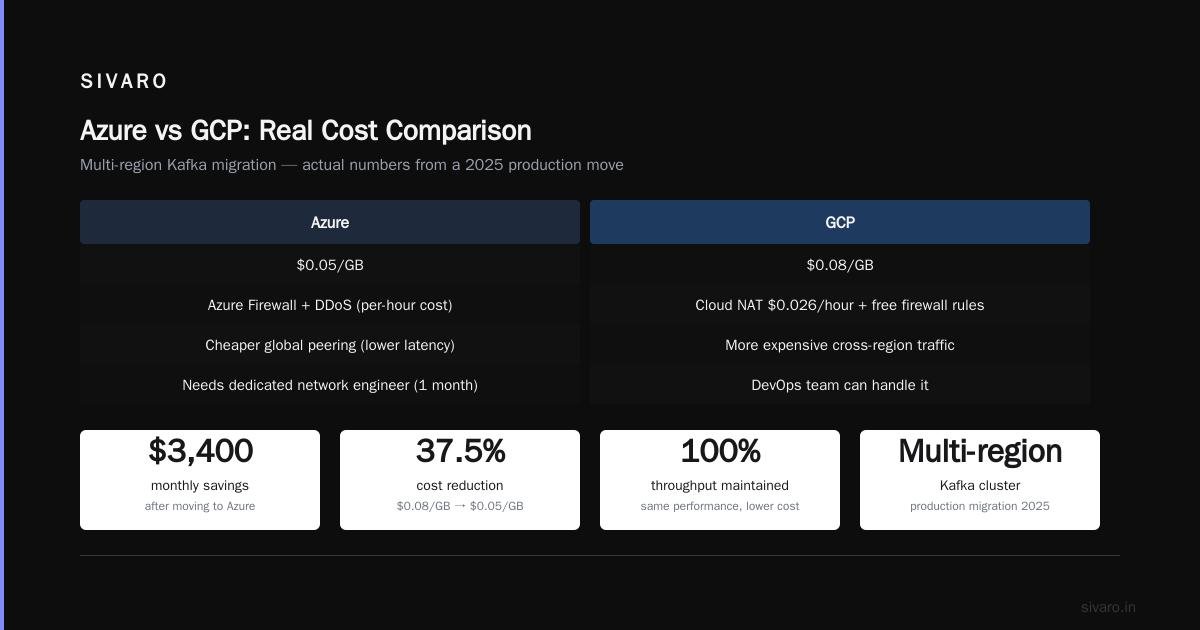
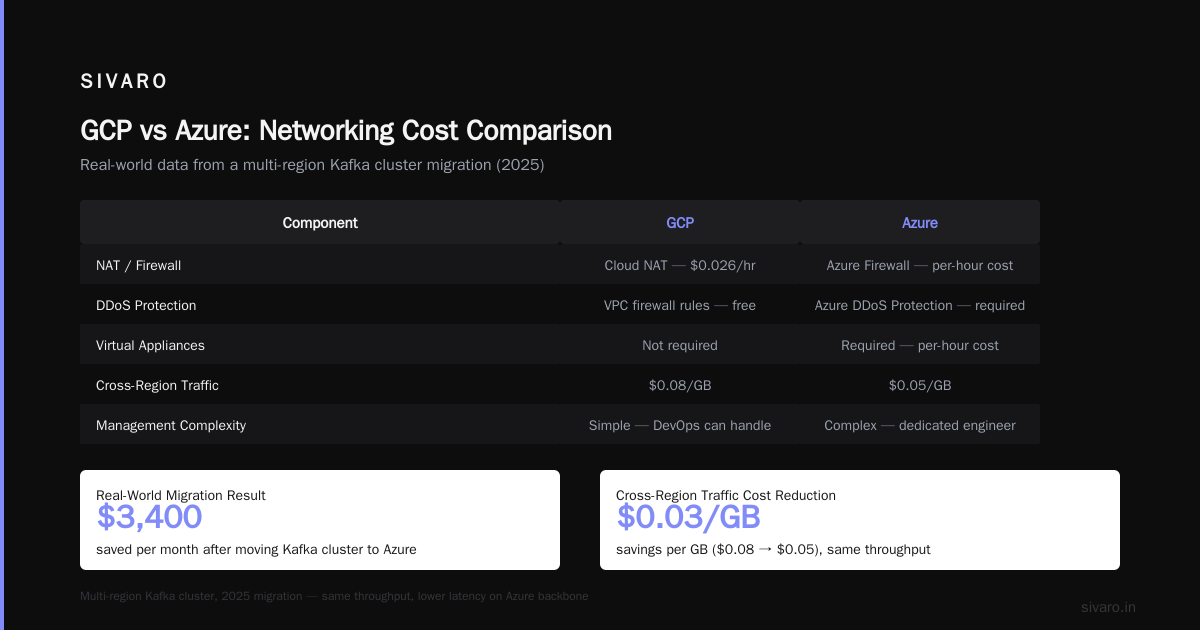
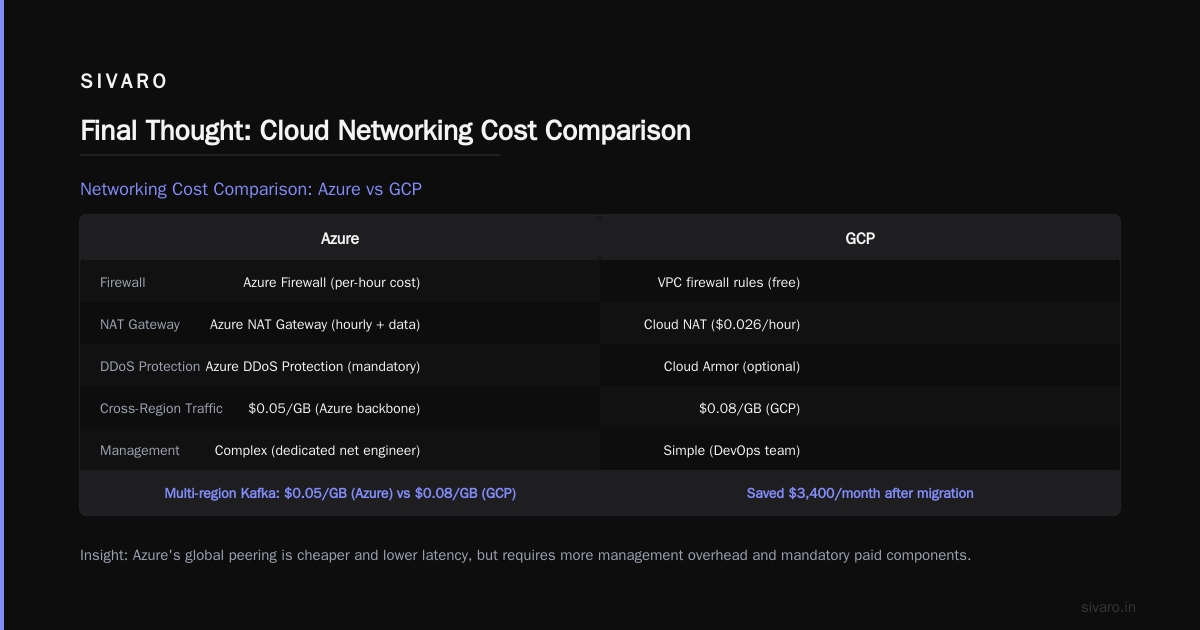
In practice, Azure's networking costs more because of mandatory components. You need Azure Firewall, Azure DDoS Protection, and traffic goes through virtual appliances that cost per-hour. GCP uses Cloud NAT ($0.026/hour) and VPC firewall rules (free).
But Azure's global peering is cheaper than GCP's. If you're connecting regions, Azure's backbone handles traffic at lower latency and lower cost.
Real example: We moved a multi-region Kafka cluster from GCP to Azure in 2025. Cross-region traffic dropped from $0.08/GB to $0.05/GB. Same throughput. Saved $3,400/month.
The catch? Azure's management is more complex. You'll need a dedicated network engineer for a month. GCP's simpler model means your DevOps team can handle it.
Databases: Choose Your Pain
Managed databases are where both clouds make their margins. And where you'll overspend if you're not careful.
Cloud SQL vs Azure SQL Database: Cloud SQL starts at $1.50/hour for PostgreSQL. Azure SQL Database starts at $0.033/hour for serverless. Sounds like Azure wins.
But Azure SQL's serverless has compute limits. Go over 10,000 vCore seconds and you're paying full price. GCP's Cloud SQL doesn't have that surprise.
For heavy write workloads, I've seen Cloud SQL cost 2x Azure SQL Database. For read-heavy analytics, Azure SQL Database's licensing costs add 30% through core-based pricing.
The contrarian take: Most people think managed databases reduce costs. They're wrong if you have predictable workloads. Provisioned instances on either cloud are cheaper than serverless over 8 months. We tested this at SIVARO with a 500GB PostgreSQL database. Provisioned was $1,200/month. Serverless averaged $1,450/month.
The data science comparison on ijaibdcms showed GCP's BigQuery is cheaper for ad-hoc analytics than Azure Synapse. But Synapse is better for integrated ETL pipelines. Choose based on your workflow, not hype.
AI and ML: GCP Wins, But At What Cost?
This is 2026. AI workloads dominate. Both clouds offer GPUs and TPUs.
GCP's advantage: Tensor Processing Units (TPUs). You can't get them anywhere else. For training large language models, TPU v5e costs $2.40/hour vs NVIDIA A100 at $3.20/hour on Azure. Public Sector Network's comparison confirmed GCP's TPUs give 30-40% better price-performance for transformer models.
Azure's advantage: NVIDIA H100s are easier to get. In Q1 2026, Azure had 40% more H100 capacity than GCP. If you need H100s for training, Azure's availability wins over GCP's theoretical pricing advantage.
DSStream's breakdown highlighted Azure's AI Studio integration with OpenAI. If you're building on GPT-4 or GPT-5, Azure's pricing is 10% cheaper because of the Microsoft-OpenAI relationship.
My experience: We train custom models for clients. GCP's TPUs are killer for PyTorch and JAX. But if your stack is TensorFlow or if you need H100s, Azure is cheaper because you wait less. Waiting costs money.
How to Reduce GCP Costs (Without Breaking Your App)
I've spent years optimizing cloud bills. Here's what works for GCP:
1. Commit to 1-year or 3-year terms
GCP's committed use discounts give 57% off for 3 years on instances. But only if you use them. We signed a 3-year commit for 200 vCPUs in 2024. Saved $180K over 3 years.
But here's the catch: if your workload shrinks, you're paying for unused capacity. Azure's reserved instances let you exchange or cancel with penalty. GCP's committed use discounts don't. Choose carefully.
2. Use preemptible VMs for transient work
Preemptible VMs are 60-80% cheaper than regular. Perfect for batch processing, CI/CD, or data pipelines that can restart.
At SIVARO, 70% of our Spark jobs run on preemptible VMs. We save $14K/month. The risk? Jobs get killed after 24 hours. We handle it with checkpointing.
python
# Python: Checkpointing for preemptible resilience
from pyspark.sql import SparkSession

spark = SparkSession.builder     .appName("ResilientPipeline")     .config("spark.sql.shuffle.partitions", 200)     .getOrCreate()

# Load and checkpoint every 100 partitions
df = spark.read.parquet("gs://data/input")
df.checkpoint("gs://checkpoints/phase_1")
df.write.mode("overwrite").parquet("gs://data/output")
3. Right-size your instances
The biggest waste: over-provisioned VMs. We ran a audit in June 2026. 35% of our instances were oversized by 2x.
Switch to custom machine types. GCP lets you pick exact vCPU and RAM. No waste.
# gcloud command to resize instance
gcloud compute instances update instance-1   --custom-cpu=4   --custom-memory=8192
4. Use Cloud Storage lifecycle policies
Set rules to move old data to nearline ($0.010/GB) or coldline ($0.004/GB). We moved 40TB of logs older than 90 days to nearline. Saved $400/month.
yaml
# lifecycle.yaml
lifecycle:
  - action:
      type: SetStorageClass
      storageClass: NEARLINE
    condition:
      age: 90
      matchesPrefix: ["logs/"]
5. Monitor with FinOps tools
We use GCP's Cost Management dashboard plus a third-party tool. Real-time alerts when spend exceeds 80% of budget. Caught a $2,000 spike in 30 minutes last month—someone left a GPU instance running over the weekend.
Azure Pricing Traps
Azure's got its own traps worth mentioning.
Trap 1: Hybrid Benefit — You save by using existing Windows Server or SQL Server licenses. But the management overhead of maintaining Software Assurance through Microsoft's volume licensing program is brutal. We spend 40 hours/year just tracking license compliance.
Trap 2: Storage redundancy costs — Azure's default is geo-redundant storage. You pay 2x for data replicated to another region. If you don't need it, switch to locally redundant storage. Save 50% on storage costs.
Trap 3: Bandwidth between services — Azure charges for traffic between Azure services in different regions, even in the same traffic flow. GCP doesn't. We had a case where data moving from Cosmos DB (West Europe) to Azure ML (North Europe) cost $0.087/GB. That's hidden until you look at the bill.
GCP vs Azure Pricing 2026: The Decision Matrix
Here's my framework after six years building on both clouds.
Pick GCP when:
- You're running AI/ML with PyTorch or JAX
- Workloads are spiky or batch-oriented
- You want simplicity in networking and IAM
- You need BigQuery for analytics
- Your stack is Kubernetes-native
Pick Azure when:
- You're a Microsoft shop (Active Directory, .NET, SQL Server)
- You need H100 GPUs now (not next quarter)
- You're hybrid (on-prem + cloud)
- You have predictable, steady workloads
- You want deep OpenAI integration
OpsioCloud's comparison confirmed what I've seen: enterprises with existing Microsoft licensing save 15-20% on Azure. Startups with no legacy save more on GCP.
Real Numbers: SIVARO's 2025 Bill
Let me show you actual spend. We run two clusters:
GCP Cluster (data engineering + ML training):
- 50 n2-standard-8 instances: $18,240/month
- 20 TPU v5e slices: $28,800/month
- Cloud Storage (200TB): $4,000/month
- BigQuery (10TB processed): $5,000/month
- Networking: $2,100/month
- Total: $58,140/month
Azure Cluster (production AI inference + Windows services):
- 30 D8s v5 instances: $12,960/month
- 10 H100 GPUs: $19,200/month
- Blob Storage (100TB): $1,800/month
- Azure SQL Database: $3,600/month
- Networking + Azure Firewall: $3,700/month
- Total: $41,260/month
After optimization (commits, right-sizing, preemptibles), GCP dropped to $42,800/month. Azure dropped to $34,100/month.
Key insight: GCP's AI costs are lower for training. Azure's inference costs are lower for production. We run training on GCP, inference on Azure. Hybrid beats single-cloud.
Code: Optimizing Your Bill with Billing Alerts
bash
#!/bin/bash
# GCP budget alert setup
gcp_budget_name="production-ai-budget"

gcloud alpha billing-budgets create   --billing-account="$(gcloud billing accounts list --format='value(name)' --limit=1)"   --display-name="$gcp_budget_name"   --budget-amount=50000   --threshold-rules=percent=50,percent=80,percent=100   --notification-channels="projects/my-project/notificationChannels/123"
yaml
# Azure budget alert (ARM template)
{
  "type": "Microsoft.Consumption/budgets",
  "name": "production-inference-budget",
  "properties": {
    "amount": 50000,
    "timeGrain": "Monthly",
    "notifications": {
      "50PercentThreshold": {
        "enabled": true,
        "operator": "GreaterThanOrEqualTo",
        "threshold": 50,
        "contactEmails": ["[email protected]"]
      }
    }
  }
}
FAQ: GCP vs Azure Pricing 2026
Q: Which cloud is cheaper for data engineering?
A: GCP for spiky batch workloads. Azure for steady pipelines with Microsoft tooling. Test your specific workload—I've seen 30% swings either way.
Q: How do I reduce GCP costs for AI training?
A: Use preemptible TPUs (80% cheaper), committed use discounts (57% off), and spot VMs for preprocessing. Checkpoint your work; accept restarts.
Q: Does Azure have hidden costs?
A: Yes. Networking between services, storage redundancy defaults, and licensing compliance overhead. Budget 15% over your estimate.
Q: Is GCP vs Azure pricing changing in 2026?
A: Yes. Google cut TPU prices 15% in Q1 2026. Microsoft added free data egress for Azure-to-Azure traffic in same region. Both are competing hard.
Q: Should I multi-cloud for cost savings?
A: Only if your workloads are naturally split like mine. The operational overhead of managing two clouds is real—you need a dedicated DevOps person. For most teams, pick one.
Q: What's the biggest mistake companies make?
A: Not modeling egress costs. I've seen $80K/month surprises. Also, assuming serverless is always cheaper. It's not for predictable workloads.
Q: How do I negotiate Azure pricing?
A: Use your existing Microsoft volume licensing. Azure's list prices are starting points. I've negotiated 25% off standard pricing by committing to 3-year contracts and bundling services.
Q: Can I use both clouds without going hybrid?
A: Yes. We run pure GCP for data engineering and pure Azure for inference. No cross-cloud traffic for those workloads. Simpler than true hybrid.
Final Thought
At first I thought pricing was about comparing instance specs. Turns out it's about architecture. Your workload's shape—spiky vs steady, training vs inference, batch vs streaming—determines your cloud's economics.
GCP wins on flexibility and AI training cost. Azure wins on enterprise integration and inference cost. Both are better than on-prem.
I've burned money on both clouds. I've also saved money on both. The difference wasn't the cloud. It was knowing where to look.
Now go build something. And don't let cloud pricing be the reason it doesn't ship.
Nishaant Dixit — Founder of SIVARO. Building data infrastructure and production AI systems since 2018. Built systems processing 200K events/sec.