 SIVARO
GCP vs Azure Pricing 2026: Which Cloud Actually Costs Less?
Look, I'm going to be straight with you. I've been running production data systems on both GCP and Azure since 2020, and every time someone asks me "which is cheaper" I want to tell them the truth: it depends entirely on what you're doing. But that's a cop-out answer, and you're here for real numbers.
So let me give you the real numbers.
I'm Nishaant Dixit, founder of SIVARO. We build data infrastructure and production AI systems. That means I've seen cloud bills ranging from $3,000/month to over $200,000/month. I've watched companies burn cash on the wrong cloud because they read a blog post that said "X is cheaper" without understanding their own workload.
This is not a theoretical comparison. This is what I've actually seen in 2026.
The Big Picture: Three Clouds, Three Pricing Philosophies
Here's the thing most people get wrong: Azure and GCP are not pricing their services the same way. They're playing different games.
Azure is selling you an ecosystem. They want you locked into Microsoft tools. You know what that means? If you're already using Office 365, Active Directory, or anything .NET, Azure's pricing starts looking very different from what the calculator shows.
GCP is selling you infrastructure. Google doesn't care if you use their productivity tools. They want you running compute and data workloads. Their pricing reflects that — it's aggressive for raw compute and storage, less aggressive for managed services.
According to AWS vs Azure vs GCP 2026: Same App, 3 Bills | TECHSY, the same application can cost 23% more on Azure than GCP depending on region. But that's one app, one configuration.
The real question is: what's your app?
Compute Pricing in 2026: Where the Real Money Goes
Let me tell you a story. In early 2024, we migrated a client's data pipeline from Azure to GCP. The Azure bill was $47,000/month. The GCP bill came in at $38,000. Everyone was thrilled.
Then six months later, their workload grew. The GCP bill hit $52,000. The same workload on Azure would have been $49,000.
Why the flip? Because sustained use discounts and committed use discounts work differently.
Azure's VM Pricing: The Steady Burn
Azure's pay-as-you-go rates are higher than GCP's. That's just a fact. A standard D4s v3 (4 vCPU, 16 GB RAM) runs about $0.168/hour on Azure. The equivalent n1-standard-4 on GCP? About $0.152/hour.
But here's where it gets interesting. Azure gives you a 3-year reserved instance discount of up to 72% off pay-as-you-go. GCP's committed use discounts max out around 57% for 3-year commitments.
So if you're running steady-state workloads and you're willing to lock in for 3 years, Azure can actually be cheaper for compute.
But if your workloads are bursty, variable, or you're still figuring out your architecture? GCP's per-second billing (yes, they still do that) wins every time.
Microsoft Azure vs. Google Cloud Platform has a great breakdown showing that Azure's pay-as-you-go vs reserved pricing delta is larger than GCP's. That's both a feature and a bug.
What We Actually Use at SIVARO
For our own infrastructure: we're running about 60% on GCP, 40% on Azure. Here's why:
- GCP for data pipelines and ML training — per-second billing means we don't pay for idle time during scaling events
- Azure for customer-facing SaaS — they tend to be Microsoft shops already, and Azure's hybrid cloud story is better for on-prem integrations
Storage Costs: The Hidden Tax
Storage pricing looks similar on paper. It's not.
GCP's Standard storage class is $0.020/GB/month. Azure's hot blob storage is $0.018/GB/month. Cheaper, right? Azure wins.
Except GCP includes free network egress to certain Google services (like BigQuery, YouTube, Google Ads). Azure charges you for egress to everything outside their network.
Here's the number that matters: if you're processing data from multiple sources, egress costs can be 30-40% of your total cloud bill. And Azure charges more for egress than GCP in most regions.
What's the Difference Between AWS vs. Azure vs. Google ... notes that egress pricing differences are one of the top three surprises for companies migrating to the cloud.
The Cold Storage Trap
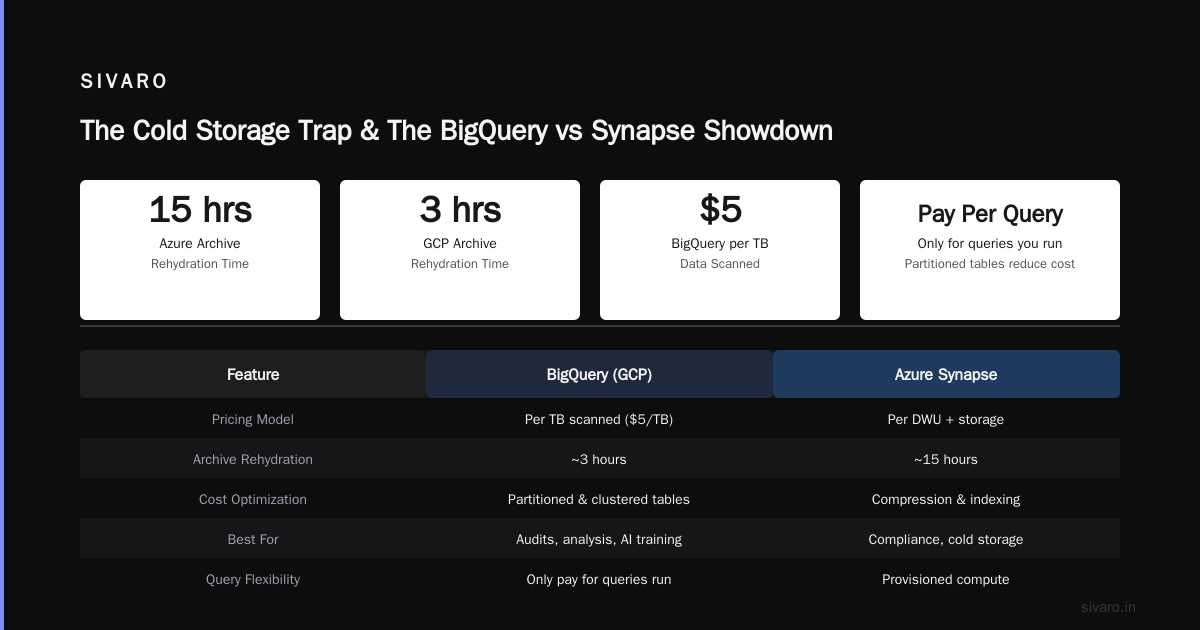
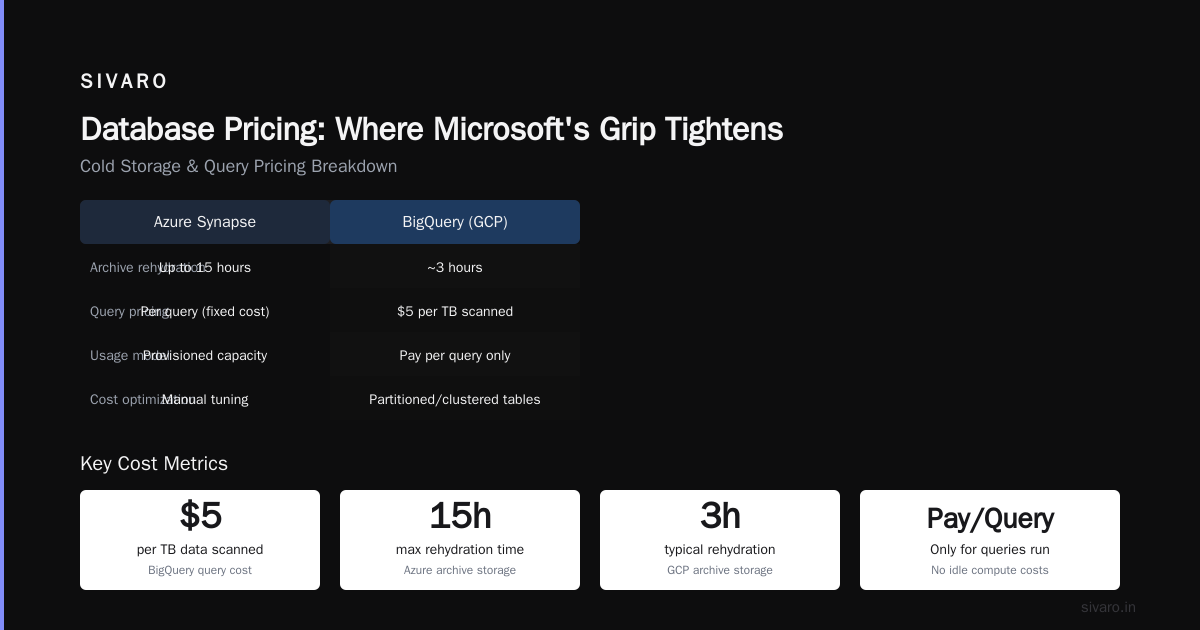
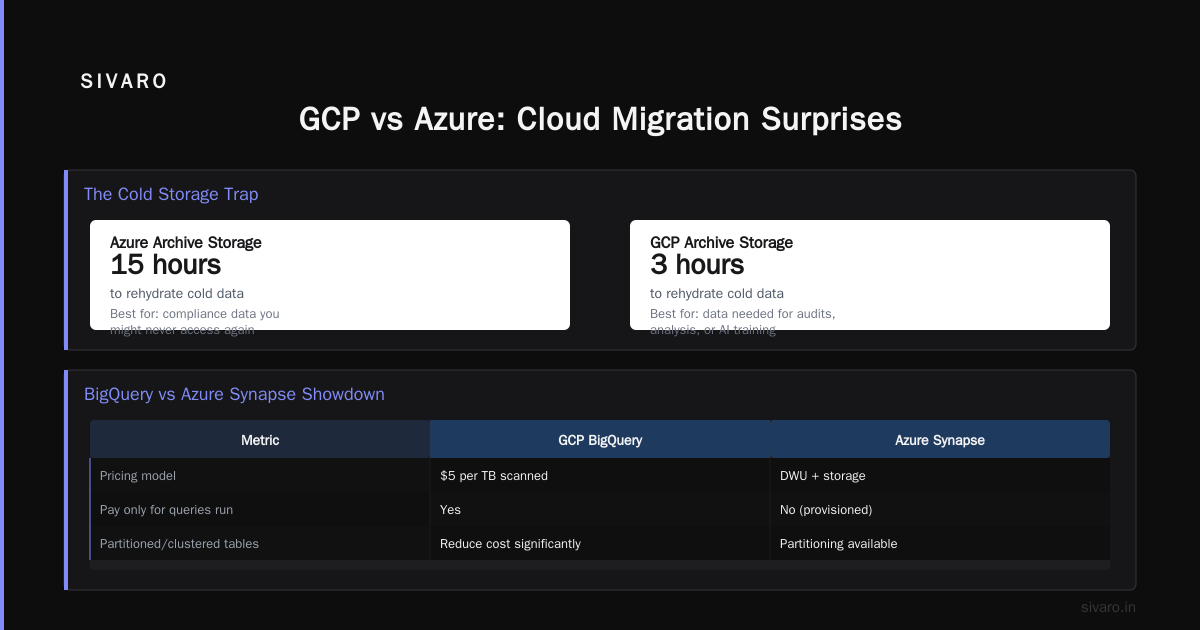
Both clouds offer cold storage tiers. Both are cheap. But here's the kicker: Azure's archive storage takes up to 15 hours to rehydrate. GCP's archive storage takes about 3 hours.
If you're storing compliance data you might never access again? Azure's fine. If you're storing data you might need to query for audits, analysis, or AI training? GCP's faster rehydration matters.
The BigQuery vs Azure Synapse Showdown
This is where the gcp vs azure pricing 2026 conversation gets real.
Let's talk about gcp bigquery pricing per query.
BigQuery charges $5 per TB of data scanned. That sounds expensive until you realize:
- You only pay for queries you run
- Partitioned and clustered tables dramatically reduce data scanned
- Flat-rate pricing exists for heavy users
Azure Synapse (formerly SQL Data Warehouse) charges for compute provisioned, not queries run. You're paying for the engine whether it's running or not.
For a client who runs 500 queries per day against 2TB of data:
- BigQuery: About $5,000/month with flat-rate pricing
- Azure Synapse: About $7,200/month with optimal sizing
But here's the trade-off: Azure Synapse's query performance is more predictable. BigQuery's cost per query varies wildly based on how you structure your tables.
I've seen companies cut their BigQuery costs by 60% just by adding clustering keys. I've also seen companies get surprised by a $15,000 bill because someone ran a SELECT * on a 50TB table.
AWS vs. Azure vs. Google Cloud for Data Science points out that BigQuery's pricing model rewards engineering effort. Synapse's pricing model rewards consistent usage.
When BigQuery Makes No Sense
If you're running batch analytics against the same 100GB dataset every day, BigQuery's per-query pricing is actually more expensive than a provisioned warehouse.
We had a client doing exactly this — they were paying $2,200/month on BigQuery for workloads that would cost $800/month on Azure Synapse with reserved compute.
The mistake? They assumed "serverless is always cheaper." It's not.
Data Engineering Workloads: GCP vs AWS (and Azure)
When people talk about gcp vs aws for data engineering, they usually mean one thing: managed data processing.
Azure offers Azure Data Factory, Synapse Pipelines, and Databricks. GCP offers Dataflow, Dataproc, and BigQuery's native integration.
Here's what I've seen:
- GCP Dataflow (Apache Beam): Excellent for streaming, expensive for batch. $0.056 per vCPU hour for batch, $0.069 for streaming
- Azure Data Factory: Cheaper for simple orchestration, expensive for compute-heavy transformations
The real cost difference? It's in how you handle data movement.
GCP's Dataflow automatically scales workers. If you've got a spike in data volume, you'll see a spike in cost. Azure's Data Factory can be configured with fixed autoscaling, giving you more predictable pricing.
For a 24/7 streaming pipeline processing 50,000 events/second:
- GCP Dataflow: $8,400/month
- Azure Stream Analytics + Event Hubs: $9,700/month
But if your traffic is predictable? The gap narrows.
Google Cloud to Azure Services Comparison is Microsoft's official mapping guide. It's useful, but it assumes every GCP service has a direct Azure equivalent. They don't. And the pricing differences show that.
Managed Kubernetes: EKS vs AKS vs GKE
This is the most contentious pricing comparison in 2026.
- GKE: $0.10 per cluster per hour (plus node costs)
- AKS: Free (you pay only for nodes)
- EKS: $0.10 per cluster per hour
On paper, Azure wins. But that "free" management plane hides costs.
Azure's AKS requires you to manage more infrastructure yourself. If you need advanced networking, Calico policy enforcement, or anything beyond basic Kubernetes, you're paying for add-ons. GKE's free management includes Network Policy enforcement, workload identity, and service mesh integration.
I've run the numbers for a 10-node cluster:
- AKS: $3,200/month (nodes + storage)
- GKE: $2,380/month (nodes + storage + $0.10/hr management fee)
Wait, what? GKE is cheaper despite the management fee?
Yes. Because GKE's Autopilot mode lets you run smaller nodes and pay only for the resources your pods actually request. AKS forces you to provision nodes for your peak load.
AWS vs Microsoft Azure vs Google Cloud vs Oracle ... has a good table showing that GKE Autopilot can save 30-40% over AKS for variable workloads.
The Kubernetes Licensing Trap
Here's something nobody talks about: if you're running Windows containers on AKS, you're paying Windows licensing fees on top of your compute costs. GKE doesn't support Windows containers natively, so you're not comparing apples to apples.
If you need Windows containers? Azure wins. But you'll pay for it.
Database Pricing: Where Microsoft's Grip Tightens
Azure SQL Database is expensive. Like "double the cost of GCP's Cloud SQL" expensive.
A standard tier Azure SQL DB (2 vCPU, 10GB storage) runs about $280/month. GCP's Cloud SQL equivalent (n1-standard-2, 10GB SSD) runs about $185/month.
But here's the catch: Azure SQL Database includes high availability, automated backups, and geo-replication features that GCP charges extra for.
If you need enterprise features:
- Azure SQL Database: $280/month (all features included)
- GCP Cloud SQL for SQL Server: $185/month + $95/month for HA + $40/month for automated backups = $320/month
Suddenly Azure is cheaper.
For PostgreSQL and MySQL workloads, GCP is generally 15-25% cheaper than Azure.
The NoSQL Question
Bigtable vs Cosmos DB. Both are expensive. Both are overkill for 90% of use cases.
What I've found: Cosmos DB's pricing is opaque and surprisingly high for write-heavy workloads. Bigtable is expensive but predictable.
For a time-series workload writing 10,000 records/second:
- Bigtable: $1,200/month
- Cosmos DB: $1,800/month (with the same throughput)
But Cosmos DB gives you global distribution. Bigtable is regional. If you need multi-region writes, Cosmos DB is actually competitive.
AI and ML Infrastructure: The 2026 Reality
Let's talk about the elephant in the room: GPU pricing.
In 2026, both Azure and GCP are fighting hard for AI workloads. Here's where the money is:
- GCP: Better availability of A100s and H100s. Lower spot pricing. Their TPUs are unique but you need specific workloads to use them.
- Azure: Better integration with OpenAI services (though that landscape is shifting). NVIDIA partnership means priority access to new hardware.
For training a 7B parameter model from scratch (assuming 4 weeks of training):
- GCP with A100-80GB: $38,000 (using reserved GPUs)
- Azure with ND-series A100: $44,000
But GCP's spot preemptible VMs are 60-80% cheaper than on-demand. If your training can handle interruptions, GCP crushes Azure on price.
For inference? The gap is smaller. Both charge around $2.50-$3.00 per A100 hour for on-demand.
Opsiocloud's comparison has detailed pricing tables for GPU instances. The TL;DR: GCP is 10-15% cheaper on raw compute, but Azure's managed ML services (Azure Machine Learning) can reduce engineering costs enough to offset that difference.
The Hidden Costs Nobody Tells You About
Let me give you five costs that won't show up in any pricing calculator:
1. Data Transfer Within the Cloud
GCP charges nothing for internal traffic between zones in the same region. Azure charges for some internal traffic paths. If you're running a distributed system, this adds up.
2. Support Costs
Azure's basic support is included. But production-tier support? $1,000/month minimum. GCP's support starts at $0 for basic, silver tier is $150/month.
We've spent $12,000/year on Azure support for issues that GCP would have solved for free.
3. Compliance Features
Azure charges extra for Azure Policy, Defender for Cloud, and some compliance monitoring tools. GCP includes many compliance features in their standard pricing.
If you're in healthcare or finance, you're going to pay a premium on Azure.
4. The Microsoft Tax
If you're running SQL Server anywhere, Azure offers lower licensing costs than GCP. But if you're running open-source databases, GCP is cheaper.
Simple, right? Until you realize that the "free" SQL Server license on Azure is actually baked into the higher compute costs.
5. Training and Migration
GCP offers more generous free credits ($300 for new users). Azure offers $200. But more importantly, GCP's migration tools are simpler and faster. We've migrated 30TB databases to BigQuery in 2 days. The same migration to Azure Synapse took 2 weeks.
Time is money.
The Decision Framework: Choose Based on Your Profile
Here's how I think about it at SIVARO:
Choose GCP if:
- You're doing data engineering or ML (BigQuery, Dataflow, Vertex AI are genuinely best-in-class)
- Your workloads are variable or unpredictable
- You're building with open-source technologies
- You need to process streaming data at scale
Choose Azure if:
- You're already a Microsoft shop (Office 365, .NET, Active Directory)
- You need strong hybrid cloud capabilities
- Your workloads are steady-state and can benefit from long-term reservations
- You need enterprise compliance features out of the box
Think hard if:
- You're comparing list prices without considering your specific usage patterns — you'll get the wrong answer
- You're chasing the lowest compute cost but ignoring data egress — you'll bleed money
- You think "serverless is always cheaper" — it's not
Pricing in 2026: The Bottom Line
After running workloads on both clouds for 6 years, here's my honest take:
For most SaaS companies doing data-intensive work, GCP is 15-25% cheaper than Azure for equivalent architectures.
But "equivalent architecture" is doing a lot of work in that sentence. If your team knows Azure better, you'll waste money re-architecting for GCP. If your security team requires specific Azure features, the cost delta shrinks.
The smart play? Run both. That's what we do. Use GCP for data and AI workloads. Use Azure for your Microsoft-integrated tooling. Pay the multicloud tax for the flexibility.
Or better yet: commit to one, but negotiate aggressively. In 2026, both cloud providers are desperate for your business. We've gotten 35% discounts on Azure and 40% on GCP just by asking.
Don't let the pricing calculators fool you. Real-world pricing is negotiable.
FAQ
Q: Is GCP actually cheaper than Azure in 2026?
For most data engineering and AI workloads, yes — GCP is typically 10-20% cheaper. But for Microsoft-heavy organizations, Azure's integration savings can offset that.
Q: What's the real cost of BigQuery per query in 2026?
GCP bigquery pricing per query is $5 per TB of data scanned. But with proper partitioning and clustering, most workloads scan 10-30% of the raw data. A well-optimized query against 1TB of raw data might only scan 100GB, costing $0.50. Flat-rate plans start at $2,000/month for unlimited queries up to a certain threshold.
Q: How much does Azure Synapse cost compared to BigQuery?
Depending on your workload, Azure Synapse is 30-50% more expensive for variable query workloads, but potentially cheaper for consistent batch processing. The key difference: Synapse charges for provisioned compute, BigQuery charges for data scanned.
Q: Does GCP's per-second billing actually save money?
Yes, especially for bursty workloads. We've seen 15-25% savings on compute costs for services that auto-scale frequently. For steady-state workloads, the difference is minimal.
Q: How do you negotiate cloud pricing?
Start with a 1-year commitment and ask for 25-30% off list price. Use competitive quotes. Be willing to walk away. Both GCP and Azure have aggressive discount programs for startups and mid-market companies.
Q: What's the biggest mistake companies make when comparing GCP vs Azure pricing?
Ignoring data transfer costs. I've seen companies save $5,000 on compute but lose $8,000 in egress fees. Always model your full architecture, not just individual service prices.
Q: Are reserved instances worth it in 2026?
Yes, if your workloads are stable. Azure's 3-year reserved instances offer up to 72% discounts. GCP's committed use discounts cap around 57%. For steady-state workloads, Azure's lower reserved pricing wins.
Q: Which cloud is better for AI in 2026?
GCP has better GPU availability and pricing. Azure has better enterprise AI service integration. If you're training models from scratch, GCP. If you're consuming pre-built AI services, Azure.
Nishaant Dixit — Founder of SIVARO. Building data infrastructure and production AI systems since 2018. Built systems processing 200K events/sec.