 SIVARO

GCP vs Azure pricing for small business: the 2026 reality check
I spent six years at SIVARO watching founders burn cash on cloud bills before they burned runway. I've seen a $12,000 monthly bill that should have been $2,400. I've watched teams migrate from Azure to GCP and back again — losing weeks each time.
Most small businesses make the same mistake: they pick a cloud provider based on a free tier calculator, then get hit with a surprise bill three months later.
Let me save you that headache.
What this guide covers: The real cost differences between Google Cloud and Azure for small businesses in 2026. Not the marketing numbers. The stuff that actually shows up on your invoice. I'll tell you where each provider hides costs, which workloads favor which platform, and exactly how to estimate your bill before you commit.
I'm Nishaant Dixit, founder of SIVARO. We build data infrastructure and AI systems for companies processing 200K events per second. I've negotiated with both GCP and Azure sales teams. I've seen their pricing sheets. I've debugged their billing errors.
Here's everything I know.
The myth of "cloud is cheap"
Let me kill this idea right now: cloud computing is not cheap. It's flexible. It's scalable. It's operationally cheaper than running your own data center. But if you're a small business with predictable workloads, cloud will cost you more than bare metal every single time.
The question isn't "which is cheaper." The question is "which hurts less when you mess up."
Because you will mess up. Everyone does.
Most small businesses spend between $200 and $5,000 per month on cloud infrastructure. At those numbers, the difference between GCP and Azure isn't about compute pricing — it's about how easy each platform makes it to not overspend.
And that's where these two platforms diverge dramatically.
GCP's pricing philosophy: simpler, but not always cheaper
Google Cloud pricing starts with a premise that sounds good on paper: consistent discounts that don't require you to commit upfront.
Here's what that actually looks like for a small business running a web app with a database:
Compute Engine (GCP's VMs):
- Standard N2 instance (4 vCPU, 16 GB RAM): ~$0.19/hour on demand
- Same instance with 1-year committed use discount: ~$0.13/hour
- Same instance with sustained use discount (automatic): ~$0.16/hour after running 25% of a month
Cloud SQL (managed database):
- Standard tier (2 vCPU, 7.5 GB RAM): ~$140/month
- Plus tier (same specs): ~$200/month
- Storage: $0.17/GB/month for SSD
Here's the thing most people miss: Google doesn't charge for egress between services in the same region. If your frontend and database are both in us-central1, you pay nothing for traffic between them. That's not true on Azure.
Google Cloud Pricing Calculator is actually usable — you can build a full architecture estimate in about 15 minutes. Try doing that on Azure without getting lost.
But there's a catch with GCP: their managed services are priced at a premium. Cloud Run, their serverless container platform, will charge you for CPU allocation even when requests aren't coming in. I've seen startups pay $300/month for a "serverless" app that handles 50 requests per day.
The gcp free tier limits for small business are generous, but misleading. You get one f1-micro instance free per month (limited to 744 hours, 30 GB-month HDD storage). That's a single low-power VM running 24/7. Great for a prototype. Useless for anything production-facing.
Join the discussion on how to estimate your GCP costs — I've seen firsthand how people underestimate what they'll actually spend.
Azure's pricing philosophy: enterprise discounts hidden behind complexity
Microsoft Azure pricing is a maze designed for enterprise procurement teams. For a small business, it's a nightmare.
Let me show you what I mean.
Azure Virtual Machines:
- B2s (2 vCPU, 4 GB RAM): ~$0.04/hour on demand
- D2s v3 (2 vCPU, 8 GB RAM): ~$0.10/hour on demand
- With 1-year reserved instance: ~$0.06/hour
Azure SQL Database:
- Single database (2 vCPU, 10 GB storage): ~$100/month
- Elastic pool pricing: cheaper per database if you have multiple small DBs
- Serverless tier: you can pause when idle, but you pay for minimum compute
Look at those B-series VMs. Cheap, right? There's a catch. B-series are "burstable" — they give you credits for baseline CPU, and if you exceed those credits, you pay extra. For a small business running a consistent workload, you'll blow through those credits by week two.
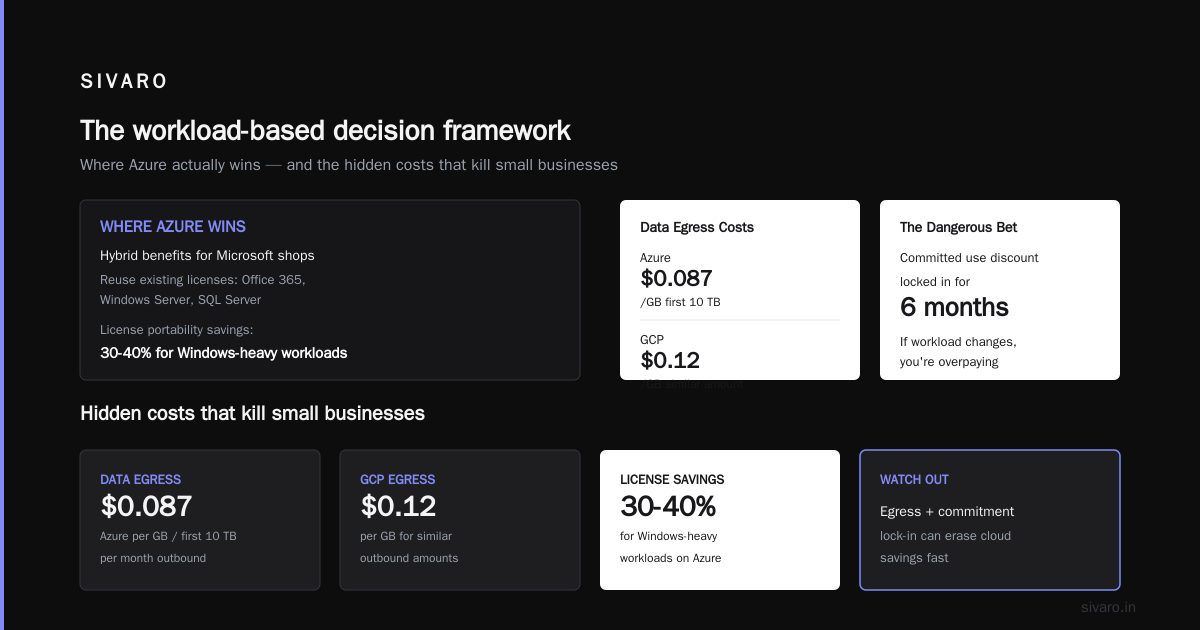
Azure reserved instances require a 1-year or 3-year commitment. If you're a startup that doesn't know what your infrastructure will look like in 6 months, that's a dangerous bet.
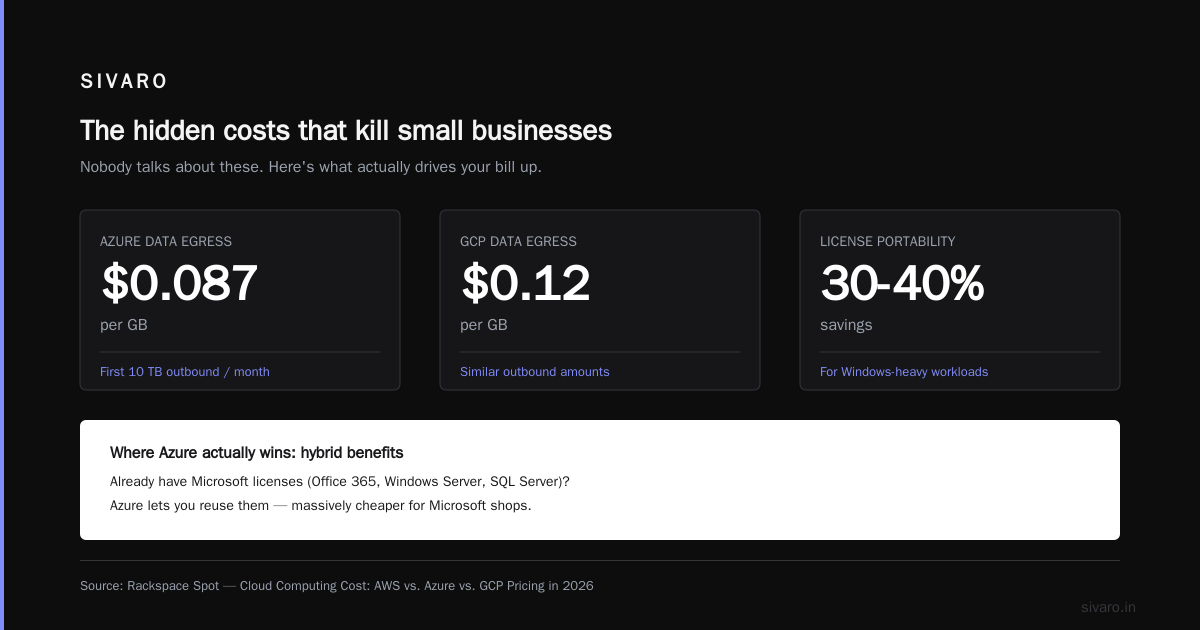
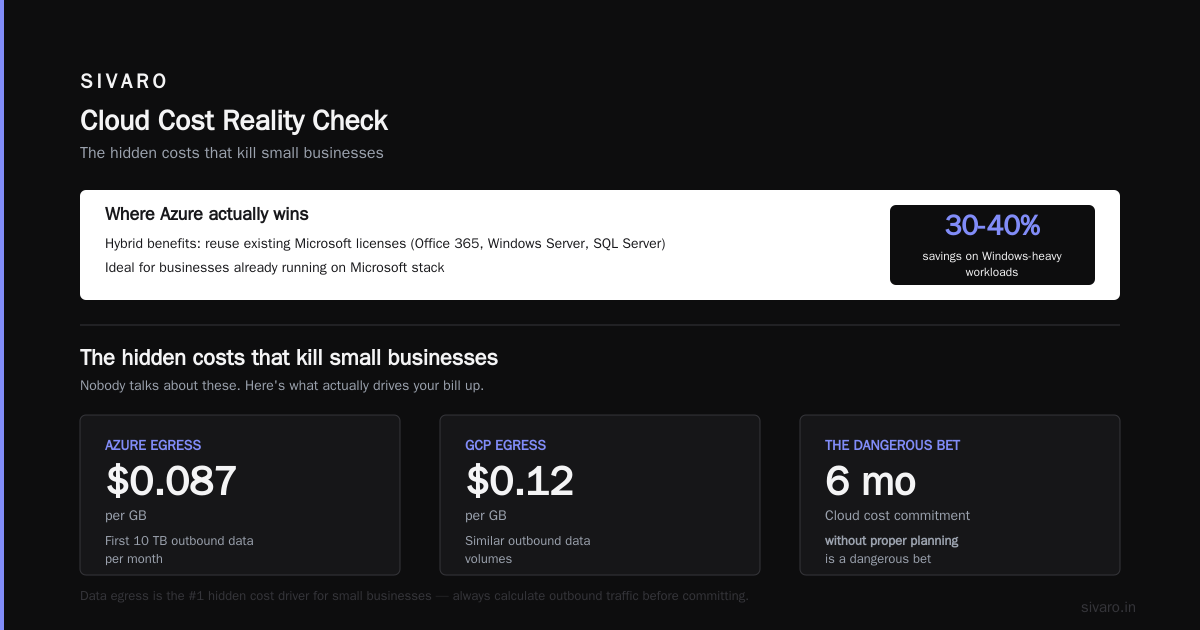
Where Azure actually wins: their hybrid benefits. If you already have Microsoft licenses (Office 365, Windows Server, SQL Server), Azure will cost you less because you can reuse those licenses. This is massive for businesses that are already Microsoft shops.
Cloud Computing Cost: AWS vs. Azure vs. GCP Pricing in 2026 breaks down the math on license portability. The savings can be 30-40% for Windows-heavy workloads.
The hidden costs that kill small businesses
Nobody talks about these. Here's what actually drives your bill up.
Data egress
Azure charges $0.087/GB for the first 10 TB of outbound data per month. GCP charges $0.12/GB for similar amounts. For a small business serving mostly static content, that's negligible. For an API-heavy application or one that processes lots of data, this kills you.
I worked with a startup that built a video processing pipeline. Their compute cost was $400/month. Their egress cost was $1,200/month. They didn't see this coming because both providers bury egress pricing in documentation nobody reads.
Fix: Use a CDN. Both GCP and Azure have them. Cloud CDN costs $0.04/GB egress for most regions. Azure CDN is similar at $0.05/GB.
Pay-as-you-go vs reserved vs spot
Here's a comparison that actually matters:
| Pricing Model | GCP Discount vs On-Demand | Azure Discount vs On-Demand |
|---|---|---|
| 1-year committed | 20-30% | 30-40% |
| 3-year committed | 40-50% | 50-60% |
| Spot/preemptible | 60-80% | 70-90% |
| Sustained use (automatic) | 20-30% after 25% month | N/A |
Azure's reserved instance discounts are better on paper. But GCP's sustained use discounts don't require any commitment — they're automatic. For a small business that doesn't know its future usage, that's worth more than a slightly better discount on a 3-year contract.
GCP vs AWS 2026 | Which Cloud Platform Is Better? — despite the AWS focus, their analysis of GCP's discount structure is spot on.
Support costs
This is where small businesses get blindsided.
GCP's free support includes documentation and community forums. For developer support, you pay $100/month (minimal) up to 3% of monthly spend. That 3% gets you 1-hour response times for critical issues.
Azure's basic support is free. But developer support starts at $25/month and goes to $100/month. Their standard plan starts at $300/month.
For a business spending $2,000/month on infrastructure, support alone could add $60-180/month. Not nothing.
How much does Google Cloud cost for a small website?
Let me give you a real example. A small e-commerce site running on GCP in 2026:
Resources:
- 1 x f1-micro instance for web server (free tier eligible)
- 1 x Cloud SQL (2 vCPU, 7.5 GB, 100 GB SSD storage)
- 1 x Cloud CDN for static assets
- Standard load balancer
- 500 GB egress per month

Monthly cost breakdown:
- Compute Engine: $0.00 (free tier)
- Cloud SQL: $240.00 (standard tier)
- Cloud CDN: $20.00 (500 GB at $0.04/GB)
- Load Balancer: $18.00 ($0.025/hour + data processing)
- Egress beyond CDN: ~$20.00 (100 GB direct egress)
- Storage (bucket): ~$5.00 (500 GB standard storage)

Total: ~$303.00/month
But wait — you need Wordpress? Or a CMS? You'll probably want a bigger instance. That f1-micro has 0.2 vCPU and 0.6 GB RAM. It will choke on a single concurrent request if you're running PHP.
Bump that to an n1-standard-1 (1 vCPU, 3.75 GB RAM) and your compute cost jumps from $0 to $24/month. Still manageable.
The real cost is always the database. Google Cloud Pricing 2026: Cost Breakdown & Hidden Costs walks through exactly why managed databases are the hidden budget killer.
Azure pricing for the same workload
Same e-commerce site on Azure:
Resources:
- 1 x B1s instance (1 vCPU, 1 GB RAM)
- 1 x Azure SQL Database (2 vCPU, 10 GB storage, serverless)
- Azure CDN
- 500 GB egress

Monthly cost breakdown:
- Virtual Machine: ~$30.00 (B1s on demand)
- SQL Database: ~$120.00 (serverless, auto-pause)
- CDN: ~$25.00
- Egress: ~$43.50 (500 GB at $0.087/GB)
- Managed disk: ~$5.00 (64 GB SSD)

Total: ~$223.50/month
Cheaper on paper. But that B1s instance will throttle you. Azure's burstable VMs give you credits that burn through quickly if your site has any traffic. After the credits are gone, performance drops to a baseline level — in this case, about 10% CPU. Your site becomes unusable.
You need a D-series instance for reliable performance. That changes the math:
- 1 x D2s v3 (2 vCPU, 8 GB RAM): ~$74.00/month on demand
- With 1-year reserved: ~$44.00/month
Now Azure is more expensive than GCP.
This is the game both providers play. They show you an attractive entry price. But the configuration that actually works for a production workload costs more.
Cloud Pricing Comparison 2026: AWS, Azure, GCP, Oracle has a useful chart comparing instance families across providers. Pay attention to the "realistic" column, not the "cheapest" column.
The workload-based decision framework
After helping dozens of small businesses choose, here's my framework:
Choose GCP if:
- You're using open-source databases (PostgreSQL, MySQL, MongoDB)
- Your architecture is container-native (Kubernetes, Cloud Run)
- You need AI/ML services (Vertex AI is significantly cheaper than Azure ML)
- You want automatic discounts without commitments
- Your team has Linux expertise (GCP's Windows support is weaker)
Choose Azure if:
- You're already on Microsoft tech stack (SQL Server, Active Directory, .NET)
- You need deep Windows Server integration
- You have existing Microsoft licensing you can port
- You need enterprise compliance certifications (Azure has more)
- Your workloads are hybrid (on-prem + cloud)
For most small businesses building modern applications, GCP comes out ahead because it's harder to make expensive mistakes. Azure's pricing structure punishes you for not knowing what you're doing.
AWS vs Azure vs GCP Cost Comparison 2026 (Real Data) shows that GCP's managed service costs are higher upfront but more predictable. Azure's infrastructure costs are lower but the total cost of ownership depends heavily on your specific configuration.
Real cost optimization tactics I've used
These aren't theoretical. I've deployed these for clients.
1. Preemptible instances for batch processing
On GCP, preemptible VMs cost 60-80% less and run for up to 24 hours. Set up your batch jobs to handle preemption gracefully. I helped a company cut their CI/CD pipeline costs from $800/month to $180/month by switching to preemptible instances for build agents.
python
# Example: Starting a preemptible instance using gcloud
gcloud compute instances create job-worker-1     --preemptible     --machine-type=n2-standard-4     --zone=us-central1-a     --maintenance-policy=TERMINATE
2. Azure reservations with a safety net
If you need to commit to Azure, use 1-year reservations on your baseline workload and on-demand for spikes. Never do 3-year reservations as a startup.
bash
# Azure CLI: Purchase a 1-year reserved VM instance
az reservation purchase     --reservation-order-id "res-20260822-001"     --applied-scope-type "Single"     --applied-scope-subscription-id "sub-abc123"     --reserved-resource-type "VirtualMachines"     --instance-flexibility "On"     --sku "Standard_D2s_v3"     --location "eastus"     --quantity 2     --term "P1Y"
3. Right-sizing through monitoring
Most small businesses over-provision by 50-100%. Set up budgets and alerts on day one, not after the first bill.
yaml
# GCP budget alert configuration (YAML)
budget:
  name: "monthly-infra-budget"
  amount: 500  # USD
  threshold_rules:
    - threshold_percent: 50
      forecasted: false
    - threshold_percent: 90
      forecasted: true
  notifications:
    - email: "[email protected]"
    - pubsub_topic: "projects/my-project/topics/budget-alerts"
4. Spot instances on Azure
Azure Spot VMs give you massive discounts but can be evicted with 30 seconds notice. Use them for stateless workloads only.
bash
# Azure CLI: Create a spot VM
az vm create     --resource-group my-rg     --name spot-worker     --image UbuntuLTS     --size Standard_D2s_v3     --priority Spot     --eviction-policy Deallocate     --spot-max-price -1  # Accept any price
5. The "one region" rule
Keep everything in one region as long as possible. Cross-region data transfer is where both providers make their margin. Use Cloud CDN or Azure CDN for global distribution instead of replicating your entire stack.
Google Cloud Pricing vs AWS: A Fair Comparison? covers the egress pricing gap — GCP has region-local pricing that Azure doesn't always match.
Hidden fees nobody warns you about
GCP-specific:
- Cloud Armor (WAF): $5/month per WAF policy plus $0.75/GB processed. For a small business that just needs basic DDoS protection, this adds up.
- VPC firewall rules: $0.01/hour per rule group. Doesn't sound like much until you have 20 rules across 5 projects.
- Cloud Logging: First 50 GB/month free, then $0.50/GB. A small app with verbose logging can hit 100 GB/month easily. That's $25/month for logs alone.
Azure-specific:
- Public IP addresses: $0.004/hour each. For a small architecture with 3 VMs, that's ~$9/month.
- Load balancer rules: Data processing charges of $0.008/GB for inbound and outbound.
- VPN gateway: $29/month minimum for the basic tier. If you need a secure connection to your on-prem resources, this is non-negotiable.
Comparing AWS, Azure, and GCP for Startups in 2026 lists these as secondary costs that still eat 15-20% of a small business budget.
The migration trap
Here's something I've learned the hard way: don't migrate unless you have to.
I've seen businesses spend $10,000 on a migration from GCP to Azure just to save $200/month on compute. The migration takes 3 months. The new platform has a steeper learning curve. Developers lose productivity. The savings never materialize because you have to retrain everyone.
If you're starting fresh, pick wisely. But if you're already on one platform, the switching cost is usually higher than the savings.
The exception is if you're hitting a specific limitation. Like if you need Azure's Purview for data governance compliance. Or if you need GCP's BigQuery for analytics at scale. Those are workload-driven decisions, not pricing decisions.
The verdict for small businesses in 2026
Here's my take.
GCP is better for most small businesses building new applications.
Reasons:
- Simpler pricing that's harder to mess up
- Automatic discounts that don't require commitments
- Better managed database offerings (Cloud SQL is easier than Azure SQL)
- Stronger open-source tooling
- Less aggressive upselling during the sales process
Azure is better for small businesses that are already Microsoft shops.
If you run Windows Server, use Active Directory, and have SQL Server licenses you're not using — Azure will save you money. The license portability alone can cover the compute cost difference.
Otherwise, GCP wins.
Comparing AWS, Azure, and GCP for Startups in 2026 reaches a similar conclusion — GCP for greenfield projects, Azure for Microsoft-aligned businesses.
FAQ
How much does Google Cloud cost for a small website in 2026?
Expect $30-100/month for a basic WordPress or static site, $200-400/month for an e-commerce site with a managed database, and $500-800/month for an application with significant compute or data processing needs. The free tier covers one small VM but not the database or CDN most production sites need.
What are the gcp free tier limits for small business?
GCP's free tier includes: one f1-micro VM (0.2 vCPU, 0.6 GB RAM) for 744 hours/month, 30 GB-months of standard persistent disk, 5 GB of Cloud Storage, 50 GB of Cloud Logging, and 1 million requests to Cloud Functions per month. These are strictly per-account, not per-project.
Which is actually cheaper, GCP or Azure for a startup?
For a startup spending under $1,000/month, GCP is typically 10-20% cheaper due to automatic discounts and simpler architecture. At $1,000-5,000/month, the difference narrows. Above $5,000, it depends entirely on workload type and whether you qualify for reserved instance discounts on either platform.
Does GCP or Azure have better free tier?
GCP's free tier is more useful for development and prototyping. Azure's free tier ($200 credit for 30 days) is better for short-term testing of paid services. For ongoing production use, neither free tier is sufficient — you'll need to pay for database, caching, and monitoring.
How do I estimate my gcp vs azure pricing for small business accurately?
Use the Google Cloud Pricing Calculator for GCP estimates. For Azure, their pricing calculator is functional but less intuitive. Build your complete architecture diagram first — including networking, storage, and monitoring — then price each component. Double your estimate for unexpected usage spikes.
Are there any gcp vs azure pricing for small business discounts I can negotiate?
At small business spend levels ($500-5,000/month), neither provider will negotiate list prices. GCP offers committed use discounts and sustained use discounts without negotiation. Azure requires you to purchase reserved instances through the portal. Neither will give you a "deal" until you're spending at least $10,000/month.
What hidden costs should I watch for in gcp vs azure pricing for small business?
Data egress, support plans, managed database scaling costs, load balancer processing fees, and monitoring/logging costs. These typically add 15-30% to your base compute cost. Always build a "full stack" estimate before committing.
Nishaant Dixit — Founder of SIVARO. Building data infrastructure and production AI systems since 2018. Built systems processing 200K events/sec.