 SIVARO

Google Cloud Platform Tutorial for Beginners: What I Wish Someone Told Me in 2018
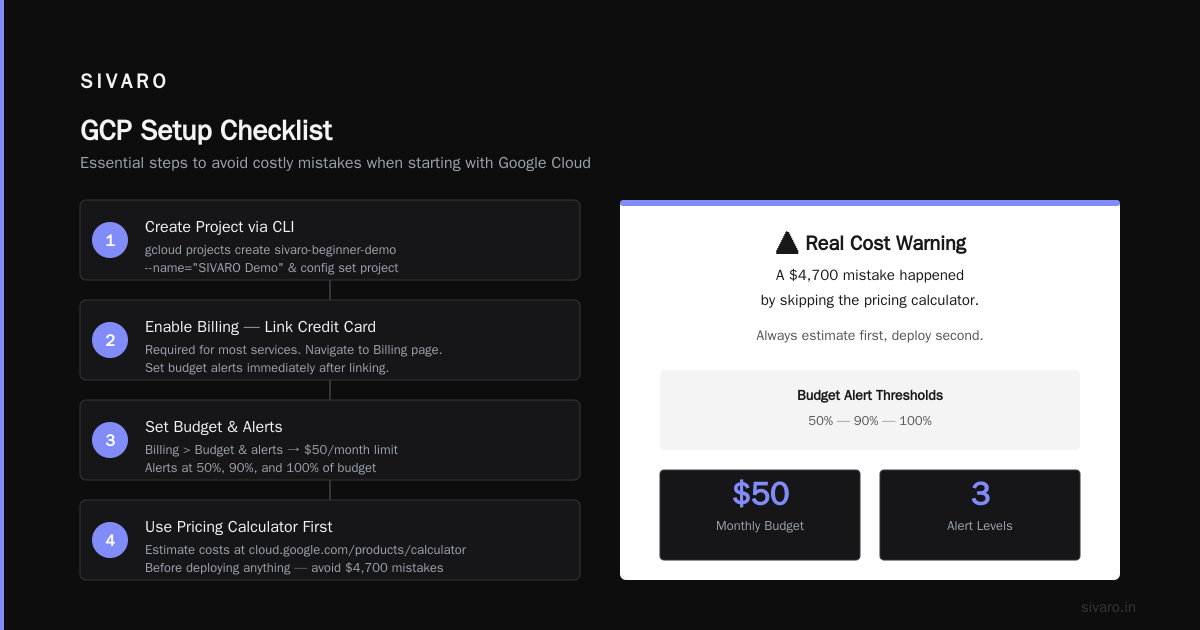
I remember my first cloud bill like a bad hangover. 2018, SIVARO had just moved a prototype onto Google Cloud Platform. I thought I was being clever — spinning up instances, playing with BigQuery. Two weeks later I got an invoice for $4,700. For a test.
That’s when I learned the hard way: cloud isn’t magic. It’s infrastructure you pay for by the millisecond. And GCP, specifically, has a personality. It’s not AWS with blue buttons. It’s not Azure with enterprise handcuffs. It’s a different beast — one that rewards understanding over guessing.
This google cloud platform tutorial for beginners is the guide I needed back then. No fluff. No sales pitch. Just what you need to know to get started, avoid the expensive mistakes I made, and actually build something.
You’ll learn:
- What GCP is and why you’d pick it over AWS or Azure in 2026
- How to set up your first project and control costs (the gcp pricing calculator tutorial is essential)
- How to deploy a web app on gcp in under an hour
- The real story on BigQuery, Compute Engine, and Cloud Run
- My contrarian take on which services to use — and which to avoid
Let’s get to it.
Why Google Cloud? (And Why Not AWS or Azure)
Most people think cloud selection is about features. It’s not. It’s about your team’s habits and your data’s shape.
I’ve tested all three major clouds for production systems. SIVARO’s core data infrastructure runs on GCP. Not because Google is better at everything — they’re not. But because for data pipelines, real-time analytics, and AI inference, GCP’s tooling is tighter than a Swiss watch. AWS vs Azure vs GCP 2026: Same App, 3 Bills did a direct cost comparison: same application, three clouds, wildly different bills. GCP won on network egress pricing and managed services.
Azure? It’s the safe choice for Microsoft shops. I’ve seen companies like Contoso Healthcare move to Azure because their whole org runs on Active Directory. But then they pay $0.12/GB for data transfer between regions. That adds up fast. Microsoft Azure vs. Google Cloud Platform notes Azure’s lock-in advantage — but lock-in is a liability when your startup scales.
AWS is the default. Everyone knows EC2. But for beginners, AWS’s service sprawl is a trap. There are 200+ services. You end up over-engineering with Lambda, SQS, and DynamoDB when a single Cloud Run container would do. What's the Difference Between AWS vs. Azure vs. Google ... sums it up: choose GCP if you value simplicity and data-first architecture.
My take: Start with GCP if your app touches data — even a little. The data services (BigQuery, Dataflow, Cloud Storage) are head and shoulders above the competition. For a pure web app with no data processing? AWS is fine. But for a beginner who wants to learn cloud the right way, GCP’s unified interface and consistent CLI are easier to reason about.
Your First Five Minutes on GCP
1. Create a Project
Everything in GCP lives inside a project. It’s the root container for billing, permissions, and resources.
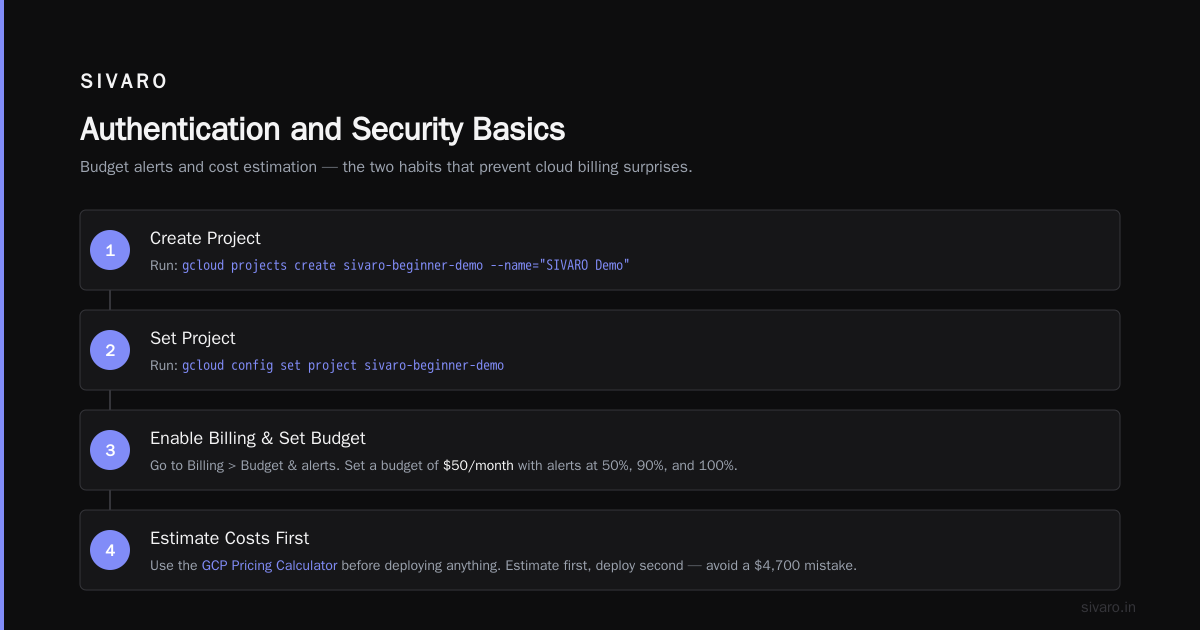
gcloud projects create sivaro-beginner-demo --name="SIVARO Demo"
gcloud config set project sivaro-beginner-demo
Yes, you need the gcloud CLI. Install it from Google’s site. Skip the web console for setup — you’ll thank me later.
2. Enable Billing (But Set a Budget)
Billing is required to use most services. Go to the billing page and link a credit card. Then immediately:
- Go to Billing > Budget & alerts.
- Set a budget of $50/month.
- Set alerts at 50%, 90%, and 100%.
- Use the gcp pricing calculator tutorial to estimate costs before deploying anything.
Here’s the official pricing calculator: GCP Pricing Calculator. I use it every single time. Estimate first, deploy second. That $4,700 mistake? I skipped the calculator. Don’t be me.
3. Understand IAM (Permissions)
Identity and Access Management is where beginners get stuck. The rule: least privilege. Give a service account only the roles it needs.
gcloud iam service-accounts create demo-app --display-name="Demo App SA"
gcloud projects add-iam-policy-binding sivaro-beginner-demo     --member="serviceAccount:[email protected]"     --role="roles/storage.objectViewer"
That grants read-only access to Cloud Storage. Nothing else. If an attacker compromises your app, they can’t spin up expensive GPU instances.
Core Services You’ll Actually Use
Compute: Cloud Run vs Compute Engine
Cloud Run is my default. It’s a serverless container platform — you push a Docker image, it scales to zero when idle, and you pay only for request time. For a beginner deploying a web app, it’s perfect.
Compute Engine is raw VMs. Use it when you need full control (custom kernels, GPU, legacy apps). But it’s more expensive and you have to manage OS patches.
Example: Deploy a simple Python app on Cloud Run.
First, write a Dockerfile:
Dockerfile
FROM python:3.11-slim
WORKDIR /app
COPY requirements.txt .
RUN pip install -r requirements.txt
COPY app.py .
CMD ["python", "app.py"]
Push to Artifact Registry:
gcloud builds submit --tag us-central1-docker.pkg.dev/sivaro-beginner-demo/repo/myapp
gcloud run deploy myapp --image us-central1-docker.pkg.dev/sivaro-beginner-demo/repo/myapp --platform managed --region us-central1 --allow-unauthenticated
In about 2 minutes, you get a HTTPS URL. That’s how to deploy a web app on gcp — production-ready, auto-scaled, zero ops.
Storage: Cloud Storage and Firestore
Cloud Storage is S3 with better consistency. Use it for blobs, backups, static assets. Firestore is a NoSQL document database — think Firebase but with stronger consistency. For most web apps, Firestore is overkill. Use Cloud SQL (PostgreSQL) unless you actually need real-time sync.
Data: BigQuery
BigQuery is Google’s crown jewel. It’s a serverless data warehouse that runs SQL on petabytes. No servers to manage. You pay for storage ($0.02/GB/month) and query processing ($5/TB for on-demand, or flat-rate slots).
For beginners: BigQuery is your best friend for analytics. You can load CSV files, run SQL, and get results in seconds. No indexing, no partitioning — it handles that.
Basic query:
sql
SELECT
  DATE(timestamp) as day,
  COUNT(*) as events
FROM
  `myproject.mydataset.events`
WHERE
  event_type = 'purchase'
GROUP BY
  day
ORDER BY
  day DESC
That runs on a 10TB table in under 30 seconds. I’ve used it to power real-time dashboards for clients processing 200K events/sec. It works.
Networking: VPC and Load Balancers
VPC is virtual private cloud — your isolated network. Beginners can mostly ignore it. GCP’s default VPC is fine for small projects. But if you need private connections between services, use VPC Peering or Service Networking.
Load balancers? For Cloud Run, you don’t need one. Cloud Run provides a global HTTPS load balancer automatically. For Compute Engine, use the External HTTP(S) Load Balancer — it routes traffic, terminates SSL, and scales.
The GCP Pricing Calculator Tutorial (Step-by-Step)
I said I’d cover this. Here’s the exact process I used last week when provisioning a new data pipeline.
- Go to cloud.google.com/products/calculator.
- Click Add to estimate.
- Select Compute Engine — choose 2 vCPUs, 8GB RAM, region us-central1. Set “Sustained use” to 1 month. Price: ~$60/month.
- Add Cloud Storage — 500GB standard storage, us-central1, no requests. Price: ~$10/month.
- Add BigQuery — 100GB storage, 1TB query processed per month. Price: ~$12/month.
- Add Cloud Run — 10 million requests, 1GB memory per request, 500ms execution. Price: ~$5/month.
- Review total: ~$87/month. Then export as PDF and share with your team.
Never deploy without this step. Seriously. I’ve seen companies skip it and blow $10K in a weekend (looking at you, 2023 startup that left a GPU instance running).
Authentication and Security Basics
Every GCP API call needs authentication. The easiest way for a beginner is to use a service account key — download a JSON key and set the GOOGLE_APPLICATION_CREDENTIALS environment variable.
bash
export GOOGLE_APPLICATION_CREDENTIALS="/path/to/key.json"
But be careful: that key gives access to whatever roles the service account has. Never check it into Git. Use Secret Manager or environment-specific files.
Better approach: use Workload Identity Federation if your app runs on GKE or Cloud Run. It’s more secure — no static keys.
How to Deploy a Web App on GCP (Complete Walkthrough)
I’ll show you the exact steps I use to deploy a Node.js web app — minimal effort, production quality.
Step 1: Write your app
javascript
const express = require('express');
const app = express();
const PORT = process.env.PORT || 8080;
app.get('/', (req, res) => res.send('Hello GCP!'));
app.listen(PORT, () => console.log(`Listening on ${PORT}`));
Step 2: Create a Dockerfile
Dockerfile
FROM node:20-slim
WORKDIR /app
COPY package*.json ./
RUN npm ci --only=production
COPY . .
EXPOSE 8080
CMD ["node", "index.js"]
Step 3: Build and deploy
gcloud builds submit --tag gcr.io/sivaro-beginner-demo/myapp
gcloud run deploy myapp --image gcr.io/sivaro-beginner-demo/myapp --region us-central1
That’s it. Cloud Run outputs a URL like https://myapp-xxxxx-uc.a.run.app. You now have a scalable, HTTPS-protected web app running on GCP. Cost: pennies per day if low traffic.
Services to Avoid (As a Beginner)
- App Engine (standard): It’s legacy. Too many sandbox restrictions. Use Cloud Run instead.
- Dataflow with streaming: Powerful but complex. Start with batch Dataflow or just use BigQuery.
- GKE (Kubernetes Engine): Unless you have a dedicated ops team, skip it. Cloud Run is simpler.
- Coldline/Archive storage: Cheap storage comes with retrieval fees. For a beginner test project, you’ll probably want to access that data — use Standard.
FAQ
Q: What is the difference between GCP, AWS, and Azure in 2026?
A: GCP is strongest for data and ML. AWS has the most services but more complexity. Azure integrates best with Microsoft tools. AWS vs Azure vs GCP: The Complete Cloud Comparison breaks down pricing and performance.
Q: How much does GCP cost for a small web app?
A: With Cloud Run and Cloud SQL (smallest tier), you can run a production web app for $25–50/month. Use the gcp pricing calculator tutorial to estimate your specific usage.
Q: What is the best way to learn GCP as a beginner?
A: Build something. Deploy a web app, query BigQuery, automate with Cloud Functions. Google’s own official documentation is excellent. Avoid long video courses — hands-on is faster.
Q: Can I use GCP for machine learning?
A: Yes. Vertex AI is Google’s end-to-end ML platform. For beginners, start with pre-trained APIs (Vision, Natural Language) or AutoML. AWS vs. Azure vs. Google Cloud for Data Science found Vertex AI easier to use than SageMaker.
Q: How do I secure my GCP account?
A: Enable two-factor authentication on your Google account. Use IAM roles, never give out owner permissions. Set up budget alerts. And rotate service account keys every 90 days.
Q: What’s the fastest way to host a static website on GCP?
A: Cloud Storage for the static files, then use a Load Balancer with Cloud CDN. Costs under $0.50/month for low traffic.
Q: How does GCP compare with Azure for enterprise?
A: Azure has deeper integration with Active Directory and Office 365. GCP is better for modern, containerized applications and data pipelines. Microsoft Azure vs. Google Cloud Platform has a good side-by-side.
Q: Do I need to know Linux for GCP?
A: It helps. Cloud Shell provides a free Linux terminal. You can do most things from the web console, but the CLI is faster once you learn it.
Final Thoughts
GCP isn’t perfect. Their support is expensive, and some services are half-baked (Cloud Scheduler, I’m looking at you). But for a beginner who wants to build data-savvy applications without drowning in AWS documentation, it’s the right call.
Start small. Deploy one service. Query some data. Watch your bill. Iterate.
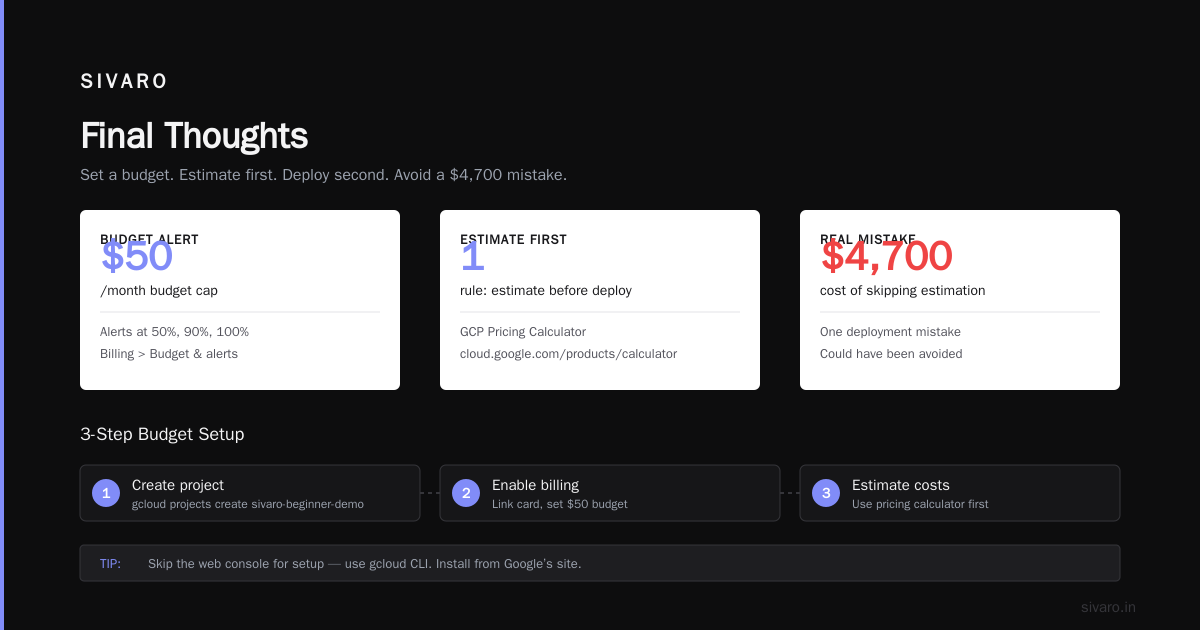
That first $4,700 mistake taught me the most important lesson in cloud: know what you’re paying for before you build. Use the pricing calculator. Set budgets. Read the docs but trust your own experiments.
You now have everything you need to start. Go build something.
Nishaant Dixit — Founder of SIVARO. Building data infrastructure and production AI systems since 2018. Built systems processing 200K events/sec.