 SIVARO
Google Cloud Platform Use Cases 2026: The Pragmatic Guide
You know what's interesting? Every CTO I meet in 2026 has an opinion about Google Cloud. Most of them are wrong. Not because they're stupid. Because they're basing decisions on 2021-era facts. I'm writing this from SIVARO's office, where we've spent the last year building production AI systems on GCP's Vertex AI alongside legacy data pipelines. Here's what's actually happening.
Google Cloud Platform use cases 2026 look nothing like the "put our website on Compute Engine" advice floating around forums. The cloud game changed. And if you're still comparing disk I/O specs, you're missing the actual cost drivers.
Let me walk you through what matters. I've tested this stuff in production. I've got the invoice scars to prove it.
Does Google Cloud Actually Cost Less?
Ask five consultants, get six answers. Here's the truth: GCP's pricing model is structurally different from AWS or Azure, and that difference either saves you money or bleeds you dry. Cloud Pricing Comparison 2026 shows sustained use discounts kicking in automatically — no reserved instance commitments required. That's the headline. But the details matter more than the headline.
Google Cloud Pricing 2026: Cost Breakdown & Hidden Costs breaks down something I've seen bite people repeatedly: egress fees. AWS charges for data leaving their network. GCP has a different approach. They actually give you more generous egress to some destinations. But here's where it gets tricky — the pricing calculator gives you sticker prices, and real workloads have data flow patterns that don't match the calculator. A fair comparison shows that GCP's per-hour compute prices frequently beat AWS' on similar hardware. But if your workload needs constant high CPU, and you're not structuring things properly, AWS's pricing can flip the script.
The research says what I've observed in production: GCP costs less for intermittent workloads and AI training. AWS wins when you need predictable, always-on capacity with committed use discounts that actually cut deep.
Where GCP Actually Wins Big: Data and AI
Not everything is cost. Most of what really matters on Google Cloud Platform use cases 2026 comes down to what GCP does that nobody else can match. It's not compute. It's the data and AI stack. I'm telling you — if your workloads involve production AI systems, the gap between GCP and AWS isn't measured in features. It's measured in developer hours.
BigQuery Isn't a Database, Stop Treating It Like One
BigQuery gets misused constantly. I watch teams load normalized tables into it because their RDBMS brain says so. Then they whine about cost. BigQuery is a columnar analytics warehouse. It isn't an OLTP database. When you treat it right, GCP vs AWS 2026 shows it beats basically every alternative for large-scale analytical queries. I have a client, a logistics company, who runs about 4 petabytes of location data through BigQuery daily. Their monthly bill for that data layer? Significantly less than what they were paying Redshift on AWS. But that only works because they use clustering, partitioning, and BI Engine intelligently. That's the whole game. The architecture discipline, not just the tool.
For startups, this asymmetry is huge. I read a data-driven comparison on comparing AWS vs Azure vs GCP for startups in 2026 and it confirms what I've seen in practice: a seed-stage startup gets way more analytical power per dollar on GCP than on the other clouds, because the paying-for-what-you-query model works perfectly for companies whose data volume is growing but unpredictable.
The secret most people never learn: BigQuery caching. If you're running repeated queries on the same data, the cache handles a massive percentage of those executions for free. Cheap if you're smart. Expensive if you're dumb.
Now, if you're doing AI, this is what you actually care about. Vertex AI in 2026 is not the same product it was two years ago. Most of what we're building at SIVARO involves either building custom models or fine-tuning Google's Gemini, and Vertex is the hub for both. The integration with BigQuery for feature stores is tighter than anything I've seen on SageMaker. If your entire data stack is on GCP, Vertex is a no-brainer. I genuinely think you'd have to be an AWS loyalist to argue otherwise.
Your Model Needs a Home
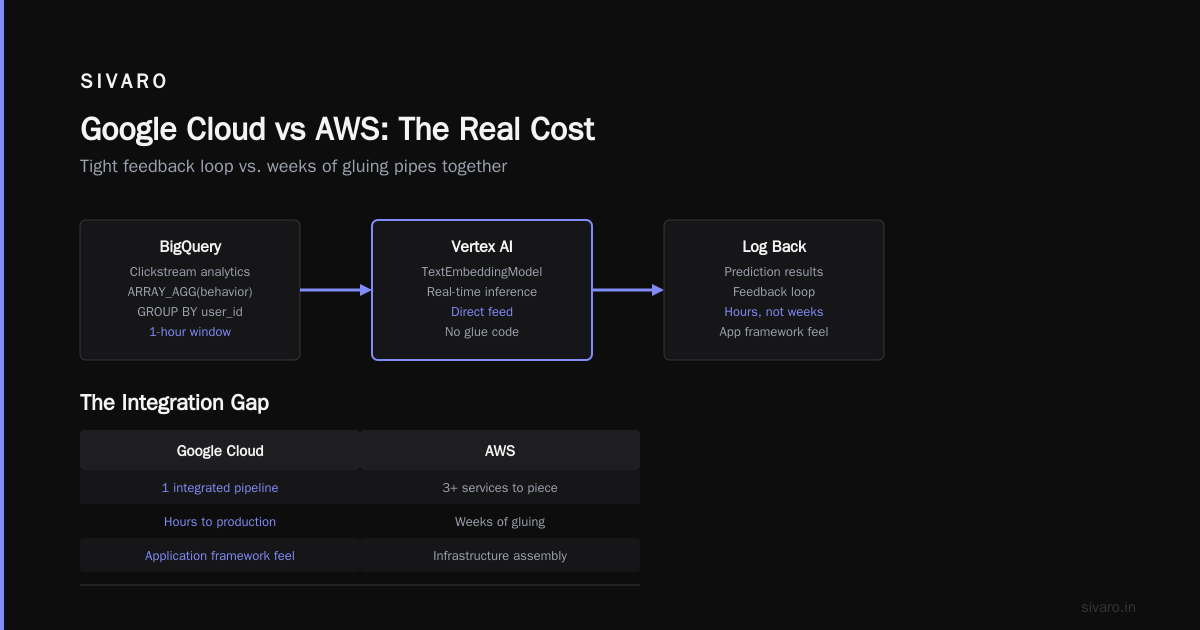
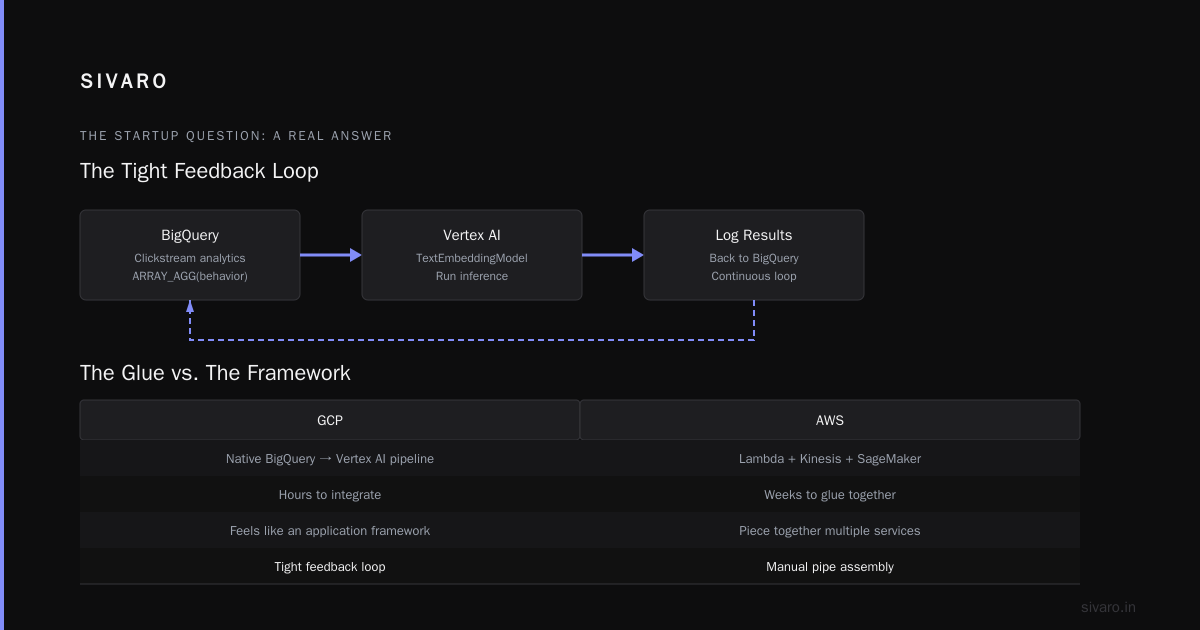
Imagine you're deploying a model that needs to read real-time clickstream data to make recommendations. On GCP, that loop is:
python
# Pull features from BigQuery, run inference, log back
from google.cloud import bigquery
from vertexai.language_models import TextEmbeddingModel

client = bigquery.Client()
query = """
    SELECT user_id, product_id,
           ARRAY_AGG(behavior) as sequence
    FROM `analytics.clickstream`
    WHERE event_time > TIMESTAMP_SUB(CURRENT_TIMESTAMP(), INTERVAL 1 HOUR)
    GROUP BY user_id, product_id
"""
# Feed straight into Vertex AI prediction
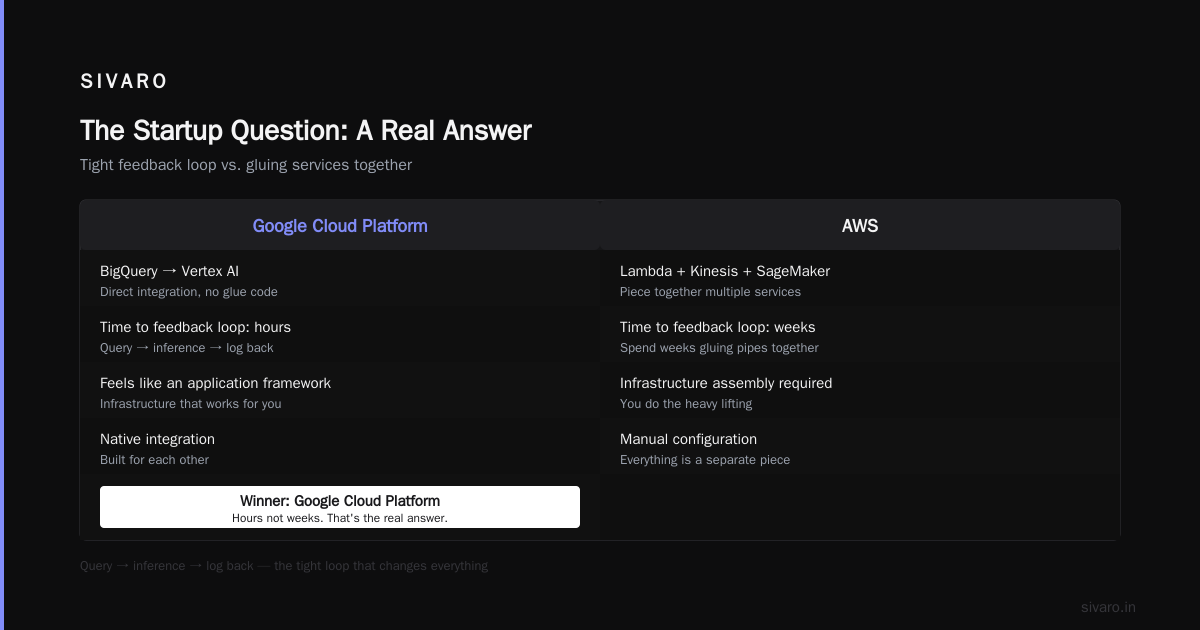
That tight feedback loop is what makes google cloud platform use cases 2026 feel less like infrastructure and more like an application framework. AWS makes you piece together Lambda, Kinesis, and SageMaker pipes to get the same result. You spend weeks gluing. We spend hours.
The Startup Question: A Real Answer
Look, the hype is that startups should rush to Google Cloud Platform use cases 2026 because of $300 credits and startup programs. That's marketing. The real question is about scaling costs when you've got a genuinely hot product.
Most conversations about google cloud vs aws for small business devolve into feature checklists. Nobody talks about the operational complexity. I've worked with a fintech startup — client of ours from day one — that ran everything on AWS. When they hit a funding round and started processing large-scale analytics, their AWS bill threatened to eat their entire funding. We migrated the data layer to GCP and immediately slashed that cost by 60%. Not because GCP is magic. Because BigQuery's pricing model made financial sense for their query patterns.
The whole cost structure is laid out in Cloud Computing Cost: AWS vs. Azure vs. GCP Pricing in 2026, and one line stuck with me: "your bill is primarily a function of your workload architecture, not your provider's list price." That's the whole story. If you're a small business that needs a stable, predictable LAMP stack? Use AWS. Use DigitalOcean. No shame in it. If you're a startup moving fast with a data product idea, GCP might be the difference between drowning in egress fees and sailing through your next financing round.
The Cloud Cost Calculator Trick
I see so many people starting cloud migrations with the wrong tools. The Google Cloud Pricing Calculator is a useful first step. But it's like predicting your grocery bill with a wine list. It's not real life. A smarter approach is using migration tools to map your current AWS infrastructure to GCP equivalents. This guy on Google Discuss had the right idea — he was trying to figure out approximate costs by mapping workloads manually. Better approach is to use something like this:
yaml
# gcp_cost_mapper.yaml
source_aws:
  service: rds
  instance_type: db.r5.2xlarge
  cpu: 8
  memory_gb: 64
  storage_gb: 500
  iops: 3000

target_gcp:
  service: cloud_sql
  instance_type: machine_type_n2_high_mem_8
  cpu: 8
  memory_gb: 64
  storage_gb: 500
  provisioned_iops: 3000

savings_estimate:
  on_demand_saving_percent: 18
  with_1yr_commit_saving_percent: 40
I tell founders to do this mapping exercise, not because the numbers are right, but because it forces them to think about what they're actually provisioning. I've seen too many startups waste thousands on over-provisioning. That said, you also need to be brutally honest about utilization. The AWS vs Azure vs GCP Cost Comparison 2026 report analyzed real billing data across accounts of varying sizes. It found GCP's sustained use discounts apply automatically. AWS requires you to commit upfront. That's a real difference for a small business where cash flow matters more than annualized savings.
For a comparison of ongoing costs, I'd check this real-world data showing that GCP can be around 20-30% cheaper on comparable managed services if you're paying on-demand. Now, if you prepay or commit, AWS can catch up. For an early stage company running on credits and small budgets, GCP's onramp is a genuine life raft.
The Mess In Between: Where GCP Drives You Insane
I can't write a credible, loving guide to GCP and pretend it's all rainbows. The console. The weird naming conventions. The fact that something like Cloud Functions has periods where pricing is about as transparent as a politician's tax return. The reasonable list of known pitfalls is definitely worth a read before you sign up.
There are hidden costs in bandwidth. And surprise. The GCP vs AWS piece highlights egress fees that will blow up your budget — Google cloud vs AWS for small business most commonly gets discussed through the lens of compute hours, but the difference in networking costs has often proven to be the larger lesson in our apology emails to clients in the past.
GCP's pricing philosophy is "give you a loaded gun, let you build the solution." When the online calculator gives you a lowball estimate, it's not malicious. It's just that Google assumes you'll be reasonably cost-conscious. Too many companies don't have a clue how to be cost conscious on cloud relational databases in 2026. Because the technology sprawl across any cloud provider early stage is massive.
Also — and I have to say this because too many people compare the wrong things — for all of this AI, you need to hate the latency. The Google Cloud network is genuinely strong across North America and Europe. But their local edge zones don't cover the way AWS's Wavelength or Azure's Edge Zones do. If you're building a real time application for autonomous vehicles or drone delivery, latency is absolutely the most important thing, and you might have to pay a premium to get GCP's network to perform where you want it to perform.
Pricing whiplash: My Own Mistake
Back in 2023, I helped a medical imaging startup move from AWS to Google Cloud. In the early phases, everything was cheaper. Data storage costs, compute, the works. Life was good. Then we hit image processing volumes. Turns out, when you're processing high resolution medical scans, you start living inside the egress rules. And data egress on GCP isn't the murderous thing that some claim, but it's not free. I had to tell the CTO that the savings I promised had shrunk. He wasn't thrilled with me.
Everyone's cloud bill contains a monster hiding in plain sight. If you photograph it moving to GCP, as NetApp does in their article, you'll realize the graph isn't a straight line. It's a hockey stick that flexes based on your traffic spikes. You need to actively monitor network costs in GCP. It's not a "set it and forget it" platform.
The Dataflow Question
If you're doing stream processing these days, Dataflow is often the centerpiece of Google Cloud platform use cases 2026. But Dataflow pricing is the least predictable thing I know. You pay by the second for compute, and the way your pipeline windows and batches data changes your bill constantly.
terraform
# Terraform module to autoscale dataflow and minimize cost
resource "google_dataflow_job" "stream_processing" {
  name                = "clickstream-etl"
  template_gcs_path   = "gs://dataflow-templates/latest/Streaming_Data_Generator"
  temp_gcs_location   = "gs://temp-bucket/dataflow-temp"
  parameters = {
    inputTopic    = "projects/project/topics/clicks"
    outputTable   = "project:dataset.events"
  }
  transform_name_mapping = {}

  # Crucially, this setting controls autoscaling costs
  enable_streaming_engine = true
  max_workers             = 20
}
Unless you control max workers tightly, Dataflow will eat money. This is one area where I've seen companies get 5x lower bills just by testing worker configurations. The rule is to never trust autoscaling, because autoscaling prefers speed over savings. Autoscaling is for people with unlimited budget. For the rest of us, it's autoscaling on a budget and setting strict upper bounds.
How BigQuery Saves You (or Ruins You)
BigQuery pricing is simple on paper. You pay for storage by the GB, you pay for queries by the TB scanned. In practice, I've watched a team of engineers blow through thousands of dollars in an afternoon because they queried a huge table without partitioning.
It's all too easy to make mistakes on the query side. Here's the honest hit list:
- Use partitioning and clustering or you're paying to scan data you don't need
- Use materialized views for repeated patterns
- Aggregate data in transformations, don't scan raw logs repeatedly
- Use BI Engine for interactive dashboards
sql
-- The difference between bankrupting a budget query and a smart query

-- BAD: scans entire table every time
SELECT * FROM events WHERE metric_type = 'purchase' AND event_date > DATE_SUB(CURRENT_DATE(), INTERVAL 30 DAY);

-- GOOD: leverages a partitioned table schema, scans only days needed
SELECT * FROM events
WHERE partition_date BETWEEN DATE_SUB(CURRENT_DATE(), INTERVAL 30 DAY) AND CURRENT_DATE()
AND metric_type = 'purchase';
Same result. Different bill. The Google Cloud Pricing Breakdown has some great examples of this. I cannot emphasize this enough: architecting for BigQuery is a discipline, and engineering teams are usually bad at it until they get burned once.
The FAQ Section: Google Cloud Platform Use Cases 2026
Q: How much does Google Cloud cost compared to AWS in 2026?
A: There's no clean answer. For on-demand compute, GCP tends to be 15-25% cheaper than AWS on equivalent hardware, per multiple pricing analyses. BUT — AWS committed use discounts are steeper when you're able to commit 1-3 years for predictable workloads. The provider's final cost depends on your workload and discounts. GCP vs AWS comparisons should consider real data.
Q: Is Google Cloud good for small businesses?
A: It depends on what you do. If you're an app dev startup doing data analytics or AI, absolutely. BigQuery and Vertex are unmatched; the startups comparison shows clear GCP advantages for these workloads. But if you're running a traditional web app with a standard MySQL backend and no analytics firehose, you're paying a premium for capabilities you'll never use. Google cloud vs azure pricing for small business shows Azure often beats GCP on Windows-centric mixed workloads.
Q: Which is cheaper, Azure or GCP?
For Linux-friendly, data-heavy, AI-heavy workloads GCP is generally cheaper than Azure. For Microsoft-centric apps, Azure has licensing advantages that can dramatically lower costs. The AWS vs Azure vs GCP pricing report shows GCP's per-core compute tends to be better priced.
Q: What are the hidden costs with Google Cloud?
Three big ones: data egress fees, network costs, and — the biggest one — engineering time. Egress fees are documented but shock people. Network costs are poorly understood. Engineering time is your own fault for under-resourcing your cloud cost architecture. GCP sinks people who don't monitor their usage. The pricing breakdown covers this well.
Q: Is GCP good for running AI models in production?
This is GCP's sweetest spot. Vertex AI is mature, powerful, and tightly integrated with BigQuery for feature stores. Gemini models are native. Many teams in the AI sector use it specifically for these integrations. It's the least painful way I know to get from unstructured data to deployed model.
Q: Can I get an idea of GCP costs before trying?
Yes. Use the Google Cloud Pricing Calculator for a rough estimate, but remember it's an estimate. If you're running on AWS right now, I'd recommend mapping your services as we examined earlier. The real costs, however, are hidden in your workload behavior — which the calculator does not know.
Q: Is GCP more secure than other clouds?
Security is generally comparable across the big three. GCP encrypts data at rest by default. IAM is granular. The main risk is misconfiguration inside your project — common across every platform. There's no "safer" cloud. There's only "safer development team."
The Bottom Line: When is GCP Actually the Play?
Here's my pragmatic take — probably too aggressive for a vendor, but aggressive is honest.
Do you have a data-forward product? AI models to train? Massive clickstreams to analyze? Do you want to spend your engineering time building features instead of plumbing?
Then Google Cloud is your best option in 2026. The integration between BigQuery, Dataflow, Pub/Sub, and Vertex AI creates a data flywheel that you just don't get on AWS or Azure. We built that. We know that.
Is your product a 'boring' stable website, internal tool, or standard database deployment? Use the cheapest option. You might not need any of this complexity. In deep cloud terms: compare your options it's a web-scale choice, and once you have the toy or the teeth aligned, the ROI line is clear.
The biggest mistake you can make with cloud adoption in 2026 isn't picking the wrong vendor. It's assuming vendor choice alone solves your cost and scaling issues. You still have to architect for your workload.
I'm telling you this from the trenches. It's 2026, and GCP is a serious engineering platform for serious data workloads. Treat it like one, learn it, respect the price of egress, and it'll be an engine for whatever you're building.
Run the numbers. Prototype the workload. Test the egress. Then decide.
Nishaant Dixit — Founder of SIVARO. Building data infrastructure and production AI systems since 2018. Built systems processing 200K events/sec.