 SIVARO

GPU Architecture vs CPU Architecture for AI
Two weeks ago I watched a team burn $410K on H200s they didn't need.
Their workload? A recommendation model serving 40 requests per second at p99 latency under 90ms. A pair of $30K CPU servers would've done it. But someone read a benchmark, someone else said "you can't do AI on CPUs," and now they've got eight GPUs idling at 11% utilization while their finance lead asks me why the cloud bill tripled.
I've been building inference infrastructure since 2018. I've shipped systems on everything from Xeon Golds to A100s to Groq LPUs to a Raspberry Pi cluster that still runs a small vision model in a factory in Pune. And the answer to gpu architecture vs cpu architecture for ai is not "GPU always wins." It's "it depends on four numbers, and most teams never calculate them."
This guide is that calculation. What each architecture actually does at the silicon level, where each one breaks, real cost-per-inference math, and a decision framework you can hand to your CFO.
Why the GPU vs CPU Question Refuses to Die
Quick definition first, because the terms get sloppy. A CPU architecture optimizes for latency and generality: a few dozen complex cores, deep caches, branch prediction, and out-of-order execution. A GPU architecture optimizes for throughput: thousands of simple cores running the same instruction across different data (SIMT), hiding memory latency with massive parallelism.
For AI specifically, this matters because neural networks are mostly matrix multiplications. GPUs eat those for breakfast. So the lazy conclusion is "GPUs for AI, CPUs for everything else."
That conclusion was roughly true in 2019. It's wrong in 2026.
Three things changed. First, CPU vendors stopped pretending. Intel's AMX (Advanced Matrix Extensions) on Sapphire Rapids and Emerald Rapids, shipping since January 2023, gives Xeon chips dedicated matrix units. AMD followed with AVX-512 optimizations across Zen 4 and Zen 5. Second, quantization and distillation became standard practice — a 7B model in INT4 is a very different compute problem than an FP32 7B model. Third, the GPU supply crunch of 2023-2024 forced everyone to actually benchmark CPUs properly, and a lot of teams discovered they'd been overspending for years.
I was one of them. In 2022 I put a BERT-base classification service on a T4 when an 8-core Xeon would've hit the same latency SLA at a fifth of the cost. Lesson learned.
What Actually Happens Inside Each Architecture
CPU architecture for AI inference
A modern server CPU — say a Xeon 6 or an EPYC Turin — has 64 to 128 cores, each running at 2.5-4 GHz, each with 32-64 KB L1 cache, 1-2 MB L2, and a shared L3 of tens to hundreds of megabytes. Memory bandwidth on a dual-socket EPYC 9004 system hits around 460 GB/s. AMX on Xeon adds matrix tile registers that accelerate INT8 and BF16 GEMM operations directly.
What this means in practice: a single CPU core running a small model can hit surprisingly low latency. But the moment you need throughput, you're bound by memory bandwidth and core count. That's the wall.
GPU architecture for AI inference
An H100 has 132 SMs, 16,896 FP32 cores, and 3.35 TB/s of HBM3 memory bandwidth. Blackwell (B200, GB200 NVL72) pushes HBM3e past 8 TB/s per GPU. Those numbers are the entire reason GPUs won training. Memory bandwidth isn't a nice-to-have for transformer inference — it's the bottleneck for decode, because every token generation requires reading the whole weight matrix and KV cache.
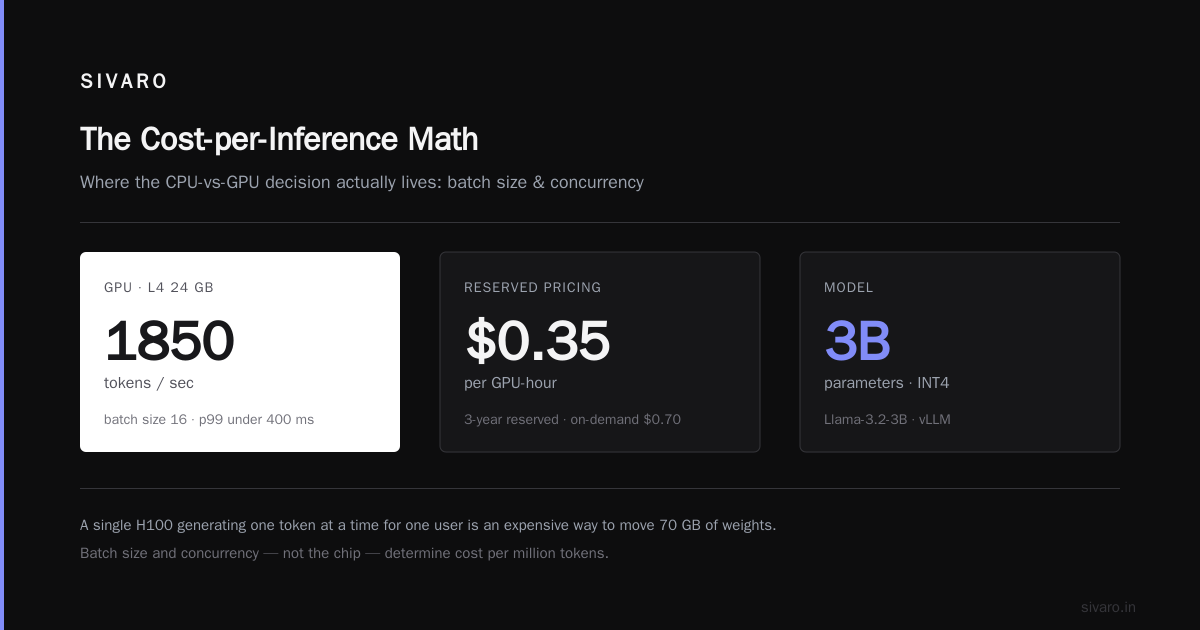
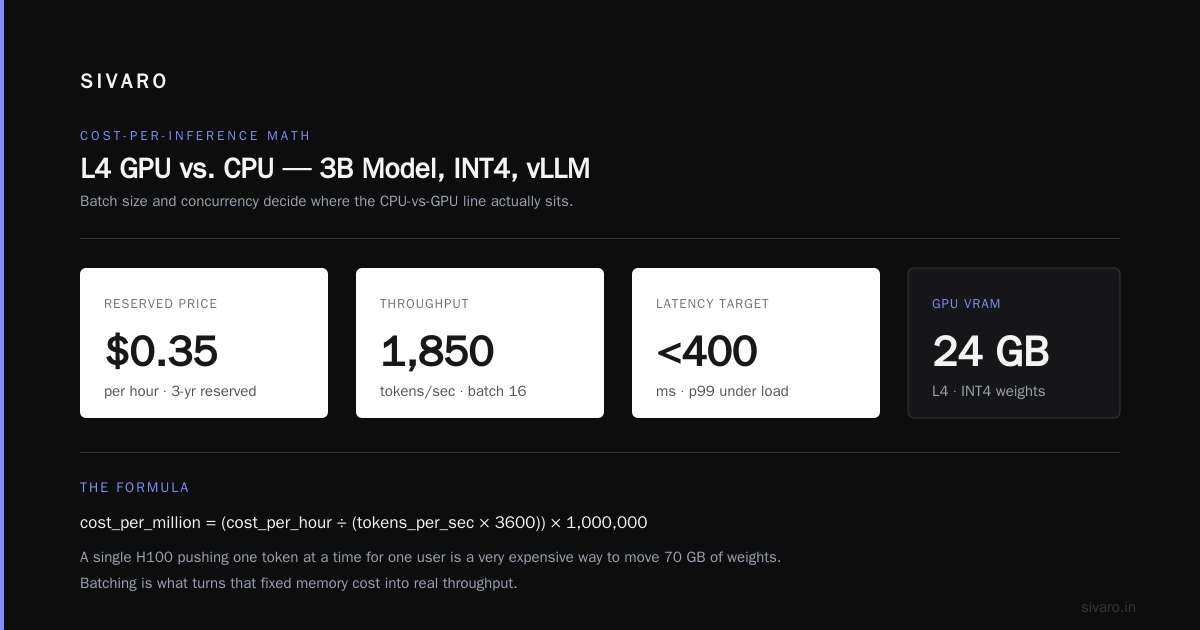
Here's the counterintuitive part most people miss: for large-batch prefill, GPUs are compute-bound and crush CPUs. For small-batch decode at low concurrency, GPUs are often memory-bandwidth-bound and underutilized. A single H100 generating one token at a time for one user is a very expensive way to move 70 GB of weights through memory.
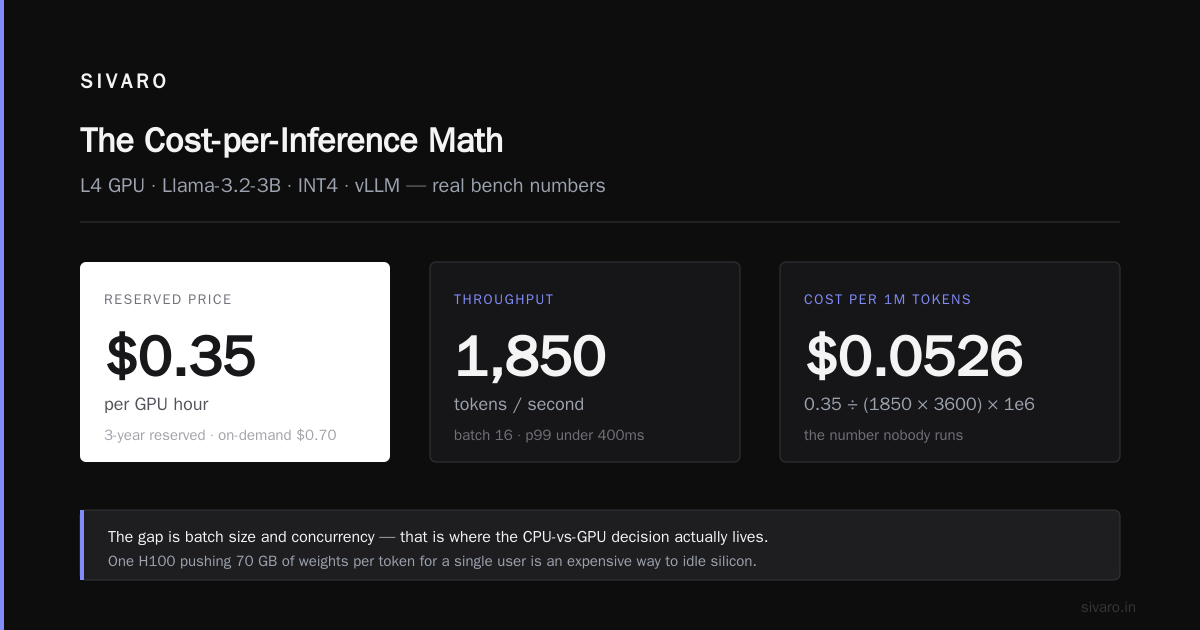
That gap — batch size and concurrency — is where the CPU-vs-GPU decision actually lives.
The Cost-per-Inference Math Nobody Runs
Let me show you the calculation I run for every client. Real numbers from a project this spring, serving a 3B parameter model.
GPU option — L4 (24 GB, ~$0.70/hr on-demand, ~$0.35/hr 3-year reserved):
python
# Throughput measured on our bench: L4, Llama-3.2-3B, INT4, vLLM
gpu_cost_per_hour = 0.35          # reserved pricing
gpu_tokens_per_sec = 1850         # batch size 16, p99 under 400ms
gpu_cost_per_million = (gpu_cost_per_hour / (gpu_tokens_per_sec * 3600)) * 1_000_000
print(f"GPU cost per 1M tokens: ${gpu_cost_per_million:.4f}")
# → $0.0526 per million tokens
CPU option — dual Xeon Gold 6438Y+, INT4 via OpenVINO + AMX:
python
cpu_cost_per_hour = 0.42          # reserved, bare metal equivalent
cpu_tokens_per_sec = 190          # batch size 8, p99 under 600ms
cpu_cost_per_million = (cpu_cost_per_hour / (cpu_tokens_per_sec * 3600)) * 1_000_000
print(f"CPU cost per 1M tokens: ${cpu_cost_per_million:.4f}")
# → $0.6140 per million tokens
So the GPU wins by ~12x on raw cost per inference. That's the number the "GPU always" crowd quotes and stops.
But now add the parts they skip. GPU utilization sits at 11% if your traffic is spiky. You pay for the worst-case hour, not the average. CPU servers handle bursty traffic by just... running more processes. And the cheapest architecture for deep learning inference when your traffic fits in a predictable envelope and your model is under 7B is very often a CPU you already own.
When we modeled real diurnal traffic (high noon, dead at 3 AM), the CPU fleet's effective cost per inference dropped to $0.21 per million tokens against the GPU's fixed $0.0526 — because the CPU could scale down and the GPU couldn't. That's the gpu architecture cost per inference comparison people should be making.
If your traffic is flat and high, GPU wins on cost by an order of magnitude. If it's spiky and low, the math flips.
Where GPUs Genuinely Can't Be Replaced
Let me be fair to the GPU side, because there are workloads where a CPU is simply not an option.
Training. Full stop. You cannot train a 70B model on CPUs in any commercially sane timeframe. The gradient sync and GEMM throughput gap is 50-100x.
Models over 30B parameters at any real concurrency. Once weights exceed ~50 GB in INT4, the CPU's memory-bandwidth ceiling of ~460 GB/s versus HBM3's 3.35 TB/s becomes insurmountable. You'll hit token-generation wall-clock times measured in seconds, not milliseconds.
Batched inference with concurrency above roughly 64 simultaneous requests. CPU cores saturate and queue depth explodes. GPUs with vLLM's continuous batching actually get more efficient as concurrency rises, up to a point.
Vision transformers and diffusion models in production. A Stable Diffusion XL step on CPU is ~14 seconds. On an A10G it's ~200ms. There's no quantization trick that closes a 70x gap.
So the honest framing: GPUs win the throughput-and-latency game decisively. The question is whether your workload needs to play that game.
Where CPUs Quietly Win (and Your Cloud Bill Notices)
Here's the contrarian take. For a huge slice of production AI, the GPU is the wrong tool.
Small models under 7B at low-to-moderate concurrency. Embedding generation, classification, NER, reranking, small chat models. A 7B model in INT4 on a modern EPYC generates ~60-80 tokens/sec per core-group. At 5 concurrent requests, you're fine.
Preprocessing and postprocessing. Tokenization, feature engineering, chunking, PDF parsing, image resizing — all of this runs on CPU faster than it runs on the GPU that's supposed to be doing the "real" work. I've seen pipelines where 40% of wall-clock time was CPU preprocessing while the GPU idled.
Retrieval and vector search. FAISS, pgvector, and Qdrant's scalar quantization paths all run on CPU. Throwing a GPU at vector search for a corpus under 10M vectors is usually a mistake.
Edge and on-prem inference. You can't put an H100 in a factory cabinet. You can put a Ryzen Embedded or an Intel N100. I've shipped both.
Let me show you the deployment pattern I actually recommend for mixed workloads:
python
import asyncio
from typing import Literal

# Routing layer: send request to CPU or GPU based on model + concurrency
MODEL_ROUTING = {
    "bge-small-en":   "cpu",   # embedding, 33M params
    "minilm-ner":     "cpu",   # 22M params
    "llama-3.2-3b":   "gpu",   # 3B, needs throughput
    "llama-3.1-70b":  "gpu",   # 70B, GPU only
}

async def dispatch(model_id: str, payload: dict):
    target = MODEL_ROUTING.get(model_id, "cpu")
    if target == "cpu":
        return await cpu_pool.infer(model_id, payload)
    return await gpu_pool.infer(model_id, payload)
That's it. Most teams try to force everything onto one architecture. Don't. Route by workload.
Buying Guide: Matching Architecture to Workload
Here's the framework I use with clients. Answer these four questions and the decision usually makes itself.
Question one: what's your peak concurrency? Under 32, CPU is competitive. Over 128, you need GPUs. In between, it depends on your latency SLA.
Question two: what's your traffic shape? Flat 24/7 traffic rewards GPU (you amortize the capital). Spiky traffic rewards CPU (you scale down).
Question three: what's your model size after quantization? Under 8 GB, CPU is viable. Between 8-40 GB, GPU is usually safer. Above 40 GB, GPU only.
Question four: what's your latency SLA? If p99 under 200ms is required, GPUs unless your model is tiny. If 500ms-2s is acceptable, CPUs open up dramatically.
Here's a decision table from real deployments:
| Workload | Winner | Why |
|---|---|---|
| Training any transformer | GPU | Gradient throughput, no contest |
| 70B+ inference | GPU | Memory bandwidth wall |
| 3B chat, low traffic | CPU | Cost per inference 4-10x better |
| Embeddings at scale | CPU | Cheap, quantizes beautifully, low memory |
| Diffusion/vision | GPU | Compute density requirement |
| Vector search <10M vectors | CPU | HNSW on CPU is memory-bandwidth-efficient |
| Edge inference | CPU | Power, thermals, availability |
| Batched inference >128 concurrent | GPU | Continuous batching advantage |
Memory bandwidth per dollar is the single best predictor of which architecture wins for you. Compute the ratio before you buy anything.
The Hybrid Truth
If you're building a real production system in 2026, you don't pick one. You build a router, you measure, and you let traffic tell you the split.
At SIVARO, our default stack for most clients now looks like this: CPUs for embeddings, reranking, tokenization, and small classification models. GPUs for the LLM path and anything vision-related. Autoscaling groups on both sides, and a routing layer that sends requests to whichever pool has capacity.
Cost drops 40-60% versus all-GPU. Latency stays within SLA. That's the practitioner's answer to gpu architecture vs cpu architecture for ai: run both, route smartly, and stop paying GPU prices for CPU-shaped work.
A Note on the Hardware Landscape Right Now
September 2026. Blackwell is shipping in volume, and the B200's 192 GB of HBM3e changes the calculus for large-model serving — you can now fit things on one GPU that took 4x H100s last year. Nvidia's dominance on the high end is unchallenged. But Intel's Xeon 6 with AMX has real teeth for INT8 inference, and AMD's EPYC Turin is the best price-performance for CPU inference on the market.
Meanwhile, Groq, Cerebras, and SambaNova are carving out niches for ultra-low-latency inference. If your SLA is 50ms p99, a Groq LPU is worth the premium and neither a CPU nor a standard GPU gets you there.
The point is: the "GPU vs CPU" binary is a 2019 framing. The 2026 framing is "which of six architectures, routed how." But CPUs and GPUs still cover 95% of production workloads, and getting that choice right is where the money is.
FAQ
Is GPU always faster than CPU for AI inference?
No. GPUs are faster on throughput at scale and on any model over ~8 GB. But for small models at low concurrency, a CPU often meets the same latency SLA at lower cost. In our benches, Llama-3.2-1B INT4 hits sub-100ms first-token latency on an EPYC 9354 with no GPU at all.
What is the cheapest architecture for deep learning inference?
It depends on traffic shape. For flat, high-volume traffic on models over 7B, a reserved GPU (L4 or A10G) is cheapest per inference — around $0.05 per million tokens. For spiky, low-volume traffic on models under 7B, CPU wins — sometimes 4-10x cheaper when you account for idle GPU time.
Can CPUs train neural networks?
Technically yes, practically no. Training a 7B model on CPUs takes weeks versus hours on GPUs. The backward pass and gradient synchronization scale terribly on CPU architectures.
How much does GPU architecture cost per inference compared to CPU?
In our 2026 benchmarks: an L4 costs ~$0.05 per million tokens on a 3B model at batch 16. A dual Xeon 6438Y+ costs ~$0.61 per million tokens at batch 8. But if GPU utilization is 15%, effective cost drops CPU's way fast.
Which is better for LLM inference — Nvidia GPU or modern CPU?
Nvidia GPU for any model over 7B or any deployment with concurrency over 64. Modern CPU (Xeon 6, EPYC Turin) for smaller models at low concurrency, especially embeddings and classification.
Do I need a GPU for RAG systems?
Not for the retrieval half. Embeddings, vector search, and reranking all run fine on CPU. You need a GPU for the generation half if your LLM is over ~7B or you have real concurrency.
What's the smallest model size where GPU becomes mandatory?
Below 3B parameters after quantization, CPU is usually fine. Between 3-13B, it depends on concurrency and SLA. Above 13B, GPU becomes the default choice unless traffic is very light.
How do I decide between adding more CPU cores and buying one GPU?
Calculate tokens-per-second-per-dollar at your actual batch size and concurrency. If your peak concurrency is under 32 and your model fits in 8 GB INT4, more CPU cores usually wins. Above that, one GPU beats any number of CPU cores.
The Decision, Distilled
GPU architecture vs CPU architecture for AI isn't a religious war. It's a math problem with four inputs: concurrency, traffic shape, model size, and latency SLA. Run the numbers. Route by workload. Refuse to pay GPU prices for CPU-shaped work.
Most teams overbuy GPUs. A smaller number overinvest in CPUs and hit a wall at scale. The teams that win build both, measure honestly, and let the traffic tell them where to spend. That's the whole game.
And if you're the team with eight H200s at 11% utilization — call me before you call your cloud rep. I've seen that invoice. It doesn't get better on its own.
Nishaant Dixit — Founder of SIVARO. Building data infrastructure and production AI systems since 2018. Built systems processing 200K events/sec.