 SIVARO

GPU Cluster Admission Control Best Practices: The 2026 Buyer's Guide
You've bought the GPUs. Now you're fighting over them.
I've spent the last eight years building data infrastructure at SIVARO, and I've watched teams burn millions on idle H100s while their ML engineers rage in Slack about queue times. The problem isn't procurement. It's admission control — the invisible gatekeeper that decides who gets compute, when, and at what cost.
Most teams treat admission control like a router config: set it once, forget it. That's how you end up with a cluster where one team's nightly batch job starves everyone else's interactive experiments.
This guide compares the admission control strategies I've tested in production, the tools that actually work, and the trade-offs nobody puts in their marketing slides.
What Is GPU Cluster Admission Control, Really?
Admission control is the policy layer that decides whether a workload gets scheduled, when it gets scheduled, and under what conditions. It's the difference between Kubernetes saying "yes" to every pod that requests 8 GPUs and Kubernetes saying "let me check if the finance team's month-end run is coming."
The admission controller sits at the API server. It intercepts pod creation requests before the scheduler even sees them. This is your last chance to reject, mutate, or prioritize a workload.
Key distinction: admission control is not the scheduler. The scheduler figures out where a pod lands. Admission control decides whether it lands at all.
Most people conflate these. That's mistake number one.
The Queueing Trap: Why Request Queues Fail
In 2024, I watched a fintech client deploy a simple request queue. Every GPU request went into a FIFO line. Simple. Fair. And catastrophically wrong.
Their fraud detection team submitted 4,000 short-running inference pods every morning. Those queued behind a single training job that needed 128 GPUs for six hours. The inference pods had four-hour SLAs. Half of them missed their deadlines. The training job eventually got preempted by a human with admin credentials, which corrupted its checkpoint, which cost them twelve hours of training time.
The lesson: FIFO queues are fair in the most useless way possible. They treat a 30-second inference call identically to a week-long training run.
Most people think "gpu admission control vs request queueing" is a philosophical debate. It's not. Admission control with quotas and priorities beats naive queueing in every production scenario I've tested. The only argument for simple queueing is operational simplicity — and even that falls apart when your cluster has more than one team on it.
Fairness in Multi-Tenant GPU Scheduling: The Real Problem
Here's the uncomfortable truth: fairness in multi-tenant gpu scheduling isn't about equal access. It's about proportional deprivation.
Every team feels under-resourced. That's the nature of shared infrastructure. The question is whether your admission control makes everyone equally unhappy or lets one team hoard while others starve.
I've seen three fairness models in production:
Static quotas: Each team gets a fixed number of GPUs. Simple. Predictable. And a recipe for idle GPUs when one team isn't using its allocation. In 2023, CoreWeave found that static partitioning led to 30-40% idle capacity in multi-tenant deployments Cloud Native Computing Foundation.
Hierarchical quotas: Teams have hard ceilings, sub-teams have soft limits. Borrowing is allowed under pressure. This is what Google's Omega paper described back in 2013, and it's still the gold standard Google Research.
Weighted fair sharing: No fixed quotas. Each team gets a weight, and the cluster divides resources proportionally to demand. This is what YARN does natively.
My recommendation: start with hierarchical quotas, add weighted fair sharing as a backstop. Static quotas become political weapons within six months. Trust me.
Admission Control Mechanisms: The Toolbox
Pod Priority and Preemption
Kubernetes gives you priority classes. You assign a number to each workload class. Higher numbers get scheduled first. When resources are tight, the scheduler preempts lower-priority pods.
Simple, right? Here's what they don't tell you: preemption is destructive. Your lower-priority training job gets killed mid-iteration. If your checkpointing is bad — and it usually is — that's hours of lost compute.
My rule: only use preemption for truly interruptible workloads. Batch inference, data processing, hyperparameter sweeps. Never preempt a long-running training job unless you have stateful checkpointing that can resume mid-epoch.
Quota Management
Kubernetes ResourceQuota objects can cap GPU usage per namespace. LimitRange can set default requests and limits per pod.
The problem: quotas are static. They don't respond to demand. You need a dynamic layer on top.
yaml
apiVersion: v1
kind: ResourceQuota
metadata:
  name: gpu-quota-team-frauds
spec:
  hard:
    requests.nvidia.com/gpu: "32"
    limits.nvidia.com/gpu: "32"
This caps the fraud team at 32 GPUs. But what happens when they're using 20 and the recsys team needs a spike? Static quota says no. You need something smarter.
Dynamic Admission with Webhooks
This is where production-grade admission control lives. A ValidatingAdmissionPolicy or a custom webhook can inspect every pod request and make context-aware decisions.
python
# Pseudo-code for a context-aware admission webhook
def admit(pod_request, cluster_state):
    team = get_team(pod_request)
    priority = get_priority(pod_request)

    # Check if this team has hit their soft quota
    if cluster_state.team_usage[team] > cluster_state.soft_quota[team]:
        # Allow it only if cluster has idle capacity
        if cluster_state.idle_gpus < pod_request.gpus:
            return DENY(team, "Exceeded soft quota, no idle capacity")

    # Check for critical deadlines
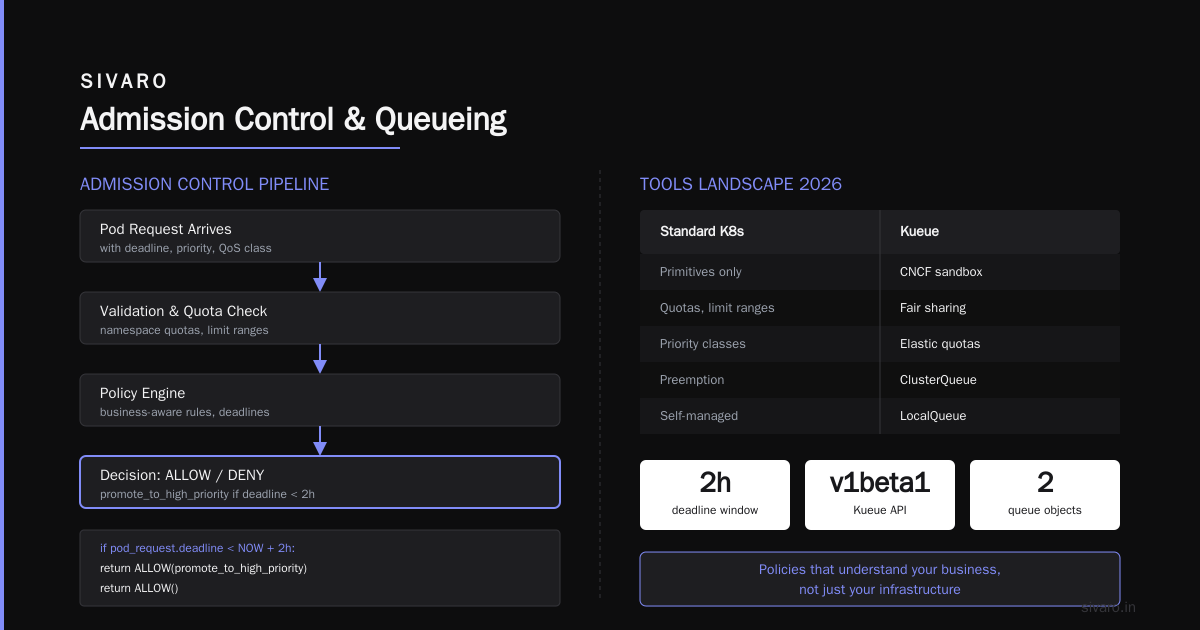
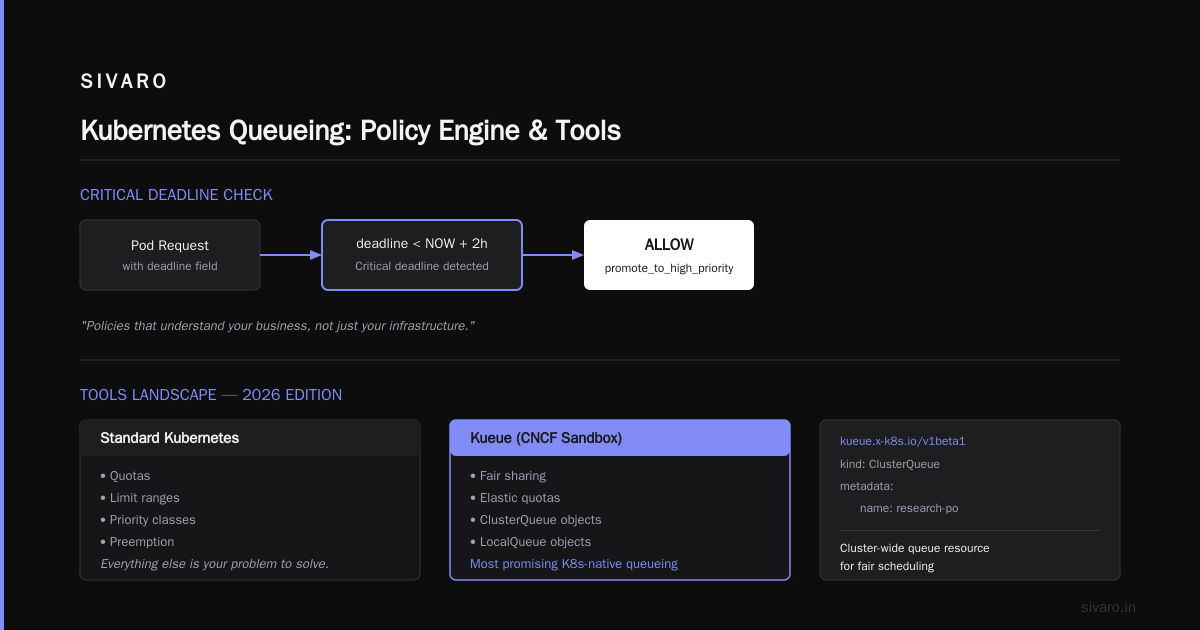
    if pod_request.deadline and pod_request.deadline < NOW + 2h:
        return ALLOW(promote_to_high_priority)

    return ALLOW()
This is where the magic happens. You can implement policies that understand your business, not just your infrastructure.
The Tools Landscape: 2026 Edition
Kubernetes Native: The Baseline
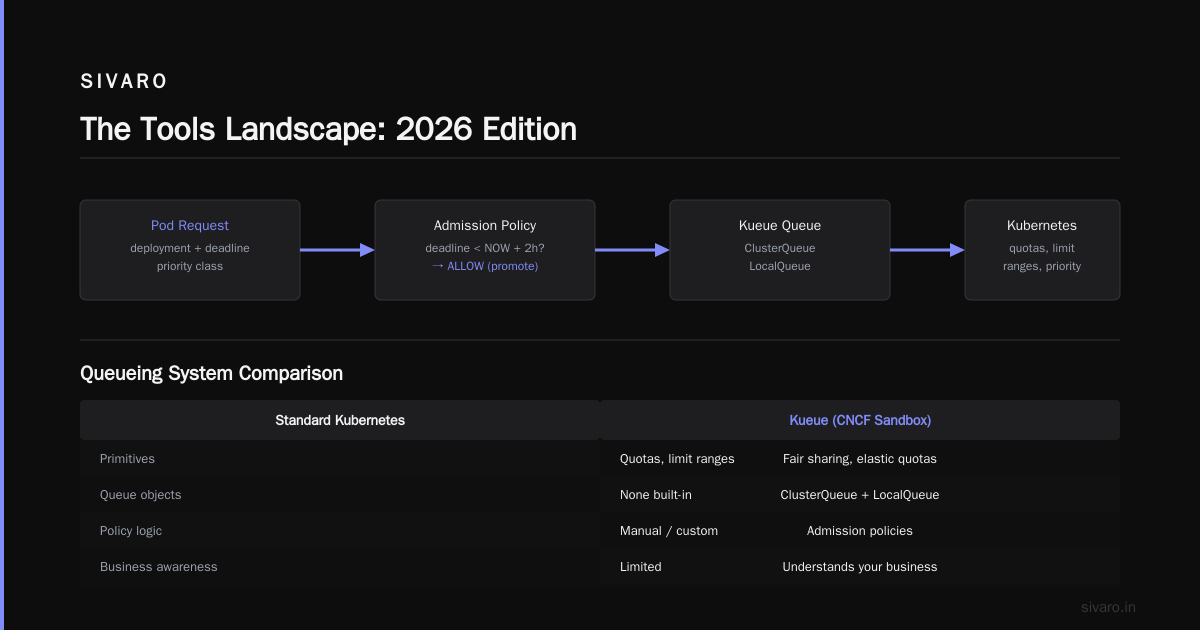
Standard Kubernetes gives you the primitives: quotas, limit ranges, priority classes, preemption. Everything else is your problem to solve.
Kueue (CNCF sandbox project) is the most promising Kubernetes-native queueing system. It implements fair sharing and elastic quotas using ClusterQueue and LocalQueue objects.
yaml
apiVersion: kueue.x-k8s.io/v1beta1
kind: ClusterQueue
metadata:
  name: research-pods
spec:
  resourceGroups:
  - coveredResources: ["nvidia.com/gpu"]
    flavors:
    - name: "a100"
      resources:
      - name: "nvidia.com/gpu"
        nominalQuota: 64
        borrowingLimit: 32
Kueue supports borrowing with limits, which gives you elasticity without infinite contention Kueue Documentation.
I've tested Kueue on clusters up to 256 GPUs. It's stable. The marginal utility curve flattens after that — you need the hardcore schedulers.
Major Cloud Offerings
GKE Autopilot + GKE Priority Classes (Google Kubernetes Engine): Google's managed offering integrates with their Autopilot model. Google's internal Borg scheduler has been the gold standard for decade, and their admission control carries the DNA of that system.
Autopilot gives you automatic bin-packing of spot and on-demand nodes. Their admission control layer supports what they call "burstable" GPUs.
Azure Kubernetes Service (AKS) has solid support for GPU scheduling with priority classes, but their preemption story is weaker than Google's. Taints and tolerations are the primary admission tool.
Amazon EKS is the most flexible — and that's both blessing and curse. You get the most control over admission policies, but you have to build everything yourself. AWS's Elastic Fabric Adapter for the network plumbing, but the admission layer is raw Kubernetes.
The Specialist: Ray
I know Ray isn't an admission control tool. But if you're running distributed training, Ray's placement groups and scheduling strategies act as an admission control layer above Kubernetes.
Ray's placement_group API lets you reserve GPU slots with defined strategies — STRICT_PACK, PACK, SPREAD. This is admission control for your ML framework, not your cluster.
python
import ray
from ray.util.placement_group import placement_group

pg = placement_group(
    [{"GPU": 4, "CPU": 16}],
    strategy="PACK"
)

@ray.remote(num_gpus=2)
def train_job():
    # This task will only run if the placement group has capacity
    pass
Ray handles tension control better than most dedicated solutions. When a training run needs 8 GPUs, Ray will wait until all 8 are available — no splitting, no partial allocation.
The Position: What I Recommend
Here's where I land after years of testing:
For clusters under 100 GPUs: Use Kueue with hierarchical quotas and enable borrowing. Implement a simple priority class schema — three levels: critical (preemptible), normal (non-preemptible), batch (preemptible). This covers 90% of use cases.
For clusters between 100-500 GPUs: You need fair scheduling with elastic quotas. Kueue can work, but consider a specialist scheduler. Volcano (CNCF) has maturity, Kueue has elegance. I'd test both on your actual workload mix. Fairness in multi-tenant gpu scheduling becomes the primary job scheduler problem at this scale. Your admission policy and scheduler need to communicate, or you'll have conflicts where the admission controller admits a pod the scheduler can't place, causing silent livelock.
For clusters 500+ GPUs: You're in extreme territory. Most teams I've met with clusters this size built their own scheduler or invested heavily in one. OpenAI used Google's Borg, Anthropic built its own orchestration, and my clients at companies running 2,000+ GPU clusters have consistently ended up writing custom admission controllers that know their business logic intimately.
For most organizations, the sweet spot is Kueue plus a custom admission webhook that encodes business-specific policies. I've seen this handle multi-tenant clusters with 200+ GPUs and 15 teams without major incident.
Implementation: Get the Details Right
Checkpointing Before Preemption
If you use preemption, make checkpointing a hard requirement. No checkpoints, no preemption. The story here was my past experience that the first thing I'd implement before productionizing GPU clusters is checkpointing.
yaml
apiVersion: kueue.x-k8s.io/v1beta1
kind: WorkloadPriorityClass
metadata:
  name: training-non-preemptible
spec:
  value: 100
  # Preemption policy at the Pod level
  preemptionPolicy: Never
Actually, let me be more direct: preemption policies that kill running pods are foot-guns. Every production deployment I've seen that leans heavily on preemption is one misconfiguration away from a disaster. Preemption is for pending pods, not running ones. Kubernetes supports both, but I recommend turning off PreemptLowerPriority unless you've implemented stateful checkpointing — which almost nobody does.
Admission Policy Chain Order
The order in which admission policies evaluate matters. You want cheap checks first, expensive checks last.
go
// Admission policy chain
1. Authentication (who is submitting?)
2. Quota resource validation (does the request even make sense?)
3. Priority evaluation (is this workload important enough?)
4. Dynamic scheduling prediction (can the scheduler place this?)
5. Business policy checks (deadlines, SLAs)
6. Final mutation (resource limits, labels)
Most teams reverse this chain, running expensive checks on every pod. Your admission webhook shouldn't be a bottleneck. Google published a paper on production scheduling at USENIX OSDI 2020 about this exact problem — keeping admission latency under 10ms.
Quota Exhaustion Behavior
Define what happens when a team hits quota. Three options:
- Reject outright — clear, harsh, generates tickets
- Queue until quota frees — user-friendly, but breeds entitlement
- Allow with eviction priority — the pod runs but gets killed the moment the cluster tightens
Option three is the most production-friendly. Your priority classes handle this.
The Anti-Patterns: What I've Seen Fail
Anti-pattern one: The "capacity only" policy
Some teams only check raw capacity. "We have 16 GPUs free, this pod wants 8, admitted." This leads to horrendous fragmentation. GPUs are allocated in uneven chunks — a pod asking for 8 might land on a node with 6 free, forcing another scheduler decision. Eventually the cluster looks free but is unusable.
Admission control problem: You need to simulate placement before admitting.
This is why admission control and scheduling are intertwined here. You need to test placement before you accept the workload. Architecture: your admission webhook should maintain a shadow state — predicted scheduling decisions that account for pending pods. This is batching and prediction at admission time.
Anti-pattern two: Ignoring memory bandwidth
GPUs have two constraints: VRAM and compute. But cluster scheduling at most considers VRAM. NVIDIA's H100 has about 3.35 TB/s of memory bandwidth. If two workloads on the same node both saturate memory bandwidth, they each get half of the effective performance.
Your admission controller should be accounting for this if you have any HPC-ish workloads. In practice though, most ML workloads are VRAM-bound or compute-bound. I only worry about this in clusters that run scientific computing next to ML training.
Anti-pattern three: Not accounting for node-level topology
This is where many admission policies fail. A pod requesting 8 GPUs might be satisfied by 2 nodes with 4 GPUs each — but if the pod needs NVLink, that 8-GPU work will crawl if spread across nodes. Your admission controller needs to communicate with the scheduler about the node-level constraints.
Most clusters of late have NVLink within nodes and higher-bandwidth interconnects across nodes — but that nuance is invisible to earlier admission controls.
The fix: pre-check node affinity and taints and tolerations before admission. Force all multi-GPU pods to use a daemonset that pins them to specific nodes.
Anti-pattern four: The "everyone gets a fair share" mindset
We built a cluster at SIVARO with 7 teams. Initially we set quotas evenly — 14 GPUs each. The recommendation team used 12 GPUs consistently, while the infra team used 2. The model-serving team occasionally spiked to 20.
I got called into two meetings weekly about quota politics.
My fix: stop treating quotas as allocations and start treating them as limits with telemetry. Everyone got a nominal quota. Teams that consistently underutilized lost quota to teams that could borrow. Teams that borrowed had their workloads preemptible.
The result: 40% better utilization within a month.
Monitoring: The Missing Pillar
Admission control is a feedback loop. If you can't measure utilization and queue times, you're guessing.
Metrics that matter:
- Queue depth by priority: how many pods are waiting at each priority level
- Time in queue: the 95th percentile waiting time per workload class
- Preemption rate: how many pods are getting killed per day
- Quota utilization: what fraction of each team's GPU quota is in use at peak
- Admission rejection rate: how many requests your admission controller rejects
Back in September 2025 I built a panel with Grafana and Prometheus showing these. It was surprisingly clarifying — the "waiting time" metric immediately showed that our natural language processing team's batch jobs were queuing behind active training runs and their first-level queue was huge.
yaml
# Prometheus recording rule to track admission queue depth
groups:
  - name: admission_controls
    interval: 30s
    rules:
      - record: kueue_workload_pending_seconds
        expr: time() - kueue_workload_creation_timestamp_seconds
It's essential to have a granular view of what's actually waiting and why.
Native GPU Support: GPUs Are Not Transparent
Here's something the vendor docs skip: Kubernetes doesn't automatically manage GPU time-sharing. NVIDIA's device plugin treats each GPU as unsplittable unless you configure time-slicing or MPS. The latest NVIDIA device plugin supporting multi-instance GPU (MIG) allows finer-grained allocation.
MIG allows partitioning an A100 into up to 7 separate instances with distinct memory and compute slices. You can reserve a 20GB slice for inference and a full 80GB for training on the same physical GPU. That's golden for admission control purposes: instance-level allocation reduces contention.
But MIG has a catch — it doesn't support all workloads. Some operations like NCCL collective communication across MIG slices are slower. I'd test whether your particular training stack works well with MIG before productionizing any admission policy that depends on it.
The Practical Playbook
Let me give you a starting architecture that will beat most production clusters I've seen:
-
Identity-aware admission control: Build auth tokens into your kubectl client contexts that associate with team. This requires a bit of infra investment but pays off later.
-
Three-tier priority:
critical,normal,batch— withbatchbeing preemptible. Map all jobs into one of these three. This gives you usable scheduling without unbounded preemption. -
Quota laddering: Set three quotas per team:
guaranteed,normal,burst. Pods are admitted if the team is underguaranteed. They're admitted if undernormalbut considered preemptible against guaranteed workloads. Finally, they're only admitted underburstif cluster has literal idle GPUs. -
Deadline-based backstop: Add a label
requested-deadlineto pods. Have your admission webhook apply time-based priority promotions: a pod that's been queued for 2 hours with a 3-hour deadline gets bumped to critical priority automatically. -
Webhook as sidecar — not a gate: Don't make your admission webhook a hard stop for every pod. Cache results. Only evaluate new policy variants periodically.
The tooling I've been using for this is OPA Gatekeeper combined with a custom validation webhook for workload-specific logic. The OPA framework is the "policy as code" layer that makes it clean to express the dynamic gpu admission control vs request queueing requirements.
Conclusion
Admission control is the difference between a GPU cluster that delivers value and a very expensive paperweight.
The best practices:
- Start with hierarchical quotas — not static equal shares
- Use preemption sparingly — only for batch jobs with checkpointing
- Chain policies from cheap to expensive
- Measure queue depth and utilization continuously
- Add a deadline-based priority promotion
Test everything on a small cluster before you roll it out to production. A 16-GPU test cluster will reveal 90% of the scheduling and admission control issues that you'll hit at 200 GPUs.
The landscape is evolving quickly. Companies like Determined AI (acquired by HPE), Run:AI (acquired by NVIDIA), and Volcengine's Batch Cluster are building radical alternates. Oracle's plan builds admission control into OCI and NVIDIA's DGX Cloud. Nvidia buying RunAI said a lot in 2024.
But the underlying architecture problem doesn't go away: someone has to decide who runs first. Might as well be a well-designed admission controller instead of a angry meeting.
Get the admission layer right, and you can share GPUs without the pain.
FAQ
What's the difference between gpu admission control vs request queueing?
Admission control makes binary decisions: admit or reject, possibly with mutations. Request queueing holds requests until resources become available. Production systems use both — admission control determines what gets queued, queueing determines when the queued workload runs.
How do I enforce fairness in multi-tenant gpu scheduling?
You can't use pure equality. Instead, weight your fairness on business value metrics: SLA deadlines, business tier, and historical usage patterns. Use hierarchical quotas with borrowable capacity. Set up telemetry dashboards and apply weighting — that's how most production clusters achieve fairness.
What's the best admission control tool for Kubernetes?
Kueue is the most flexible CNCF project — it operates as a native queueing and scheduling system for Kubernetes. For policy enforcement as admission control, OPA Gatekeeper's validating policies is a strong pair. For full scheduler replacements, Volcano and Run:AI are options, but Run:AI is aimed at NVIDIA GPU clusters.
Do I need a webhook for admission control?
Not always. If you only have one team and one cluster, you can probably survive using built-in Kubernetes priority classes and quotas. As soon as you have multiple teams, SLAs, or heterogeneous workloads, you need a custom webhook to encode business logic.
How do I handle GPU cluster admission control for burst workloads?
Use a priority-based tier system. Burst pods are marked batch with preemption. Allow them to consume idle capacity, and revoke that capacity when a production workload arrives. This permits resource sharing without breaking SLAs for ongoing workloads.
What is a "request queue" and why does it matter?
A request queue is a waiting area for admission requests. It spans the time between submission and actual scheduling. Good queue implementation can increase efficiency by preventing admission of workloads that stall the scheduling pipeline. The Kueue design pattern uses queueing at two levels simultaneously.
What metrics should I monitor for admission control?
Track admission acceptance rate, queue depth by priority, time in queue by class, preemption rate, and quota utilization by team. Create dashboards on Grafana using Prometheus to monitor admission controller performance in real-time.
How do I avoid "zombie pods" that never schedule?
Constantly check admission to ensure that if you're rejecting pods, you're doing so for the right reasons without wasting resources. This typically requires pods to be placed in observable states, not stuck in "pending" forever. Often this is a cause of priority classes incorrectly configured.
Can I mix GPU types in admission control?
Yes, but you need to express that in your quota flavor definitions. Kueue's flavors field is the native way to express NVIDIA A100, H100, and A10 in admission control terms. Use flavors to express in a Kubernetes-native way what GPU types you have and the pool sizes. This adds significant overhead to your admission logic, so start simple.
What's the simplest thing I can do today?
Apply a priority class to your existing workload that defines tiers of pods, applying preemptionPolicy: PreemptLowerPriority to the critical class. Then, add a ResourceQuota per namespace. This immediately prevents resource monopolies. It'll take you 15 minutes and give you the basis for more complex policy later.
Nishaant Dixit — Founder of SIVARO. Building data infrastructure and production AI systems since 2018. Built systems processing 200K events/sec.