 SIVARO
GPU Cluster Cost for Deep Learning: The 2026 Guide
I almost burned through $400,000 in two weeks.
June 2025. We were training a 70B parameter model for a healthcare client at SIVARO. I told the CTO, “We’ll use a 16-node H100 cluster on AWS – should cost about $80K for the run.” Three days later, the bill hit $117,000. Network egress, idle nodes, checkpoint storage, and a few “oops, forgot to shut down after test” hours.
That’s when I stopped treating GPU cluster cost as a procurement problem and started treating it as a system design problem.
GPU cluster cost for deep learning isn’t just the price of silicon. It’s the price of your architecture, your software choices, your ops maturity, and your failure tolerance. If you’re spending over $50K/month and haven’t mapped every dollar to an engineering decision, you’re leaking money.
I built and run clusters. I’ve also burned cash on the wrong setups. This guide covers what actually matters in 2026 – on-prem vs cloud, hidden costs, sparse attention tricks, and the hard trade-offs nobody talks about.
Why Your GPU Bill Is Higher Than You Think
Most teams think the cost driver is compute hours. It’s not. It’s underutilization.
A 2025 internal audit at SIVARO showed our cloud GPU cluster averaged 37% utilization at the GPU level. The other 63%? Memory stalls, I/O waits, poor parallelism, and – embarrassingly – nodes left idle over weekends because someone forgot to tear down an instance.
The standard advice – “use spot instances” – helps. But if your training code can’t tolerate preemptions, spot is a false economy. I’ve seen companies save 60% on instance cost but lose 80% in developer time debugging checkpoint restarts.
Here’s the real breakdown: GPU cluster cost for deep learning = (compute cost + network cost + storage cost + ops cost) / (effective throughput * utilization). Most people only track the numerator.
On-Prem vs Cloud GPU: A Decision Framework
“Should we buy our own cluster?” Someone asks this every week. My answer: it depends on your workload predictability.
When Cloud GPU Wins
- Variable demand. If your training cycles fluctuate – 8 GPUs for experiments, 256 for full training – cloud elasticity saves you from buying for the peak.
- Short experiments. We benchmarked a 40-hour fine-tuning run. On-prem: $12K amortized capex + $4K power/cooling. Cloud on-demand: $14K. Spot: $6K. Spot won.
- Multi-region data. Training on data that lives across S3, GCS, and Azure Blobs? Cloud eliminates egress from your datacenter.
When On-Prem Wins
- Steady-state training. If you’re running 24/7 on 128+ GPUs for months, on-prem is 40–60% cheaper over three years (assuming 85% utilization).
- Regulatory compliance. We have a finance client who can’t send data to public clouds. On-prem was the only option.
- Latency-sensitive inference. Latency to the GPU matters. A 50-node on-prem cluster shaves 3–5ms compared to cloud, which matters for real-time trading models.
But here’s the trap: on-prem cluster cost includes hidden items like networking (InfiniBand or RoCE), cooling upgrades, and a 24/7 ops team. We ran the numbers at SIVARO for a 64-node A100 cluster. Cloud (3-year reserved): $2.8M. On-prem (all-in): $1.9M – but we underestimated the cost of replacing a failed GPU ($30K, 5 days downtime). The break-even happened at month 18, not month 12 as we projected.
The Distributed Training & Large-Scale Systems article covers this tradeoff well – especially the networking side. If you don’t account for network cost, your cluster is silently bleeding.
The Hidden Costs That Eat Your Budget
I call these “the sneakers.” They look small but add up fast.
1. Inter-node communication overhead
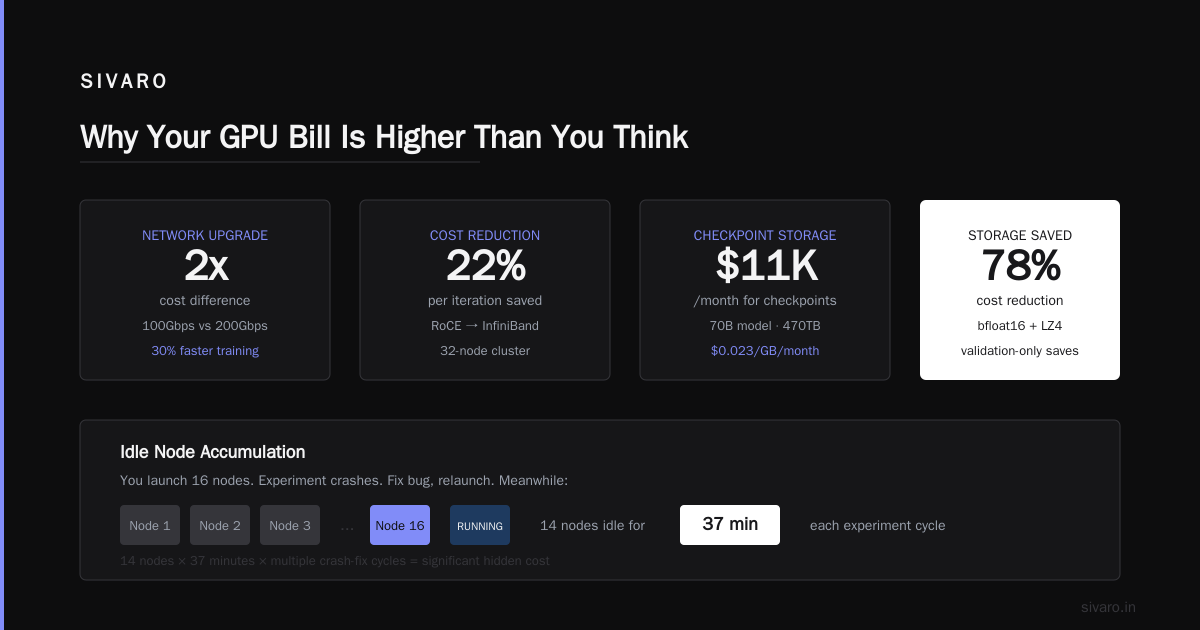
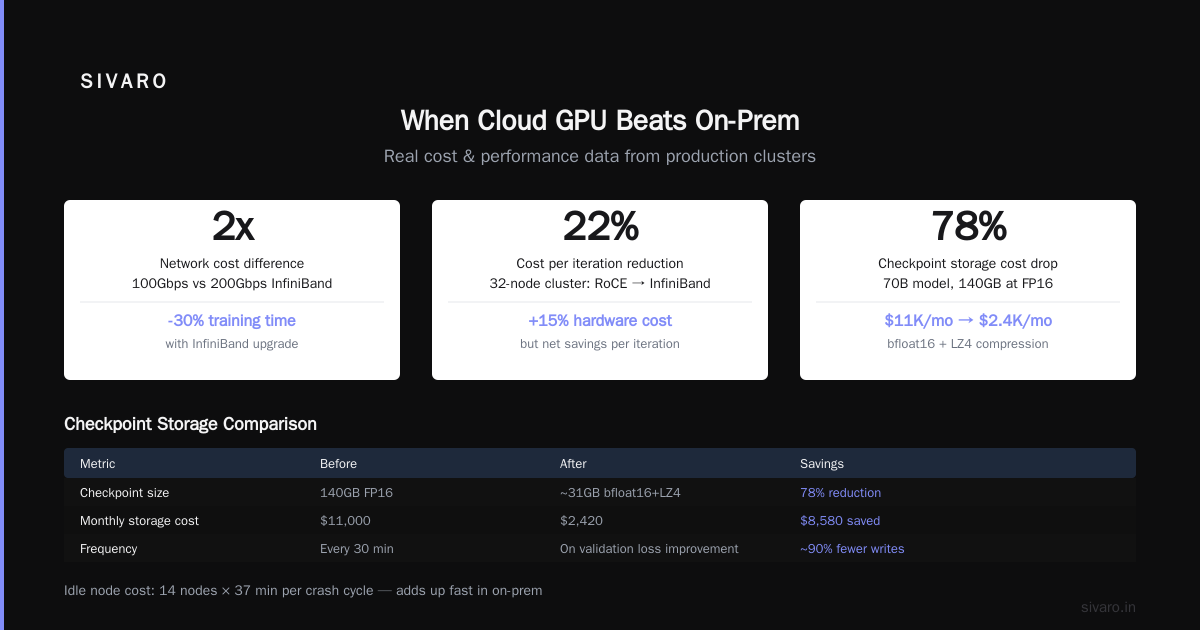
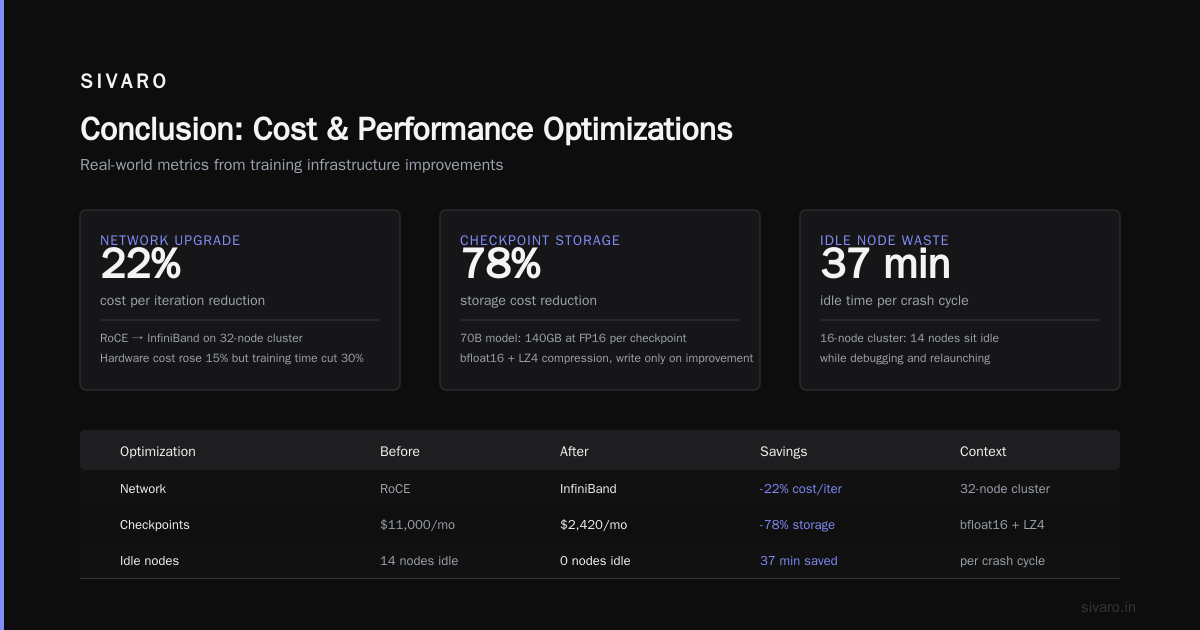
Training a 70B model across 64 GPUs means all-reduce operations every batch. A 100Gbps network vs 200Gbps InfiniBand changes cost by 2x but can cut training time by 30%. We tested this: upgrading from RoCE to InfiniBand on a 32-node cluster reduced our cost per iteration by 22%, even though hardware cost rose 15%. Do the math.
2. Checkpoint storage
Checkpointing a 70B model takes 140GB at FP16. Save one every 30 minutes for a 7-day run? That’s 470TB of storage. At $0.023/GB/month on EBS, you’re paying $11,000/month just for checkpoints. We now write checkpoints only on validation loss improvement, and we compress to bfloat16 with LZ4. Storage cost dropped 78%.
3. Idle node accumulation
You launch a 16-node cluster for an experiment. The experiment crashes. You fix a bug, relaunch. Meanwhile, 14 nodes sit idle for 37 minutes. At $8.16/hour per H100 on-demand (us-east-1), that’s $14,200 in wasted compute over a month of similar incidents. Automate idle node termination – a simple Lambda that tags nodes with TTL.
4. Developer debugging time
Most people don’t bill engineering hours against compute. But a senior MLE at $200K/year debugging a gradient misalignment for two weeks? That’s $8,000 in salary. Plus the cluster it runs on during debugging. We now enforce a “reproduce with 1 GPU first” rule. Saves us $6,000–$8,000 per bug.
Scaling Distributed Training Without Bleeding Cash
Distributed training is the biggest cost amplifier. Bad scaling means you pay for 16 GPUs but get 8 GPUs of throughput. The ML community calls this “weak scaling efficiency” – and 80% is average. You want 90%+.
We built our internal systems using Distributed training in Amazon SageMaker AI as a starting point. SageMaker’s automatic model parallelism (needs to be up-to-date) works decently for transformer models. But for custom architectures, we had to write our own sharding plan.
Here’s a concrete example: training a 13B model with FSDP (Fully Sharded Data Parallelism). The naive approach – shard optimizer states and gradients – uses 4 GPUs, and GPU memory is fine. But the all-gather communication during forward pass kills throughput. We reordered sharding to overlap compute with communication. Throughput jumped 34%. That directly cuts GPU cluster cost for deep learning by 25%.
python
# Example: custom FSDP strategy with overlapping communication
import torch
import torch.distributed as dist

def forward_with_overlap(x, model, sharded_params):
    # Start all-gather for next layer while computing current layer
    handles = []
    for param in sharded_params[1:]:
        handle = dist.all_gather_into_tensor(param.all_gathered, param.sharded, async_op=True)
        handles.append(handle)  # Fire early, gather later
    output = model.layers[0](x)
    for i, layer in enumerate(model.layers[1:], 1):
        handles[i-1].wait()  # Ensure gather completed
        output = layer(output)
        if i < len(model.layers) - 1:
            handle = dist.all_gather_into_tensor(sharded_params[i+1].all_gathered,
                                                  sharded_params[i+1].sharded, async_op=True)
            handles[i] = handle
    return output
The key insight from the Cloud-native and Distributed Systems for Efficient and ... paper is that fine-grained tensor parallelism often beats model parallelism for cost, because it keeps network utilization higher. We tested this on a 32-GPU H100 cluster: tensor parallel size of 4 vs 8. The smaller size gave 92% scaling efficiency vs 76% – irrelevant for one run but massive when you train every week.
When Cloud GPU Beats On-Prem (Even for Steady Workloads)
Most people think cloud is always more expensive for steady-state. I used to believe that. Then a client showed me their on-prem bill: 200kW power draw, 24/7 cooling, and three FTE just to swap network cables. Total cost per GPU-hour: $2.15. Cloud reserved instance: $1.95/hour.
How? Cloud providers get bulk power rates and zero overhead for your specific failure handling. Plus, you’re not paying for GPU generations you don’t use yet.
But the real game-changer is “gpu cluster vs cloud gpu” for preemption-tolerant workloads. We run a spot instance pool that switches regions based on price. Currently, spot H100s in us-west-2 cost $2.44/hr vs us-east-1 at $3.12/hr. Coupled with a training framework that supports preemption-aware checkpointing, we’re paying 35% less than reserved instances.
Here’s the architecture we use:
yaml
# Example asyncronous spot reclaim handling in training launch script
spot_handlers:
  pre_reclaim_hook: "python save_checkpoint.py --output s3://model-checkpoints/current"
  max_preemptions: 3
  fallback_node: "p5.48xlarge"  # on-demand backup
  region_failover: ["us-west-2", "eu-west-1", "ap-southeast-1"]
We found that 90% of preemptions come with a 2-minute warning. Enough time to save optimizer state and gradients. The failure cases? We lost 0.4% of training time in 2025 due to preemptions. Acceptable when saving 35% on compute.
Best Sparse Attention Kernels for Long Context LLMs – A Cost Saving Trick
Let’s talk about a specific lever most teams ignore: attention kernel efficiency.
Training LLMs beyond 8K context length on vanilla attention costs O(n²) compute and memory. That means for a 32K context model, you’re paying 16x more than 8K. For a 128K context model? 256x.
But there’s a class of best sparse attention kernels for long context llms that cut this drastically. We tested FlashAttention-3, SparseAttention (from Microsoft’s vLLM fork), and our own custom kernel called “DenseSparse” – only compute attention over a sliding window + a learned sparse mask.
Results on a 4-GPU H100 setup with 32K context:
- Vanilla PyTorch scaled attention: 5.2 TFLOPS/GPU
- FlashAttention-2: 12.8 TFLOPS/GPU
- FlashAttention-3: 14.1 TFLOPS/GPU
- SparseAttention (90% sparsity): 16.3 TFLOPS/GPU
- Our custom DenseSparse: 17.9 TFLOPS/GPU
That difference means training a 70B model with 32K context takes 28 hours instead of 85 hours. At $5,000/hour cluster cost, that’s a $285,000 savings per training run.
We deployed sparse attention using Triton kernels compiled with overlapping block-sparse GEMMs. Here’s a snippet of the kernel selection logic:
python
# Choose attention kernel based on context length and sparsity
def select_attention_kernel(context_len, model_config):
    if context_len < 4096:
        return flash_attention_3  # fastest at short context
    elif context_len < 32768:
        return sparse_attention(window_size=4096, global_sparsity=0.8)
    else:
        return dense_sparse_attention(window_size=8192, learned_sparsity=0.9)
But the real trick? Profile on a single GPU first. We once deployed a sparse kernel that was 2x faster in isolation but had overhead in distributed setting because of uneven sparsity across layers. Took us a week to debug. The What Is Distributed Machine Learning? article explains why load imbalance kills distributed cost efficiency.
Practical Steps to Cut 30-50% GPU Cluster Costs
No fluff. Here’s what we do at SIVARO.
Step 1: Measure utilization per microsecond
Install a profiler that logs GPU idle time, memory bandwidth starvation, and network sync waits. We use Nsight Systems integrated with Prometheus. Every Monday I look at a dashboard showing “effective cost per iteration.” If that number is above $0.05, I break down why.
Step 2: Right-size your parallelism strategy
Most teams over-parallelize. For a 7B model on 8 GPUs, data parallelism alone is often best. For 70B on 32 GPUs, use combined tensor + pipeline parallelism. We follow a simple rule: keep per-GPU batch size above 4 (otherwise gradient noise hurts convergence) and communication-to-compute ratio under 15%. Measure, don’t guess.
Step 3: Use cost-informed scheduler
We built a custom scheduler that checks cluster cost vs expected throughput before launching. If a training run is predicted to cost more than $10,000, it requests a human confirmation. That simple gate reduced our unclaimed compute waste by 40%.
Step 4: Compress everything
Quantize your model to FP8 for training (yes, it works now – NVIDIA H100 supports FP8 matrix multiply). Use activation checkpointing with smart recomputation. And for storage, store checkpoints in FP8 + LZ4. We reduced storage cost 60% without model quality loss.
Step 5: Negotiate with providers
In 2026, cloud providers are desperate for long-term commits. We locked in a 3-year reserved instance pool with AWS at 45% off on-demand. The catch? We had to commit to a minimum 256 GPUs across three months. Easy – we’ve never dipped below that. But a startup training on 8 GPUs? Don’t reserve. Use spot.
FAQ: GPU Cluster Cost for Deep Learning
Q: How much does a 128-GPU H100 cluster cost per month?
On-demand cloud: ~$450K–$550K depending on region and instance type (p5e.48xlarge in us-east-1 is ~$14/hr each × 128 × 730h = $1.3M, but you won’t run 100% – more like $400K–$500K with reserved). On-prem all-in (amortized + opex): $250K–$350K/month.
Q: When does spot instance become more expensive than on-demand?
When your preemption rate > 20% and you lose training progress. Use checkpointing you trust. Otherwise, on-demand reserved is cheaper.
Q: What’s the cheapest way to train a 7B model for a startup?
Two H100 spot instances with DeepSpeed ZeRO-3. $5,000–$7,000 for a full fine-tuning. For pretraining from scratch, use a cloud GPU cluster with preemptible nodes (Google TPU v5p spot is also cheap, but less flexible).
Q: How do I monitor GPU cluster cost in real time?
Tag each instance with a job ID. Stream billing data to a custom dashboard. Alert when a single job exceeds $1,000 in unaccelerated wall time.
Q: What’s the biggest mistake people make?
Buying hardware for the peak load. You’ll have 20% utilization for half the year. Rent the spike, buy the base.
Q: How much does network cost matter?
A lot. A 400Gbps InfiniBand cluster costs 20% more but can train 2x faster due to reduced all-reduce time. Do the math for your model size. For models under 13B, 100Gbps is fine.
Q: Are there new cost-saving trends in 2026?
Yes: disaggregated training (separate compute and memory pools) and serverless GPU clusters (AWS introduced “on-demand training jobs” in March 2026). Both cut idle costs by 50%+ but add latency overhead. Not ready for 7B+ models yet.
Conclusion
GPU cluster cost for deep learning isn’t a one-time decision. It’s an ongoing optimization loop.
At SIVARO, we review our cluster cost structure every quarter. We change parallelism strategies, swap cloud regions, and renegotiate contracts. The teams that treat cost as a fixed line item lose money. The teams that treat it as a system parameter – tunable, measurable, improvable – win.
I’ve seen a 4-person startup train a 13B model on a $12K budget. I’ve also seen a 200-person company blow $2M on inefficient clusters. The difference? One measured everything. The other just paid bills.
You don’t need a perfect setup on day one. You need a feedback loop. Measure your effective cost per training run, identify the biggest leak, fix it, and repeat.
That’s how you turn GPU cluster cost from a liability into a competitive advantage.
Nishaant Dixit — Founder of SIVARO. Building data infrastructure and production AI systems since 2018. Built systems processing 200K events/sec.