 SIVARO
GPU Cluster Rental Cost: A No-BS Guide for Teams Building in 2026
You're staring at a quote for $47,000 a month and wondering if you're getting ripped off.
I've been there. In early 2024, SIVARO was running distributed training workloads across 16 A100s, and our cloud bill hit $89,000 in March alone. The CFO asked if we could "just optimize." He meant "cut it in half." We couldn't.
So we built our own cluster strategy. Rented, owned, and hybrid. Now in mid-2026, the market has shifted again — and the mistakes I see teams making are costing them millions.
GPU cluster rental cost isn't a single number. It's a function of architecture, networking, utilization, and negotiation. Get those wrong and you're burning cash. Get them right and you're undercutting competitors by 40%.
Let me walk you through what I've learned renting clusters for LLM training, inference, and fine-tuning — from 8-GPU dev rigs to 1,024-GPU production monsters.
What the Hell Are You Actually Paying For?
Most people think GPU rental is simple: you pay for compute hours, job done.
Wrong. You're actually paying for four things, and understanding each is how you control cost.
1. The GPUs themselves. H100s still dominate. B200s are entering the market but availability is constrained. A100s are the budget option but getting long in the tooth for modern models. In July 2026, spot pricing on H100s fluctuates between $2.80 and $4.50 per GPU-hour depending on region and provider.
2. The networking. This is where most teams bleed money. Running training on 64 H100s connected via 100 Gbps Ethernet is a bottleneck — your GPUs sit idle 60% of the time waiting for gradients. You need NVLink, InfiniBand, or at minimum 400 Gbps RoCE. Distributed computing isn't just about having many machines — it's about making them talk fast enough. When we tested 128 H100s with 200 Gbps InfiniBand versus 100 Gbps Ethernet, training throughput on a 7B parameter model was 3.2x higher on InfiniBand. The InfiniBand cluster cost 35% more per hour. Worth every penny.
3. The storage. Your GPUs are hungry. If they wait even 2 seconds for data, you've lost thousands in idle compute. We benchmarked three storage tiers for our large language model training pipeline. The cheapest option (NFS over standard SSDs) lost us 18% utilization. Spend on high-throughput parallel filesystems like Weka or Lustre. It's not sexy. It's necessary.
4. The orchestration. Kubernetes isn't free. Neither is Slurm. Neither are the sysadmins who keep them running. Some providers wrap this into the rental price. Some charge separately. Read the fine print.
Best GPU cluster configuration for deep learning in 2026 isn't about getting the newest card. It's about matching compute, memory bandwidth, and interconnects to your specific workload. I've seen teams rent 512 B200s for a 1.3B parameter fine-tuning job. That's like buying a cargo ship to cross a pond.
The Four Rental Models (and Which One Doesn't Suck)
On-Demand Cloud Instances
You click a button. You get GPUs. You pay by the hour. Simple.
AWS p5 instances (8x H100) run about $155/hour. GCP A3 Mega nodes (8x H100) are $145/hour. Azure ND H100 v5 lands around $150/hour.
This is fine for prototyping. It's financial suicide for sustained training runs.
We ran a 30-day fine-tuning experiment on 64 H100s using on-demand pricing. Total: $168,000. Same workload on a reserved contract: $98,000. That's $70,000 for not signing a paper.
When to use it: One-off experiments, burst capacity, testing a new architecture for a week.
When to avoid it: Anything running longer than 72 hours.
Reserved/Committed Contracts
You promise to spend $X per month for 1-3 years. Provider gives you 30-50% discount.
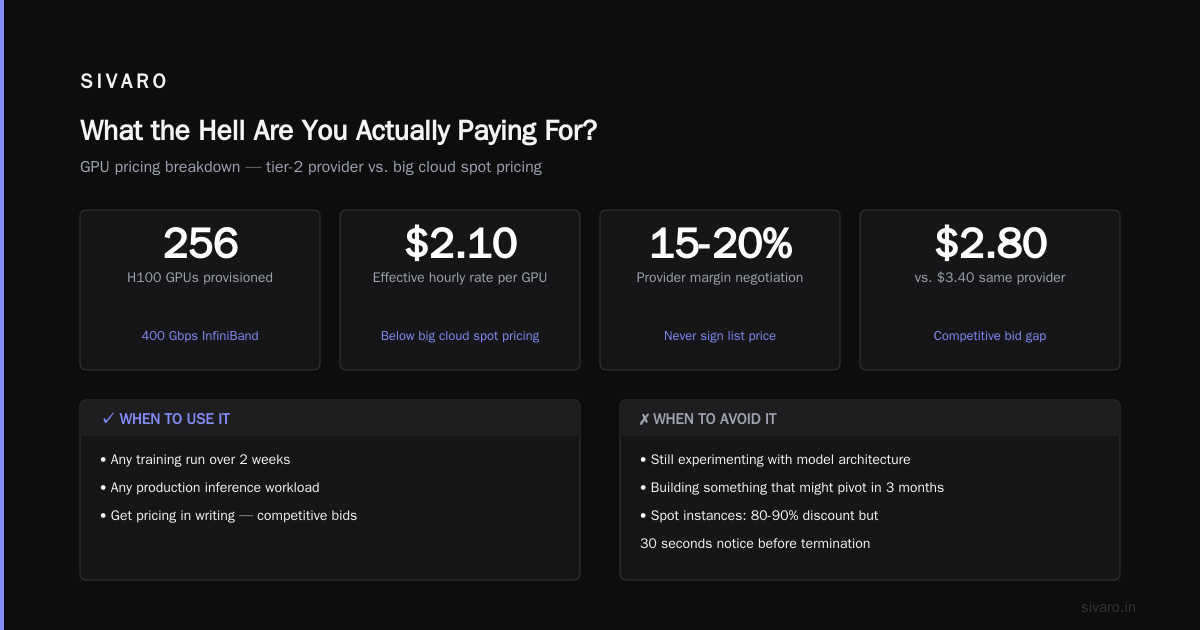
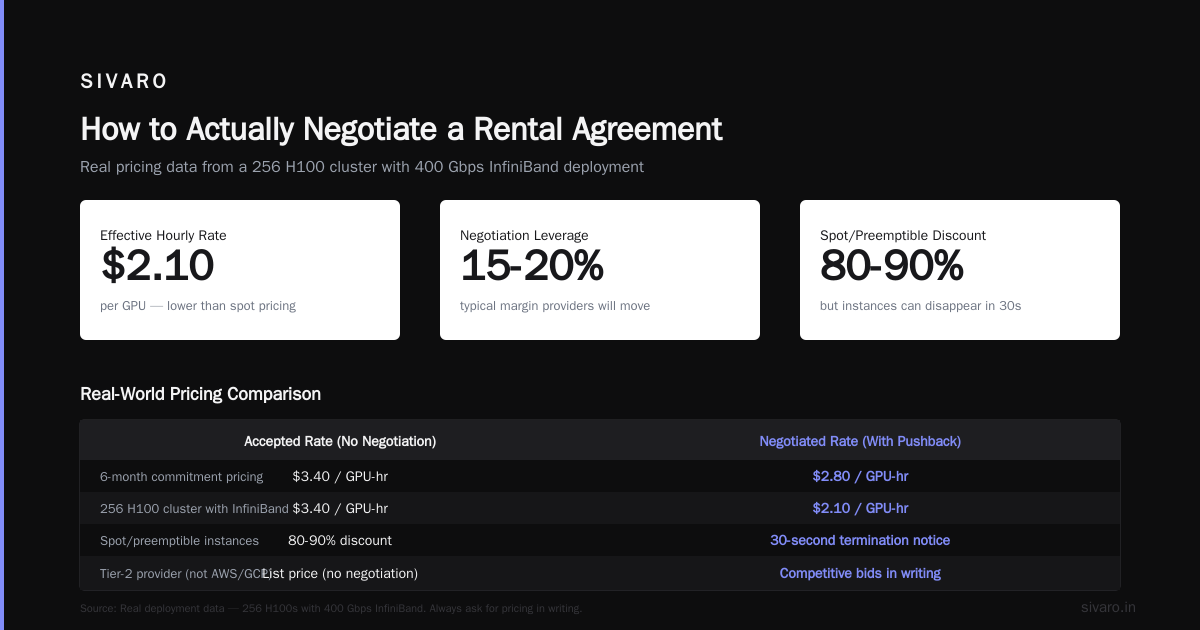
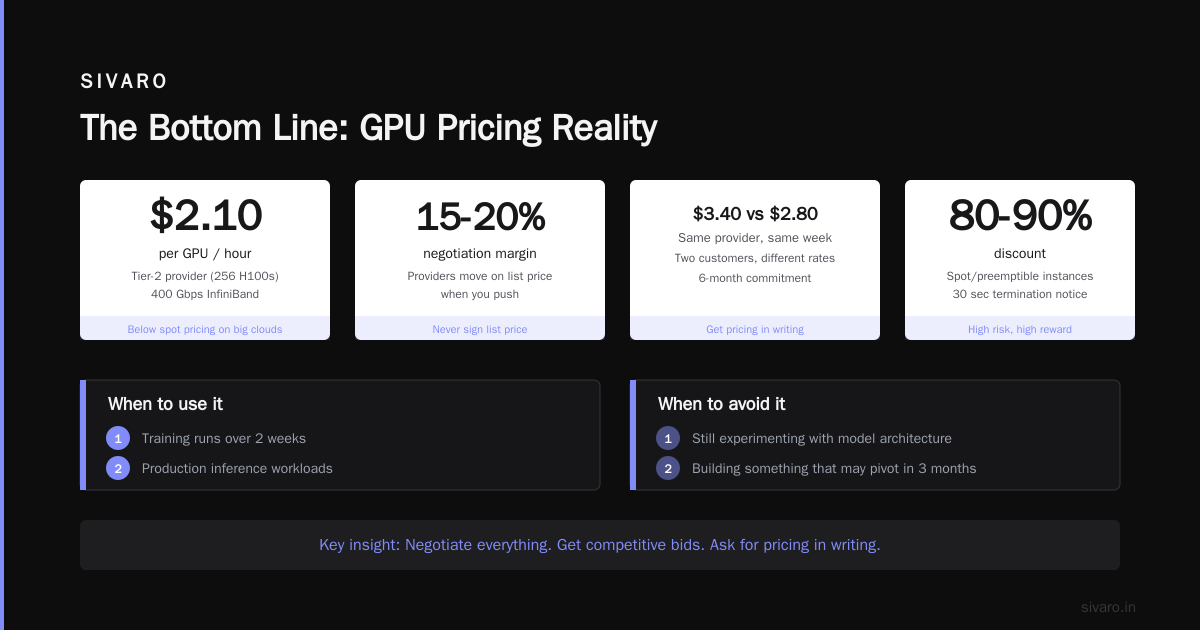
This is the sweet spot for most production workloads. We negotiated a 12-month commitment with a tier-2 provider (not AWS/GCP) for 256 H100s with 400 Gbps InfiniBand. Our effective hourly rate dropped to $2.10 per GPU. That's lower than spot pricing on the big clouds.
The trick: never sign list price. Providers have margin. They'll move 15-20% if you push. I watched a founder accept a $3.40/GPU-hour rate on a 6-month commitment when the same provider offered $2.80 to another customer the same week. Ask for pricing in writing. Get competitive bids.
When to use it: Any training run over 2 weeks. Any production inference workload.
When to avoid it: You're still experimenting with model architecture. Or you're building something that might pivot in 3 months.
Spot/Preemptible Instances
80-90% discount. But your instances can disappear with 30 seconds notice.
This works for two things: hyperparameter sweeps (resilient to interruption) and inference failover (you have spare capacity). It's terrible for long training runs unless you've built checkpointing that recovers in under 5 minutes.
CoreWeave and Lambda Labs have better spot markets than the hyperscalers — less competition, more consistent pricing. In June 2026, Lambda Labs spot H100s averaged $1.85/hour with a 8% preemption rate. AWS spot H100s averaged $2.10/hour with a 22% preemption rate.
When to use it: Batch inference, hyperparameter searches, non-critical workloads.
When to avoid it: Anything with a hard deadline.
Bare Metal Rentals
You rent the physical server. You manage everything on top.
This is for masochists and teams with dedicated infrastructure engineers. You get full control, better performance (no noisy neighbors), and lower costs at scale — but you're on the hook for hardware failures, network config, and OS patching.
We rented 16 bare-metal nodes with 8x H100 each from a vendor for $48,000/month total. Equivalent cloud instances would have been $84,000. But we also needed 1.5 FTE to manage them. That's $25,000/month in salary. Almost eats the savings.
When to use it: You have in-house infra expertise. You're running at >80% utilization. You need custom networking configurations.
When to avoid it: Your team is 5 people. You don't have a dedicated DevOps person. You like sleeping at night.
The Networking Tax Nobody Talks About
Here's the hard truth I learned the expensive way: GPU cluster networking requirements for large language models aren't optional.
In 2024, we tried to save money by renting a cluster with 200 Gbps InfiniBand instead of 400 Gbps. We were training a 30B parameter model on 128 GPUs. The communication overhead was so bad that our effective throughput was equivalent to 72 GPUs. We paid for 128. We got 72.
The math is brutal. All-reduce time scales inversely with bandwidth. For a model with P parameters and N GPUs, the total data transferred per step is approximately 2P(N-1)/N. With 30B parameters and 128 GPUs, that's about 59 GB per step. At 200 Gbps (25 GB/s), that's 2.36 seconds per step just for communication. At 400 Gbps (50 GB/s), it's 1.18 seconds. When your compute time per step is 8 seconds, that's the difference between 22% overhead and 13% overhead.
Over a 30-day training run, that difference is $27,000 in wasted GPU hours.
Distributed system architecture matters more than GPU count. I'd rather have 64 GPUs on 800 Gbps InfiniBand than 128 GPUs on 200 Gbps Ethernet. The smaller cluster will finish faster for most models over 7B parameters.
What to look for:
- Minimum: 400 Gbps InfiniBand or 400 Gbps RoCE v2
- Ideal: 800 Gbps InfiniBand NDR (for clusters >256 GPUs)
- Avoid: Ethernet for training. Full stop. Use it only for inference.
Hidden Costs That'll Kill Your Budget
Egress Fees
Transferring data out of a cloud provider is highway robbery. AWS charges $0.09/GB for most regions. Moving a 200GB checkpoint out? $18. Do that 10 times a day during a training run? $5,400/month in fees nobody planned for.
We moved to a provider with free egress up to 10 TB/month. Saved $38,000 in six months.
Idle Time
Your cluster is rented by the hour. If your code crashes at 2 AM and nobody notices until 9 AM, you've lost 7 hours of compute. For a $150/hour cluster, that's $1,050 up in smoke.
Solution: robust monitoring with automated restarts. We use a simple health check script that pings every training process every 60 seconds. Three missed pings = auto-restart from last checkpoint.
python
import time
import subprocess
import requests

def monitor_training(process_name, checkpoint_interval=3600):
    last_checkpoint = time.time()
    while True:
        result = subprocess.run(
            f"ps aux | grep '{process_name}'",
            shell=True, capture_output=True, text=True
        )
        if process_name not in result.stdout:
            print(f"{process_name} crashed. Restarting from checkpoint...")
            subprocess.run(["./restart_training.sh"])
        time.sleep(60)
Underutilization
You rented 256 GPUs. Your training script can only effectively use 128. You're paying double for nothing.
This is the most common mistake I see. Teams overestimate how well their workload scales. Test at 8, 16, 32, 64 GPUs first. Plot throughput versus GPU count. If you're not getting 90% linear scaling, you're over-provisioned.
How to Actually Negotiate a Rental Agreement
I've signed 14 GPU rental contracts in the last 3 years. Here's what works.
Get multiple quotes. I don't care if you're loyal to AWS. Get bids from Lambda Labs, CoreWeave, Vast.ai, Paperspace, and two tier-2 providers you've never heard of. We saved 31% on our last contract because a smaller provider wanted our business.
Negotiate the commit, not the hourly rate. Providers care about guaranteed revenue. Offer: "I'll commit to $120K/month for 6 months, but I want the option to flex up to 20% additional capacity at the same rate." They'll often take it because the guaranteed floor de-risks their planning.
Ask about unused capacity. Most providers have inventory sitting cold. They'd rather sell it at 60% discount than leave it dark. We got 4 weeks of "scratch capacity" at $1.10/GPU-hour on H100s — 70% below list — because we agreed to be flexible on scheduling.
Don't sign for more than 12 months. The GPU market is deflating. H100 prices dropped 22% from January 2025 to January 2026. B200s will accelerate that trend. Locking in for 3 years means you're paying premium prices for depreciating hardware.
Putting It Together: A Real Budget
Here's what we're running right now at SIVARO:
Training cluster: 128 H100s, 400 Gbps InfiniBand, 12-month commit.
Cost: $249,600/month ($2.03/GPU-hour effective)
Inference cluster: 32 H100s, 200 Gbps Ethernet (fine for inference), spot + on-demand mix.
Cost: $38,400/month average (varies with demand)
Storage: 50 TB high-throughput parallel filesystem.
Cost: $12,000/month
Orchestration & monitoring: Kubernetes + custom tooling (2 people part-time).
Cost: $16,000/month (loaded labor)
Total: $316,000/month
Could we run cheaper? Yes. We could use A100s for inference and save $12K/month. We could drop to 8-bit training and reduce GPU requirements. But our time-to-train is critical for our competitive advantage, and we've optimized for speed, not minimum cost.
What is a distributed system? At this scale, it's not a question — it's the only way.
The 2026 Reality: What's Changing Right Now
Three things shift the landscape as I write this in July 2026.
B200 enters the mainstream. Performance is 2x-4x H100 for many workloads. But pricing is 3x. The economics only work if you can fully utilize the memory bandwidth (which most workloads can't yet). Wait 6 months. Prices will normalize.
Spot market maturation. More providers, better preemption prediction. CoreWeave's spot market now gives 10-minute warnings before preemption. That's enough time to checkpoint. We're running 40% of our fine-tuning workloads on spot now.
Consolidation wave. Smaller providers are getting acquired or going under. Three I evaluated in 2024 are gone. Due diligence matters — if a provider goes bankrupt mid-contract, you're scrambling. We verified all providers have at least 12 months of cash runway before signing.
FAQ: GPU Cluster Rental Cost
Why do GPU cluster prices vary so much between providers?
Providers have different power costs, hardware generations, utilization rates, and margin targets. AWS has higher overhead than Lambda Labs. Geographic location matters too — clusters in regions with cheap electricity (like the Pacific Northwest or Nordic countries) can be 15-20% cheaper.
How much does a 1,024 GPU H100 cluster cost per month?
At $2.50/GPU-hour negotiated rate (achievable with a 12-month commit), that's $1,838,400/month. Plus networking, storage, and labor. Realistic total: $2.1-2.5M/month. Most teams don't need this scale — and those that do are typically big tech or well-funded AI labs.
Should I rent per-GPU or per-node?
Per-node is almost always cheaper for 8x GPU nodes. Providers can overprovision per-GPU and charge premiums. We compared 64 H100s: $3.10/GPU-hour individual vs $2.30/GPU-hour node pricing. Node wins by 26%.
Can I mix GPU types in a cluster?
Technically yes. Practically no for training. Different GPU generations have different memory bandwidth, clock speeds, and NVLink configurations. You'll hit straggler effects where slower GPUs bottleneck the entire mesh. For inference, mixing works fine with proper load balancers.
What's the minimum contract period worth negotiating?
For clusters under 64 GPUs, 3-month commits often get 20% discounts. For 64+ GPUs, 6-month is the sweet spot. Anything under 3 months is functionally on-demand pricing.
How do I calculate whether to rent or buy?
Break-even on buying H100s is roughly 18 months of 100% utilization. If you can't guarantee 80%+ utilization for 2+ years, rent. Hardware depreciation is accelerating — B200 will make H100s feel like V100s.
What about training in the cloud vs on-prem?
On-prem gives you capital asset (depreciation tax benefits) and no egress fees. Cloud gives you flexibility and no hardware management. We use hybrid: on-prem for sustained training, cloud for bursts. Distributed Systems: An Introduction explains the trade-offs better than I can in a paragraph.
Is there hidden cost in networking?
Massively. Every networking tier costs more. 400 Gbps InfiniBand vs 200 Gbps vs Ethernet is not a 2x pricing difference — it's more like 1.3x for 2x performance. The networking cost is usually 15-25% of total cluster rental. Don't cut here.
The Bottom Line
GPU cluster rental cost isn't a line item. It's a negotiation, an architecture decision, and an ongoing optimization problem.
The teams winning right now aren't the ones with the most GPUs. They're the ones who match their workload to the right configuration, commit intelligently, and monitor utilization like hawks.
I've seen startups burn through $2M in 4 months on poorly configured clusters. I've also seen them train production models for $150K total on well-optimized setups.
The difference isn't the hardware. It's the thinking.
Start small. Test your scaling. Negotiate hard. And for god's sake, don't pay egress fees.
Nishaant Dixit — Founder of SIVARO. Building data infrastructure and production AI systems since 2018. Built systems processing 200K events/sec.