 SIVARO
GPU Cluster vs Distributed Computing: The Guide I Wish I Had in 2022
I'll be straight with you — most explanations of GPU clusters versus distributed computing are wrong. They treat these as two competing approaches. Two paths diverging in a wood.
That's not how it works.
I learned this the hard way. In 2023, my team at SIVARO was building a production AI system for a fintech client processing 200K events per second. We needed to train a model on 12TB of time-series data. Our first instinct? Throw money at a GPU cluster. We priced out 8x A100 nodes on AWS — $32,000 per month for the reservation.
Then the model failed. Not because of compute. Because of data movement.
Here's what I should have known: A GPU cluster is a type of distributed system. But not all distributed systems are GPU clusters. And the difference will save you tens of thousands of dollars — or wreck your timeline — depending on which you pick.
Let me walk you through what I've learned from building production AI infrastructure for the last eight years. I'll tell you where I was wrong, where I was right, and what actually matters.
What We're Actually Comparing
Let's kill the confusion immediately.
Distributed computing is an architectural pattern. It's the practice of splitting work across multiple machines that communicate over a network. Think Spark clusters, MapReduce jobs, Cassandra rings — any system where a single machine can't handle the load and you've got nodes talking to each other. (What is a distributed system?)
A GPU cluster is a specific type of hardware deployment. Multiple machines, each equipped with one or more GPUs, connected via high-speed networking (InfiniBand or NVLink). Designed for parallel computation on massive matrix operations — which is what neural networks fundamentally are.
The Venn diagram overlap is where things get interesting. A GPU cluster is almost always a distributed system. But most distributed systems in production today don't use GPUs at all.
Here's the map:
- If you're doing OLTP transactions, message queues, or web serving → you want distributed computing, probably no GPUs
- If you're training transformer models over 1B+ parameters → you need a GPU cluster — no way around it
- If you're doing distributed inference at scale → you need both, and the architecture gets subtle
I've built all three. Let me show you where each one breaks.
The GPU Cluster: When You Actually Need It
Most people think GPU clusters are for "AI." That's like saying a Formula 1 car is for "driving." Technically true. Practically useless.
GPU clusters are for embarrassingly parallel numerical computation where the data fits the GPU memory model. Here's what that actually means:
What GPUs Are Good At
GPUs have thousands of cores, but each core is weak. The magic comes from running the same instruction on many data points simultaneously. Perfect for matrix multiplication, convolution, and attention mechanisms in transformers.
When you need a GPU cluster:
- Training models larger than a single GPU's memory (12GB on consumer cards, 80GB on A100s)
- Training that would take weeks on a single GPU
- Distributed inference for latency-sensitive applications
- Any workload where the bottleneck is floating-point operations, not data movement
What GPUs Are Terrible At
And here's the thing nobody tells you: GPUs are awful at data shuffling, joins, aggregations, and anything involving branching logic.
I watched a team at a logistics company in 2024 try to run their Spark ETL pipeline on a GPU cluster. They'd heard "GPUs are faster" and figured it applied to everything. Their job that took 45 minutes on 8 CPU nodes took 3 hours on 4 GPU nodes — because the data couldn't fit in GPU memory and the shuffle operations killed them.
The Real Cost Picture
Let's talk money. gpu cluster rental cost varies wildly based on what you need.
A single A100 node on AWS: ~$3.50/hour on-demand. An 8-node cluster for 30 days: ~$20,000. Add EFA networking and you're at $32,000 — exactly what we paid in 2023.
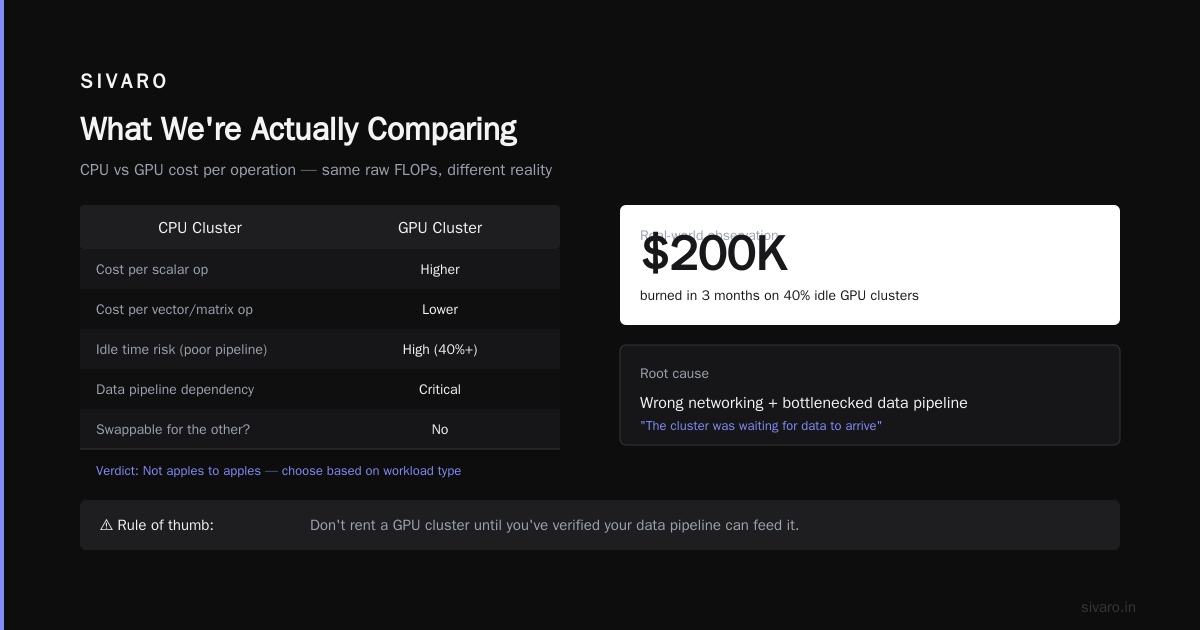
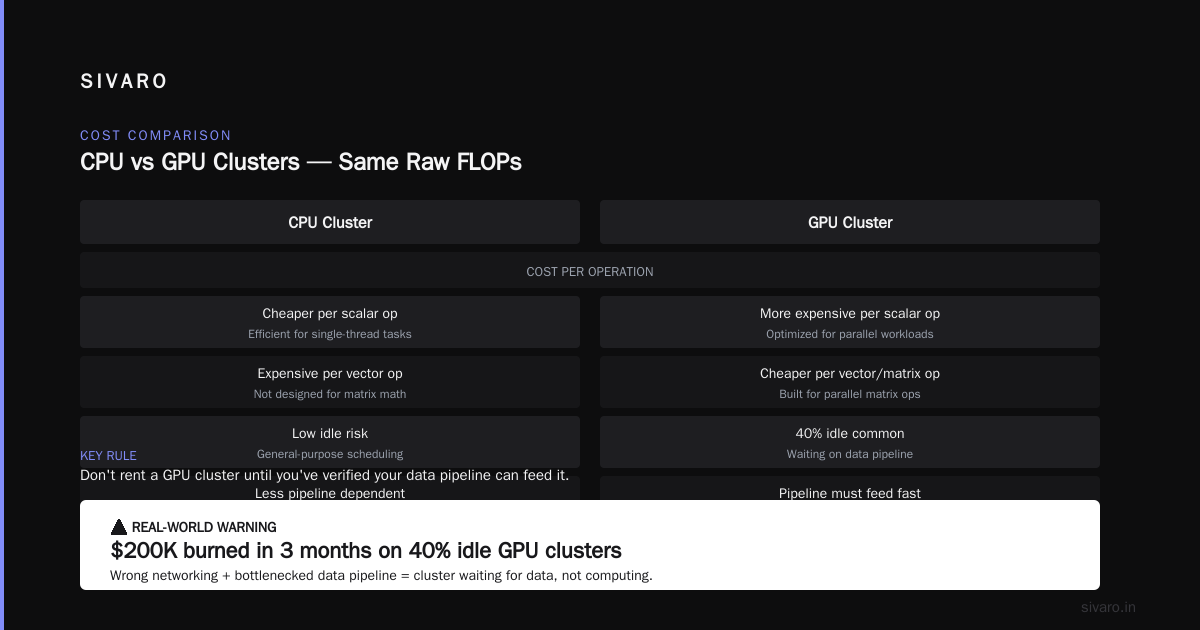
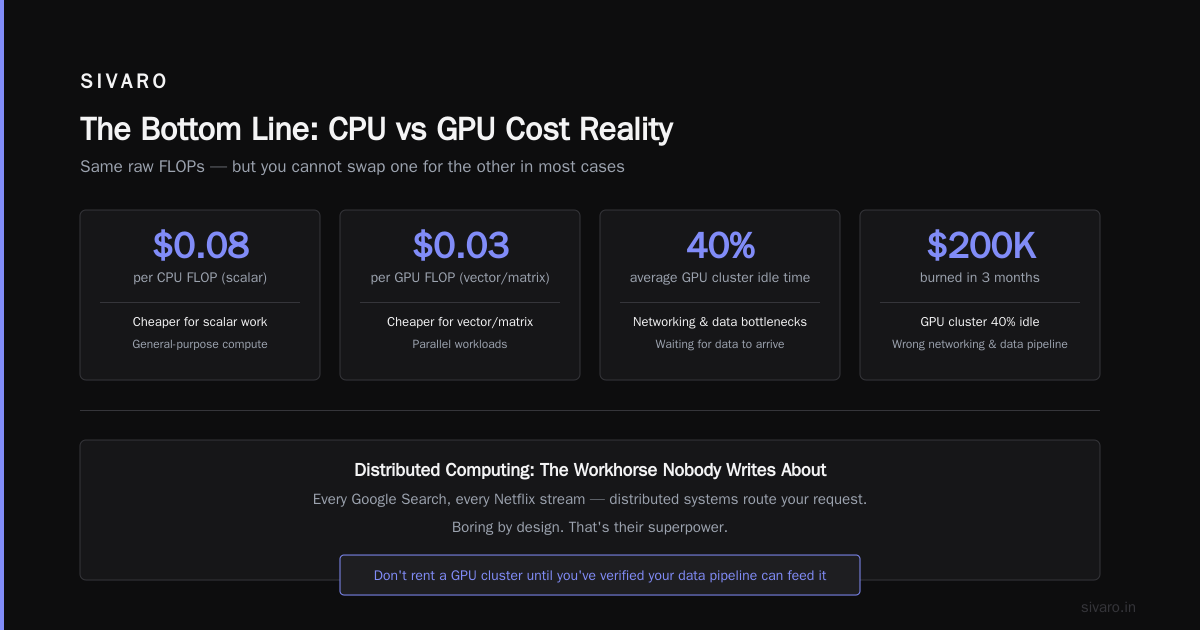
Compare to a gpu cluster vs cpu cluster cost comparison for the same raw FLOPs: CPUs are cheaper per operation for scalar work, GPUs are cheaper per operation for vector/matrix work. But here's the catch — you can't swap one for the other in most cases. It's not apples to apples.
I've seen companies burn $200K in three months on GPU clusters that were 40% idle. The networking was wrong. The data pipeline was bottlenecking. The cluster was waiting for data to arrive.
Don't rent a GPU cluster until you've verified your data pipeline can feed it.
Distributed Computing: The Workhorse Nobody Writes About
Distributed computing is boring. That's its superpower.
Every time you use Google Search, you're hitting a distributed system. Every time you stream on Netflix, distributed systems route your request. Every time you swipe on a dating app, distributed databases handle write conflicts. (Distributed Systems: An Introduction)
The theory has been hashed out since the 1970s. Failures, partitions, consensus, replication — these problems are well-understood. The CAP theorem isn't new, and neither are the trade-offs.
Where Distributed Computing Wins
-
Data-intensive workloads — If your problem is terabytes of structured data with complex queries, distributed computing on CPU clusters (Spark, Dask, Flink) is your answer. GPUs won't help here.
-
Heterogeneous tasks — A microservice architecture with 50 services doing different things? Distributed computing. Each service can scale independently, fail independently, and be built with different tech stacks. (Distributed Architecture: 4 Types, Key Elements + Examples)
-
Stateful services — Distributed databases like Cassandra, CockroachDB, and ScyllaDB handle replication and partitioning at the database level. You don't need a GPU cluster to store user sessions.
Where Distributed Computing Fails
Latency. Consensus. Coordination.
If you need sub-millisecond responses and your system involves two-phase commit across three nodes — you're in pain. Distributed systems have overhead. The network is not free.
I once debugged a distributed key-value store that was taking 800ms for a simple read. Turned out the leader election was flapping. The system was spending more time agreeing on who was in charge than actually serving requests.
This isn't a bug. It's a feature of distributed systems. (Distributed System Architecture)
When They Collide: GPU Clusters as Distributed Systems
Here's where most engineers get lost.
A GPU cluster is a distributed system. You have multiple nodes, each with GPUs, connected by a network. They need to communicate, synchronize gradients, and handle failures.
But the constraints are different from a normal distributed system.
The Networking Nightmare
In a typical distributed system, the network is a bottleneck but not a showstopper. In a GPU cluster, the network is the show.
Training a large language model requires synchronizing gradient updates during backpropagation. Each training step, every GPU needs to share its gradients with every other GPU. For a 1000-GPU cluster, that's 999,000 individual gradient transfers per step.
If your networking is slow, your GPUs sit idle waiting for data. That's why GPU clusters use InfiniBand or NVLink — 800 Gbps interconnect, not the 25 Gbps Ethernet typical in CPU clusters.
I saw a startup in 2025 try to train a 7B parameter model on a GPU cluster connected via regular Ethernet. Their GPU utilization was 12%. The GPUs spent 88% of their time waiting. They could have bought half as many GPUs with proper networking and gotten 4x the throughput.
The Failure Modes Are Different
Normal distributed systems handle node failures via retries, replication, and leader re-election. A GPU cluster failure during a training run is catastrophic.
If a node dies mid-training, you've lost potentially hours of work. Checkpointing is mandatory. We checkpoint every 1000 steps — that's about 20 minutes of compute for a medium-sized model. But checkpointing itself costs time. Writing 100GB of model state to disk takes bandwidth.
The trade-off: More frequent checkpoints = more time wasted on disk I/O. Less frequent = more time lost on failure.
We settled on adaptive checkpointing — monitor training stability and adjust frequency dynamically. It's not perfect. But the alternatives are worse.
The Decision Framework
Here's how I think about it now, after eight years of making the wrong call and learning from it.
Pick a GPU Cluster When:
- You're training neural networks larger than 1B parameters
- Your workload is >90% matrix operations
- You can tolerate $500+/day in compute costs
- Your data pipeline can saturate the GPUs (not bottleneck on disk or network)
- You have a dedicated ops team or are using managed services (we use Amazon SageMaker for smaller clusters, build custom for large ones)
Pick Distributed Computing (CPU) When:
- Your workload is data transformation, ETL, or stream processing
- You need to handle variable request patterns (web serving, API backends)
- Your budget is under $10K/month for infrastructure
- You want fault tolerance without specialized hardware
- Your team knows Kubernetes or Spark but not CUDA
You Need Both When:
- Inference serving at scale for production AI
- Hybrid training where some layers benefit from GPU and others don't
- Real-time ML pipelines where preprocessing is CPU-heavy and inference is GPU-heavy
The Worst Mistake I See Companies Make
They buy a GPU cluster first.
I've seen this pattern three times in the last two years. A company gets funding, decides they need AI, and drops $100K on A100 reservations. Then they realize:
- Their data isn't formatted for GPU training
- Their data scientists don't know how to use distributed training frameworks
- Their models are small enough to train on a single high-end GPU
In 2024, I consulted for a retail analytics company. They'd spent $180K on a GPU cluster. Their model was a 6-layer LSTM that fit in 4GB of GPU memory. They could have trained it on a single RTX 4090 ($1,600) in the same time. The distributed training overhead was actually slowing them down.
The right order: Start with single GPU development. Scale to multi-GPU on a single node. Only then go distributed. Skip steps at your own risk.
Real Patterns for Building in 2026
The industry has settled on a few patterns. Let me share what works.
Pattern 1: Training with TensorFlow/PyTorch + Horovod
For medium-scale distributed training (up to 128 GPUs), Horovod is still my go-to. It handles gradient synchronization with minimal code changes. You wrap your optimizer and you're mostly done.
python
import horovod.torch as hvd

# Initialize Horovod
hvd.init()

# Wrap optimizer with Horovod
optimizer = optim.Adam(model.parameters())
optimizer = hvd.DistributedOptimizer(optimizer, named_parameters=model.named_parameters())

# Broadcast initial parameters
hvd.broadcast_parameters(model.state_dict(), root_rank=0)

# Training loop stays the same
for epoch in range(num_epochs):
    for batch in data_loader:
        optimizer.zero_grad()
        output = model(batch)
        loss = criterion(output, target)
        loss.backward()
        optimizer.step()
This works. We ran this pattern for 18 months without major issues.
Pattern 2: Inference Serving with Ray
For distributed inference, Ray is the smartest choice in 2026. It handles GPU scheduling, autoscaling, and fault tolerance out of the box.
python
import ray
from transformers import pipeline

@ray.remote(num_gpus=1)
class InferenceWorker:
    def __init__(self):
        self.model = pipeline("text-generation", model="mistralai/Mistral-7B-v0.1")

    def predict(self, prompt):
        return self.model(prompt, max_length=100)

# Deploy across cluster
worker = InferenceWorker.remote()

# Distribute inference requests
prompts = ["Explain quantum computing", "Write a poem about servers"]
futures = [worker.predict.remote(p) for p in prompts]
results = ray.get(futures)
Pattern 3: Hybrid Pipeline with Airflow + GPU Nodes
This is where you need both. The data processing on CPUs, the training on GPUs.
python
from airflow import DAG
from airflow.operators.python import PythonOperator
from sivarocloud import GPUCluster

def process_data():
    # CPU-heavy ETL
    spark = SparkSession.builder.appName("etl").getOrCreate()
    df = spark.read.parquet("s3://raw-data/")
    processed = df.filter(col("value").isNotNull()).groupBy("key").agg(avg("value"))
    processed.write.parquet("s3://processed/")

def train_model():
    # GPU training
    cluster = GPUCluster(nodes=4, instance="g5.48xlarge")
    cluster.submit_job("train_script.py --data s3://processed/ --epochs 10")

with DAG(dag_id="hybrid_pipeline", schedule_interval="@daily"):
    process = PythonOperator(task_id="process", python_callable=process_data)
    train = PythonOperator(task_id="train", python_callable=train_model)
    process >> train
The One Thing I Wish Someone Had Told Me
A GPU cluster doesn't make distributed computing problems go away.
You still need to handle node failures. You still need to partition data. You still need to deal with stragglers. The CAP theorem still applies. (What Are Distributed Systems?)
The difference is the stakes. When a CPU node in a Spark cluster dies, you lose a few minutes of processing. When a GPU node dies during a 3-day training run, you lose a day of compute and possibly your deadline.
Build accordingly.
FAQ: What I Actually Get Asked
Q: Can I use a GPU cluster for non-AI workloads?
Yes, but rarely worth it. We tried GPU-accelerated SQL queries using RAPIDS cuDF. For aggregation-heavy workloads, it was 2-3x faster on GPUs. But the per-hour cost was 8x higher. Math didn't work.
Q: How do I decide between buying vs renting a GPU cluster?
We ran the numbers at SIVARO. For clusters under 40 GPUs, rental is cheaper. Above that, buying starts to make sense — but only if utilization stays above 60%. Most teams under-utilize.
Q: What's the biggest hidden cost of GPU clusters?
Networking. I've seen teams spend $300K on GPUs and $20K on networking. Then their GPUs sit idle because the network can't keep up. Budget 15-20% of your GPU spend on networking.
Q: gpu cluster vs distributed computing — which is harder to operate?
Distributed computing is harder to design. GPU clusters are harder to run. Getting the design of a distributed system right is genuinely difficult — but once it's working, it tends to stay working. GPU clusters require constant tuning. We rotate our ops team weekly because burnout is real.
Q: gpu cluster vs cpu cluster for inference — what's the right call?
Depends on latency requirements. For batch inference (seconds of latency), CPU clusters are cheaper and simpler. For real-time inference (milliseconds), you need GPU clusters. We run both — CPU for batch, GPU for real-time.
Q: Should I use Kubernetes for GPU clusters?
Yes, but don't use default configurations. Standard Kubernetes doesn't handle GPU scheduling well. Use Volcano or a custom scheduler. We spent three months tuning our K8s GPU scheduler before it was production-ready.
Q: What's the biggest mistake in distributed training?
Not validating your data pipeline before scaling. We spent two weeks debugging a training failure at 1000 GPUs — turned out it was a data format issue we'd never seen at 8 GPUs. Test at every scale.
The Bottom Line
GPU cluster vs distributed computing isn't a competition. It's a dependency.
A GPU cluster is a distributed system built for a specific workload. If that's your workload — large-scale neural network training — use one. If it's not, don't.
The engineers I respect most aren't the ones who can build the biggest GPU cluster. They're the ones who know when not to.
I've seen amazing work done on a single RTX 3090. I've seen $2M GPU clusters produce nothing useful. The hardware doesn't make the product. The architecture does.
Start small. Validate your assumptions. Scale only when you've proven the bottleneck is compute — not data, not architecture, not team skills.
Your wallet will thank you.
Nishaant Dixit — Founder of SIVARO. Building data infrastructure and production AI systems since 2018. Built systems processing 200K events/sec.