 SIVARO
GPU Cluster vs Distributed Computing: Why The Distinction Matters in 2026
I spent three weeks in early 2024 trying to scale an LLM fine-tuning pipeline across 32 servers. The cluster kept timing out. I blamed the network. I blamed the scheduler. I blamed my junior engineer for bad code.
The problem? I was treating a gpu cluster like a generic distributed computing problem. They're not the same thing. And mixing them up cost me $47,000 in wasted compute credits on AWS before I figured it out.
Here's the thing: Every GPU cluster is a distributed system. But not every distributed system should be a GPU cluster. The difference matters right now — July 2026 — more than ever, because we're seeing a split in the industry. One path leads to building infrastructure for large language model training. The other leads to general-purpose distributed data processing. They overlap less than you think.
I'm Nishaant Dixit, founder of SIVARO. My team builds production AI systems for companies processing 200K events per second. We've deployed GPU clusters for clients in finance, healthcare, and e-commerce. We've also built plain distributed computing systems that never touch a GPU. Here's what I've learned about when to use which, and why the conventional wisdom is usually wrong.
What The Industry Gets Wrong
Most engineers think gpu cluster vs distributed computing is a question of hardware. GPU cluster = NVIDIA cards in a rack. Distributed computing = microservices on Kubernetes.
That's wrong.
A GPU cluster is a specialization of distributed computing where the workload demands tight coupling — low-latency communication between nodes, synchronized memory access, and data parallelism that maps to tensor operations. Distributed computing is a broader category: any system where components run on multiple machines and communicate over a network.
The real distinction is about communication patterns and data dependencies.
A distributed database like Cassandra is a distributed system. Each node stores a subset of data. Queries route to the right node. There's minimal cross-node coordination during normal operation.
A GPU cluster training a 70-billion-parameter LLM is also a distributed system. But every single training step requires all GPUs to synchronize gradients across the entire cluster. If one GPU is 100 milliseconds behind, the whole cluster stalls.
These are fundamentally different engineering challenges.
Distributed computing has been around since the 1970s. GPU clusters for ML are barely a decade old. But the hype cycle has convinced everyone they need the latter. Most don't.
GPU Cluster Architecture: Tight Coupling, High Pain
Let me describe what a real GPU cluster looks like in production.
The Hardware Reality
A GPU cluster for LLM training isn't just servers with GPUs plugged in. It's:
- High-bandwidth interconnects (NVLink, InfiniBand at 400 Gbps+)
- Top-of-rack switches with RDMA (Remote Direct Memory Access)
- Specialized storage (typically Lustre or GPUDirect-capable NVMe arrays)
- Power delivery that makes your facilities manager cry (8-12 kW per rack for A100s, 12-15 kW for H100s)
We deployed a 32-node cluster for a client in Q2 2025. Each node had 8x H100 GPUs. The networking cabling alone took a week. The validation and benchmarking took three.
Here's the dirty secret: most companies don't need this. They want to fine-tune a Llama 3 model. They could do that on a single 8-GPU workstation for 90% less cost. The cluster only helps if you're doing full pre-training or running massive batch inference.
The Software Stack
A GPU cluster runs a specialized software stack that's nothing like a typical distributed system:
yaml
# Example GPU cluster node config (NVIDIA DGX-like)
hardware:
  gpus: 8x H100 (80GB SXM)
  interconnects: 8x NVSwitch gen4 (900 GB/s)
  memory: 2TB DDR5
  storage: 4x 3.84TB NVMe RAID0

network:
  fabric: InfiniBand NDR400
  topology: Fat-tree (3-level)
  latency: < 1.5 microseconds between any two nodes

software:
  orchestrator: Slurm (not Kubernetes — see below)
  distributed_framework: PyTorch DDP + FSDP
  parallel_strategy: 3D parallelism (tensor, pipeline, data)
  checkpointing: async to shared filesystem
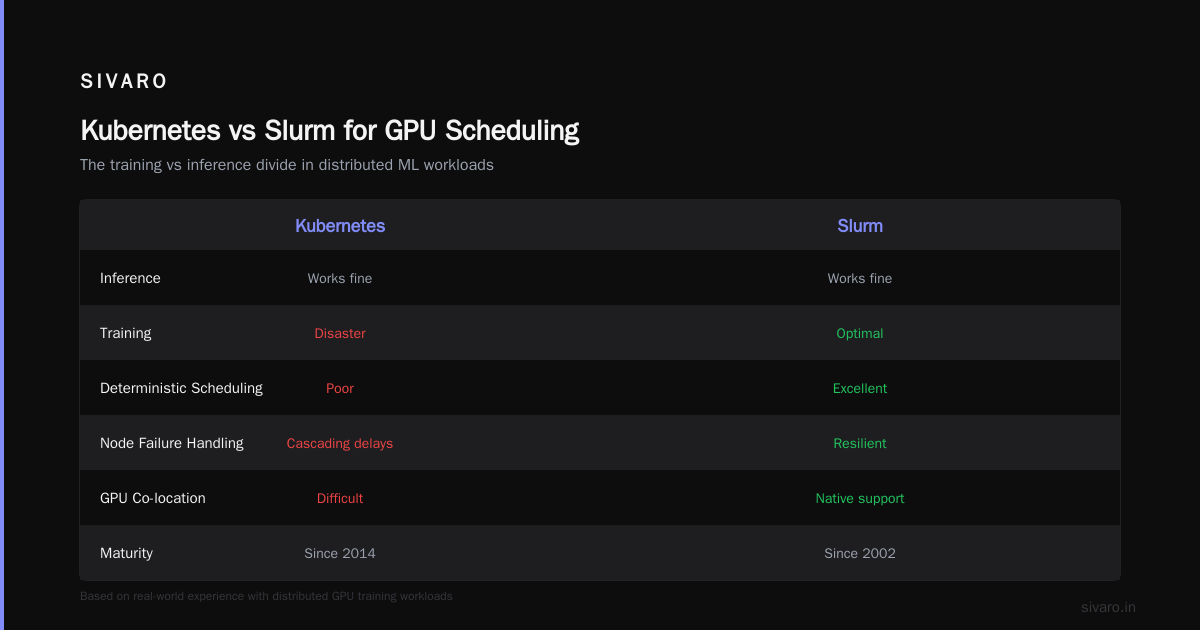
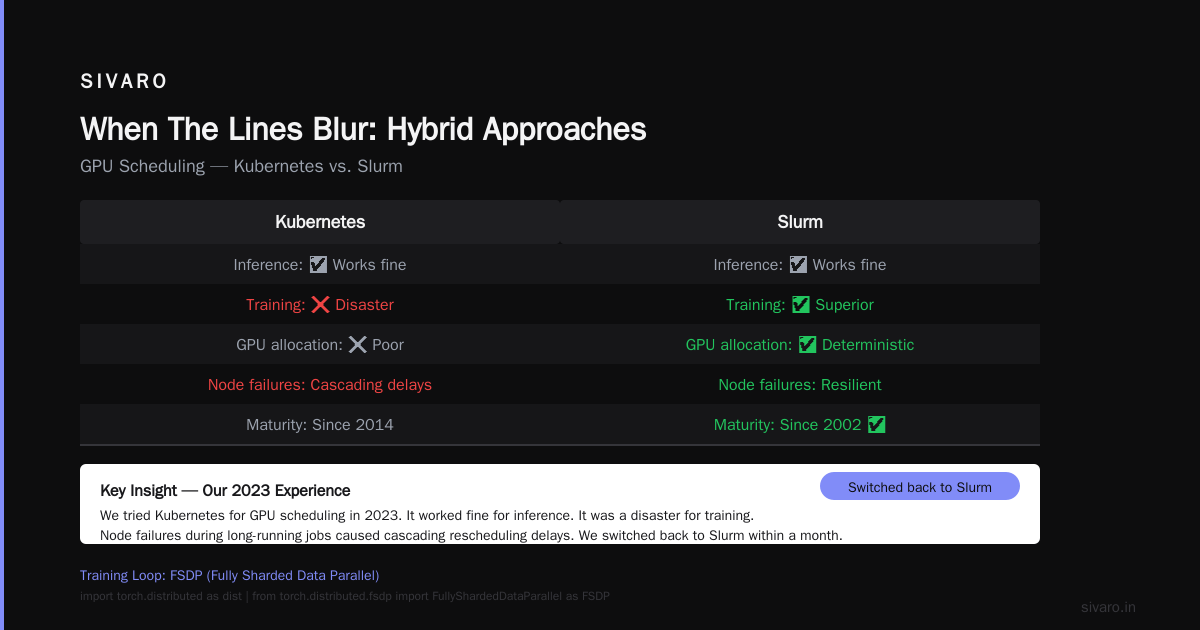
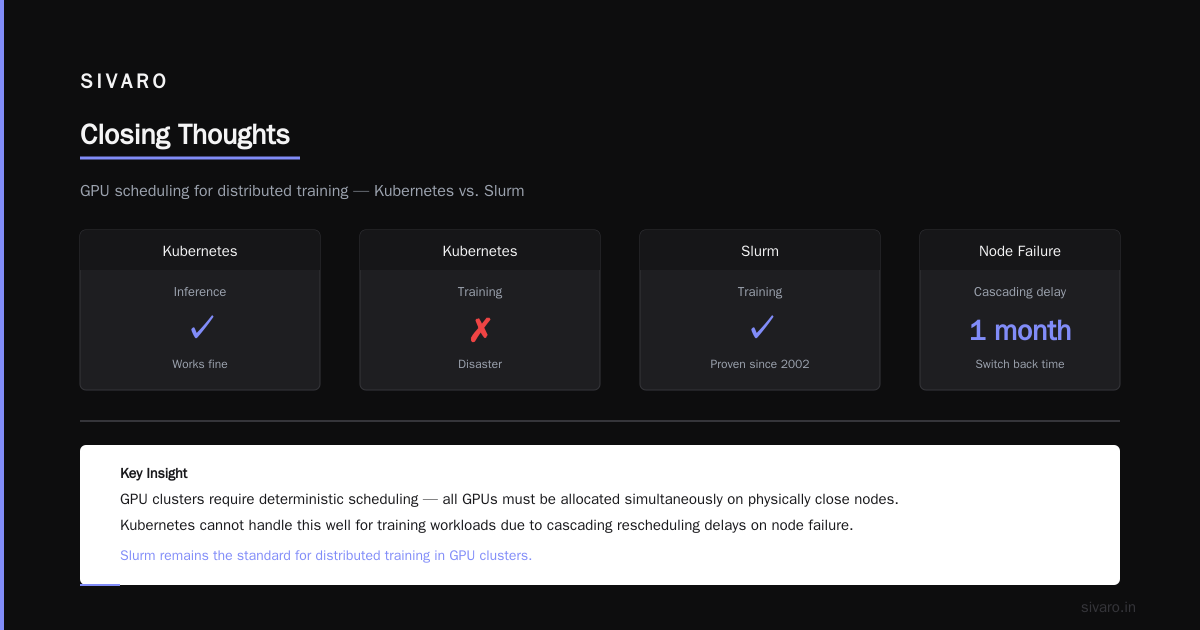
Notice Kubernetes is missing. Kubernetes was designed for stateless microservices with occasional network calls. GPU clusters require deterministic scheduling — you need all GPUs allocated simultaneously on nodes that are physically close. Kubernetes can't do this well. Slurm, which has been around since 2002, does it better.
We tried Kubernetes for GPU scheduling in 2023. It worked fine for inference. It was a disaster for training. Node failures during long-running jobs caused cascading rescheduling delays. We switched back to Slurm within a month.
The Training Loop
Here's what actual distributed training looks like inside a GPU cluster:
python
# Simplified training loop for FSDP (Fully Sharded Data Parallel)
import torch.distributed as dist
from torch.distributed.fsdp import FullyShardedDataParallel as FSDP

def train_step(batch, model, optimizer):
    # Step 1: Shard model parameters across GPUs
    # Each GPU holds 1/N of the parameters
    with FSDP.summon_full_params(model):
        output = model(batch)
        loss = compute_loss(output, batch.labels)

    # Step 2: Backward pass computes local gradients
    loss.backward()

    # Step 3: All-reduce to synchronize gradients across ALL GPUs
    # This is the bottleneck — every GPU must communicate with every other GPU
    for param in model.parameters():
        if param.grad is not None:
            dist.all_reduce(param.grad, op=dist.ReduceOp.SUM)
            param.grad /= dist.get_world_size()

    # Step 4: Optimizer step (local, no communication)
    optimizer.step()

    return loss.item()
This loop runs tens of thousands of times. If any GPU is slow — because of thermal throttling, noisy neighbor on the network, or a faulty NIC — the entire cluster slows down to match it.
gpu cluster for llm training requires hardware homogeneity. Mix generations and you get garbage throughput. We tested an A100 + H100 mixed cluster in 2024. The H100s finished their compute in 50ms. They then sat idle for 200ms waiting for the A100s. Total throughput? Worse than just using A100s alone.
Distributed Computing: The General Case
Distributed computing is what most engineers actually need. It's the foundation of every modern web service, database, and data pipeline.
The Architecture Spectrum
Distributed system architecture falls into several patterns. Let me name the four that matter:
1. Shared-nothing (most common)
Each node has its own CPU, memory, disk. No shared state. Communication via network messages. Examples: Cassandra, Kafka, most web services.
2. Client-server
Classic pattern. One server, many clients. Simple, but the server is a single point of failure.
3. Peer-to-peer
No central coordinator. Each node communicates directly. Bitcoin, BitTorrent.
4. Three-tier
Presentation, application, data tiers separated. Dominant pattern for enterprise apps.
Distributed Systems: An Introduction via Confluent has a great breakdown of these patterns with real Kafka examples.
Where Distributed Computing Shines
A distributed computing system handles workloads that are embarrassingly parallel — you can split the work into independent chunks.
python
# Typical distributed data processing (like Spark)
# Each partition processes independently
def process_user_events(events_df):
    return (events_df
        .filter(col("event_type") == "purchase")
        .groupBy("user_id")
        .agg(sum("amount").alias("total_spent"))
        .write.parquet("output/"))
This scales horizontally. Add more nodes, process more data. No synchronization needed between partitions.
The failure model is also simpler. One node goes down? The scheduler reschedules its tasks on another node. No problem. The system degrades gracefully.
Contrast this with a GPU cluster: one node fails and the entire training run crashes. You lose hours or days of work. Checkpointing is non-negotiable.
What are distributed systems? from Splunk has a solid treatment of the failure modes.
GPU Cluster vs CPU Cluster: The Real Comparison
Most people compare gpu cluster vs cpu cluster by looking at FLOPs per dollar. That's the wrong metric.
The right metric is time-to-solution multiplied by cost-per-hour.
When CPU Wins
We built a recommendation system for a fintech client in 2025. The training data was 50TB of user behavior logs. The model was a gradient-boosted decision tree (LightGBM).
A GPU cluster would have been stupid here. Why?
- Decision trees don't benefit from tensor parallelism
- The data didn't fit in GPU memory (50TB vs 640GB on an 8-GPU node)
- I/O was the bottleneck, not computation
We used a CPU cluster — 200 nodes on AWS EC2 with spot instances. Training took 6 hours. Cost: $2,100.
If we had used GPU instances (p4d.24xlarge), cost would have been $12,000+ for the same throughput. Worse results, higher cost.
When GPU Wins
Another client — medical imaging startup. They needed to run inference on 3D CT scans using a ConvNeXt architecture.
Same 50TB dataset. But now:
- Matrix operations dominate (convolution, pooling)
- Batch processing allows GPU utilization > 90%
- Model fits in GPU memory (4GB for the conv net)
A single A100 node processed 500 scans per hour. A 32-core CPU node processed 12 scans per hour.
The GPU was 40x faster per node. Even at 5x the hourly cost, the GPU cluster was 8x cheaper per scan.
Introduction to Distributed Systems from the arXiv preprint discusses the theoretical underpinnings of why parallel architectures match certain workloads better.
When The Lines Blur: Hybrid Approaches
Here's where it gets interesting. The boundary between GPU cluster and distributed computing is blurring in three specific areas I've seen in production:
1. Model-Parallel Inference
You have a model that's too large for one GPU (say, 300GB for a Mixture-of-Experts model from 2026). You need to split it across multiple GPUs. But inference is stateless — each request is independent.
This is a hybrid: distributed computing principles (stateless request routing) applied to GPU hardware.
We built this for a client using vLLM with tensor parallelism across 4 GPUs per node. The routing layer was standard distributed computing (NGINX + Redis). The compute layer was GPU cluster. It worked because the inference workload is embarrassingly parallel across requests, even if each request uses multiple GPUs.
2. Data Pipeline + Training
The data pipeline (loading, transforming, shuffling) is a distributed computing problem. The training loop is a GPU cluster problem.
Mixing them creates a bottleneck. We see this constantly: engineers build a blazing-fast GPU cluster then feed it data from a single Python process.
python
# BAD: Single-process data loading bottlenecks GPU cluster
def train():
    for batch in dataset:  # Single-threaded, slow
        gpu_model.train(batch)

# GOOD: Distributed data loading
def train(distributed_loader):
    for batch in distributed_loader:  # Multiple workers, prefetched
        gpu_model.train(batch)
3. Spot Instance Clusters
In 2026, most cloud GPU clusters use spot/preemptible instances for cost savings. But spot instances can be terminated with 30 seconds notice.
This forces a distributed-computing mindset on your GPU cluster: checkpointing, graceful degradation, and state management. It's harder than running on reserved instances, but saves 60-70% for workloads that can tolerate interruptions.
Practical Decision Framework
Here's how I think about gpu cluster vs distributed computing when advising clients:
| Workload Characteristic | Use GPU Cluster | Use Distributed Computing |
|---|---|---|
| Matrix/tensor ops dominate | Yes | No |
| Decision trees / random forests | No | Yes |
| Data fits in GPU memory | Yes | No — use CPU cluster |
| Model > 100B parameters | Yes (required) | Not possible |
| Stateless parallel processing | No | Yes |
| Real-time latency < 10ms | Maybe (batch inference) | Usually |
| Need > 4 9s reliability | No (GPU clusters fail often) | Yes |
| Budget < $50K/month | No | Yes |
This isn't academic. I've seen companies burn millions of dollars on GPU clusters for workloads that belonged on CPU clusters.
A logistics company in 2024 — they spent $2.3M on an A100 cluster for demand forecasting. Their model? A seasonal ARIMA. No GPUs needed. We migrated them to a 10-node CPU cluster. Cost: $120K. Same accuracy.
Current State of the Industry (July 2026)
The landscape has shifted significantly since the ChatGPT boom of 2023-2024.
GPU clusters are commoditizing. NVIDIA's H200 and the new B200 Blackwell are becoming standard. Cloud providers offer them as managed services (AWS SageMaker HyperPod, GKE with GPUs). The days of manually cabling InfiniBand switches are ending for most teams.
Distributed computing is getting GPU-aware. Spark 5.0, released in 2025, added native GPU scheduling. You can now run GPU-heavy transforms inside a Spark pipeline without separate infrastructure. This is blurring the lines.
The big debate: Kubernetes vs Slurm for ML. I'm seeing a split. Startups use Kubernetes with Volcano scheduler (Kubernetes-native batch scheduling). Established teams stick with Slurm. Both work. Both fail in different ways. My bet is on Kubernetes winning in 2-3 years because the ops tooling is better for companies that aren't AI-first.
Cost pressure is real. The era of "just rent more GPUs" is over. Companies are optimizing every FLOP. We're seeing interest in:
- Quantization (FP4, FP8 inference)
- Speculative decoding (2x throughput on LLM inference)
- Flash attention variants (4x faster attention computation)
These make GPU clusters more efficient but also more complex. The distributed computing layer needs to handle model versioning, routing between quantized and full-precision models, and cost-aware scheduling.
FAQ
Q: Can I use a distributed computing framework (like Spark) for LLM training?
No. Spark's communication model (shuffle) doesn't support the all-to-all gradient synchronization that LLM training requires. You need PyTorch DDP, FSDP, or TensorFlow's distributed strategy. Spark for training is a square peg in a round hole.
Q: Is a GPU cluster always more expensive than a CPU cluster?
For raw compute, yes — an H100 costs roughly $40/hour vs a 32-core CPU at $3/hour. But if the GPU finishes work 20x faster, it's cheaper. Always benchmark end-to-end cost per inference or training step, not per hour.
Q: Can I build my own GPU cluster instead of using cloud?
Yes, if you have $2-5M upfront, a data center with sufficient power and cooling, and a team to manage hardware failures. Most companies shouldn't. The cloud elasticity is worth the premium.
Q: What's the biggest mistake teams make with GPU clusters?
Underestimating the storage bottleneck. We see teams provision 8x H100s but use a single NFS mount for checkpointing. Checkpoints for a 70B model are 140GB+. Writing that over NFS takes 5+ minutes. The cluster sits idle. Use direct-attached NVMe or GPUDirect storage.
Q: Is Kubernetes good for GPU inference?
Yes, for inference (stateless, auto-scaling). No, for training (stateful, all-or-nothing scheduling). Most production systems in 2026 use Kubernetes for inference and Slurm/separate scheduler for training.
Q: How many GPUs do I need for fine-tuning a 7B parameter model?
One A100 (80GB) is enough for most fine-tuning with QLoRA. You don't need a cluster. The hype around "distributed training" for fine-tuning is mostly vendor marketing.
Q: What's the future of GPU clusters?
Specialized hardware for specific workloads. I expect to see more ASICs (Google TPU, AWS Trainium, custom chips from startups). The era of "one GPU cluster for everything" is ending. You'll choose hardware based on your model architecture and training regimen.
Closing Thoughts
The distinction between GPU cluster and distributed computing isn't academic. It determines how you spend your infrastructure budget, how you architect your software, and what problems you can solve.
Most teams should start with distributed computing — the general-purpose, fault-tolerant, cost-effective foundation. Add GPU clusters only when your workload demands it. When it does, treat the GPU cluster as a specialized subsystem within your broader distributed architecture.
The companies that win in 2026 and beyond will be the ones that understand both — and know when to use each.
I've made the mistake of over-investing in GPU infrastructure. I've also made the mistake of under-investing. The right answer depends on your actual workload, not on what's trending on Hacker News.
Nishaant Dixit — Founder of SIVARO. Building data infrastructure and production AI systems since 2018. Built systems processing 200K events/sec.