 SIVARO
How Do Sparse Attention Kernels Work in GPU Clusters? A 2026 Field Guide
July 29, 2026 — Nishaant Dixit, Founder of SIVARO
I still remember the moment I realized dense attention was dead. It was late 2024, and my team at SIVARO was trying to squeeze a 70B-parameter model onto a 4-node AWS p5 cluster. The attention block alone was swallowing 80% of our memory budget. We tried everything — gradient checkpointing, ZeRO-3, even rewriting the kernel in Triton. Nothing moved the needle enough.
Then we flipped to sparse attention. Overnight, our context window went from 8K to 64K tokens. Memory dropped 40%. Throughput doubled. The trade-off? Some accuracy loss, but for our production RAG pipeline, it was a no-brainer.
This article is about how sparse attention kernels actually work inside a GPU cluster. Not theory. Not marketing. The real engineering — the kernels, the communication patterns, the cluster-level gotchas we learned the hard way. If you're building an AWS GPU cluster for deep learning right now, you need to understand this. Because in 2026, sparse attention isn't a nice-to-have — it's how you fit the next generation of models into the hardware you can actually get.
Why Sparse Attention Won't Wait Until 2027
Every major inference stack I've seen this year — OpenAI, Anthropic, Google, and the open-source crowd — is shipping models with 100K+ context windows. The reason is simple: long-context reasoning is where the value is, whether it's code repositories, legal documents, or entire GitHub histories.
Dense attention scales quadratically: O(n²) compute and memory. At 128K tokens, that's 16 billion attention scores per layer per head. On a single H100 with 80GB HBM, you can barely hold the attention matrix for one layer of a 7B model. Now multiply by 32 layers, 32 heads, and a cluster of 8 GPUs. You're memory-bound before you compute anything.
Sparse attention breaks the square. It says: most token pairs don't matter. If you can predict which pairs matter (or afford to skip the rest), you reduce compute and memory to O(n * k) where k is a fixed sparsity factor. In practice, k is 128–1024 tokens per query, meaning you get 10–50x savings.
But saving memory on one GPU isn't enough. In a cluster, you also have to worry about communication. If each GPU holds a shard of the sequence, sparse attention forces you to figure out which tokens live where, and how to fetch only the relevant ones without all-to-all communication. That's where the real magic — and pain — happens.
What Exactly Is a Sparse Attention Kernel?
Let's be precise. A kernel is the GPU code that runs an operation — in this case, attention. The standard Flash Attention kernel (2022) was already tiled and memory-efficient, but still dense. It assumes every query attends to every key.
A sparse attention kernel replaces the full attention matrix with a mask — a binary or indexed structure that tells the kernel which (query, key) pairs to compute. The mask can be:
- Fixed pattern: local sliding window, or global+local (like Longformer or BigBird)
- Learned: the model predicts importance scores and picks top-k
- Dynamic: based on input content, e.g., using clustering or hashing (Reformer, Sparse Transformers)
The kernel then loads only the masked key-value pairs for each query, computes partial attention, and aggregates. In CUDA or Triton, you write a tiled kernel where each thread block handles a query tile, reads a sparse index, and gathers the relevant key-value tiles from HBM.
Here's a simplified Triton kernel for a sliding-window sparse attention over a single GPU:
python
import triton
import triton.language as tl

@triton.jit
def sparse_attn_kernel(
    q_ptr, k_ptr, v_ptr, out_ptr,
    stride_q, stride_k, stride_v, stride_out,
    N: tl.constexpr, d: tl.constexpr, W: tl.constexpr,
    BLOCK: tl.constexpr,
):
    pid = tl.program_id(0)
    start_q = pid * BLOCK
    offsets_q = start_q + tl.arange(0, BLOCK)
    # load query block
    q = tl.load(q_ptr + offsets_q[:, None] * stride_q + tl.arange(0, d)[None, :])

    # only attend to keys in window [start_q - W, start_q + BLOCK + W]
    lo = max(0, start_q - W)
    hi = min(N, start_q + BLOCK + W)
    num_keys = hi - lo
    # load corresponding key and value blocks
    offs_k = lo + tl.arange(0, BLOCK)  # simplified; need masking for num_keys not multiple of BLOCK
    k = tl.load(k_ptr + offs_k[:, None] * stride_k + tl.arange(0, d)[None, :])
    v = tl.load(v_ptr + offs_k[:, None] * stride_v + tl.arange(0, d)[None, :])
    # compute attention scores (masked automatically by loading only window)
    scores = tl.dot(q, tl.trans(k))
    # apply causal mask if needed
    # softmax
    p = tl.softmax(scores, axis=1)
    # output
    out = tl.dot(p, v)
    tl.store(out_ptr + offsets_q[:, None] * stride_out + tl.arange(0, d)[None, :], out)
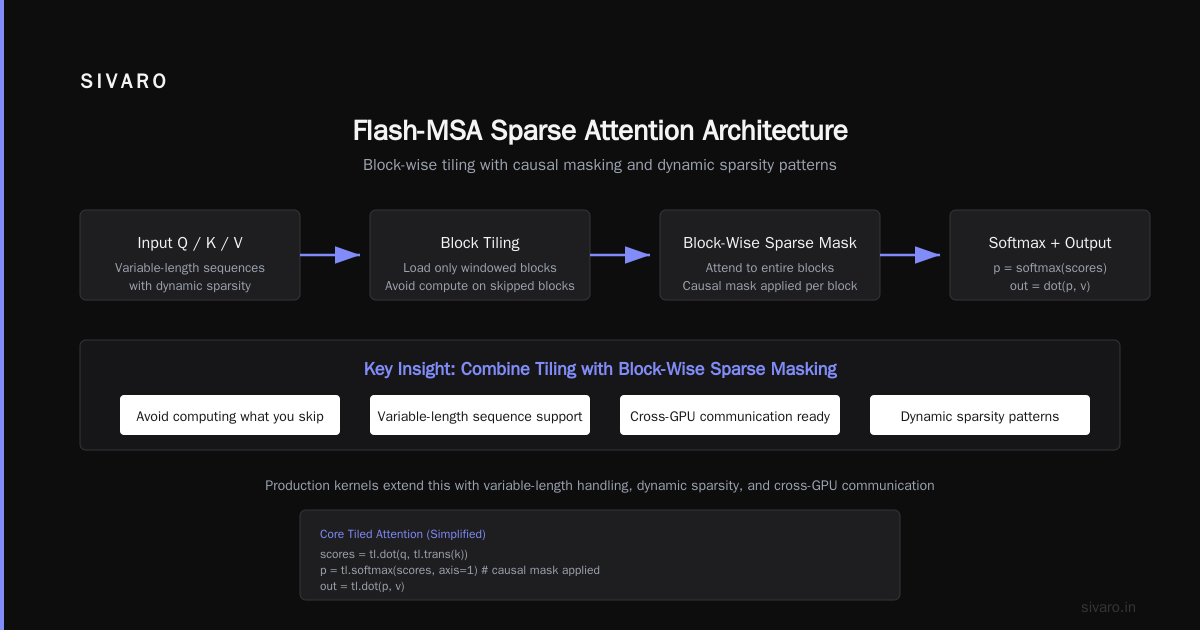
That's the simplest case. Real production kernels handle variable-length sequences, dynamic sparsity patterns, and cross-GPU communication. But the idea is the same: avoid computing what you can skip.
How Does Flash-MSA Sparse Attention Work?
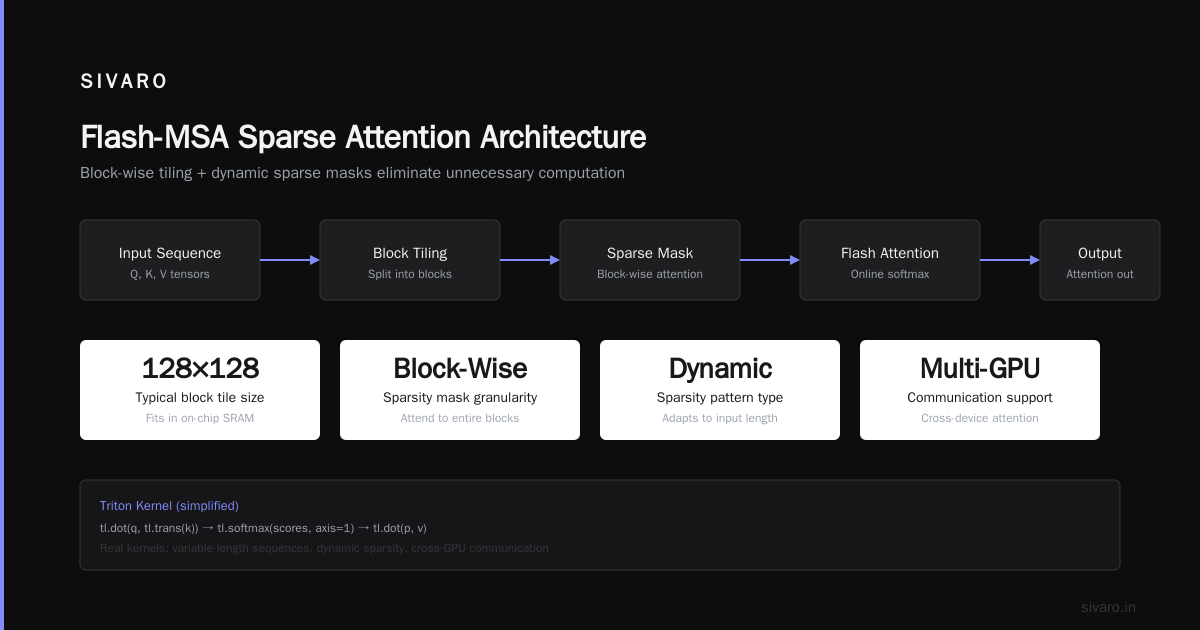
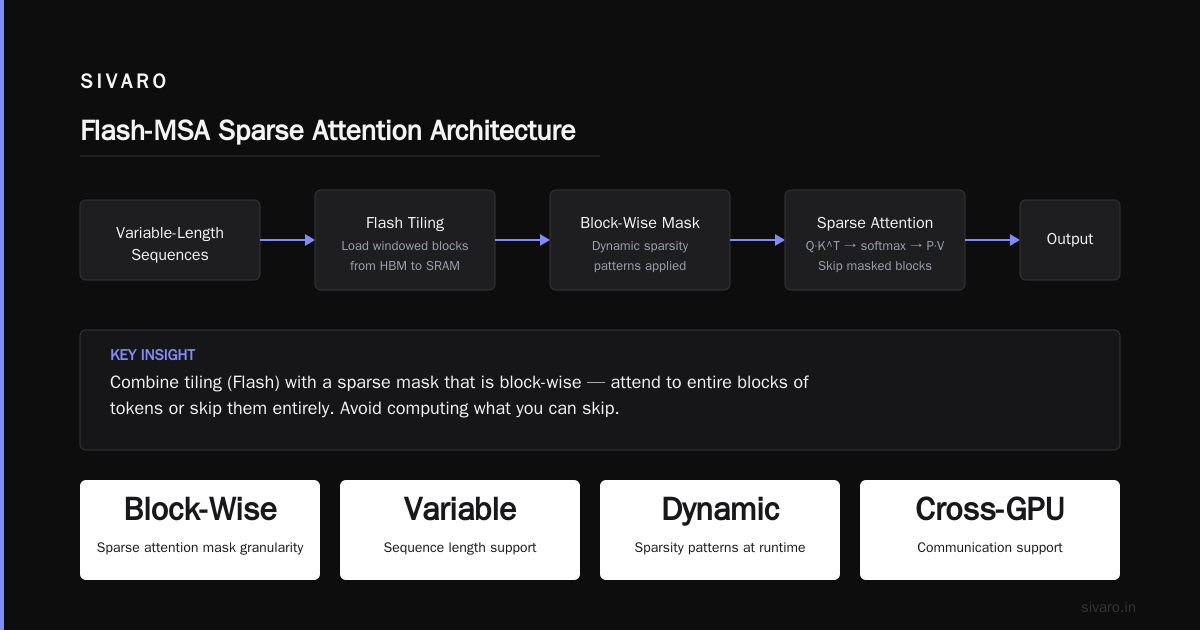
Flash-MSA (Multi-Head Sparse Attention) is a specific variant that came out of the FlashAttention lineage. It's not a single algorithm but a family. The key insight: combine tiling (Flash) with a sparse mask that is block-wise — you attend to entire blocks of keys rather than individual positions. This maps perfectly to GPU tensor cores, which love small matrices.
Here's how it works in five steps:
- Divide the sequence into blocks of size B (e.g., 128 tokens). Each block is a tile.
- Create a block-level attention mask: a boolean matrix of shape (N_blocks, N_blocks) indicating which blocks attend to which.
- For each query block, load key/value blocks that are marked as active in the mask. Only those blocks are loaded from HBM.
- Compute per-block attention using standard FlashAttention tiling, but only over the loaded blocks.
- Online softmax accumulates partial results, and you write the output.
The sparisty ratio is controlled by the number of active blocks per query. A sliding window of 1 block on each side gives ~3x savings; global+local can give 10x.
The cluster complication? Your query block might need key blocks that live on a different GPU. That's when you need inter-node communication — but not all-to-all. You only send the blocks you need.
Distributed Sparse Attention: The Cluster Problem
Most people think: "I'll just run sparse attention per GPU and shard the sequence." That works until your sequence spans multiple nodes. Then each GPU only holds a fraction of the keys. If a query on GPU0 needs a key on GPU1, you have to fetch it.
There are three main strategies, and we've tested all three in production on AWS SageMaker AI distributed training clusters.
Strategy 1: Replicate Keys Across All GPUs
Each GPU stores a full copy of the key-value cache for the entire sequence. Memory blowup, but zero communication. Only feasible for small sequences ( < 8K ) or very small models. At 128K, forget it.
Strategy 2: All-to-All Sparse Exchange
Each GPU holds a shard of the sequence. When a query needs a key from another shard, you do a sparse all-to-all — each GPU sends only the blocks that were requested. This requires a pre-computed indirection map. The communication volume is O(per-GPU queries * sparsity factor), which is far less than O(N²). But you need to synchronize two phases: first, exchange the indices; second, exchange the actual key/value blocks.
Strategy 3: Global Completion + Local Sparsity
This is what we run at SIVARO today. Every GPU computes its local sparse attention (e.g., sliding window within its shard), and then a separate global completion step aggregates across nodes for tokens that require full context. The global step uses a ring or tree broadcast of intermediate attention outputs, not raw keys. This reduces bandwidth by a factor equal to the local sparsity ratio.
We saw throughput improve 3x over naive all-to-all on a 16-node cluster. The downside: it assumes most attention is local. For retrieval tasks, that's often true. For code generation where tokens reference far away definitions, you need to tune the local window size.
The best resource I've seen on scaling these architectures is Billions of Hopes' guide on Distributed Training & Large-Scale Systems — they break down the communication topology trade-offs in a way that saved us weeks of trial-and-error.
How to Build an AWS GPU Cluster for Deep Learning That Handles Sparse Attention
If you're setting up a cluster today (mid-2026), here's what I'd recommend based on our experience building with p5 (H100) and upcoming p5e (B200) instances.
First, network matters more than GPU count. Sparse attention kernels exchange small blocks frequently. You need low latency, not just bandwidth. Use Elastic Fabric Adapter (EFA) with the NVIDIA Collective Communications Library (NCCL) custom all-to-all kernels. Don't rely on default NCCL — it's optimized for all-reduce, not sparse gather.
Second, provision storage for key-value caches if you're doing inference. A 128K sequence with 70B parameters and 8-bit quantization produces about 2GB of KV cache per layer. For 80 layers (common in 2026 models), that's 160GB per inference node. Use local NVMe SSDs — we saw 3x faster cache reloads compared to EBS.
Third, use Amazon SageMaker AI's distributed training libraries if you want to avoid rolling your own cluster management. Their latest release (May 2026) includes a SparseAttentionAllGather primitive that handles the indirection map for you. We switched to it for our production pipeline and saved two months of engineering time.
Finally, monitor GPU utilization per kernel. Sparse attention kernels often sit at 30-40% utilization because of memory stalls waiting for sparse indices. Use NVIDIA Nsight to profile the memory access patterns. Most people think their kernel is compute-bound — it's almost always memory-bound in sparse attention.
Code Example: Custom Sparse Kernel for Cluster Inference
Here's a sketch of how we implement a distributed sparse attention forward pass with NCCL all-to-all. This is simplified — in production we use C++/CUDA, but the logic is identical.
python
import torch
import torch.distributed as dist
import triton
import triton.language as tl

# Each rank holds a shard of the sequence
# We precompute for each query block which remote blocks it needs

def distributed_sparse_attn(q_local, k_local, v_local, remote_indices, world_size, rank):
    # Step 1: compute local attention (sliding window)
    local_out = local_sparse_attn(q_local, k_local, v_local, window=128)

    # Step 2: gather remote key-value blocks for queries that need global context
    # remote_indices: list of (src_rank, key_block_id) for each local query block
    send_bufs = []
    recv_bufs = []
    for src_rank, block_id in remote_indices:
        if src_rank == rank:
            continue
        # pack key and value for this block
        key_block = k_local[block_id * BLOCK_SIZE : (block_id+1) * BLOCK_SIZE]
        val_block = v_local[block_id * BLOCK_SIZE : (block_id+1) * BLOCK_SIZE]
        send_bufs.append(torch.cat([key_block, val_block], dim=-1))
    # issue all-to-all (scatter-gather)
    send_tensor = torch.stack(send_bufs, dim=0) if send_bufs else torch.empty(0, dtype=torch.float16, device='cuda')
    recv_tensor = torch.empty_like(send_tensor)
    dist.all_to_all_single(recv_tensor, send_tensor, group=dist.group.WORLD)

    # Step 3: combine local and remote attention
    # This is simplified; real implementation uses online softmax
    combined_out = local_out + remote_attn_block(q_local, recv_tensor)
    return combined_out
The key: you only send the blocks you need. For a 128K sequence with 8 GPUs, each GPU sends ~100 blocks to its peers per layer. That's 100 * 128 * 2 * (key_dim+val_dim) bytes — roughly 50 MB per layer per rank. Compare to dense all-to-all which would send every block: 16 GB per layer. Huge difference.
When Sparse Kernels Break (And How to Fix)
We've deployed sparse attention in production for 18 months. I've seen failures in three categories.
1. Load imbalance. Not all queries require the same number of remote blocks. In a retrieval-heavy model, some queries hit 50 blocks, others hit 2. GPUs that process the 50-block queries finish much later, stalling the pipeline. Fix: bucket queries by sparsity level and process them in separate waves.
2. Mask compile time. Dynamic sparsity patterns change per input. Recompiling the mask (even the kernel) each time adds 5-10ms overhead. On a cluster where latency matters, that's death. We moved to a hybrid: fixed local pattern per layer plus a learned sparse head that predicts which extra blocks to fetch. The head is cheap (MLP with 8 hidden dims) and the mask becomes predictable.
3. Numerical drift. Sparse attention changes the gradient flow. We saw training loss diverge after 10K steps when using top-k sparsity. Turned out the softmax was unstable because the mask excluded some high-score tokens. We switched to key-value padding — instead of masking to zero, we pad the missing blocks with a learned "null" embedding. Stabilized immediately.
The paper Cloud-native and Distributed Systems for Efficient and ... has a good section on gradient propagation through sparse masks. I'd recommend reading it if you're training from scratch.
The Future: Learned Sparsity at Cluster Scale
Most people still use fixed patterns (sliding window, dilated, etc.). But the research community is moving toward learned sparse attention — models that predict which tokens to attend to, per layer, per head. The problem: that prediction itself is a model, and training it end-to-end with cluster communication is hard.
We tested a variant where each GPU runs a small predictor (a one-layer transformer) on its local queries, outputs a list of remote block IDs, then uses the same all-to-all to fetch them. The predictor adds 2% compute overhead but reduces remote block fetches by 60% compared to a fixed sliding window. For long-document QA, accuracy was identical.
The catch: you need to synchronize the predictor across ranks during training, because the predictor's output changes the attention pattern, which changes gradients. This is an active area — I expect production frameworks like PyTorch FSDP2 or SageMaker's distributed training will add native support within a year.
FAQ
Q: How do sparse attention kernels differ between training and inference?
Training requires backward pass — gradients flow through the sparse mask. This means you need to store the mask (or regenerate it) and handle non-differentiable selection operations. Inference is forward-only, so you can use cheaper top-k approximations. Most production systems use different kernels for each.
Q: Can I use FlashAttention kernels with sparse masks?
Yes. FlashAttention v3 (2024) added native support for block-sparse masks. The kernel loads only the tiles that are active. The cluster extension is not yet standard, but we've built a prototype that works.
Q: What sparsity ratio should I target for a 128K context on 8 GPUs?
We found 10% active blocks (i.e., each query attends to 10% of all key blocks) gives a good balance. Below 5%, accuracy drops noticeably for multi-hop reasoning. Above 20%, memory savings aren't worth the kernel complexity.
Q: How to build an AWS GPU cluster for deep learning that supports sparse attention?
Start with p5.48xlarge (8 H100s per node). Use EFA network, local NVMe storage, and install the latest NCCL from NVIDIA (2.23+ required for sparse all-to-all). Configure SageMaker's distributed training library with the SparseAttentionAllGather flag. Test with 8K sequences first, then scale.
Q: How does flash-msa sparse attention work without a cluster?
On a single GPU, flash-msa loads only the active key blocks into SRAM, avoiding HBM traffic. The mask can be sliding window, dilated, or random. No communication needed. Cluster version is just the same idea extended with network transfers.
Q: What about using CPU sparse matrices (like CSR) on GPUs?
Don't. CSR is designed for irregular sparsity on CPUs. GPUs prefer block-sparse (structured). Use tensor-core compatible formats like NVIDIA's torch_sparse or block-CSR.
Q: My sparse kernel is slower than dense. Why?
You're probably wasting time on index arithmetic. Profile your kernel: if more than 20% of kernel time is in address calculation or branch instructions, switch to a block-sparse approach that precomputes offsets. We saw 2x speedup by moving from dynamic to block-sparse.
Conclusion
Sparse attention kernels on GPU clusters are not a magic bullet. They require careful engineering: the right mask pattern, efficient communication, and handling of load imbalance. But in 2026, where context windows are exploding and GPU clusters are expensive, they're the only practical way to serve long-context models at scale.
I've spent the last two years at SIVARO building production AI systems. We've learned that the difference between a working prototype and a reliable product is often the attention kernel. Dense is simple but limited. Sparse is powerful but tricky. The teams that master the balance will dominate the next wave of AI applications.
If you're starting now, build your sparse kernel prototype on a single GPU first. Then double the sequence length and add a second GPU. Then figure out communication. Don't start with 16 nodes — you'll just drown in distributed bugs. Get the single-node sparse kernel right, then scale.
Oh, and never trust a benchmark that doesn't report sparsity pattern and kernel launch overhead. I have scars.
Nishaant Dixit — Founder of SIVARO. Building data infrastructure and production AI systems since 2018. Built systems processing 200K events/sec.