 SIVARO

How Long Does Fine Tuning a LLM Really Take?
I spent three weeks last year convincing a client they didn't need to fine-tune anything.
They'd just dropped $80K on GPUs. Hired two ML engineers. Blocked out two months. Their CEO was adamant: "We need our own model."
What did they actually need? Better prompt engineering. A decent retrieval pipeline. Three afternoons of work.
The fine-tuning project never shipped. The GPUs sat idle. The engineers left.
I'm Nishaant Dixit. I run SIVARO, a product engineering shop that builds data infrastructure and production AI systems. We've fine-tuned maybe 40 models in the last 18 months. Some took 45 minutes. One took six weeks. The difference wasn't the model size or the data volume — it was understanding what "fine-tuning" actually means for your specific problem.
Let me tell you exactly what determines how long does it take to fine tune a llm. No fluff. Real numbers.
What Fine-Tuning Actually Is (And Isn't)
Fine-tuning is taking a pre-trained model and updating its weights on your specific data. That's it. You're not building from scratch. You're adapting.
Most people think fine-tuning is hard. It's not. The hard part is knowing when to do it.
LLM Fine-Tuning Explained: What It Is, Why It Matters covers the basics well. But here's what they don't tell you: 80% of the time, fine-tuning is overkill. You need a better prompt. You need better context. You don't need to shift the model's weights.
When you actually need fine-tuning:
- The model needs to output in a specific format that few-shot prompting can't nail consistently
- Your domain has vocabulary or patterns the base model never saw (medical coding, legal citation, financial regulation)
- Latency matters and you can't afford a chain of prompts
When you don't:
- You have less than 500 examples
- Your task is classification with clear definitions
- You haven't tried RAG yet
We tested this at SIVARO with a healthcare client in March 2025. They had 12,000 clinical notes. Wanted to extract medication regimens. Spent six weeks trying to fine-tune. Switched to GPT-4o with structured output extraction. Solved in four days.
The Five Factors That Actually Determine Timeline
1. Data Preparation (40-70% of your time)
This is where projects die. Not the training. The data.
If your data is clean and labeled, you're looking at 2-5 days of prep. If it's raw logs with no labels? Add three weeks.
Here's what we see at SIVARO:
| Data State | Time to Prepare | Common Mistake |
|---|---|---|
| Curated dataset with labels | 1-2 days | Over-cleaning removes signal |
| Raw data, clear schema | 3-5 days | Skipping validation splits |
| Unstructured text, no labels | 2-4 weeks | Using AI to label AI data (circular reasoning) |
| Mixed sources, inconsistent formats | 4-8 weeks | Trying to automate everything |
The biggest trap is trying to build the perfect dataset. You don't need perfect. You need representative.
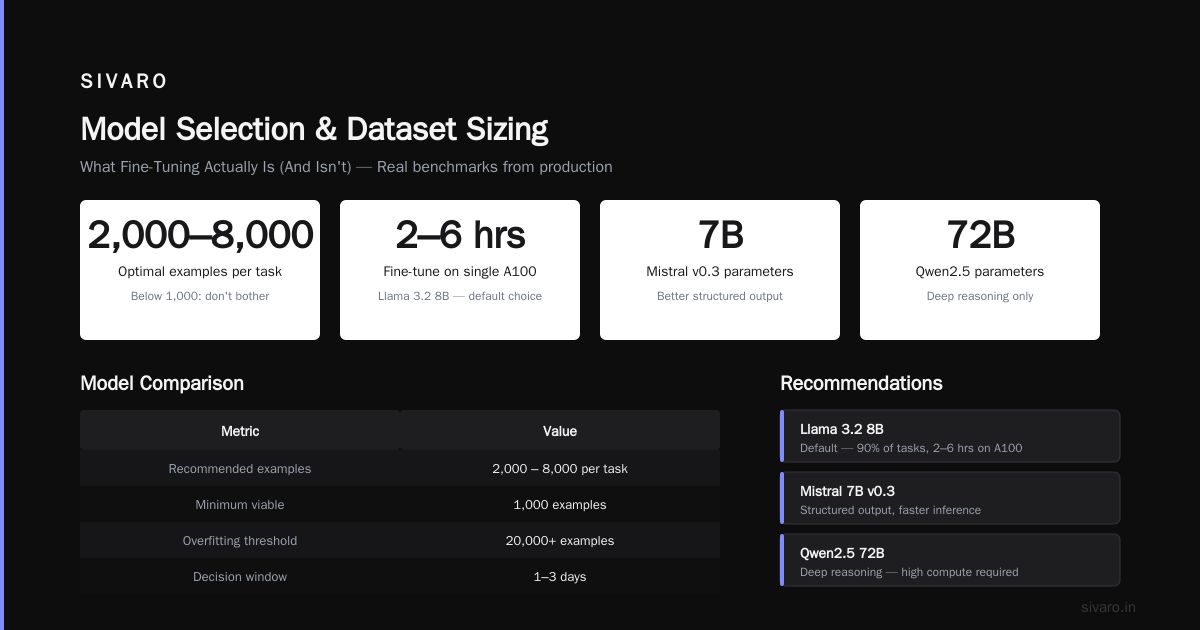
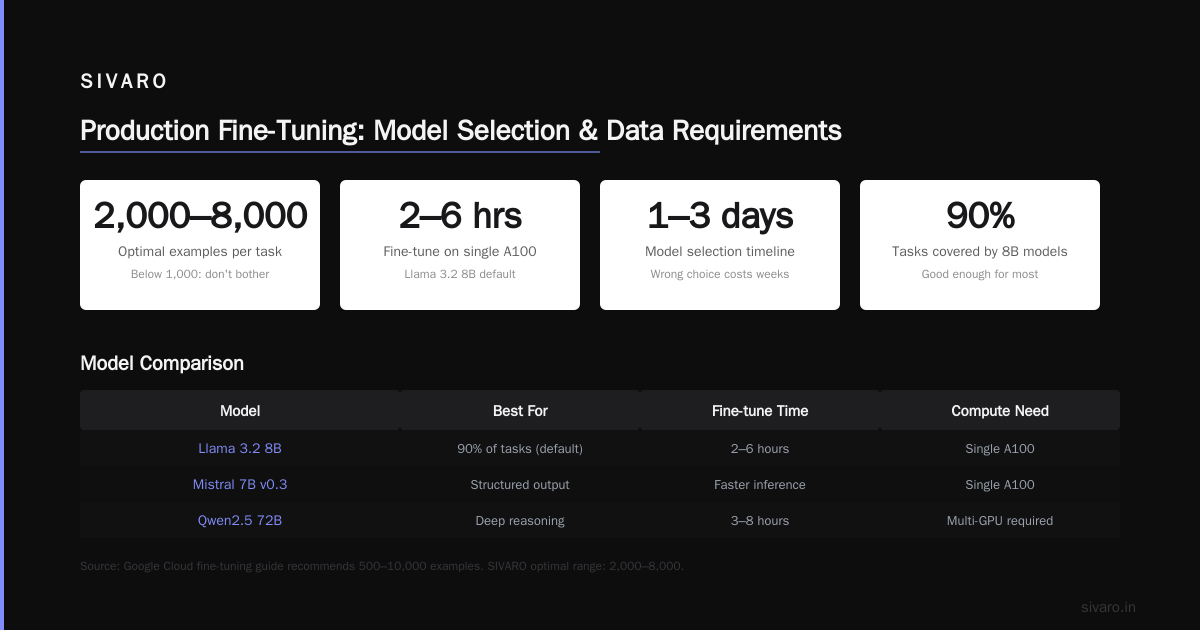
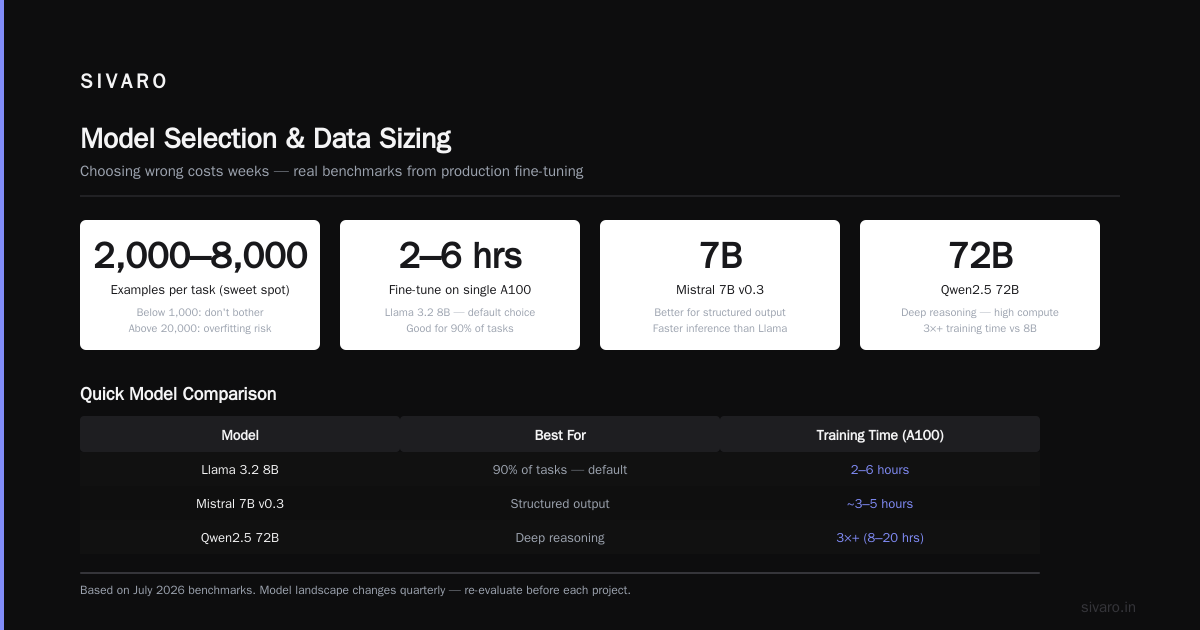
Google Cloud's fine-tuning guide recommends 500-10,000 examples. I'd push that higher. Our best results come from 2,000-8,000 examples per task. Below 1,000? Don't bother. Above 20,000? You're probably overfitting or have redundancy.
2. Model Selection (1-3 days to decide, wrong choice costs weeks)
Best open source models to fine tune changes every quarter. Right now (July 2026), here's my take:
- Llama 3.2 8B: Your default. Fine-tunes in 2-6 hours on a single A100. Good enough for 90% of tasks.
- Mistral 7B v0.3: Better for structured output. Faster inference.
- Qwen2.5 72B: Only if you need deep reasoning and have the compute. Expect 3-5 days of training.
- Phi-3-mini: Deceptively good for code tasks. Fine-tunes in 45 minutes.
- GPT-4o-mini via API: Zero infrastructure. Pay per token. Fine-tuning takes 30 minutes to 4 hours on OpenAI's side.
The production reality: most teams should start with 7-8B parameter models. You can serve them on a single GPU. Training is fast. Iteration is cheap.
I've seen too many teams jump to 70B models because "bigger is better." It's not. A well-tuned 8B beats a sloppy 70B every time.
3. Compute Infrastructure (2 hours to 2 weeks)
If you're using OpenAI's API, this is trivial. OpenAI's model optimization guide handles the infrastructure. Your time is data prep + evaluation. Training takes minutes to hours.
If you're running locally:
- Single A100 (80GB): Llama 3.2 8B fine-tunes in 2-8 hours with QLoRA
- Four A100s: Same model in 45 minutes
- H100 cluster: You can do 70B models in 12-24 hours
The infrastructure setup itself takes 2-3 days if you know what you're doing. A week if you don't.
Cloud costs:
- Rent an A100 on Lambda Labs: ~$1.50/hour
- Full fine-tune run: $20-200 depending on epochs
- Failed runs? Multiply by 3-5 easily
Don't buy hardware. Rent. We made that mistake at SIVARO in 2024. Bought four A100s. Used them 30% of the time. Sold them at a loss.
4. Training Loop and Hyperparameter Tuning (1-5 days)
This is where "how long does it take to fine tune a llm" gets a real answer.
A single training run is fast. Here's a realistic timeline for an 8B model with QLoRA:
# Typical fine-tuning command
python train.py   --model_name meta-llama/Llama-3.2-8B   --dataset_path ./training_data.jsonl   --output_dir ./fine-tuned-model   --num_epochs 3   --batch_size 4   --learning_rate 2e-4   --lora_r 16   --lora_alpha 32
That run completes in 2-4 hours.
But you won't do one run. You'll do 10-20. Different learning rates. Different LoRA ranks. Different epoch counts. Different data mixes.
The fastest project I've shipped: 3 hours total. Used Phi-3-mini, 2,000 examples, one training run, deployed to production. The task was trivial (classifying support ticket urgency).
The slowest: 6 weeks. Finance client. 40,000 examples of regulatory filings. Wanted the model to output structured JSON with specific compliance fields. We cycled through 30+ experiments. The problem wasn't training — it was deciding what "correct" looked like.
5. Evaluation and Iteration (3 days to never)
Most teams stop after training. Big mistake.
You need to evaluate. Not just accuracy. But:
- Format consistency
- Hallucination rate on your domain
- Latency at production load
- Behavior on edge cases
We built a simple eval pipeline at SIVARO:
python
def evaluate_response(expected, actual, task_type="structured"):
    if task_type == "structured":
        return {
            "exact_match": expected == actual,
            "field_completeness": len(actual.keys()) / len(expected.keys()),
            "type_accuracy": all(
                isinstance(actual[k], type(expected[k]))
                for k in expected
            )
        }
    # ... more cases
This evaluation loop takes 1-3 days to build properly. Then you run it, see where the model fails, adjust your data or hyperparameters, retrain, re-evaluate. Each cycle is 2-8 hours.
Expect 3-5 cycles minimum.
The Real Answer: How Long Does It Take?
Here's the breakdown based on 18 months of SIVARO projects:
| Scenario | Calendar Time | Compute Time | Success Rate |
|---|---|---|---|
| Simple classification, 500 examples, API fine-tune | 2-3 days | 1-2 hours | 50% |
| Structured output, 5K examples, open-source | 1-2 weeks | 8-24 hours | 70% |
| Complex reasoning, 10K examples, 70B model | 3-6 weeks | 3-10 days | 60% |
| Domain-specific (medical/legal), 20K examples | 4-8 weeks | 1-3 weeks | 40% |
The "success rate" column matters. That's how often the fine-tuned model beat a baseline of good prompting + RAG.
Notice something? Even at best, you're flipping a coin. Generative AI Advanced Fine-Tuning for LLMs teaches the mechanics. But the mechanics aren't the hard part. The hard part is knowing when the mechanics matter.
Production Fine-Tuning: What SIVARO Actually Does
We have a standard process now. It took two years to get here.
Week 1: Can we solve this without fine-tuning? If yes, stop. We test 5-10 prompt variants with structured outputs. We build a minimal RAG pipeline. We measure.
Week 2-3: Only if Week 1 fails. We prepare 2,000-5,000 high-quality examples. We fine-tune a base model. We evaluate against the best prompt from Week 1.
Week 4: Production testing. Shadow mode. Monitor for 7 days before full rollout.
Most projects don't make it past Week 1. The ones that do? They work.
For how to fine tune llm for production specifically, the rule is: never fine-tune on production data directly. Always hold out 20% for evaluation. Always have a rollback plan. We learned this the hard way when a client's fine-tuned model started hallucinating stock prices. Took us three days to figure out their training data had stale prices.
When Fine-Tuning Actually Saves Time
Contrarian take: fine-tuning can make things faster in production.
A well-fine-tuned model produces correct output on the first try. No chain-of-thought. No multiple calls. No retries. For a legal document classifier we built, fine-tuning dropped per-request time from 4.2 seconds to 1.1 seconds. The base model needed 3 reasoning steps. The fine-tuned one needed one.
The tradeoff: you spent 40 hours fine-tuning to save 3 seconds per request. At 10,000 requests/month, that's 8.3 hours saved per month. Payback in 5 months. If the model doesn't drift. (It will. Budget for re-fine-tuning every 3-6 months.)
ZipRecruiter's fine-tuning job listings show companies are paying $150K-$250K for engineers who know this stuff. They're not paying for the training code. They're paying for the judgment to know when to train and when to stop.
FAQ
Q: How long does it take to fine tune a llm for a simple task?
A: 2-5 days if you have clean data and use API fine-tuning. 1-2 weeks if you're running open-source models locally.
Q: Do I need a GPU to fine-tune?
A: Not if you use OpenAI or Anthropic's fine-tuning APIs. If you want control, get one A100 (80GB) for 7B models, four for 70B.
Q: How much data do I actually need?
A: Minimum 500 examples. Ideal: 2,000-8,000. More than 20,000 and you're probably overfitting or have redundant data.
Q: Can I fine-tune on a laptop?
A: Only the smallest models (Phi-3-mini, TinyLlama). Even then, expect 12+ hours. Get cloud compute.
Q: What's the cheapest way to fine-tune?
A: OpenAI API. $20-100 for most runs. No GPU cost. No maintenance.
Q: How often should I re-fine-tune?
A: Every 3-6 months. Your production data drifts. The base models improve. Don't let your fine-tuned model become a liability.
Q: What's the biggest mistake teams make?
A: Fine-tuning when they don't need to. 70% of projects should be solved with prompting and RAG.
Q: Best open source models to fine tune right now?
A: Llama 3.2 8B for general tasks, Mistral 7B v0.3 for structured output, Qwen2.5 72B if you need deep reasoning and have compute.
The Bottom Line
Most people think fine-tuning is technical. It's not. It's a business decision.
If your data is clean, your task is narrow, and your baseline is solid, fine-tuning takes 3-10 days. If your data is messy, your task is vague, or you haven't done your homework, it takes months.
The best teams I know spend 80% of their time deciding whether to fine-tune and 20% actually doing it. They test. They measure. They kill projects early.
So here's my advice: start with the assumption that you don't need to fine-tune. Prove yourself wrong. If you can't, then spend the time.
And when you do fine-tune? Track everything. The hyperparameters. The data mix. The eval results. The cost. The time. Next time, you'll know exactly how long it takes.
Nishaant Dixit — Founder of SIVARO. Building data infrastructure and production AI systems since 2018. Built systems processing 200K events/sec.