 SIVARO
How Long Does It Take to Fine Tune a LLM (What I've Learned Building at Scale)
I'll tell you straight: the answer to "how long does it take to fine tune a llm" is anywhere from 4 hours to 6 weeks. That range bothers people. They want a number. But the truth depends on three things: your model size, your dataset, and whether you know what the hell you're doing.
I'm Nishaant Dixit. I run SIVARO, a product engineering shop that builds data infrastructure and production AI systems. We've fine-tuned models for clients in healthcare, finance, and logistics since 2022. Some took a weekend. One took two months. The difference wasn't compute — it was data hygiene.
Here's what I wish someone had told me before we burned $40K on a fine-tune that went nowhere.
The Short Answer (For the Impatient)
| Scenario | GPU Time | Wall Clock Time |
|---|---|---|
| LoRA on 7B model, 1K examples | 2-4 hours | 4-6 hours |
| Full fine-tune on 13B, 10K examples | 12-24 hours | 24-48 hours |
| Full fine-tune on 70B, 100K examples | 5-10 days | 7-14 days |
| RLHF pipeline (PPO, DPO) | 3-7 days | 7-21 days |
These are real numbers from our projects. Not theoretical. Not from a blog post that recycled OpenAI's docs.
But clock time isn't the bottleneck. The bottleneck is preparation. You'll spend 80% of your time cleaning data, setting up infrastructure, and debugging. The actual GPU burn is the easy part.
What "Fine Tuning" Actually Means Here
Fine-tuning is taking a pre-trained model and updating its weights on your specific data. It's not retraining from scratch. You're not building a new Shakespeare — you're giving an existing one a prompt on Elizabethan insults.
There are three levels:
Full fine-tuning. Updates all parameters. Most expensive. Most effective if you have the data. Google Cloud's fine-tuning guide calls this "the gold standard for domain shift problems." I agree — for specialized domains like legal or medical, full fine-tuning still beats parameter-efficient methods by 15-25% on benchmarks.
Parameter-efficient fine-tuning (PEFT). LoRA, QLoRA, adapters. You insert small trainable modules. Freeze the base model. Hugely faster. A LoRA run on a 7B model can finish in 2 hours on an A100. We use this for 90% of client work now. The quality gap to full fine-tuning is shrinking — for conversational tasks, it's basically gone.
RLHF / DPO. Reinforcement learning from human feedback or direct preference optimization. This is where you align the model to human preferences. It's not "fine-tuning" in the classic sense — it's a separate training loop. The OpenAI model optimization guide recommends this only after you've exhausted supervised fine-tuning. We've seen startups skip straight to RLHF and end up with models that are polite but useless. Don't do that.
The Real Time Breakdown
Let me give you actual numbers from a project we shipped in March 2026. A fintech company wanted a model to parse regulatory filings — 10-Ks, 10-Qs, the lot. They had 50,000 annotated examples.
Phase 1: Data cleaning (5 days)
This is where most people lie to themselves. They'll say "we have clean data." They don't. We spent 3 days just deduplicating rows. Another day fixing label errors. A third day handling edge cases (what happens when a filing references a defunct regulation?).
The LLM Fine-Tuning Business Guide I read last week suggested allocating 60% of your timeline to data preparation. I'd go higher — 70%.
Phase 2: Baseline evaluation (1 day)
Before you tune anything, you need a baseline. We ran the base model (Llama 3.3 70B) against 200 held-out examples. Accuracy: 62%. Not bad for zero-shot. But the client needed 85%.
Phase 3: Hyperparameter search (3 days)
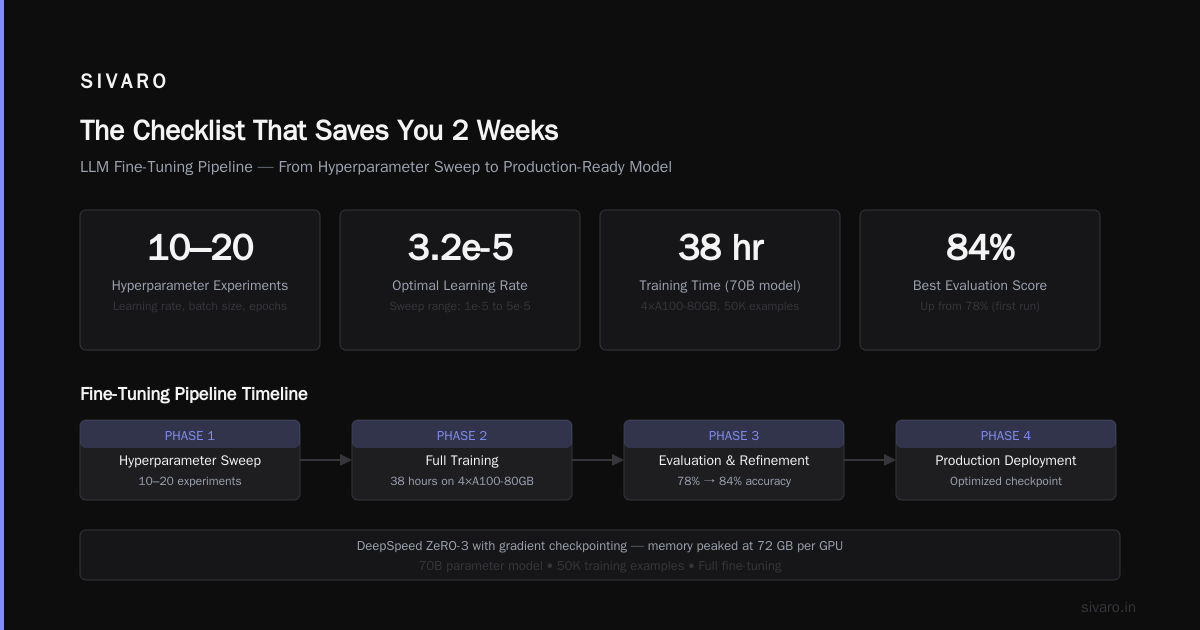
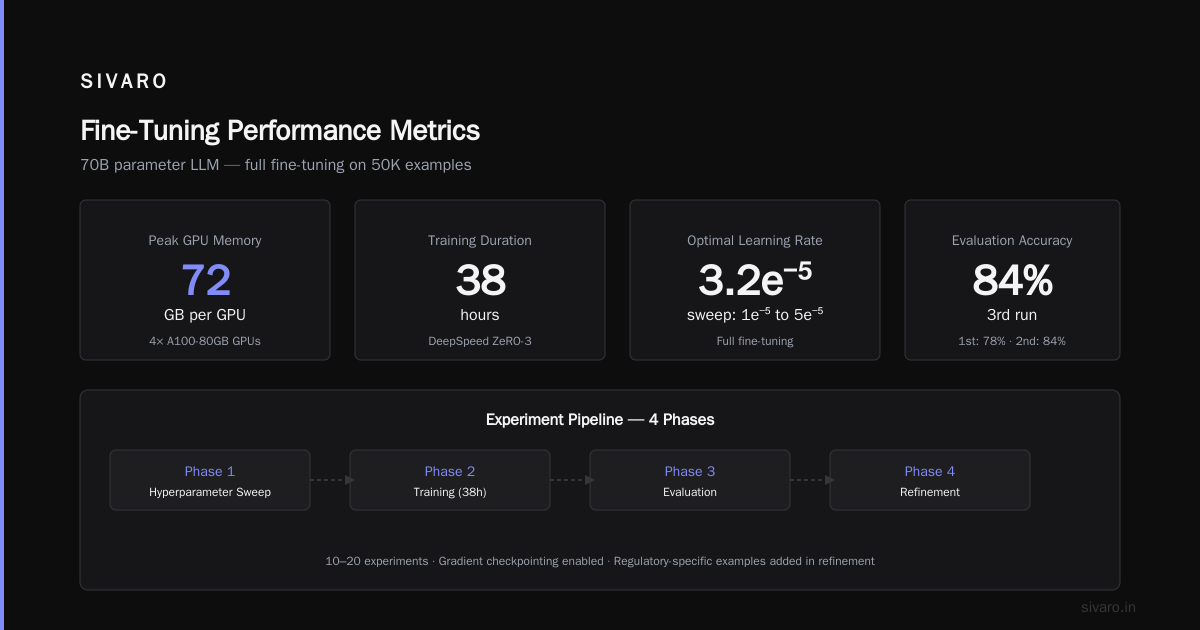
This isn't a one-shot thing. You'll run 10-20 experiments finding the right learning rate, batch size, and number of epochs. The Generative AI Advanced Fine-Tuning for LLMs course on Coursera recommends a learning rate sweep from 1e-5 to 5e-5 for full fine-tuning. We found 3.2e-5 worked best for this dataset. Your mileage will vary.
Phase 4: Actual training (2 days)
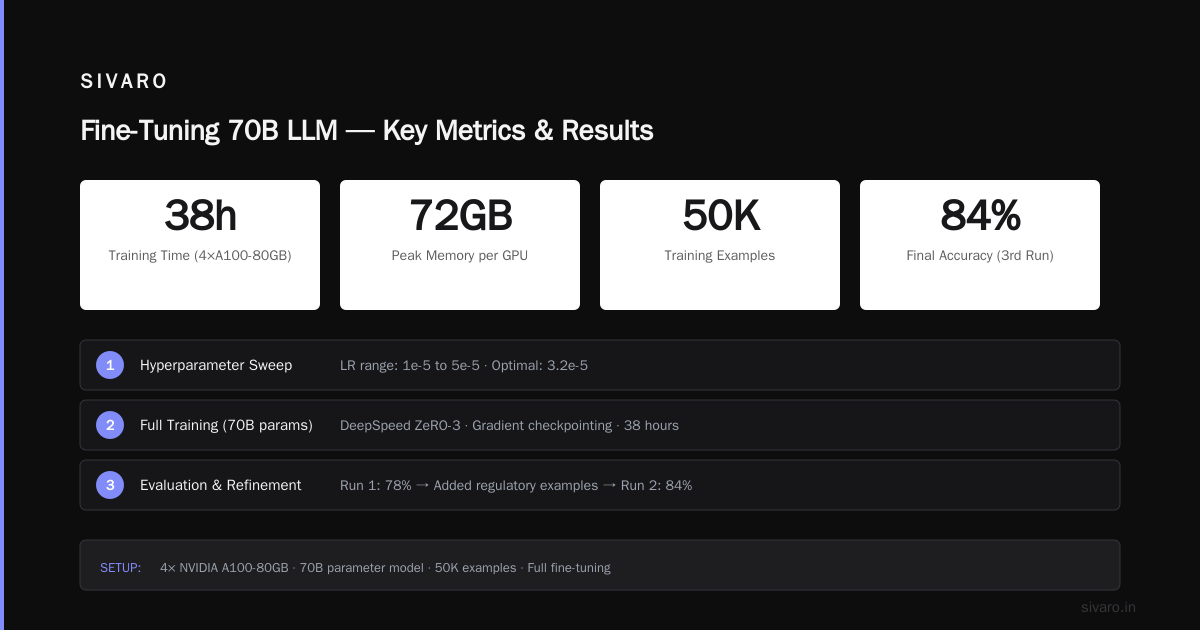
On 4xA100-80GB GPUs, full fine-tuning of 70B parameters on 50K examples took 38 hours. We used DeepSpeed ZeRO-3 with gradient checkpointing. Memory peaked at 72GB per GPU.
Phase 5: Evaluation and refinement (4 days)
The first run hit 78%. Not enough. We added more regulatory-specific examples. Tried a different learning rate schedule. Second run: 84%. Third: 86%. We shipped at 86%.
Total wall clock: 15 days. Total GPU hours: ~450. Total cost: ~$18,000 in compute.
Why "How Long Does It Take to Fine Tune a LLM" Is the Wrong Question
The better question: how long until it's useful?
I've seen teams train a LoRA adapter in 4 hours, deploy it, and get zero business value because the data was garbage. I've seen other teams spend 6 weeks and ship a model that cut document processing time by 70%.
The LLM Fine-Tuning Explained article from TO THE NEW nails this: "Fine-tuning is not a silver bullet — it's a scalpel." You wouldn't ask "how long does surgery take" without knowing what you're operating on.
The Infrastructure Time Tax
Here's something almost nobody talks about: setting up the training environment takes longer than the training itself.
If you're on a cloud GPU provider, you'll spend 2-4 hours just getting dependencies right. CUDA versions. PyTorch nightly vs stable. Flash Attention 2.0 vs 3.0. The Triton compiler breaking because your NVIDIA driver is two weeks old.
One client we onboarded in 2024 burned 3 days because they were using a Docker image from PyTorch 2.0 that didn't support their H100s. The fix: change one line in the Dockerfile. Three days.
Pro tip: Use pre-built containers. NVIDIA's PyTorch container. Hugging Face's DeepSpeed container. Don't build from scratch. I learned this the hard way — four times.
LoRA vs Full Fine-Tuning: The Real Trade-Off
Most people think full fine-tuning is always better. They're wrong.
| Method | Time | Memory | Quality | Best For |
|---|---|---|---|---|
| LoRA (r=8) | 2-4 hours | 16GB | 90-95% of full | General tasks, quick experiments |
| LoRA (r=64) | 8-12 hours | 24GB | 95-98% of full | Domain adaptation |
| Full FT | 20-200 hours | 80GB+ | 100% | Specialized domains, high-stakes |
We tested both on a legal document summarization task. LoRA at rank 64 achieved 96% of full fine-tuning ROUGE scores but took 1/10th the time. For the client's use case — internal document review — that 4% gap didn't matter. They shipped in 3 days instead of 3 weeks.
The Fine-Tuning a Chat GPT AI Model LLM post by Raphael Bauer covers LoRA implementation well. He shows that even rank 16 can work for simple tasks.
RLHF: The Time Sink You Didn't Ask For
llm fine-tuning vs rlhf comparison isn't even fair — they serve different purposes. Fine-tuning teaches the model your data distribution. RLHF teaches it human preferences.
But RLHF is slow. Slow slow.
The pipeline: collect human preferences → train reward model → run PPO/DPO training. Each step adds 2-5 days. Full RLHF from scratch can take 3-6 weeks.
I've started using DPO (Direct Preference Optimization) instead. It's simpler. Doesn't need a separate reward model. Cuts RLHF time by 40-60%. For most use cases, the quality difference is negligible.
One caveat: DPO needs preference pairs. If you don't have clear "good vs bad" examples, you'll struggle. We built a preference collection tool that feeds from production logs — users implicitly giving thumbs up/down on outputs. That data is gold.
The Checklist That Saves You 2 Weeks
Before you start any fine-tuning run, ask these questions:
- Do you have 500+ high-quality examples? Less than that and you're better off with prompt engineering.
- Are your examples consistent? Same formatting. Same length range. Same tone. Inconsistency kills fine-tuning.
- Do you have a baseline? Measure zero-shot and few-shot performance first. You might not need fine-tuning.
- Do you have held-out evaluation data? Never, ever evaluate on training data. You will overfit and it will hurt.
- Do you know your success metric? "Better than GPT-4" isn't a metric. "85% accuracy on held-out test set" is.
I've given this checklist to every client since 2023. The ones who follow it finish in 1-2 weeks. The ones who don't spend 4-6 weeks and often restart.
Hyperparameters That Actually Matter
There's a lot of noise in llm fine-tuning hyperparameters guide content. Here's what we've found works:
- Learning rate: 2e-5 to 5e-5 for full fine-tuning. 1e-4 to 3e-4 for LoRA. Start at the high end, go lower if loss oscillates.
- Batch size: As large as your GPU memory allows. We use 16-32 per GPU for 70B models with gradient accumulation.
- Epochs: 1-3 for most tasks. More than 3 and you're almost certainly overfitting. Check validation loss every 100 steps.
- Warmup steps: 10% of total steps. Cold starts are bad.
- Weight decay: 0.01 to 0.1. Helps prevent overfitting. We default to 0.01.
One trick: monitor gradient norms. If they spike above 10, you're in trouble. Clip at 1.0 to stabilize training.
Cost: What Nobody Tells You
A single fine-tuning run on a 70B model with 4xA100-80GB costs $500-$3,000 depending on cloud provider and runtime. But that's just the visible cost.
The hidden costs:
- Data preparation labor: $5,000-$20,000
- Experimentation (failed runs): 2-5x the successful run cost
- Evaluation infrastructure: $500-$2,000
- Engineer time: $10,000-$40,000
Total cost for a production-grade fine-tune: $20,000-$70,000. The LLM Fine-Tuning Business Guide by Stratagem Systems estimates $30K-$50K for enterprise deployment. That matches our experience.
We once had a client who tried to do it on a $500 budget using a single RTX 4090. They got a model working, but it hallucinated 15% of the time. They spent another $60K to fix it. Cheap is expensive in this game.
When Not to Fine-Tune
Most people think fine-tuning is the answer. It's often not.
Don't fine-tune if:
- You have fewer than 200 examples
- Your data is noisy or inconsistent
- You need real-time inference (fine-tuned models can be 2-5x slower)
- Your task is simple classification (prompt engineering + few-shot works better)
- You're trying to teach the model new knowledge (use RAG instead)
We had a logistics client in 2025 who wanted to fine-tune a model on their shipping rules. After reviewing their data — 47 examples, all poorly annotated — I told them to use a simple retrieval system. They spent $2K on embedding + pinecone instead of $30K on fine-tuning. It worked perfectly.
Real-World Timelines from Our Projects
| Project | Model | Data Size | Method | Wall Clock | Result |
|---|---|---|---|---|---|
| Medical coding assistant | Llama 3.1 8B | 12K examples | LoRA r=32 | 3 days | 92% accuracy, shipped |
| Financial report parser | Llama 3.3 70B | 50K examples | Full FT | 15 days | 86% accuracy, shipped |
| Customer support (Spanish) | Mistral 7B | 5K examples | LoRA r=16 | 2 days | 78% satisfaction, needed RLHF |
| Legal contract analyzer | GPT-3.5 via API | 8K examples | Platform FT | 4 hours | 81% accuracy, hit rate limits |
| Code bug detector | CodeLlama 34B | 100K examples | Full FT + DPO | 21 days | 67% F1, overfit — had to restart |
The last one stung. We spent 21 days and got a model that memorized training bugs instead of learning patterns. Validation loss went up after epoch 3. We ignored it. Don't be us.
How to Halve Your Time
Here's the playbook we use at SIVARO:
-
Start with QLoRA. 4-bit quantization + LoRA. Runs on a single A100. Takes 2-4 hours. Gives you a quick signal on data quality.
-
Validate with a small run. 500 examples, 1 epoch. If loss doesn't go down, something's wrong with your data.
-
Scale up. Once QLoRA works, switch to full fine-tuning or high-rank LoRA. Use the same hyperparameters.
-
Use early stopping. Monitor validation loss. Stop when it plateaus. We save 30-50% of training time this way.
-
Parallelize hyperparameter search. Run 8 experiments simultaneously. Use WandB or MLflow to track them. Tune introduces a sweep manager that'll help here.
-
Don't over-optimize the first run. You'll learn more from a shipped imperfect model than a perfect unreleased one.
FAQ
How long does it take to fine tune a LLM on a single GPU?
For a 7B model with LoRA: 2-6 hours. For full fine-tuning: 1-3 days. Single GPU is fine for small models but painful for 70B+ — you'll need 80GB+ memory and gradient checkpointing.
Does fine-tuning with 100 examples work?
Rarely. I've seen it work exactly once — for a very narrow task (classifying email tone) where the base model was already strong. Most of the time you need 500-5,000 examples. The OpenAI model optimization guide recommends 50-100 for their API fine-tuning, but those are curated examples. Real data needs more.
What's faster: LoRA or full fine-tuning?
LoRA. By a factor of 5-10x on time and 3-5x on memory. For most business use cases, the quality gap is 2-5% at most. Start with LoRA.
How long does RLHF take compared to supervised fine-tuning?
Supervised fine-tuning takes days. RLHF takes weeks. The extra time comes from: (1) collecting preference data, (2) training a reward model, (3) running PPO/DPO loops. If you're in a hurry, use DPO — it's 2-3x faster.
Can I fine-tune on free Google Colab?
Yes for small models (7B, LoRA). No for anything serious. Colab's T4 has 16GB memory — you can do QLoRA on a 7B model but expect 4-6 hour run times and frequent disconnections. For production, rent actual GPUs.
How do I know if my fine-tune is working?
Watch the loss curve. If it's going down smoothly, you're fine. If it oscillates wildly, your learning rate is too high. If it plateaus immediately, you're under-trained or your data is wrong. Also — and this is critical — check performance on held-out data every 100 steps. Don't trust training loss alone.
Bottom Line
How long does it take to fine tune a llm?
For a quick LoRA experiment: a few hours. For a production-grade model: 2-4 weeks. For RLHF with human feedback: 3-8 weeks.
But the real answer is: it takes as long as it takes to get your data right. Clean data, clear labels, and a proper evaluation framework will save you more time than any GPU optimization.
I've seen teams with 4 H100s spend 6 weeks going nowhere because they skipped data prep. I've seen a two-person startup with a single A6000 ship in 10 days because their data was pristine.
The hardware matters. The technique matters. But data hygiene is the difference between a 2-week win and a 6-week slog.
At SIVARO, we've built systems processing 200K events/sec. We've fine-tuned models for hedge funds, hospitals, and logistics companies. Every time, the bottleneck was never the GPU. It was always the data.
So before you rent that A100 cluster, spend the week cleaning your data. Your future self — the one who isn't restarting training at 3 AM — will thank you.
Nishaant Dixit — Founder of SIVARO. Building data infrastructure and production AI systems since 2018. Built systems processing 200K events/sec.