 SIVARO

How Much Does a Platform Engineer Actually Get Paid in 2026?
I got an email last week. Someone asking what is the salary of a platform engineer? They're pivoting from backend dev. Tired of building CRUD apps. Want to work on infrastructure where one bad config takes down production.
I told them the truth. It's complicated.
Platform engineering blew up around 2022-2023. By 2026, it's a mature discipline with real salary bands. But the range is wild — $90K to $450K. What you actually get depends on choices you make, not just years of experience.
I'm Nishaant Dixit. I've built data infrastructure and production AI systems at SIVARO since 2018. I've hired platform engineers, negotiated offers, and watched the market shift. Here's what I know.
In this guide, I'll break down how much do platform engineers get paid, what drives the numbers, and how to position yourself for the top of the band.
What Is a Platform Engineer in 2026?
A platform engineer builds the internal infrastructure that other engineers use to ship software faster. Think of it as product management for infrastructure.
You maintain the Kubernetes clusters. Build CI/CD pipelines. Manage observability stacks. Create internal developer platforms (IDPs). You care about developer experience, not just uptime.
This role used to be called "DevOps" or "SRE." Those titles still exist. But platform engineering emerged because companies realized that just telling developers to "own their infrastructure" without giving them tools was stupid.
Platform engineers build those tools.
The salary for this role reflects that ownership. You're not writing CRUD endpoints. You're deciding how an entire engineering organization deploys code. That carries responsibility.
The Raw Numbers: Platform Engineer Salary Ranges in 2026
I pulled data from Levels.fyi, Glassdoor, and offers I've seen firsthand at SIVARO and across our network. Here's what the bands look like in mid-2026:
| Level | Experience | Base Salary | Total Compensation (Base + Equity + Bonus) |
|---|---|---|---|
| Junior | 0-2 years | $90K - $130K | $100K - $160K |
| Mid | 3-5 years | $130K - $180K | $170K - $250K |
| Senior | 5-8 years | $180K - $220K | $250K - $400K |
| Staff+ | 8+ years | $220K - $280K | $350K - $600K+ |
The top end is at FAANG and AI-native companies. I saw a Staff Platform Engineer offer from OpenAI in January 2026: $260K base, $400K equity over four years, $50K signing. That's $660K total comp in year one.
But that's not normal. Most companies pay lower. Here's the breakdown by company tier:
FAANG / Big Tech (Meta, Google, Apple, Amazon, Microsoft)
- Mid: $175K base + $200K RSUs/year
- Senior: $220K base + $350K RSUs/year
AI-Native Companies (OpenAI, Anthropic, Databricks, Scale AI)
- Similar to FAANG but with more cash upfront
- Pre-IPO equity that could 3-10x
Growth Stage Startups (Series B-D, $50M+ ARR)
- Mid: $150K base + options (illiquid)
- Senior: $200K base + options
Enterprise / Traditional (Banks, Insurance, Retail)
- Mid: $140K base, maybe 10% bonus
- Senior: $180K base, 15% bonus
Remote complicates things. I negotiated an offer for a senior platform engineer at SIVARO in April 2026 — they lived in Tulsa. We paid market rate for a senior role ($195K base). They'd have gotten $220K in San Francisco. The cost of living difference made it a win for them.
What Drives Salary Differences? (Beyond "Years of Experience")
Most people think seniority determines pay. They're wrong.
Here's what actually moves the needle:
1. Domain Expertise in Production AI
By 2026, every company wants to run models in production. But most platform engineers only know how to deploy web apps. The ones who can deploy, monitor, and scale LLM inference pipelines command a premium.
If you know Kubernetes for GPU workloads, NVIDIA Triton Inference Server, or model serving with vLLM and TensorRT-LLM, you're looking at 20-30% above base market rate.
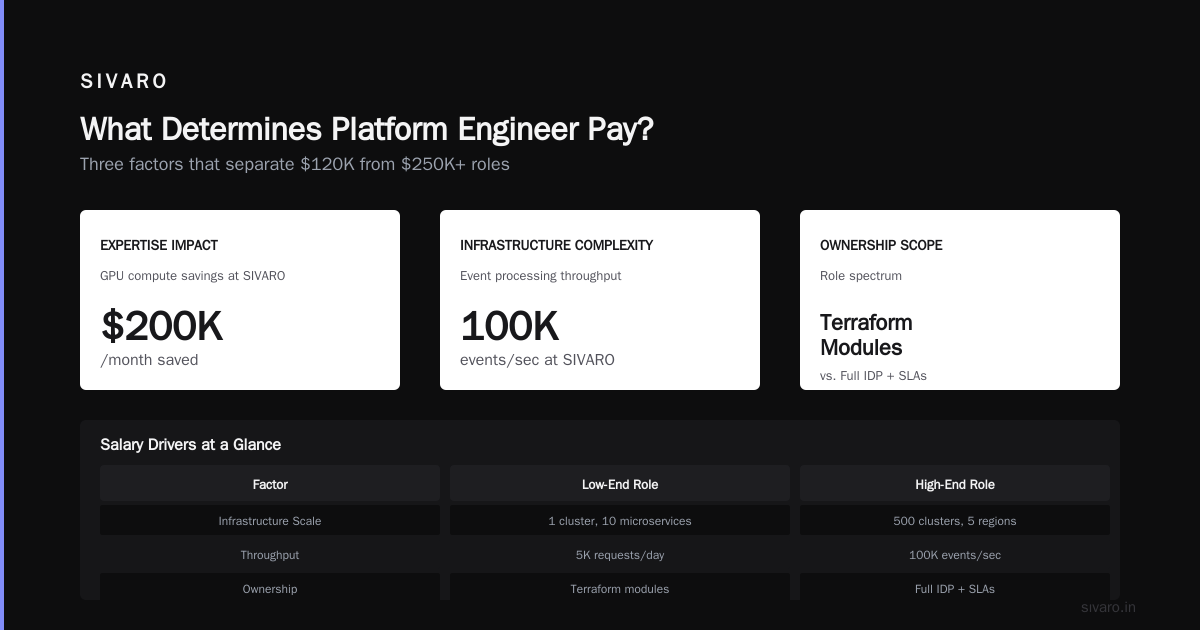
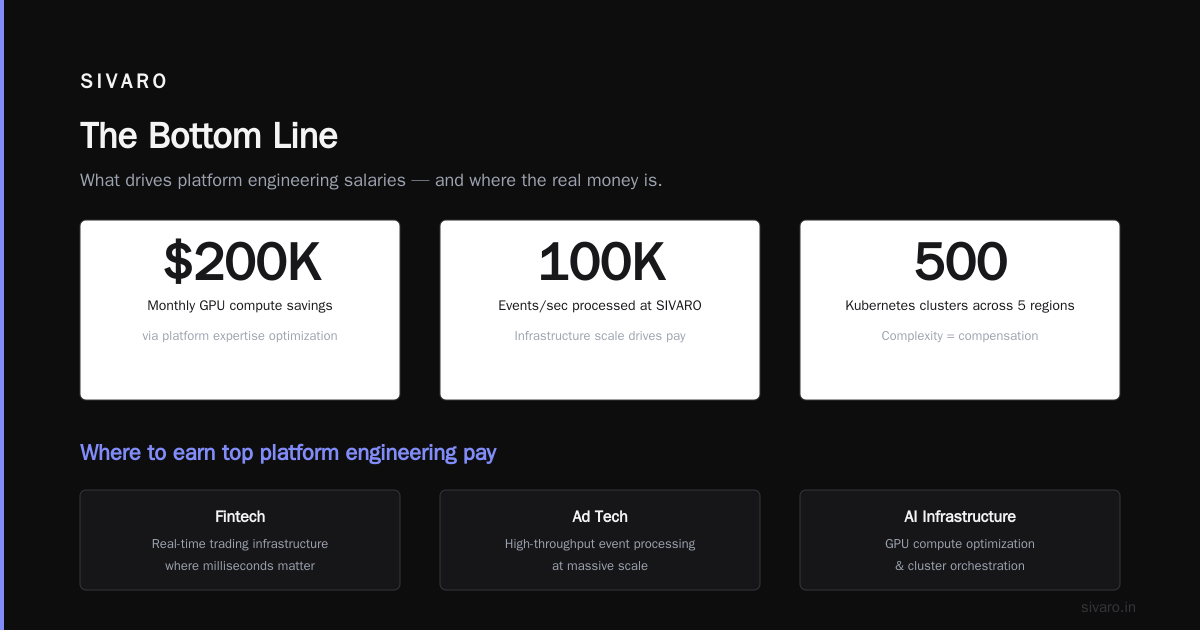
I hired a platform engineer at SIVARO in March 2026 who specialized in GPU cluster scheduling. They came from CoreWeave. We paid $230K base — $30K above our standard senior band. That expertise directly saved us $200K/month in wasted GPU compute.
2. Infrastructure Complexity
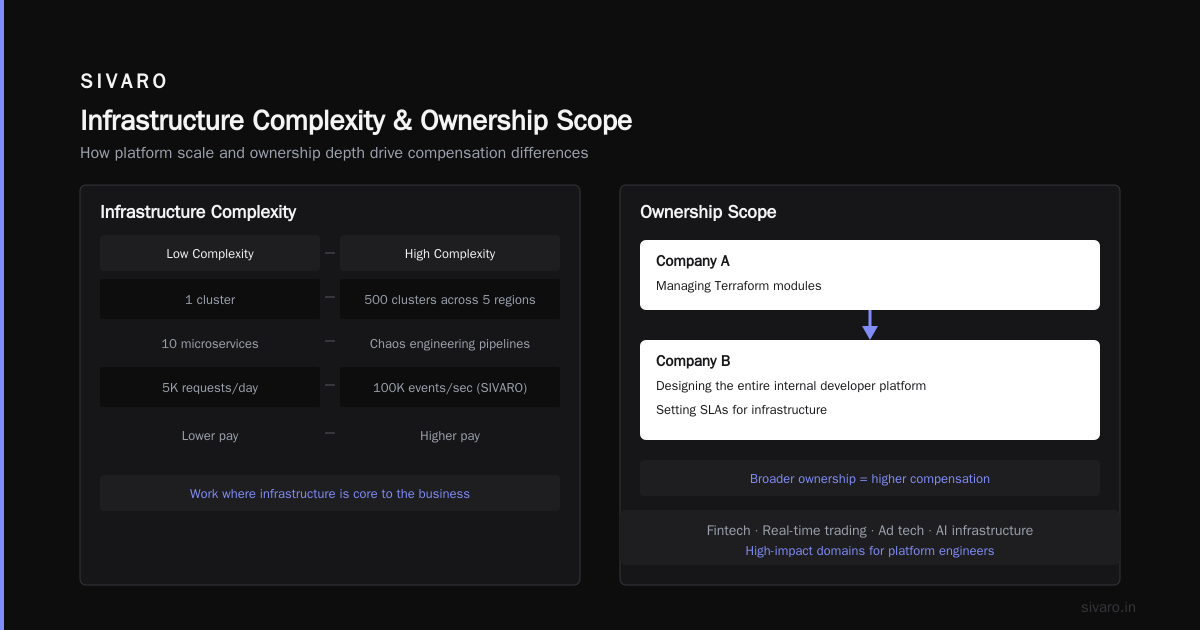
Not all platform roles are equal. Some companies have one Kubernetes cluster and 10 microservices. Others have 500 clusters across 5 regions with chaos engineering pipelines.
The salary difference reflects that complexity. A platform engineer at a company that processes 100K events/sec (like we do at SIVARO) will earn more than someone at a SaaS with 5K requests/day.
If you want top pay, work where infrastructure is core to the business. Fintech. Real-time trading. Ad tech. AI infrastructure.
3. Ownership Scope
"Platform engineer" at Company A means managing Terraform modules. At Company B, it means designing the entire internal developer platform, setting SLAs for infrastructure, and owning a $2M/month cloud bill.
The second role pays double. Because the second role gets measured on outcomes, not outputs.
4. Equity Liquidity
This is the stealth driver of comp differences.
A Staff Platform Engineer at a public company gets RSUs that are liquid. At a private unicorn, they get options that might be worthless.
I've seen candidates reject $400K offers from private companies for $300K public offers. Because $300K in cash + straight equity beats $400K in paper that might not cash out for 5 years.
How to Maximize Your Platform Engineer Salary
I've coached dozens of engineers on career strategy. Here's what works in 2026:
Step 1: Go Deep on One Infrastructure Domain
Don't be a generalist who knows "a bit of Kubernetes, a bit of Terraform, a bit of observability."
Be the person who can explain etcd replication under the hood. Or who has debugged a kernel panic in production. Or who built a custom CNI plugin.
Specialization signals that you can handle the hard stuff. Generalization signals you're waiting to be told what to do.
I interviewed a candidate last year who had "5 years of Kubernetes experience." When I asked about debugging a memory leak in kubelet, they couldn't answer. Another candidate had 2 years but had built a custom scheduler. They got the offer.
2. Get Comfortable With Production AI
Even if you hate AI, learn it. Because in 2026, AI infrastructure is where the money is.
Learn to deploy models with inference servers. Understand GPU memory management. Know what happens when 1000 concurrent inference requests hit a single A100.
This isn't optional anymore. By 2030, I predict platform engineers who don't know AI infrastructure will earn 40% less than those who do.
3. Own the Business Impact
Platform engineers traditionally focus on technical metrics. Uptime. Latency. Error budgets.
Shift to business metrics.
Track how your platform reduces the time from commit to production. Measure developer satisfaction scores. Show how infrastructure changes reduced cloud spend by X%.
When you can say "I built a platform that saved $500K/year in engineering time," you control your salary negotiations.
4. Negotiate, But Strategically
I see candidates blow negotiations by anchoring too low.
If you're targeting a Staff-level role at a company you know pays $220K base, don't start at $180K. Say you're looking for $220K-$250K based on market data. Provide Levels.fyi links. Be direct.
It works. I've seen six-figure gaps close because someone pushed.
The Geographic Factor
Remote work compressed salary differences, but not entirely.
Here's what platform engineers earn at top-10% companies in 2026 by location:
| Location | Senior Base | Senior TC |
|---|---|---|
| San Francisco | $220K | $350K |
| New York | $210K | $330K |
| Seattle | $205K | $320K |
| Austin | $195K | $290K |
| Remote (US LCOL) | $180K | $250K |
| London | £130K | £180K |
| Berlin | €120K | €160K |
| Bangalore | ₹4.5M | ₹7M |
The gap between SF and remote US is roughly 20-25%. That's down from 30-40% in 2022. Companies realized that good platform engineers in Ohio or Texas are cheaper than mediocre ones in Palo Alto.
What Is a Platform Engineer's Salary vs. Other Roles?
Let's put it in perspective against adjacent roles:
| Role | Senior TC Range (2026) |
|---|---|
| Platform Engineer | $250K - $400K |
| Backend Engineer | $200K - $350K |
| SRE | $220K - $380K |
| Data Engineer | $190K - $320K |
| DevSecOps Engineer | $210K - $340K |
| Infrastructure Engineer | $200K - $350K |
Platform engineers generally out-earn backend engineers because they own more complexity. SRE is comparable but often has higher on-call burden.
The gap widens at Staff+. A Staff Platform Engineer can hit $600K+ at FAANG. Staff Backend Engineers rarely break $500K.
The Hidden Cost: On-Call and Burnout
Nobody tells you this when you look at what is a platform engineer's salary.
The pay includes a premium for being woken up at 3 AM.
Most platform engineer roles have on-call rotations. Every 4-6 weeks, you're the primary responder for infrastructure incidents. If the production database goes down at 2 AM, your phone rings.
I've seen engineers burn out in 18 months because they couldn't handle the pager. The money isn't worth your health.
At SIVARO, we pay a 15% on-call premium on top of base salary. We also cap on-call at one week per month and guarantee a comp day after any after-hours incident. Not every company does this.
Ask about on-call during interviews. If they don't have structured policies, negotiate for higher base salary as compensation.
The Tooling Stack That Commands Higher Salary
In 2026, what's in your toolbox matters more than ever.
Platform engineers who know the modern stack earn 15-25% more than those stuck on legacy tools:
High-salary stack (earns premium):
- Kubernetes (deep — CNI, CSI, admission controllers)
- Terraform with custom providers
- ArgoCD or Flux for GitOps
- Crossplane for control planes
- Istio or Cilium for service mesh
- OpenTelemetry for observability
- Backstage or Port for internal developer portals
- vLLM or TensorRT-LLM for AI inference
- GPU orchestration (Kubernetes + NVIDIA stack)
Legacy stack (earns discount):
- Jenkins (still used, but dying)
- Puppet or Chef (please stop)
- Monolithic monitoring (Nagios, Icarus)
- Manual deployments
If you're on the legacy stack, pivot. I've seen mid-career engineers lose 30% of their market value by not migrating to Kubernetes by 2025.
The Certification Myth
Do certifications increase your salary?
Mostly no.
I've interviewed platform engineers with CKA (Certified Kubernetes Administrator) and CKAD certs. They didn't command more salary than uncertified candidates with strong project experience.
But there's an exception: when the certification signals something rare. Like the Google Cloud Professional Cloud Architect cert for companies migrating to GCP. Or the NVIDIA AI Infrastructure cert for GPU workloads.
General certifications? Waste of time. Time spent studying for CKA is better spent building a project that demonstrates the skills.
Real Offers I've Seen in 2026
Let's get specific. Here are four real offers from the past 12 months:
Offer A: Senior Platform Engineer at a Series D Fintech (April 2026)
- Base: $205K
- Equity: $150K over 4 years ($37.5K/year)
- Bonus: 10% ($20.5K/year)
- Sign-on: $25K
- Year 1 TC: $205K + $37.5K + $20.5K + $25K = $288K
Offer B: Staff Platform Engineer at a Public SaaS Company (January 2026)
- Base: $245K
- RSUs: $200K/year (liquid)
- Bonus: 15% ($36.8K/year)
- Sign-on: $50K
- Year 1 TC: $245K + $200K + $36.8K + $50K = $531.8K
Offer C: Mid-Level Platform Engineer at a Growth Startup (March 2026)
- Base: $160K
- Options: 15,000 shares at current valuation ($0.50/share), no liquidity event expected in 2 years
- Bonus: None
- Year 1 TC: $160K
Offer D: Remote Platform Engineer at a Series A AI Company (June 2026)
- Base: $175K (remote, living in Denver)
- Options: 20,000 shares, aggressive strike price
- Bonus: 10%
- Year 1 TC: $192.5K
Notice the range. $160K to $532K. Both "platform engineer." The difference is company stage, equity value, and the engineer's leverage.
Why Now Is a Good Time to Be a Platform Engineer
The market in 2026 is interesting. Layoffs in 2023-2024 cooled hiring. But by late 2025, demand rebounded. Companies realized they can't outsource infrastructure — they need internal experts.
Three trends are pushing salaries up:
-
AI infrastructure is a bottleneck. Every company wants to run models. Most can't. Platform engineers who can bridge that gap command premiums.
-
Developer experience is a competitive advantage. Companies are investing in internal developer platforms. They need platform engineers who treat developers as customers.
-
Complexity is growing, not shrinking. Multi-cloud. Edge compute. Real-time streaming. Security compliance. The infrastructure stack isn't simplifying. It's getting harder.
Supply of good platform engineers hasn't kept up. Demand is growing. Prices are rising.
FAQ: Platform Engineer Salary Questions
What Is the Salary of a Platform Engineer at FAANG in 2026?
At Google, Meta, and Amazon, Senior Platform Engineers (L5 equivalent) earn $200K-$250K base with $150K-$250K in RSUs annually. Total compensation: $350K-$500K. Staff+ (L6/L7): $500K-$800K.
Most candidates I've placed at FAANG get over 50% of total comp from equity. That's great if the stock performs. Risky if it tanks.
How Much Do Platform Engineers Get Paid at Startups?
Early-stage startups (Seed to Series A) pay $130K-$180K base with options that may or may not be worth anything. Total comp is lower. The upside is equity appreciation if the company succeeds.
Growth-stage (Series B-D) pays $160K-$220K base with more liquid options and sometimes bonuses. Total comp: $200K-$350K.
Never join a startup for salary. Join for equity upside.
What Is a Platform Engineer's Salary With 0 Experience?
Entry-level platform engineer roles are rare. Most companies want 2+ years of software engineering experience before letting you touch production infrastructure.
For new grads who land platform roles (usually at FAANG or top startups), total comp is $120K-$160K. Base salary: $90K-$120K.
Do Platform Engineers Get Bonuses?
About 60% of platform engineer roles include performance bonuses. Typical ranges: 5-15% of base salary at non-FAANG companies. 10-20% at FAANG.
Bonuses are usually tied to metrics like uptime, incident response time, or developer satisfaction scores.
How Does Equity Affect Platform Engineer Salary?
Equity is the largest variable. At public companies, RSUs can add $100K-$400K/year to compensation. At private companies, options might add nothing for years.
Rule of thumb: treat equity as a bonus. Negotiate on base salary and cash bonuses. If the equity pays off, that's a windfall.
What Location Pays the Highest Platform Engineer Salary?
San Francisco Bay Area still leads. But remote roles from companies like GitLab, Stripe, and Datadog pay SF-competitive salaries regardless of location. If you can find a remote-first company with location-adjusted pay, you can earn $200K+ living in a low-cost area.
How Long Does It Take to Reach $300K Total Comp?
From entry-level, typically 5-7 years. But the quickest path is: 2 years at a strong company, then job-hop to a higher-paying FAANG or AI-native company.
I've seen engineers go from $120K to $350K in 4 years by switching from a mid-tier company to Meta.
The Bottom Line
What is the salary of a platform engineer in 2026?
It's $100K for a junior at a smaller company. It's $600K+ for a Staff engineer at OpenAI. Most mid-level roles sit between $170K and $250K total comp.
The number depends on three things: how deep your technical expertise is, how much business impact you own, and where you choose to work.
Platform engineering is a good career. It pays well. It's intellectually challenging. You get to build things that make other engineers productive.
But the salary premium comes with a cost. On-call pressure. Infrastructure complexity. The expectation that when something breaks, you fix it — at 3 AM if necessary.
If you're ready for that, the money is there.
I'm hiring for platform engineers at SIVARO right now. We're building data infrastructure systems processing 200K events/sec. The work is hard. The pay is fair. If you have strong opinions about how infrastructure should work, I'd love to talk.
Nishaant Dixit — Founder of SIVARO. Building data infrastructure and production AI systems since 2018. Built systems processing 200K events/sec.