 SIVARO

How Much Does AI Development Cost in 2026?
You're not asking the right question.
I know, I know. You typed "how much does ai development cost in 2026?" into Google and got a spreadsheet of numbers. But after building AI systems at SIVARO for the last eight years, I can tell you the real question isn't "how much?" — it's "what are you actually buying?"
The range is brutal: $5,000 for a chatbot wrapper, $2 million for a production system that won't fall over. In 2026, I've seen both. The gap isn't about greed. It's about what's actually being built.
Here's what this guide covers: the real cost tiers, what actually drives price, where you can cut corners (and where you absolutely cannot), and how to figure out your number before you talk to a single vendor.
Let's start with the uncomfortable truth.
The Three Buckets of AI Development
Every project I've scoped in 2026 falls into one of three cost tiers. There's no fourth option. If a vendor tells you otherwise, they're selling you something.
Bucket One: The Prototype ($5K–$30K)
This is a proof of concept. Maybe you want to test whether GPT-4o or Claude can handle your document extraction. Maybe you need a chatbot that answers questions from your internal wiki.
I worked with a logistics company in Chicago this spring. They paid $18,000 for a prototype that classified shipping manifests. Took six weeks. The output was genuinely useful — but it was not a product. It had no authentication, no monitoring, no failover. It ran on a single machine in my partner's office.
For many teams, this is the right starting point. You learn what your data looks like when an AI actually processes it. That's worth the money by itself.
Bucket Two: The Product ($50K–$250K)
This is where production AI lives. You're building something your team will actually use daily. It integrates with your existing systems. It has a proper interface. Someone is responsible for it.
A healthcare provider in Austin paid us $140,000 earlier this year for an AI system that triages patient intake messages. That included:
- Fine-tuning a smaller model on their historical data
- A web interface for nurses to review AI suggestions
- Integration with their EHR system
- Three months of monitoring and adjustment
The price felt high to them until they calculated manual triage costs. The system paid for itself in seven months.
Bucket Three: The Enterprise System ($250K–$2M+)
Full production infrastructure. Custom model training, or complex RAG pipelines with strict latency requirements. Multiple teams involved. Security audits. Compliance documentation.
A national retailer in the UK spent roughly £1.2 million (about $1.5M) on a demand forecasting system that processes 50 million order lines per day. That included custom feature engineering, model evaluation infrastructure, and a dedicated MLOps platform.
These projects fail more often than they succeed. Not because the AI doesn't work — because the organization can't absorb the change. The technology is the easy part.
The honest breakdown from Albiorix's 2026 cost analysis puts enterprise AI between $200K and $1M+, which matches what I've seen. Their advice about scoping is solid: start narrow, prove value, expand.
Why the Price Range Is So Wide
You want a straight answer. I get it. But the range exists because you're not comparing like for like.
The same "AI document processing" request got quoted at $25,000 and $350,000 from two different vendors this year — same client, same requirements document. The difference wasn't greed. It was architecture.
The Four Cost Drivers
Data complexity. This is the #1 differentiator in 2026. If your data is clean, structured, and labeled, you'll spend half as much as someone with messy, fragmented data. A manufacturing client in Ohio had 14 years of maintenance logs across four ERP systems. Just ingesting and cleaning that data consumed 40% of the project budget.
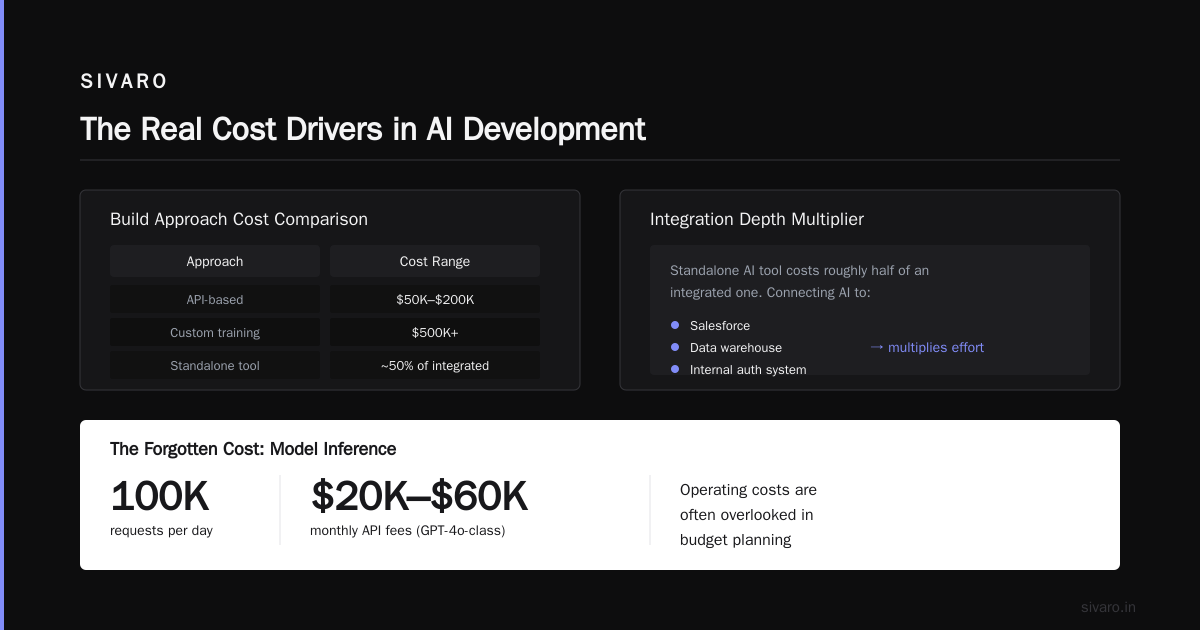
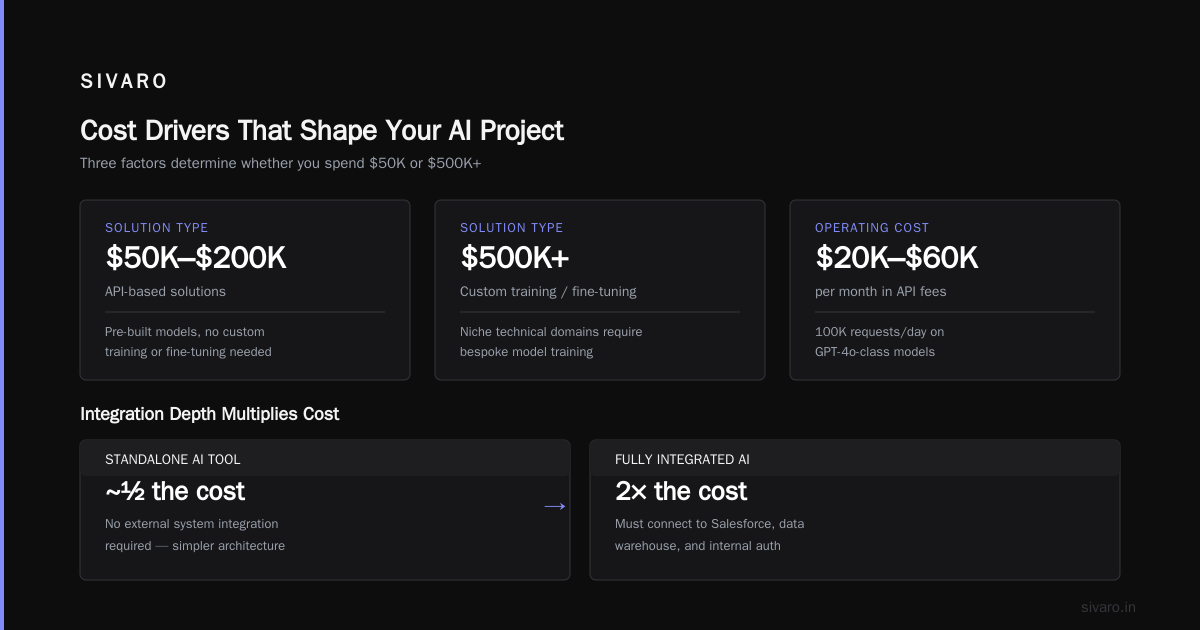
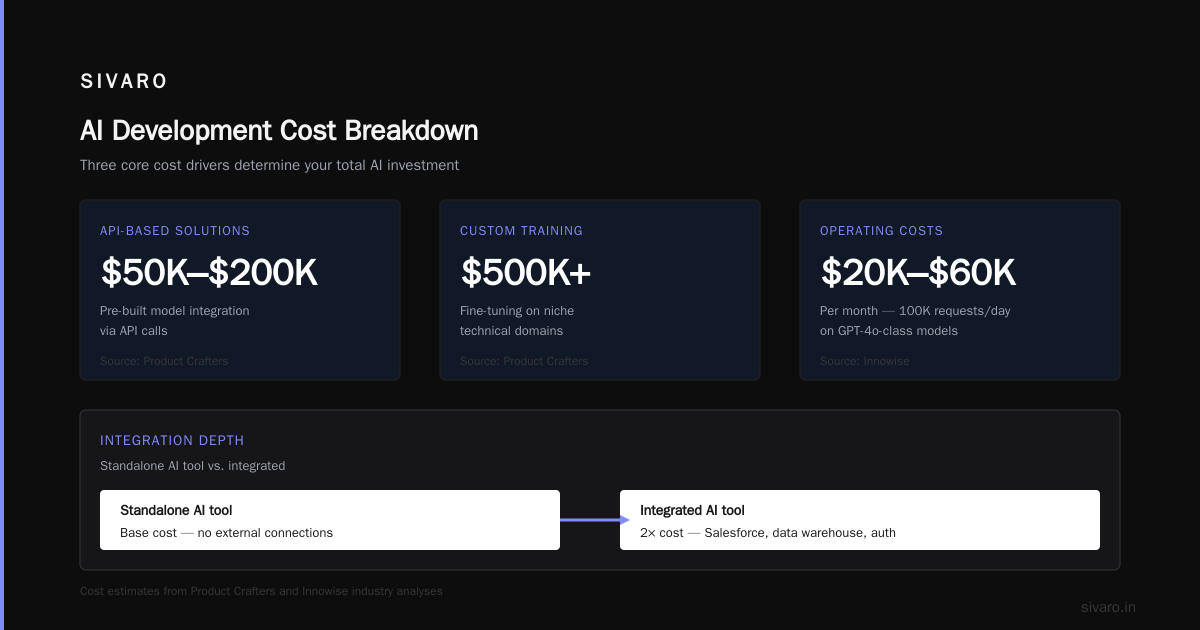
Model strategy. Most teams don't need to train their own model. Using existing APIs (OpenAI, Anthropic, open-source fine-tunes) costs far less. But if you need specialized performance — medical imaging, legal reasoning, niche technical domains — training or fine-tuning becomes unavoidable. Product Crafters' pricing breakdown shows API-based solutions running $50K–$200K while custom training pushes past $500K.
Integration depth. A standalone AI tool costs half what an integrated one costs. The moment you need your AI to talk to Salesforce, your data warehouse, and your internal auth system, the engineering effort multiplies.
Operating costs. This is the one everyone forgets. Model inference isn't free. A system processing 100,000 requests per day on GPT-4o-class models will cost $20,000–$60,000 per month in API fees. Innowise's cost analysis covers this well — their recurring cost breakdown matches what we see in production.
The Hidden Costs That Kill Budgets
Here's where I earn my keep. I've watched three projects blow past their budgets this year. All three hit the same walls.
Prompt Engineering Isn't Engineering
Everyone thinks prompt engineering is the skill. It's not. The real work is building evaluation sets — test cases that verify your AI system actually performs correctly. That's where 15% of the total budget goes, and it's the part most vendors skip.
If you hire a team that doesn't build evaluations into the process, you'll pay later. The system will look like it works on demo data. Then it'll hit your real edge cases and fall apart.
Infrastructure Maturity
I've said this before and I'll keep saying it: most AI failures aren't AI failures. They're infrastructure failures. Slow retrieval, memory leaks, poorly managed vector databases, unoptimized inference servers.
Sparkout Tech's analysis breaks down infrastructure costs at roughly 20–30% of total budget. That matches my experience. If someone quotes you a price with less than that, they're either going to cut corners or hit you with change orders later.
The "Stupid Question" Tax
Every project has unanticipated requirements. The client who says "can you just make it work with our legacy system?" — that's a tax. The executive who insists the AI needs a "human-like personality" when all you need is accurate extraction — also a tax.
A fintech startup in Singapore lost six weeks to scope creep because their CTO kept asking for "AI features" that had no business use case. The budget overrun wasn't technical. It was governance.
Leaning on AI Tools to Cut Costs
I mentioned earlier that some projects are cheaper now. Here's the deal: AI-assisted development is genuinely changing the economics of software.
At SIVARO, we've cut development time on certain components by 30–50% using AI pair programming tools. That's real. That translates directly to lower project costs.
But — and this is a big but — the efficiency gains are not uniform. They're concentrated in well-understood, structured coding tasks. Data integration, API orchestration, front-end scaffolding. That's where we see the gains.
The complex parts — understanding your specific domain, designing evaluation frameworks, debugging production anomalies — those still need humans.
A mobile development firm's analysis of AI tools claims you can cut budgets 3x with AI tools. I'd push back on that. We've seen 30–50% savings on specific workstreams, but the overall project cost only drops 15–25% because the hard parts dominate the timeline.
Use AI tools to make good engineers faster. Don't use them to replace the thinking.
Real Pricing, Real Projects
Let me give you actual numbers from Avenga's 2026 analysis and our internal project records. These are genuinely what we're seeing:
| Project Type | Typical Cost | Timeline | Typical Failure Reason |
|---|---|---|---|
| Chatbot, API-based | $10K–$50K | 4–8 weeks | Poor data foundation |
| Document extraction | $30K–$120K | 2–4 months | Edge cases unhandled |
| RAG-based knowledge assistant | $75K–$250K | 3–6 months | Retrieval quality |
| Custom fine-tuned model | $150K–$500K | 4–8 months | Dataset quality |
| Enterprise AI platform | $500K–$2M+ | 6–18 months | Organizational resistance |
| Computer vision system | $100K–$800K | 3–8 months | Hardware/latency constraints |
The RameSt analysis breaks their pricing down similarly, though their starting points are a bit lower. That's regional variation — Eastern European and South Asian teams run 20–30% cheaper than US or Western European teams.
The Kellton enterprise analysis has the most useful lens: they argue that enterprise AI costs shouldn't be compared to the price of the AI system alone. Factor in the cost of doing nothing — the lost productivity, the errors, the manual labor. That reframing changed how I present pricing to clients.
So How Do I Estimate My Project?
I keep this process simple. You should too.
Step 1: Define the output, not the feature.
"What AI does our business need?" is the wrong question. The right question is: "What decision or action should happen that doesn't today?"
A logistics company doesn't need "AI for trucking routes." They need "a system that reduces empty miles by 15%." That's a measurable outcome. It costs what it costs to achieve it.
Step 2: Audit your data honestly.
I'll say this without sugar-coating: if your data is a mess, your AI project costs more. Period.
Cleaning and structuring data is often 40–60% of the total budget. A garbage-in/garbage-out system isn't a discount — it's a donation.
Step 3: Decide between "buy and adapt" vs. "build from scratch."
For 80% of use cases, you can adapt an existing solution. Deploy a fine-tuned open-source model or use an API. The build-from-scratch path is only justified when you have extreme performance requirements or strict data governance needs.
Step 4: Get a monthly operating cost estimate.
The upfront price is only half the story. Ask vendors for the monthly inference, hosting, and maintenance costs. If the monthly recurring cost exceeds 15–20% of the upfront cost per month, you're buying a subscription dressed up as a project.
Step 5: Commit to an evaluation framework.
If you don't know what success looks like, you'll pay twice. Build your acceptance criteria before you sign anything.
Regional Differences in Pricing
The same project can cost very different amounts depending on where the development team sits. This isn't a quality judgment — it's market reality.
- North America & Western Europe: $100–$250/hour. Higher communication quality, better timezone overlap, but you're paying for the economy.
- Eastern Europe: $60–$120/hour. Strong engineering culture, good English, solid AI expertise. I've used Ukrainian and Polish teams for years with excellent results.
- South Asia: $30–$80/hour. Fast, capable, but be careful with scoping. The cheap rates can hide weaker QA practices and less mature infrastructure experience.
- Latin America: $50–$100/hour. Good timezone overlap with US, growing AI ecosystem, particularly strong in data engineering.
Your mileage varies. I've seen beautiful work from all regions. I've also seen disasters from all regions.
The Innowise breakdown includes a thorough hourly rate table that reflects what I've experienced. Use their numbers as reference points, not gospel.
The biggest single variable is the team's actual experience with production AI systems. Not demos. Not conference talks. Production.
Ask every vendor: "What's the maximum throughput of a system you've built, and what happened when it scaled past that?" Their answer tells you everything.
The Pushback: Why I Don't Believe in "Cheap" AI
I said earlier I'd be honest. Here's the contrarian take.
The market is flooded with "$5,000 AI chatbot" shops. They're all competing on price because they're not competing on capability. And they're dangerous.
Not because the chatbots don't work — they do, for basic use cases. The danger is the conversation they make possible in your organization.
Your leadership sees a $5,000 chatbot that works for the demo. Then they ask why your production system costs $200K. Now you're in a conversation that wastes everyone's time, because the $5,000 chatbot wasn't solving the actual problem. It was solving "show me something with AI attached."
I'm not saying every project needs enterprise budgets. I'm saying you need to be honest about what you're buying. A prototype is not a deployment. A demo is not a system.
Digital transformation via AI has a price. It's not the price of the models. It's the price of changing how your organization operates — and that cost is mostly humans, not technology.
What I'd Tell a Friend (or a Founder)
If you came to me, sat across my desk at SIVARO, and asked me "how much does ai development cost in 2026?", here's what I'd say:
Start with $20,000 in reserve and a 6-week sprint. Attack one narrow, high-value problem. Measure everything. If the prototype shows promise — go build the real thing for $75K–$150K. If it doesn't, you've spent 10% of what a big project would've cost on a lesson that would've cost you 10x more to learn mid-project.
Don't start with a pilot that has no owner. The most expensive AI projects I've seen were the ones where no senior leader was accountable for the outcome. Budget for a project champion who has skin in the game.
And please, stop asking for "the price." Ask for "the cost" — as in, the full cost, including operating expenses, maintenance, training, and the cost of your people learning to work alongside the system.
That's the number that matters. The Avenga article makes this same point: the total cost of ownership over 3 years runs 3–5x the initial build. Plan for that.
FAQ
Q: Can I get an AI system built for under $10,000?
Yes, for narrow prototypes and simple chatbot integrations. But you shouldn't expect production reliability, security, or scalability at that price. You're paying for a proof of concept, not a product.
Q: What's the most common budget surprise?
Data preparation. Nobody budgets enough for cleaning, labeling, and structuring their data. I've seen this overrun budgets by 50–100% repeatedly. Audit your data before you start.
Q: How long does a typical AI project take?
A production-ready AI system takes 3–6 months for most business applications. Enterprise-scale projects with heavy integration or custom training can take 9–18 months. If a vendor promises production in 2 weeks, they're either heroic or lying. Usually the latter.
Q: Do I need to hire AI engineers in-house, or outsource?
This depends. If AI is core to your product, hire in-house over time. If it's supporting your main business, buy from specialists. The hybrid model — internal product owner, external engineering team — works well for many companies.
Q: How much does it cost to run AI after deployment?
Plan for 10–20% of the build cost per year for maintenance, model updates, and tuning. On top of that, compute costs (inference, hosting) will run based on usage — from a few hundred dollars a month to tens of thousands.
Q: Are open-source AI models cheaper?
Cheaper upfront, not necessarily cheaper overall. You save on API fees but pay more in engineering time, infrastructure, and operational expertise. For simple use cases, APIs are the pragmatic choice. For high-volume or high-sensitivity applications, open-source fine-tuning often wins.
Q: What's the one thing that makes AI projects fail?
Scope. AI projects collapse when you can't measure success. Every successful project I've seen has a clear evaluation framework. Every failure didn't.
Here's my final thought, and it's the only thing that matters.
The price of AI development in 2026 isn't the number on a quote. It's the cost of your organization not adapting to what AI actually does. Every business in every industry is figuring this out. The question isn't "can we afford it?" — it's "can we afford to keep producing the same way while competitors iterate?"
The answer, most days, is no.
Nishaant Dixit — Founder of SIVARO. Building data infrastructure and production AI systems since 2018. Built systems processing 200K events/sec.