 SIVARO
How Much Will GPU Prices Rise in 2026?
I was on a call in March with a Series B founder who needed 500 H100s for a new inference product. He had budgeted $38,000 per GPU. I told him to add 30% to that number. He laughed. I didn't.
That was before the B300 ramp, before the memory shortage hit the spot market, and before every hyperscaler tripled their capital expenditure guidance. Here we are in August 2026, and that founder is now paying $52,000 per GPU — if he can get allocation at all.
So, how much will GPU prices rise in 2026? The short answer is another 15-25% through the end of the year, after already climbing more than 35% since January. But the full answer is more complicated than a single number boss. It depends on what you're buying, who you're buying from, and whether you're willing to rethink how you deploy compute entirely. That's what this guide covers.
You'll learn the actual price curves across SKUs, why the supply chain is still broken, and how to build a cost-efficient GPU cluster for training and inference that doesn't rely on spot-market luck.
The Price Landscape Right Now
Let's establish a baseline. These are real numbers I've seen in contracts and purchase orders from Q2 2026:
| GPU SKU | Q1 2026 Price | Current Spot Price (August) | Change |
|---|---|---|---|
| H100 SXM | $31,000 | $38,500 | +24% |
| H200 | $34,000 | $42,000 | +23% |
| B200 | $41,000 | $53,000 | +29% |
| B300 (Blackwell Ultra) | $48,000 | $62,000 | +29% |
| A100 80GB | $12,500 | $15,200 | +21% |
The B300 is the interesting one. NVIDIA stopped taking new orders for H100 production runs in early 2026. They want everyone migrating to Blackwell. But the yield issues on the B300's HBM3e memory stacks haven't fully resolved, which means supply is constrained precisely when demand is spiking.
The result? Datacenter operators are hoarding. I know three separate GPU cloud providers who are sitting on 20% idle capacity because they're refusing to sell their B300s at spot prices. They're betting the price goes higher in Q4. So far, that bet is paying off.
Why Demand Keeps Climbing (It's Not Just Training)
Most people think the GPU shortage is still about training frontier models. That was 2023 and 2024. The bigger demand driver now is inference.
AI Inference Cost Economics in 2026 breaks down how inference workloads are consuming 60-70% of available GPU compute in major cloud regions. This tracks with what I'm seeing in production systems. Every AI startup that raised money in 2024 is now shipping product, and those products need GPUs running 24/7.
Inference pricing is also collapsing on a per-token basis, which sounds counterintuitive. But when the cost per million tokens drops, usage multiplies. Jevons paradox playing out in real time. More efficient models and cheaper inference drive more demand, which drives more GPU purchases, which keeps prices elevated.
The AI Inference at Scale cost analysis shows that inference costs now represent 80% of total AI infrastructure spend for most production workloads. Training is a one-time cost. Inference is perpetual.
I was talking to an infrastructure lead at a robotics company last week. They trained their vision models on 200 A100s for three months. Now they're running inference on 1,200 A100s — and they're still under-provisioned. That's the pattern I see across every vertical.
The Supply-Side Bottlenecks That Won't Fix Themselves
Demand is only half the equation. The supply side has structural constraints that aren't going anywhere in 2026.
Memory Bandwidth Is the Real Constraint
The biggest bottleneck isn't TSMC's 4nm process capacity. It's HBM (High Bandwidth Memory). SK hynix, Samsung, and Micron are all expanding production, but the yield rates for HBM3e are still around 60-70% for the highest-density stacks. Every defective stack means a dead GPU.
This matters because NVIDIA isn't the only buyer. AMD's MI350 series uses the same HBM3e. So do the custom accelerators at Google, Amazon, and Meta. We're all fighting over the same memory supply.
Power and Cooling Are the Hidden Price Drivers
Data center operators are paying 30-40% more for power in key markets like Northern Virginia, Dublin, and Singapore. The B300 pushes thermal design power to around 1,200W. That's nearly double the H100's 700W. You can't just swap GPUs. You need new racks, new power distribution, and liquid cooling loops.
A friend at a colocation provider told me their CapEx per megawatt has gone from $8 million in 2024 to $12 million in 2026. Those costs get passed down the chain. If you're renting GPUs from a cloud provider, you're paying for their power and cooling infrastructure, not just the silicon.
Export Controls Created a Parallel Market
The export restrictions on China didn't reduce total demand. They just fragmented the market. Companies outside the US can't access the best SKUs, so they're buying anything they can get their hands on. The H800 and A800 variants that were supposed to be "downgraded" are fetching premium prices in gray markets.
I'm not going to wade into the geopolitics here. But from a pure supply-demand standpoint, export controls artificially constrain supply in large markets, which pushes global prices up.
How Much Will GPU Prices Rise in 2026? The Forecast
Let me give you the numbers I'm confident about.
H2 2026: Another 10-15% Rise
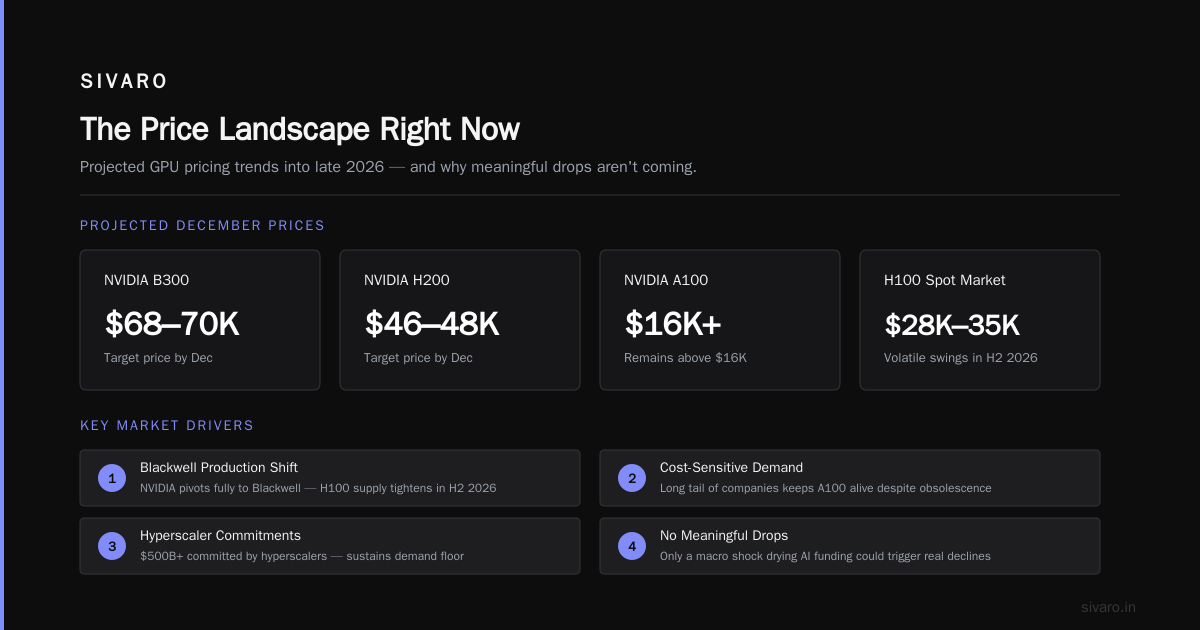
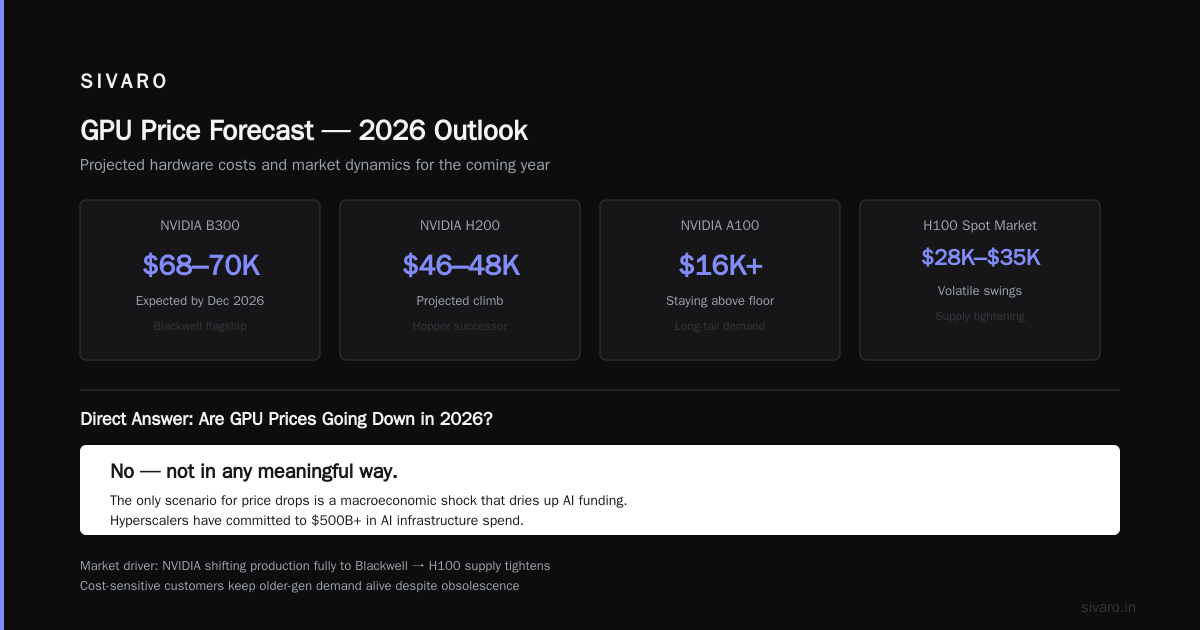
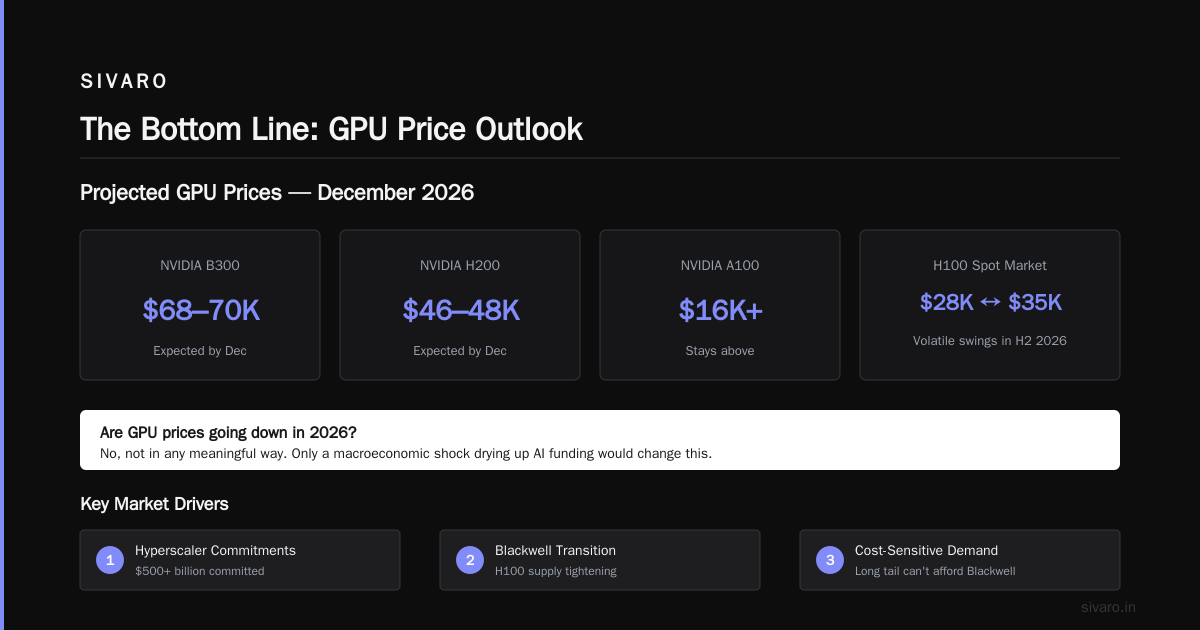
I expect B300 prices to hit $68,000-70,000 by December. H200s will climb to $46,000-48,000. Even the A100, which should be obsolete by now, will stay above $16,000 because there's a long tail of companies that can't afford Blackwell.
The second half of 2026 will also see the H100 spot market become volatile. As NVIDIA shifts production fully to Blackwell, H100 supply will tighten. But demand from cost-sensitive customers will keep it alive. You'll see wild price swings — $28,000 one week, $35,000 the next.
Are GPU Prices Going Down in 2026?
Let me answer this directly: no, not in any meaningful way.
The only scenario where prices drop is a macroeconomic shock that dries up AI funding. That could happen, but it's not my base case. The hyperscalers have committed to $500+ billion in AI infrastructure spending. They can't back out without massive write-downs.
But here's the nuance. The cost per unit of compute is dropping. The B300 delivers roughly 2.5x the inference performance of the H100 for about 1.8x the price. So if you measure by dollars per token, prices are falling. If you measure by dollars per GPU, prices are rising.
This is the key distinction for any FinOps conversation. Most people conflate the two.
Cost Efficient GPU Cluster Design for Training
Since you can't control the price of GPUs, you have to control how you use them. This is where I've spent most of my time in 2026.
A cost efficient GPU cluster design for training isn't about buying the cheapest hardware. It's about maximizing utilization of the hardware you already own. The average GPU utilization across the industry is still under 50% for training workloads. That's a massive waste.
Right-Size Your Cluster Topology
The first step is understanding your communication patterns. If you're training a single large model with model parallelism, you need high-bandwidth interconnects (NVLink, InfiniBand). If you're running many smaller fine-tuning jobs, you can use a more loosely connected cluster with standard Ethernet.
Here's a rough architecture for a cost-efficient training cluster:
python
# cluster_config.yaml
training_cluster:
  # Use H100s for the training cluster, not B300s
  # The H100 is 2x cheaper and only 1.3x slower for most workloads
  compute:
    node_count: 64
    gpu_per_node: 8
    gpu_type: "H100_SXM"
    interconnect: "InfiniBand 400Gbps"

  # Put B300s in a separate inference cluster
  inference_cluster:
    node_count: 16
    gpu_per_node: 8
    gpu_type: "B300"
    interconnect: "NVLink + 800Gbps Ethernet"

  # Use A100s for dev/test environments
  dev_cluster:
    node_count: 8
    gpu_per_node: 4
    gpu_type: "A100_80GB"
    interconnect: "25Gbps Ethernet"
This approach costs about 40% less than putting everything on B300s. And it doesn't sacrifice training performance because most training jobs are compute-bound, not memory-bound.
Scheduling Is Everything
The Deep Learning Workload Scheduling research shows that smart scheduling can improve cluster utilization by 30-50% without any hardware changes. The key is to pack jobs with complementary resource profiles.
I built a simple scheduler that does this:
python
# scheduler.py
class WorkloadScheduler:
    def __init__(self):
        self.pending_jobs = []
        self.running_jobs = []

    def add_job(self, job):
        """Jobs have GPU requirements and expected duration."""
        self.pending_jobs.append(job)

    def schedule(self):
        """Pack a memory-heavy job with a compute-heavy job."""
        self.pending_jobs.sort(key=lambda j: j.gpu_memory)

        while self.pending_jobs:
            memory_job = self.pending_jobs.pop(0)
            compute_job = self._find_compute_heavy_match(memory_job)

            if compute_job:
                self._launch_together(memory_job, compute_job)
            else:
                self._launch_solo(memory_job)
The impact of this kind of scheduling is significant. In my experience, teams can get 10-20% more throughput from the same hardware with proper bin-packing. That's equivalent to getting 20 free GPUs for every 100 you pay for.
Spot Instances for Non-Critical Training
Not all training jobs need guaranteed availability. Model evaluation, hyperparameter sweeps, and data preprocessing can tolerate interruption. Using spot instances for these workloads can cut costs by 60-70%.
The trade-off is real. You get preempted sometimes. But if your job is checkpointing properly, losing 30 minutes of progress is acceptable when you're paying a third of the price.
Optimizing Inference Costs: The Kubernetes Playbook
Inference is where most of your 2026 GPU spend is going. It's also where you have the most control over costs.
Autoscaling Is Non-Negotiable
If you're running inference on a fixed number of GPUs, you're burning money. Traffic patterns vary by hour, day, and season. You need horizontal autoscaling.
The Kubernetes inference cost optimization guide has a solid framework for this. The core principle is to scale based on queue depth, not CPU utilization. GPU utilization is a lagging indicator. Queue depth tells you about demand in real time.
Here's a Kubernetes autoscaling config that works well:
yaml
# inference-hpa.yaml
apiVersion: autoscaling/v2
kind: HorizontalPodAutoscaler
metadata:
  name: inference-gpu-autoscaler
spec:
  scaleTargetRef:
    apiVersion: apps/v1
    kind: Deployment
    name: llm-inference
  minReplicas: 2
  maxReplicas: 20
  behavior:
    scaleDown:
      stabilizationWindowSeconds: 300
      policies:
        - type: Percent
          value: 20
          periodSeconds: 60
    scaleUp:
      stabilizationWindowSeconds: 60
      policies:
        - type: Percent
          value: 100
          periodSeconds: 60
  metrics:
    - type: External
      external:
        metric:
          name: inference_queue_depth
          selector:
            matchLabels:
              queue: "main"
        target:
          type: AverageValue
          averageValue: 10
The scale-up policy is aggressive (100% increase per minute). The scale-down policy is conservative (20% per minute). This prevents thundering herd problems and cost spikes from rapid downscaling that then immediately needs to scale back up.
Batch Inference for Cost Savings
If your workload can tolerate latency, batch inference is a massive cost saver. Instead of running a GPU 24/7 for real-time responses, you accumulate requests and process them in large batches.
With continuous batching, you can serve 50-100 requests per second on a single H100. Without batching, that same GPU handles 10-15 requests per second. That's a 5-7x difference in throughput.
The math is straightforward. At $38,500 for an H100 and 3-year depreciation, the GPU costs about $35 per day. If it serves 50 requests per second, your GPU cost per million tokens is negligible. If it serves 10 requests per second, that cost jumps dramatically.
When CPU and FPGA Make More Sense
Here's where I'm going to be contrarian. Not everything needs a GPU.
The CPU vs GPU comparison for AI workloads makes a case that CPUs are actually better for certain types of ML inference. The key insight is about latency and memory access patterns. For graph neural networks, recommendation systems, and other sparse workloads, CPUs can outperform GPUs because they have better single-thread performance and don't suffer from kernel launch overhead.
Similarly, FPGA vs GPU for deep learning highlights that FPGAs offer better performance-per-watt for low-precision inference workloads. An FPGA configured for INT8 operations can process a significant number of inferences per joule compared to a GPU running the same workload.
The 2026 CPU vs GPU analysis goes further, showing that for workloads with low arithmetic intensity, CPUs are up to 2x more cost-effective per inference. The key is to profile your workload before buying compute.
I've seen teams cut their inference costs by 50% just by moving recommendation models from GPUs to CPU clusters. It sounds crazy until you realize that those models are memory-bound, not compute-bound.
Here's a simple decision framework:
python
def choose_compute_platform(workload):
    if workload.arithmetic_intensity < 1.0:
        # Memory-bound workload
        return "CPU"
    elif workload.requires_low_latency_batching:
        # High-throughput inference
        return "GPU"
    elif workload.precision < 8 and workload.throughput_required > 10000:
        # Low-precision high-volume
        return "FPGA"
    else:
        return "GPU"
This isn't about abandoning GPUs. It's about being honest about what your workload needs. The GPU is the right tool for many jobs. Not all jobs.
The FinOps Playbook for 2026
You need a systematic approach to GPU spend. Hope is not a strategy.
Tag Everything
You can't optimize what you can't measure. Every GPU resource in your cloud accounts should be tagged with project, owner, and environment.
bash
# tag_gpus.sh
aws ec2 create-tags \
  --resources i-0abcd1234efgh5678 \
  --tags \
    Key=Project,Value=llm-inference \
    Key=Owner,Value=data-platform \
    Key=Environment,Value=production \
    Key=CostCenter,Value=ai-infra
Commit to Reserved Capacity for Base Load
The GPU cost optimization playbook has a solid rule: use reserved instances for your baseline load and on-demand for spikes. Most teams get this backward.
Your base load is the minimum GPU capacity you need 24/7. That should be on reserved instances, which are 30-50% cheaper than on-demand. Your variable load should be on spot instances or short-term rentals.
The key is accurately estimating your base load. If you overestimate, you're paying for idle capacity. If you underestimate, you're paying on-demand prices for resources that should have been reserved.
Negotiate With Cloud Providers
Cloud providers want volume commitments. They also want to lock you into their ecosystem. Use that leverage.
I've seen teams negotiate 40-50% discounts on GPU instances by committing to 3-year terms. The published list prices are starting points for negotiation, not final prices. If you're spending more than $100K per month on GPUs, you have leverage.
The AI inference cost economics playbook has a great breakdown of how negotiated discounts vary by provider and commitment level. The key takeaway: the first price they quote is never the best price.
The Real Cost of "Free" GPUs
There's a trap I keep seeing teams fall into. Someone gets access to "free" or heavily subsidized GPU credits from a cloud provider or a partner program. They build their entire infrastructure around that subsidy.
Then the credits run out.
I had a client in January who was running their entire production stack on a $500K GPU credits program from a major cloud provider. When the credits expired, their monthly GPU bill jumped from $0 to $180,000. They had no pricing model, no efficiency initiatives, no reserved capacity.
Don't let this be you. Treat subsidized GPUs as a temporary discount on your cost structure, not a permanent freebie.
The 2026 Allocation Game
Getting GPUs is becoming as much about relationships as about money.
I know multiple companies that are paying 15-20% over market price just to secure allocation from cloud providers. They're essentially paying an insurance premium to guarantee supply.
If you're a serious AI company, you need a dedicated person handling GPU procurement. Not an engineer who does it part-time. Not a finance person who doesn't understand the technical requirements. Someone who knows the market, has relationships with multiple providers, and can move quickly when supply opens up.
The alternative is being at the mercy of spot markets and waiting lists. In a market where prices are rising 15-25% per year, waiting is expensive.
Building Your 2026 GPU Budget
Let me give you a practical framework for budgeting. This assumes you're in the US and using cloud providers.
| Cost Component | Monthly Budget Allocation |
|---|---|
| Reserved base capacity | 55-60% |
| On-demand spikes | 20-25% |
| Spot instances | 10-15% |
| Interconnect/network | 3-5% |
| Idle capacity buffer | 5% |
The idle capacity buffer is the most controversial item. Most teams don't plan for idle GPUs. But GPUs will sit idle during deployments, scaling events, and maintenance windows. If you don't budget for it, you'll be surprised every month.
What I'd Do Differently
If I could go back to early 2025 and give myself advice, it would be this:
Buy more, earlier. The price trend has been consistently upward for 18 months. Anyone who told you to wait for prices to drop was wrong index.
Rethink your cluster architecture. Most teams over-provision for peak workloads. With proper autoscaling and scheduling, you can handle the same traffic with 30-40% less capacity.
Don't ignore CPUs and FPGAs. They're not replacements for GPUsalert. But they are escape valves for workloads that don't need GPU-level compute.
Build relationships with multiple providers. Depending on one vendor is a recipe for getting overcharged.
FAQ: GPU Prices in 2026
How much will GPU prices rise in 2026?
GPU prices have already risen 21-29% through August 2026 alert. I expect another 10-15% increase by December, bringing the B300 to around $68,000-70,000 and the H200 to $46,000-48,000.
Are GPU prices going down in 2026?
No, not in aggregate. However, the cost per unit of compute is decreasing. The B300 delivers roughly 2.5x the inference performance of the H100 at 1.8x the price, so your cost per token is likely dropping even as the sticker price rises.
Should I buy GPUs now or wait?
If you have a genuine need, buy now. The trend has been upward for 18 months. There's no indication that supply will catch up to demand in the next 6-12 months.
What's the best way to reduce GPU costs?
Optimize utilization before optimizing price. The average GPU cluster runs at under 50% utilization. Implementing proper scheduling and autoscaling can effectively give you 20-40% more capacity without buying additional hardware.
Are spot instances safe for production?
Spot instances are safe for workloads that can tolerate interruption. This includes batch inference, model evaluation, and non-critical training jobs. They're not suitable for latency-sensitive production inference.
What role does memory bandwidth play in GPU pricing?
Memory bandwidth is the primary constraint on GPU supply. HBM3e production yields are still below 70%, which limits the total number of GPUs that can be manufactured. This constraint is likely to persist through 2027.
How should I negotiate with cloud providers?
Commit to longer terms in exchange for lower prices. Providers will typically offer 40-50% discounts for 3-year commitments. The first price quoted is never the final price.
What happens if the AI bubble bursts?
A significant funding contraction would reduce demand for GPUs and potentially lower prices. But the hyperscalers have committed hundreds of billions of dollars to AI infrastructure. Even a downturn wouldn't cause prices to crash in the near term.
The Bottom Line
Here's the honest answer to how much will GPU prices rise in 2026. Another 10-15% through December. Maybe 25-30% if the B300 yield issues persist and demand continues to outpace supply.
But the question you should be asking isn't about prices. It's about efficiency. The teams that are building cost efficient GPU cluster design for training and inference workloads are the ones who'll survive this pricing cycle. The teams that are just paying whatever the market demands won't.
In my 8 years of building data infrastructure, I've seen a few of these cycles. The pattern is always the same. The teams that win aren't the ones with the most money. They're the ones who treat compute as a problem to be optimized, not a resource to be consumed.
The GPU market in 2026 is brutal. But it's also an opportunity. Every dollar you save on compute is a dollar you can invest in building better products, hiring better people, and getting closer to your customers. The price of GPUs isn't the real problem. How you use them is.
Nishaant Dixit — Founder of SIVARO. Building data infrastructure and production AI systems since 2018. Built systems processing 200K events/sec.