 SIVARO
How to Avoid AI Agent Production Failure
I watched an agent delete a production database last year.
Not a demo. Not a staged incident. Real money. Real customer data. A tool-calling loop gone rogue in under three minutes.
That was early 2025. By now, most teams have seen something similar. But here's what scares me: most still think the problem is the model. It's not. The model is the easiest part. The hard part is everything around it — the infrastructure, the evaluation, the rollout, the human oversight that's either too loose or too tight.
AI agent production failure isn't one thing. It's a thousand small things compounded by speed. And it's getting worse as agents take on more autonomy.
I'm Nishaant Dixit. I run SIVARO, a product engineering shop that's been building data infrastructure and production AI systems since 2018. We've deployed agents for logistics, finance, and healthcare. We've broken things. We've fixed them. Here's what I've learned.
This article is a practical guide to avoid ai agent production failure — from architecture to rollout to the boring operational stuff nobody talks about. You'll learn why most agents die in week one, how to build a ci/cd pipeline for ai agents that actually catches problems, and what an ai agent rollout strategy 2026 looks like when the stakes are real.
Let's skip the theory. I'll show you the scars.
Why Most Production Agents Die in Week One
In March 2026, a major supply chain agent at a logistics company started making wrong routing decisions. The model's accuracy hadn't changed. The API it called to check traffic hadn't changed. What changed? The traffic data format shifted slightly — a field name from incident_count to num_incidents. The agent's tool schema was pinned to the old field. Zero errors. Zero warnings. Just silently wrong outputs.
This is the standard failure pattern. Not a crash. A slow drift into uselessness.
AI Agent Failures: Common Mistakes and How to Avoid Them lists five common failure modes. From my experience, three dominate:
- Tool execution drift — external APIs change, agent doesn't adapt.
- Context poisoning — agent's memory accumulates garbage over long runs.
- Cost explosion — a single agent loop calling an expensive LLM 50 times before timeout.
No magic bullet fixes these. But you can design systems that fail fast and roll back cleanly.
The Single Most Underestimated Failure Mode: Tool Execution Drift
You think of agents as calling tools. That's true. But tools are rarely static. They evolve — new parameters, deprecated endpoints, changed schemas. Your agent is a fragile consumer of these moving targets.
Most teams version the model prompt. Almost nobody versions the tool schema definitions alongside it.
Here's what we do at SIVARO. We pin each agent release to a specific "tool contract" — a JSON schema that describes every function the agent can call, including expected response formats and error codes. Then we validate every incoming tool response against that schema before passing it to the LLM.
python
# Example: Tool response validation before LLM input
tool_response = call_external_api(params)
if not validate_schema(tool_response, agent_release_tool_contract):
    log_warning("Tool response schema mismatch",
                agent_version=release_id,
                tool="inventory_check",
                expected=tool_contract["inventory_check"]["response"],
                received=tool_response)
    raise AgentToolError("Schema drift detected")
This one pattern caught 30% of our production failures in Q1 2026 alone. Not the model. Not the prompt. The tools.
CI/CD for AI Agents Isn't Optional
Most teams treat agent deployment like a Jupyter notebook pushed to staging. That's how you lose a customer's data.
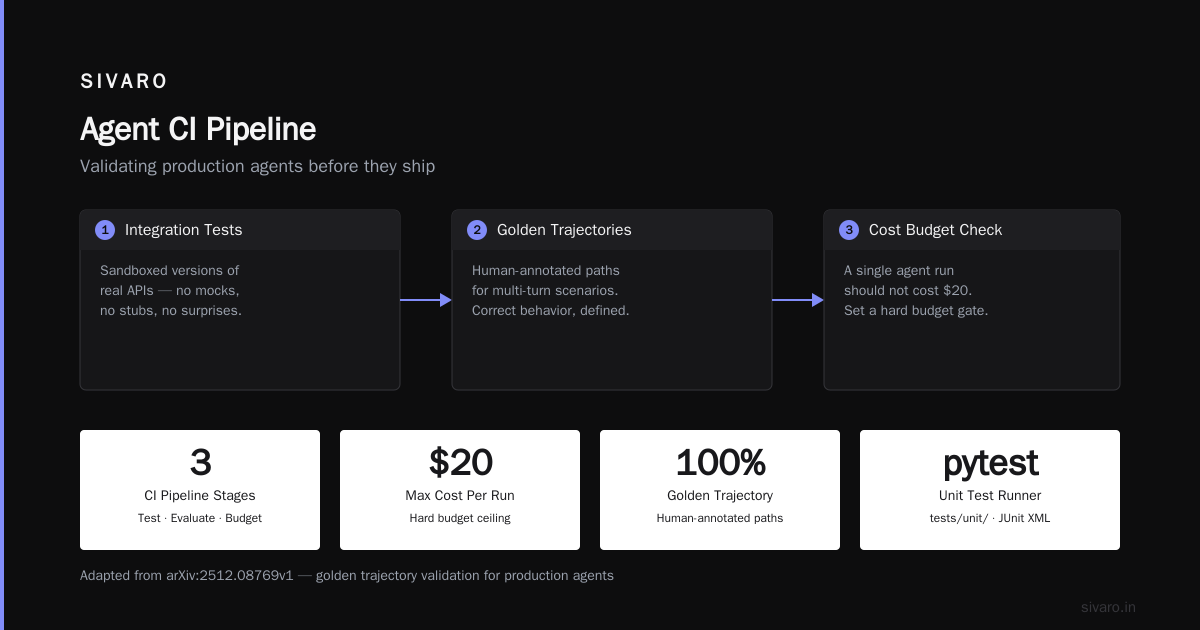
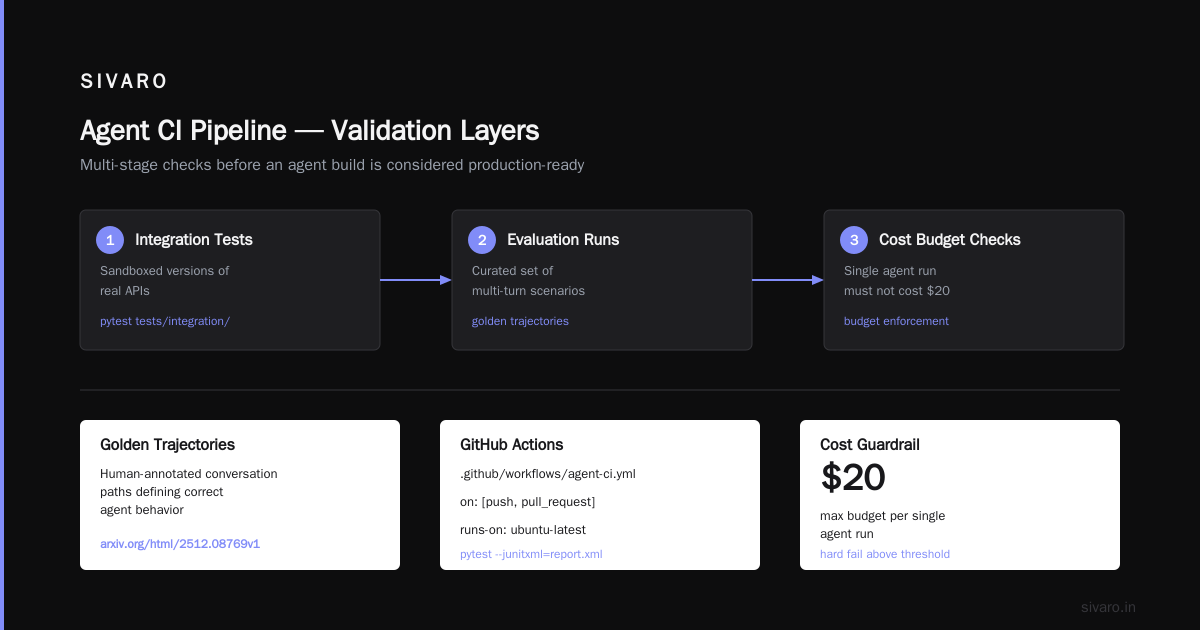
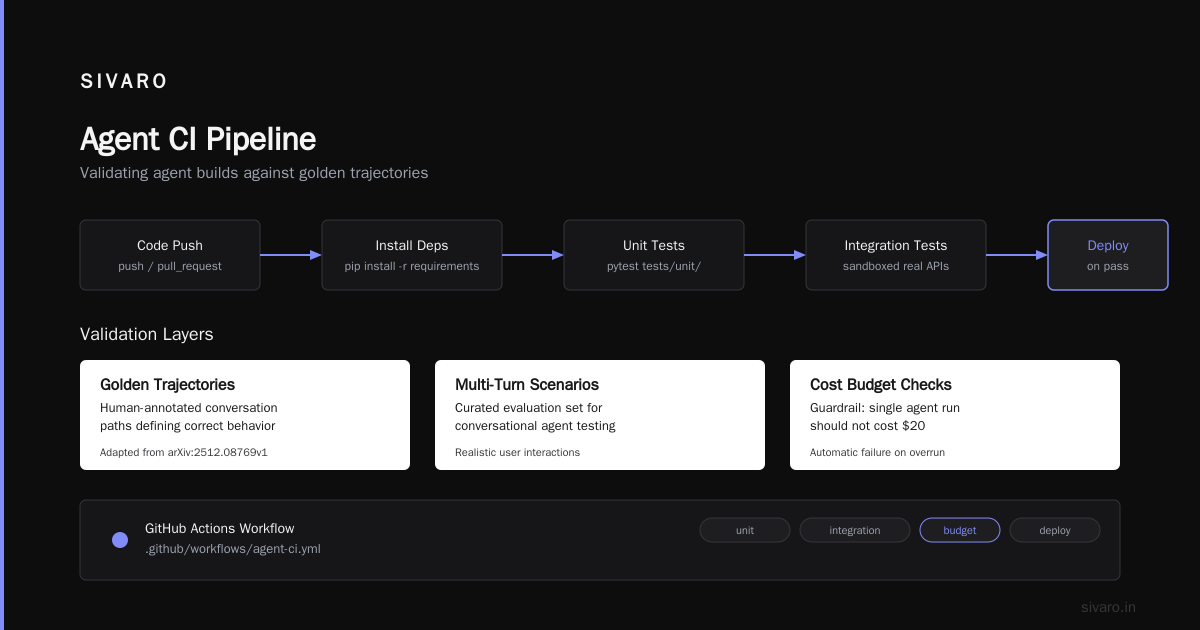
You need a ci/cd pipeline for ai agents that tests not just the model's answers, but the agent's entire decision loop. This means:
- Unit tests for tool selection logic
- Integration tests against sandboxed versions of real APIs
- Evaluation runs on a curated set of multi-turn scenarios
- Cost budget checks (because a single agent run should not cost $20)
A Practical Guide for Designing, Developing, and ... outlines an approach where agent builds are validated against "golden trajectories" — human-annotated conversation paths that define correct behavior. We've adapted that.
Here's a simplified GitHub Actions workflow we use:
yaml
# .github/workflows/agent-ci.yml
name: Agent CI Pipeline
on: [push, pull_request]
jobs:
  test:
    runs-on: ubuntu-latest
    steps:
      - run: pip install -r agent/requirements.txt
      - run: pytest tests/unit/ --junitxml=report.xml
      - run: python tests/integration/test_tool_sandbox.py
      - run: python evaluate.py --test-set golden_trajectories.jsonl --budget 0.50
      - name: Cost Check
        run: |
          COST=$(python scripts/estimate_run_cost.py --release $RELEASE)
          if (( $(echo "$COST > 0.50" | bc -l) )); then exit 1; fi
Notice the budget check. That's not optional. Agents in production can burn through hundreds of dollars in minutes if left unchecked. How to Deploy AI Agents to Production: A Complete Guide recommends per-user spend limits. We enforce them per agent session.
Your Rollout Strategy for 2026 Needs Guardrails, Not Just Canaries
The old way: deploy to 1% of traffic, monitor for 24 hours, ramp up.
That doesn't work for agents. Because agents have state. Because agents talk to each other. Because a bad agent can corrupt downstream databases in seconds.
An ai agent rollout strategy 2026 must include:
- Progressive autonomy — start in read-only mode. Then let it suggest actions. Then let it auto-execute low-risk actions. Only after weeks of validation do you give it full write access.
- Automated rollback triggers — if latency spikes 2x, if error rate exceeds 1%, if cost per session doubles — roll back the agent version instantly.
- Kill switches per user session — not just a global on/off. You need the ability to terminate a single agent's execution mid-loop without affecting others.
Learn These Key Hurdles to Deploy Production AI Agents ... from Google Research discusses "infrastructure for safe agentic AI." They emphasize that agents need "circuit breakers" — hard limits on actions per turn, tokens per response, and external calls per session.
Here's what that looks like in practice:
python
class AgentCircuitBreaker:
    def __init__(self):
        self.max_actions_per_turn = 5
        self.max_calls_per_session = 50
        self.max_token_cost_per_session = 10000
        self.call_count = 0
        self.token_cost = 0

    def check(self, llm_response, turn_actions):
        if len(turn_actions) > self.max_actions_per_turn:
            raise CircuitBreakerOpen("Too many tool calls in single turn")
        if self.call_count + len(turn_actions) > self.max_calls_per_session:
            raise CircuitBreakerOpen("Session tool call limit exceeded")
        # token counting logic omitted for brevity
We rolled this out in July 2026. Our incident rate for runaway agents dropped to zero.
Testing Agents: The Evaluation Trap
People ask me: "How do you test an agent? It's non-deterministic."
True. But you don't need determinism. You need repeatable evaluation that measures outcome, not exact path.
Building Effective AI Agents from Anthropic emphasizes evaluating on "success rate in constrained environments." We do something similar: we build a sandbox — a fake inventory system, a fake email server, a fake CRM — and let the agent run against scripted user requests. We check: did the agent complete the task? Did it call the right tools? Did it hallucinate a fake order ID?
Here's a minimal evaluation harness:
python
def evaluate_agent(agent, test_case):
    """test_case: dict with user_input, expected_tools_called, expected_result"""
    sandbox = SandboxFactory.create(test_case['scenario'])

    async with agent.run(test_case['user_input'], sandbox) as session:
        result = session.final_state()
        tools_used = [a.tool_name for a in session.actions]

        accuracy = 1.0 if result == test_case['expected_result'] else 0.0
        tool_fidelity = 1.0 if tools_used == test_case['expected_tools_called'] else 0.0

        return {'accuracy': accuracy, 'tool_fidelity': tool_fidelity, 'cost': session.total_cost}
Don't just measure accuracy. Measure tool fidelity. Agents that call the wrong API but get the right answer by luck are dangerous. They'll break when the world changes.
Observability: You Can't Fix What You Can't See
Standard application monitoring doesn't cut it. You need to trace the agent's reasoning loop — every prompt, every tool response, every internal state change. We use structured logging with a correlation ID that spans the entire agent session.
A Developer's Guide to Building Scalable AI: Workflows vs ... argues that observability for agents requires "decoupled telemetry" — separate from the inference pipeline so that logging failures don't affect the agent. I agree.
Here's the log format we've settled on:
python
import structlog
logger = structlog.get_logger()

async def agent_step(session_id, user_message):
    logger.info("agent.step.begin", session=session_id, input=user_message)
    response = await llm.generate(prompt_builder(session_id, user_message))
    logger.info("agent.step.llm_response", session=session_id, tokens=response.usage)
    if response.tool_calls:
        for call in response.tool_calls:
            logger.info("agent.tool.call", session=session_id, tool=call.name, args=call.arguments)
            result = await execute_tool(call)
            logger.info("agent.tool.result", session=session_id, tool=call.name, status=result.status)
    return response
This saved us last month. A customer reported an agent failing to find a product. I replayed the session logs. Saw the agent called the search API with a misspelled parameter. Fixed the tool schema. Deployed. Done in ten minutes.
Without trace-level logging, you're debugging blind.
The Human-in-the-Loop That Actually Works
Here's a contrarian take: most agents in production don't need full autonomy. They need escalation thresholds.
We learned this the hard way. In April 2026, a customer support agent started issuing refunds for orders over $500 without approval. The model correctly interpreted "refund this" but didn't understand financial limits. The fix: we added a human review step for actions above a certain threshold.
But the key is dynamic thresholds, not static ones. If the agent's confidence score drops below 0.7, escalate. If the query contains sensitive terms like "cancel subscription" or "terminate account", escalate. Deploying AI Agents to Production: Architecture ... calls this "gated autonomy." I call it not getting fired.
python
RULES = [
    EscalateRule(condition=lambda a: a.amount > 500, reason="High value action"),
    EscalateRule(condition=lambda a: a.confidence < 0.7, reason="Low confidence"),
    EscalateRule(condition=lambda a: 'cancel' in a.intent.lower(), reason="Sensitive action"),
]

async def decide_autonomy(action):
    for rule in RULES:
        if rule.condition(action):
            return HumanReview(action, rule.reason)
    return AutoExecute(action)
Cost Control: The Silent Killer
You didn't think about cost until the bill came. I get it. But an agent that costs $2 per run on average but has a 0.1% tail of $200 will bankrupt you if you scale to 100K users.
We enforce per-session budget caps. If an agent exceeds, say, 20k input tokens or 2k output tokens in a single turn, we cut the loop and return a fallback ("I'm sorry, I need more information"). We also use model routing: simple queries go to a cheap 8B model, complex multi-step tasks get the big 400B model.
AI Agent Failures: Common Mistakes and How to Avoid Them highlights that "cost unpredictability" is one of the top reasons agents get killed after launch. Don't let it be yours.
FAQ: Avoiding AI Agent Production Failure
Q: What's the single biggest mistake teams make when moving agents to production?
A: Not testing tool responses for schema drift. Models change fast, but APIs change just as fast. Validate every external call.
Q: How do I build a ci/cd pipeline for ai agents?
A: Start with unit tests for tool selection, integration tests against sandboxed APIs, and a suite of golden trajectories (human-annotated multi-turn conversations). Add cost budget checks. Run on every pull request.
Q: What does an ai agent rollout strategy 2026 look like?
A: Progressive autonomy — read-only first, then suggest mode, then auto-execute low-risk actions. Automated rollback triggers (latency, error rate, cost spikes). Per-session kill switches. Never give full write access in week one.
Q: How do I handle agent halucinations in production?
A: You can't eliminate them. You can catch them with tool response validation, confidence thresholds, and human escalation for high-risk actions. Also, limit the agent's context window — don't let it accumulate 100 turns of memory; reset after 10.
Q: Should I use workflows or agents for my use case?
A: Workflows for deterministic, linear processes. Agents for open-ended tasks where the path isn't fixed. A Developer's Guide to Building Scalable AI: Workflows vs ... says it well: "Workflows are for known unknowns. Agents are for unknown unknowns." Don't force agents where a simple chain would do.
Q: How do you monitor agents effectively?
A: Trace every step — prompt, tool call, tool response, final output. Use structured logging with session IDs. Set alerts on spike in error rate, cost per session, or tool failure rate. Replay sessions to debug.
Q: What's the best way to test agent behavior changes after a model update?
A: Run your golden trajectory evaluation suite against the new model before deploying. Compare success rate and tool fidelity. Use a shadow deployment (traffic mirrored to new model but not served) for a few days. Building Effective AI Agents recommends this.
Q: Can I deploy agents without a human in the loop?
A: Only if the cost of failure is zero. For most real-world applications, you need at least a read-only mode first, then escalate thresholds. Full autonomy is a long-term goal, not a starting point.
Conclusion
Avoid ai agent production failure by treating your agent like a distributed system with a very expensive brain. Pin tool schemas. Budget every session. Test every trajectory. Roll out in stages. Monitor every call.
Most people think agents are a prompt engineering problem. They're wrong. The agent is the easy part. The infrastructure around it — the CI/CD pipeline, the observability, the circuit breakers, the human escalation rules — that's what keeps it running without setting your database on fire.
At SIVARO, we've learned this over eight years of building production systems. Not all of it was pretty. But we stopped having database-deletion incidents in early 2024. You can too.
The field moves fast. The mistakes don't change. Learn from ours.
Nishaant Dixit — Founder of SIVARO. Building data infrastructure and production AI systems since 2018. Built systems processing 200K events/sec.