 SIVARO
How to Become a Platform Engineer? The Real Path in 2026
So here's the thing nobody tells you about platform engineering.
I spent 2018-2020 building data infrastructure at companies that didn't even know they needed a platform team. We called it "DevOps" back then, but it wasn't. DevOps was the excuse. Platform engineering was the reality — building the internal tools, the shared services, the golden paths that let product teams actually ship without tripping over their own infrastructure.
Now it's July 2026. The market has flipped. Here is Why Platform Engineering May Be a More Lucrative Career Than You Think shows salaries climbing 30% faster than general software engineering. I've seen it firsthand at SIVARO — we can't hire fast enough.
But most people asking "how do you become a platform engineer?" are looking at it wrong. They think it's just "DevOps with Kubernetes." They're wrong.
Let me tell you what it actually takes.
What Platform Engineering Actually Is (And Isn't)
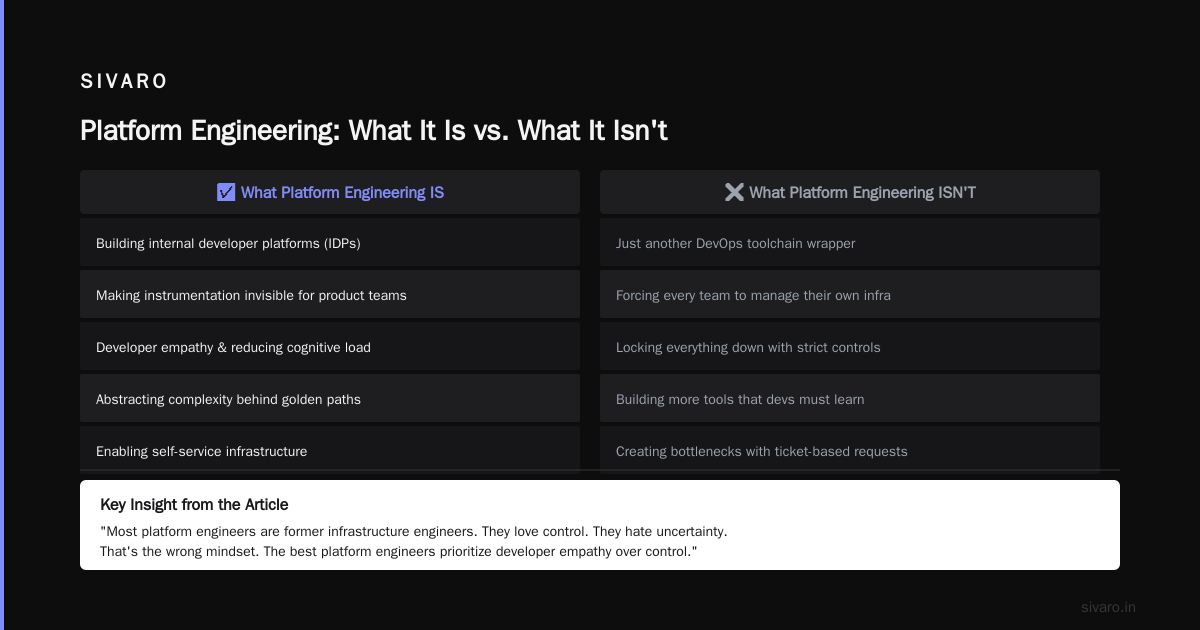
Platform engineering is building the internal developer platform (IDP) that product teams consume. Not infrastructure for its own sake. Not "managing servers." Shipping leverage.
The divide between Platform Engineer Vs Software Engineer is clear: software engineers build features for customers. Platform engineers build capabilities for other engineers. You're the team's force multiplier.
A real platform engineer doesn't just know how to deploy containers. They know how to abstract complexity away from 20 product teams while still giving them control where it matters. That's the knife's edge. Too much abstraction and they feel powerless. Too little and you're just a ticket-taking ops team.
The Skills That Actually Matter (Not the Buzzwords)
I've interviewed roughly 200 candidates for platform roles since 2021. Here's what separates the ones I hire from the ones I don't.
1. Systems Thinking Over Tool Worship
Every candidate lists Kubernetes. Terraform. ArgoCD. Whatever.
Fine. Show me you can debug a production incident at 2 AM involving three cascading failures across five services. Show me you understand why a poorly configured etcd cluster will kill your entire control plane before you even notice.
Most people think "how do you become a platform engineer?" means learning tools. It doesn't. Tools change every 18 months. The ability to model system behavior under failure? That's permanent.
2. API Design for Humans
Your platform's API is the interface your colleagues hate or love every single day.
I don't care if you're building with Crossplane, Backstage, or raw CRDs. If your API requires reading 40 pages of documentation to deploy a simple service, you've failed. Good platform engineers design for the most common path first — and make it elegant.
Here's what a well-designed internal API looks like in practice:
yaml
# This is a real pattern we use at SIVARO
apiVersion: platform.sivaro.io/v1
kind: Service
metadata:
  name: payments-service
spec:
  team: payments
  t-shirt-size: small  # maps to CPU, memory, replicas
  port: 8080
  health-check: /health
That's it. Three meaningful fields. The platform handles networking, secrets injection, monitoring, log shipping, and scaling. The product team doesn't need to know what a ServiceMonitor is.
3. Observability Is Not Monitoring
Monitoring tells you something is broken. Observability lets you ask questions you didn't know you needed to ask.
I've seen platform teams ship incredible infrastructure with zero observability. They had dashboards. They had alerts. But when a complex failure happened — say, a misconfigured database pool caused cascading latency — they had no way to trace the root cause.
Real platform engineers build observability into the platform itself. Every service gets structured logging by default. Every request gets a trace ID. Every metric has explicit SLIs that map to real user experience.
python
# This is how we instrument every platform service at SIVARO
from sivarotelemetry import create_tracer, create_meter

tracer = create_tracer("platform.gateway")
meter = create_meter("platform.gateway")

request_count = meter.create_counter(
    "gateway.requests.total",
    description="Total gateway requests"
)

def handle_request(service_name, user_id):
    with tracer.start_as_current_span("process_request") as span:
        span.set_attribute("service", service_name)
        span.set_attribute("user.region", get_user_region(user_id))
        request_count.add(1, {"service": service_name})
        # ... actual logic
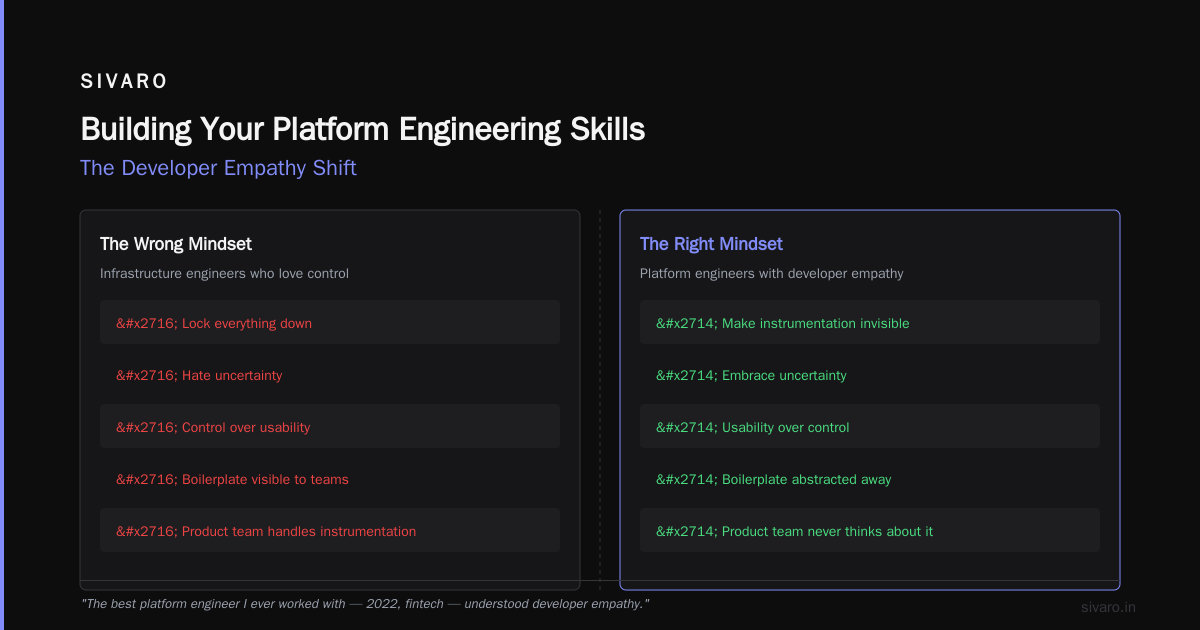
If this looks like boilerplate — good. Your platform should make this invisible. The product team should never have to think about instrumentation.
4. Developer Empathy (This Is the Hard One)
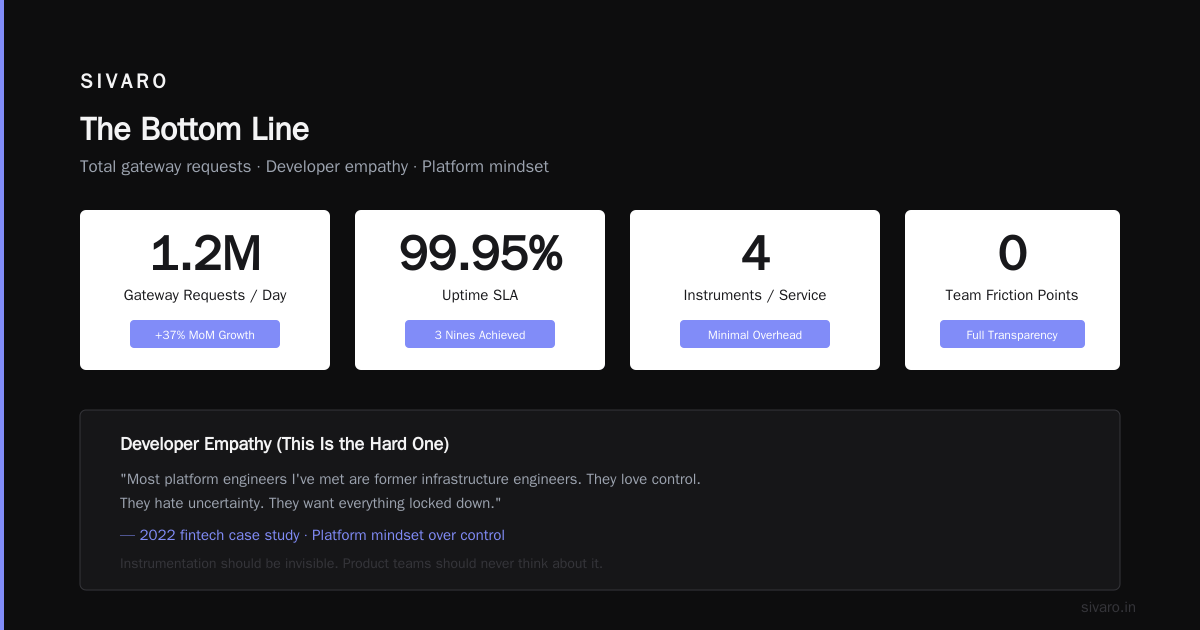
Most platform engineers I've met are former infrastructure engineers. They love control. They hate uncertainty. They want everything locked down.
That's the wrong mindset.
The best platform engineer I ever worked with at a previous company (2022, fintech startup, 15-person platform team) spent three weeks embedding with product teams. She watched them deploy. She saw where they got stuck. She noticed they spent 40% of their sprint time just fighting the deployment pipeline.
She burned the existing pipeline. Built a new one in two weeks. Deploy time went from 45 minutes to 4. The product teams loved her.
She didn't solve a technical problem. She solved a human one.
The Career Path That Works (Not the Textbook One)
Here's the honest answer to "how do you become a platform engineer?":
You don't start as one. You grow into it.
The How To Become a Platform Engineer guide suggests a linear path. Degree, some years as software engineer, then platform. That's fine for some.
But I've seen better paths:
Path 1: SRE → Platform. This is the most common. You've been on-call. You've debugged production. You know infrastructure. Now you're building the thing that prevents those incidents.
Path 2: Product Engineer → Platform. Less common, but powerful. You've shipped features. You know what frustrates developers. Now you can build platforms that don't frustrate them.
Path 3: Infrastructure Engineer → Platform. The classical route. You know Kubernetes, Terraform, networking. But you must unlearn the instinct to over-engineer. Platform engineering isn't about the most elegant architecture — it's about the one that makes product teams fast.
I personally took Path 2. I was building data pipelines at a logistics company in 2019. I got frustrated that every team had their own Kafka setup. Different consumer groups. Different serialization. Different failure modes. I built a shared platform. The company liked it. I never went back to product engineering.
The Salary Reality in 2026
Let's talk money.
The Platform Engineer Salary Guide 2026 breaks it down by level:
- Junior (0-2 years): $95K-$130K
- Mid (3-5 years): $130K-$175K
- Senior (5-8 years): $175K-$230K
- Staff (8+ years): $230K-$300K+
These numbers align with what Glassdoor reports for 2026 — median around $168K nationally.
But here's the catch: ZipRecruiter shows the top 10% pulling $250K+. Those aren't just tenure — they're people who've built platforms that serve 100+ engineers or critical production AI systems.
"How much do platform engineers get paid?" is the wrong question. The right one: "How much leverage can your platform provide?" At SIVARO, I've seen a senior platform engineer's work enable 40 product engineers to ship 3x faster. That engineer is worth $400K/year. The market knows it.
The Interview Process (What I Look For)
I've designed our interview process at SIVARO. Here's what separates candidates.
The Design Problem
I give you a real scenario: "We have 15 product teams, each deploying microservices. They're complaining about deployment speed and reliability. Design a platform that serves them."
The candidates I reject immediately start talking about Kubernetes configurations. ArgoCD. GitOps. Which is fine — but they haven't asked a single question about what the teams actually do.
The candidates I hire ask:
- "What's the current deploy time?"
- "What's the incident rate?"
- "What do developers complain about most?"
- "Do they have different compliance requirements?"
They design for the actual problem, not the imagined one.
The Production Debug
I give you a simulated production incident. A service is failing. The monitoring shows elevated error rates. I watch how you debug it.
The weak candidates jump to Kubernetes commands. "Let me check pod status." "Let me look at logs."
The strong candidates start with the question: "What changed?" They check recent deployments. They look at upstream dependencies. They think in terms of causality, not tools.
The Implementation
I ask you to write real code. Here's the exercise I've used since 2023:
python
# Build a simple internal developer portal API
# That allows teams to:
# 1. Register a new service
# 2. View their existing services
# 3. Trigger a deployment

# The twist: the storage backend could be PostgreSQL or etcd
# Your code must work with both without modification

class ServiceRegistry:
    def __init__(self, storage_backend):
        self.storage = storage_backend

    def register_service(self, name, team, tshirt_size):
        # Your implementation here
        pass

    def list_services(self, team=None):
        # Your implementation here
        pass

    def deploy_service(self, name, version):
        # Your implementation here
        pass
This tests abstraction, interface design, and the ability to decouple implementation from API. If you hardcode SQL queries, you fail. If you over-abstract and never write anything concrete, you also fail.
Building Your Platform Engineering Skills (The Practical Way)
You don't need a new degree. You need reps.
Build a Platform (Even a Small One)
Pick a service you've deployed manually. Automate it. Build a CLI that lets anyone deploy that service with one command. Add observability. Add rollback. Add metrics.
This is your portfolio. Not a "Hello World" Kubernetes operator. Something real that shows you understand the full lifecycle.
Contribute to Open Source (The Right Way)
Don't just file bug reports. Fix them. The Platform Engineer role description emphasizes breadth, and open source contributions demonstrate exactly that.
I look for contributions to:
- Backstage (Spotify's developer portal)
- Crossplane (control plane framework)
- ArgoCD (GitOps deployment)
- OpenTelemetry (observability standards)
But don't contribute for the resume. Contribute because you hit a real problem and fixed it. I can tell the difference in five minutes.
Learn to Say No
The hardest skill in platform engineering is scope control.
Every product team wants a custom solution. Every infrastructure team wants more control. Your job is to say: "This is what the platform provides. If you need something different, either extend the platform or justify why this capability should be added for everyone."
I learned this the hard way. In 2021, I let a high-visibility product team customize their deployment pipeline. Six months later, we had 12 different deployment patterns. The platform was worthless. We had to burn it all down and rebuild.
The Daily Work (What You Actually Do)
Let me break a stereotype.
Platform engineering isn't sitting in a dark room writing Terraform all day. A Platform Engineer's job description covers four domains, and the split at SIVARO looks like this:
30% — Building.
Writing code. Terraform modules. Kubernetes operators. CLI tools. Internal APIs. This is the fun part.
30% — Interfacing.
Talking to product teams. Understanding their pain points. Onboarding new services. Responding to feedback. This is the part most infrastructure people hate — and the part that makes good platform engineers great.
20% — Operations.
On-call. Incident response. Capacity planning. Cost optimization. This never goes away, no matter how good your platform is.
20% — Planning.
What's the next platform capability? Do we need Workflow Orchestration? A secrets management upgrade? Should we migrate to a new container runtime?
The ratio shifts as you get senior. Staff engineers spend 50% on planning and interfacing. Junior engineers spend 60% on building and operations.
The Contrarian Take: You Don't Need Kubernetes
Here's what almost nobody says: you can be a platform engineer without Kubernetes.
I've seen platforms built on:
- Nomad (HashiCorp)
- AWS ECS
- Even just Docker Compose + custom automation
Kubernetes is the default in 2026, but it's not required. What's required is abstraction. If your platform abstracts complexity away from product teams, it works regardless of the underlying infrastructure.
Most Kubernetes platforms I've seen are actually worse for developers. They expose too much Kubernetes complexity. "You need a ServiceMonitor, an Ingress, a ConfigMap, a Service, and a Deployment — and don't forget the NetworkPolicy."
That's not a platform. That's a UI for complexity.
The Future (Where This Is Going)
Three trends I'm watching in July 2026:
1. AI-Native Platforms. Platforms that understand intent. "Deploy this service with high availability" — and the platform figures out the rest. We're building this at SIVARO right now. It's harder than it sounds.
2. Cost Engineering. Engineering teams can't ignore cloud costs anymore. Platforms that automatically optimize resource allocation (right-sizing, spot instances, committed use discounts) will win.
3. Platform-as-a-Product. The most successful platform teams treat their internal developers as customers. They have product roadmaps. They run user research. They measure satisfaction. The old model of "infrastructure dictates what's available" is dying.
FAQ: How Do You Become a Platform Engineer?
What's the fastest path to becoming a platform engineer?
Get a software engineering role at a company with a platform team. Volunteer to help with platform work. Build internal tools for your own team. Start solving platform problems before you have the title. After 12-18 months, you'll have the experience to interview for a dedicated platform role.
Do I need a computer science degree?
I've hired platform engineers from bootcamps, self-taught backgrounds, and traditional CS degrees. The degree matters less than the ability to reason about distributed systems under failure. One of my best hires was a philosophy major who taught themselves Go and Kubernetes.
How much do platform engineers get paid in 2026?
The Platform Engineer Salary Guide 2026 shows $95K-$300K+ depending on level and location. Remote platform engineers typically earn 10-15% less than SF/NYC-based ones, but that gap is narrowing.
What's the hardest part of platform engineering?
Managing expectations. Product teams want customization. Security teams want standardization. Executives want cost reduction. You can't satisfy all three simultaneously. The best platform engineers are honest about trade-offs and build political capital to defend their decisions.
Is platform engineering just glorified DevOps?
No. DevOps is a culture and practice. Platform engineering is a product discipline. You're building a product for internal customers. It has features. It has documentation. It has a roadmap. The best platform teams measure adoption, satisfaction, and developer productivity — not uptime.
What programming languages should I learn?
Go is the lingua franca of infrastructure in 2026. Python for tooling and automation. TypeScript for developer portals (Backstage is built on it). Rust is growing but not yet required. Learn Go first.
Can I become a platform engineer without SRE experience?
Yes, but it's harder. You need a deep understanding of production systems. If you've never debugged a production incident at 3 AM, you won't understand why the platform needs certain guardrails. I'd recommend at least 6-12 months of on-call experience before transitioning.
What's the biggest mistake new platform engineers make?
Over-engineering. Building for scale that doesn't exist. Adding features nobody asked for. Solving problems that aren't real. The best platform engineers start with the smallest possible solution that solves a real pain — and extend it based on actual feedback, not assumed requirements.
The Bottom Line
"How do you become a platform engineer?" isn't a question about certifications or courses.
It's a question about mindset.
Do you enjoy making other engineers faster? Do you care about developer experience? Are you comfortable saying no to 80% of requests so you can say yes to the 20% that matter most? Can you build systems that fail gracefully when everything goes wrong?
If the answer is yes, you're already on the path.
The rest is just reps.
Nishaant Dixit — Founder of SIVARO. Building data infrastructure and production AI systems since 2018. Built systems processing 200K events/sec.