 SIVARO
How to Become a Platform Engineer Without a Degree
July 30, 2026
I hired a platform engineer last month at SIVARO. She was twenty-three. No degree. She rebuilt our incident response pipeline in week three and cut PagerDuty fatigue by 40%.
Six years ago, I was the guy without the degree, trying to convince someone to let me touch their production systems.
This article is the path I wish I'd had back then.
Platform engineering is the discipline of building and maintaining the internal tools, infrastructure, and workflows that let product engineers ship code without thinking about servers, databases, or deployment pipelines. You're the person who makes "it just works" actually work.
By the end of this guide, you'll know exactly what to learn, what to build, and how to prove you can do the job — even if your formal education stopped at high school.
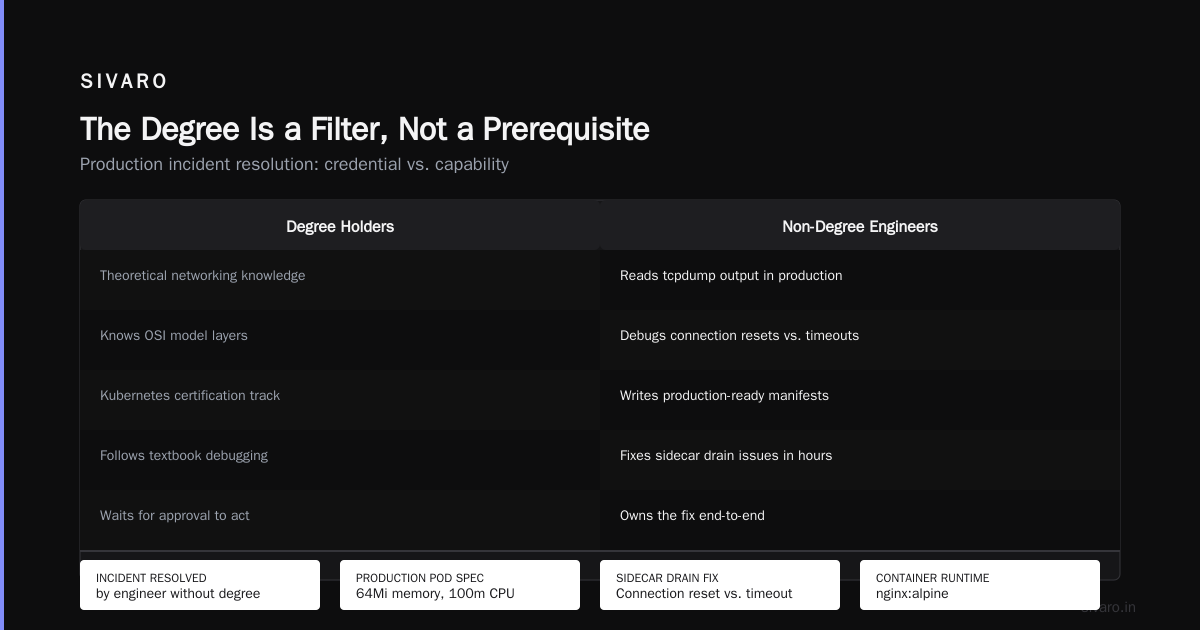
The Degree Is a Filter, Not a Prerequisite
Most engineering job descriptions still say "BS in Computer Science or equivalent experience." That "or equivalent experience" is doing more heavy lifting than most people realize.
I've interviewed candidates from Stanford. I've interviewed candidates who learned to code in prison. The degree correlates with shelf-stable employment history. It does not correlate with ability to debug a kernel panic at 2 AM.
Platform engineering is particularly well-suited to the non-degree path because the field moves fast. What you learned in a 2019 cloud computing class is mostly irrelevant by 2026. What you learned last month building that Kubernetes operator? That's current.
The real gatekeeper isn't HR. It's your portfolio. How to become a platform engineer makes this explicit: employers want demonstrated ability, not transcripts. Google's own documentation says "most platform engineers start as software engineers or systems administrators." Neither requires a degree.
I'm not saying it's easy. It's harder than the degree path in the short term. But in the long term, you'll learn faster because you can't coast. Every project you ship is your resume.
Build the Foundation — The Technical Stack
Here's the stack you need to own. Not "know about." Own.
Linux and the Shell
Platform engineers live in the terminal. If you can't navigate a Linux filesystem, parse logs with grep and awk, and write a bash script that doesn't explode, stop reading and go learn that.
Target: You should be able to diagnose a high-CPU process without a GUI. You should understand cgroups, namespaces, and the proc filesystem.
bash
# The tool I reach for more than anything else
# Find top 10 processes by memory usage
ps aux --sort=-%mem | head -n 11

# Quick network diagnostics
ss -tulpn | grep LISTEN

# Check which processes are using swap
for pid in $(ls /proc | grep -E '^[0-9]+$'); do
    swap=$(grep -i "Swap" /proc/$pid/status 2>/dev/null | awk '{print $2}')
    if [ -n "$swap" ] && [ "$swap" -gt 0 ]; then
        echo "PID: $pid - Swap: ${swap}KB - $(cat /proc/$pid/cmdline 2>/dev/null | tr '' ' ')"
    fi
done
Networking
Not the CCNA level. But you need to understand TCP, DNS, HTTP, and load balancing. You need to read a packet capture. You need to know why curl returns connection refused vs. connection reset vs. timeout.
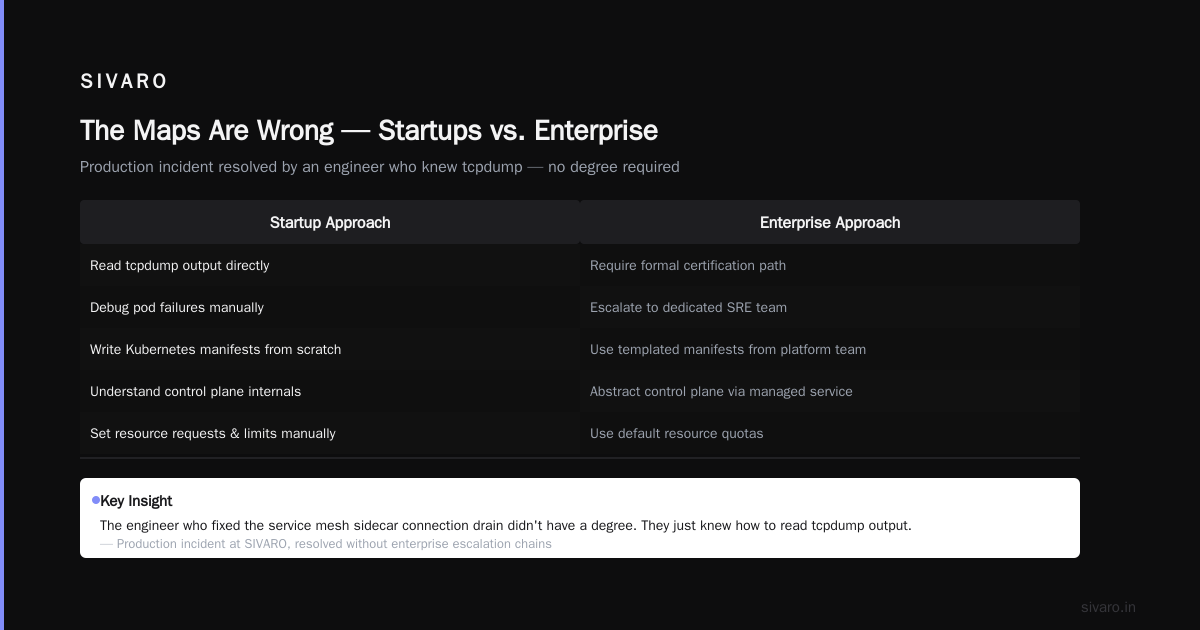
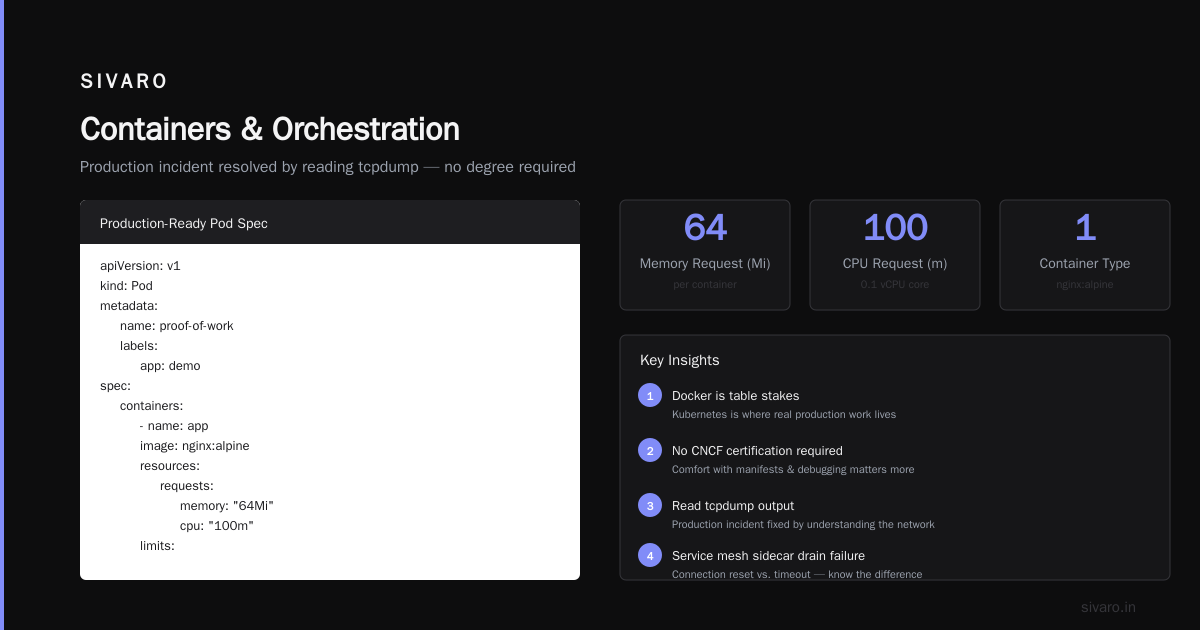
At SIVARO, we had a production incident last year where a service mesh sidecar was draining connections incorrectly. The engineer who fixed it didn't have a degree. They just knew how to read tcpdump output.
Containers and Orchestration
Docker is table stakes. Kubernetes is where the real work lives.
You don't need to be a CNCF-certified expert. You need to be comfortable writing manifests, debugging pod failures, and understanding the control plane.
yaml
# A production-ready pod spec is more than just a container
apiVersion: v1
kind: Pod
metadata:
  name: proof-of-work
  labels:
    app: demo
spec:
  containers:
  - name: app
    image: nginx:alpine
    resources:
      requests:
        memory: "64Mi"
        cpu: "100m"
      limits:
        memory: "128Mi"
        cpu: "200m"
    livenessProbe:
      httpGet:
        path: /healthz
        port: 80
      initialDelaySeconds: 3
      periodSeconds: 10
    readinessProbe:
      httpGet:
        path: /ready
        port: 80
      initialDelaySeconds: 3
      periodSeconds: 5
    securityContext:
      runAsNonRoot: true
      capabilities:
        drop: ["ALL"]
CI/CD and Automation
You should be able to build a pipeline that tests, builds, and deploys with zero manual steps. GitHub Actions, GitLab CI, Jenkins — pick one and go deep.
The key insight: pipelines are software. Test them. Version them. Review them.
Scripting and Infrastructure as Code
Python for tooling. Terraform for infrastructure. Ansible or Salt for configuration management.
hcl
# Terraform that doesn't make me want to cry
resource "aws_ecs_cluster" "main" {
  name = "sivaro-production"

  setting {
    name  = "containerInsights"
    value = "enabled"
  }
}

resource "aws_ecs_service" "api" {
  name            = "api-service"
  cluster         = aws_ecs_cluster.main.id
  task_definition = aws_ecs_task_definition.api.arn
  desired_count   = 3
  launch_type     = "FARGATE"

  network_configuration {
    subnets         = var.private_subnet_ids
    security_groups = [aws_security_group.api.id]
  }
}
Observability
Monitoring is not dashboards. Monitoring is knowing your system is broken before your users do.
Learn Prometheus for metrics. Learn Loki or Elasticsearch for logs. Learn Grafana for visualization. Learn OpenTelemetry for traces.
At SIVARO, we process 200K events per second through our observability pipeline. The engineer who maintains it never took a university course on distributed systems. They learned by debugging.
Cloud Platforms
AWS, GCP, or Azure. Pick one. Go deep. Then learn the others well enough to understand why they're different.
The cloud is not magic. It's someone else's Kubernetes cluster with better billing.
Prove It — Your Portfolio Isn't a Resume
Here's the hard truth: without a degree, your resume goes in the "maybe" pile. Your portfolio drags it into the "call them" pile.
Build Something Real
Not a todo app. Build something that demonstrates platform engineering.
Ideas:
- A CI/CD pipeline that provisions infrastructure, runs tests, and deploys to a real environment
- A monitoring stack that alerts on anomalies, not just thresholds
- A tool that automates a painful operational task — rotating credentials, cleaning up old resources, migrating data
- An internal developer platform (even a simple one) that abstracts infrastructure complexity
Open Source Is Your Resume
Contribute to projects. Fix bugs. Improve documentation. Add tests.
When I review candidates, I look at their GitHub profile. I don't count stars. I look at the quality of their PR descriptions. I look at whether they engage in code review conversations. I look at whether they ship.
How to Become a Software Engineer without a Degree emphasizes building a portfolio of work. This is the single most important piece of advice in that article. A good portfolio beats a good GPA every time.
Write About What You Learn
Blog posts. Twitter threads. YouTube videos. Documentation.
Writing forces you to understand. It also builds credibility. When I google your name, I should find you explaining something I didn't know I needed to learn.
The Job Hunt — Lead with Context, Not Credentials
You will get rejected. A lot. I applied to 87 jobs before I got my first offer. That's not a flex. That's the math.
Target the Right Companies
Startups and mid-size companies care more about ability than credentials. FAANG companies have HR filters you might not get past without a degree — but it's not impossible. Learn how to become a software engineer without a degree notes that some large companies have eliminated degree requirements entirely. But they're the exception.
Your Cover Letter Is a Technical Document
Don't write about your passion for technology. Show me.
"I noticed your job posting mentions managing 50+ Kubernetes clusters. I maintain a multi-cluster setup at home that handles 10K requests per day. Here's the architecture."
That will get you a phone screen.
The Interview Is a Conversation
Technical interviews for platform engineering should be about systems, not algorithms. I don't care if you can reverse a binary tree. I care if you can design a system that doesn't fall over at 3 AM.
When I interview candidates, I ask them to walk me through a production incident they resolved. The ones who can describe the debugging process in detail — that's who I hire.
The Maps Are Wrong — Startups vs. Enterprise
Most advice says start at a startup because they're more flexible about credentials. That's true, but it's not the whole story.
Startups give you more surface area to learn. You'll touch everything from CI/CD to database administration to security compliance. You'll be forced to make trade-offs under pressure.
Enterprise gives you more structure and more resources. You'll learn what "operating at scale" actually means. You'll work with people who've been doing this for decades.
I started at a startup. I burned out after two years. Then I joined a larger company and realized I didn't know half of what I thought I knew.
Both paths work. Pick the one that matches your temperament.
2026 Reality Check — AI Changed the Rules
I can't write a 2026 article without addressing the elephant in the room.
AI tools like Claude and Gemini have changed how platform engineers work. I use them daily for:
- Generating Terraform modules
- Debugging configuration issues
- Writing complex regular expressions
- Drafting incident postmortems
But — and this is important — the engineers who thrive with AI are the ones who already understand the fundamentals. AI accelerates the expert. It doesn't replace the beginner.
If you don't know what a good Kubernetes manifest looks like, you can't tell when AI generates a bad one. If you don't understand networking, you can't verify AI's suggestion about DNS resolution.
Learn the fundamentals. Then use AI to move faster.
FAQ
Is a degree completely useless for platform engineering?
No. A CS degree teaches fundamentals that are hard to learn on your own — operating systems, networking, algorithms. But it's not necessary. I've seen self-taught engineers outperform CS graduates because they built real systems instead of completing assignments.
How long does it take to become a platform engineer without a degree?
If you're consistent — 6-12 months of focused learning to get your first job. 2-3 years to become genuinely competent. The learning never stops.
Do I need to know math?
Not really. You need operational thinking and debugging skills. You don't need calculus. Basic statistics for monitoring and observability is helpful.
What certifications should I get?
CKA (Certified Kubernetes Administrator) is useful. AWS Solutions Architect Associate is worth having. But certifications are proof you can study, not proof you can operate. Build things first.
How do I get experience if nobody will hire me without experience?
Build a home lab. Use free tier cloud credits. Contribute to open source. Run a project for your friend's business. Document everything. That's experience.
Is platform engineering different from DevOps?
Yes. DevOps is a culture and set of practices. Platform engineering is the implementation — building the tools and systems that enable DevOps at scale.
Should I learn cloud-native or learn on metal?
Both. Learn Kubernetes on real hardware if you can. Understanding what happens below the abstraction layer makes you better at using the abstraction layer.
Can I start this path if I don't know how to code?
Start with Python. Build small tools. Automate one thing at a time. In six months, you'll be writing production code.
The Uncomfortable Truth
Most people who try this path quit.
Not because it's too hard. Because it takes too long. Because they compare themselves to people who had advantages they didn't. Because they get rejected five times and decide it's not meant to be.
The people who make it aren't the smartest. They're the most stubborn.
I spent a year building projects nobody used. I spent another year applying to jobs I wasn't qualified for. I spent another year learning from mistakes that would have been embarrassing if I had time to be embarrassed.
But by year four, I was the person other engineers came to for answers. By year six, I started a company that builds infrastructure for companies who process more data in a day than most people do in a year.
The degree doesn't make you a platform engineer. What you build makes you a platform engineer.
Now go build something.
Nishaant Dixit — Founder of SIVARO. Building data infrastructure and production AI systems since 2018. Built systems processing 200K events/sec.