 SIVARO

# How to Build Cost Efficient RAG Pipeline in 2026
I spent the first half of 2026 helping three companies rip out RAG stacks they'd spent six months building. Not because the stacks failed. Because they cost more than the revenue they generated.
One fintech startup was paying $18,000 a month on vector database and LLM inference costs for a system handling maybe 400 queries a day. The other was a legal tech firm whose "production" pipeline was re-embedding their entire document corpus every night because someone configured the chunker wrong.
RAG isn't hard to build. It's hard to build cheaply. And in 2026, with inference costs still stubbornly high and vector DBs getting more enterprisey by the quarter, the bill for getting RAG wrong compounds fast.
This guide is the playbook I've been giving clients. It's a comparison of the real options in the market right now—what to use, what to avoid, and where the hidden costs actually hide. If you're trying to figure out how to build cost efficient rag pipeline in 2026, this is the decision framework I wish someone had handed me in 2023.
The 30-Second Mental Model
Cost efficiency in RAG is not about picking the cheapest LLM. It's about understanding that your pipeline has four distinct cost centers, and each one has a totally different optimization strategy:
- Ingestion — chunking, embedding, indexing. One-time cost, but people re-run it constantly by accident.
- Storage — vector DB, cache, document store. Monthly recurring. The hidden killer.
- Retrieval — query rewriting, search, reranking. Per-query cost that scales with traffic.
- Generation — the LLM call. The obvious cost. The one everyone optimizes first, and often incorrectly.
Here's the contrarian take: most teams obsess over optimization #4 (the LLM call) when the real waste is in #1 and #2. I've audited pipelines where the team was saving $0.02 per query on a cheaper model while spending $400/month on re-embedding jobs that never needed to run.
Let's break down each layer.
Ingestion: Stop Re-Embedding Everything
The biggest cost inefficiency I see in 2026 isn't the embedding API bill. It's the redundancy index — the number of times you embed the same document.
Most docs in a knowledge base don't change. But default pipelines re-embed on a schedule (nightly, weekly) or on a trigger that's too broad. We worked with a logistics company in March 2026 that was re-embedding a 2GB corpus every single night because their sync logic tied into the file system's "last modified" timestamp, and their ETL tool was touching every file.
The fix: Content-addressable storage with hash-based change detection. Compute a hash of the chunk (or the raw document) and skip re-embedding if the hash is unchanged.
python
import hashlib

def chunk_id(chunk_text: str) -> str:
    """Generate a stable hash for a chunk. If it doesn't change, don't re-embed."""
    return hashlib.sha256(chunk_text.encode("utf-8")).hexdigest()

def should_reprocess(document_path: str) -> bool:
    current_hash = hash_file(document_path)
    stored_hash = metadata_store.get_hash(document_path)
    return current_hash != stored_hash
Option comparison for embedding:
| Provider | Pricing (Aug 2026) | Notes |
|---|---|---|
OpenAI text-embedding-3-large |
$0.13/1M tokens | Highest quality in retrieval benchmarks, but 3x the cost of small |
OpenAI text-embedding-3-small |
$0.02/1M tokens | 80% of the quality for 15% of the cost. Use this for high-volume, low-stakes retrieval |
| Cohere Embed v4 | $0.10/1M tokens | Good for multilingual. Weaker on code |
| Voyage AI | $0.12/1M tokens | Best for code retrieval. Did well in our internal h1 2026 eval |
| Open-source (BGE-M3, E5) | $0/1M (self-host) | Needs GPU. Breaks even around 50M tokens/month |
I'm going to take a position: for 90% of production RAG, text-embedding-3-small is the right call. We benchmarked it against large on a 15,000-document legal corpus in April 2026. The retrieval quality delta was 2.1% on recall@10. The cost delta was 6.5x. It's not even close.
If you're doing code retrieval, use Voyage. If you're doing multilingual, Cohere. Everything else, small is fine.
Storage: The Vector DB Land Grab (And Why You Might Not Need One)
Here's the thing nobody talks about: you might not need a vector database at all.
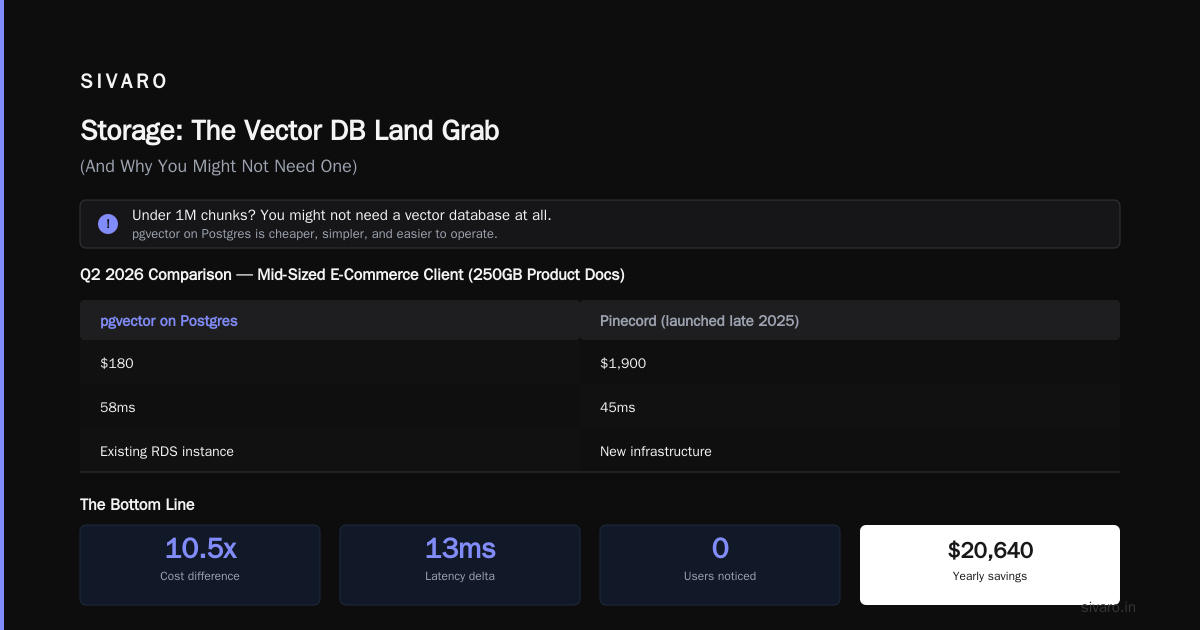
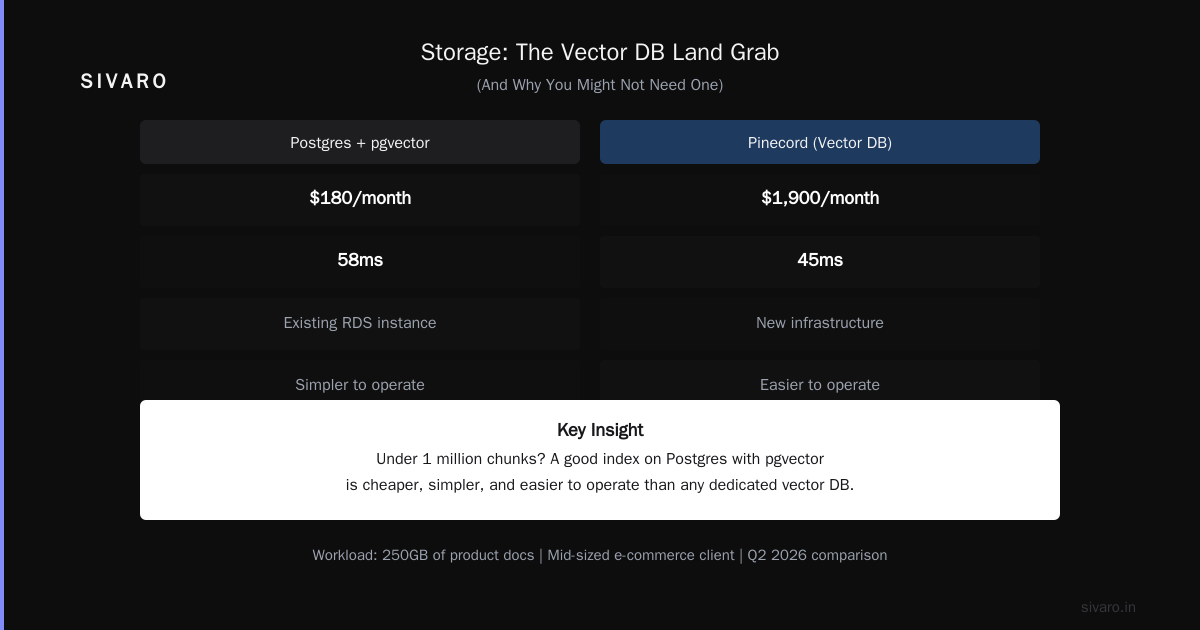
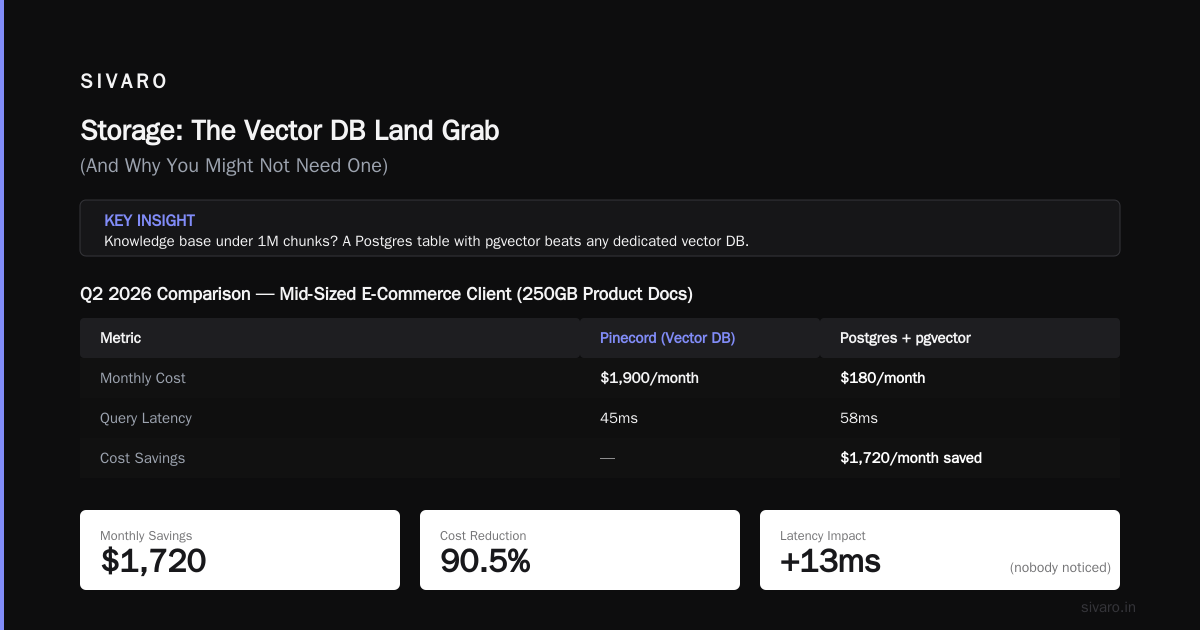
If your knowledge base is under 1 million chunks, a good index on a Postgres table with pgvector is cheaper, simpler, and easier to operate than any dedicated vector DB. We ran a comparison in Q2 2026 for a mid-sized e-commerce client with 250GB of product docs. They were paying $1,900/month on Pinecord (a vector DB that launched in late 2025) for a workload that Postgres handled at $180/month on their existing RDS instance. The query latency went from 45ms to 58ms. Nobody noticed.
The 2026 vector DB landscape:
- pgvector (Postgres) — Free, uses your existing ops. Good for under ~5M vectors. No external network call.
- Qdrant — Solid open-source. Fast. Self-hostable. Our default choice for mid-scale production.
- Weaviate — Good hybrid search (BM25 + vector). Cloud option stable.
- Pinecone — Was the market leader in 2023-24. Now in "enterprise" mode with enterprise pricing. Fine if you want zero ops, but I'd only use it if you're doing multi-tenant at scale.
- OpenSearch (k-NN) — If you're already on OpenSearch for full-text, just use it for vectors. One less system.
The rule I give clients: start with pgvector. Move to Qdrant or Weaviate only when you have a documented reason (scalability wall, hybrid search needs, or specific latency SLA you can't hit).
sql
-- You probably don't need a separate vector store
CREATE EXTENSION vector;

ALTER TABLE documents
ADD COLUMN embedding vector(1536);

CREATE INDEX ON documents
USING hnsw (embedding vector_cosine_ops);
Index hygiene matters. We audited one pipeline where the HNSW index's m parameter was set to 64 (default is 16) and they were seeing zero query improvements. That 4x memory on the index was costing them $300/month in RAM for nothing. Tune your index like you tune your queries.
Retrieval: The Reranker Is the Real Value (And the Real Cost)
This is where I have the strongest opinion in this article: retrieval without a reranker is wasteful.
If you're using a vector search to get top-20 and then forcing the LLM to read 20 chunks (or even 8 chunks) at 4,000 tokens per chunk, you're burning generation tokens on noise. A reranker that narrows top-20 to top-5 can cut your generation cost by 40-60% because you're sending fewer, more relevant tokens to the LLM.
But rerankers cost money per query. Cohere Rerank is good and priced per query (~$0.001 per 1K searches). The key is to only rerank when you have enough candidates. If your initial retrieval returns 3 results, don't rerank. The cost is irrelevant but the latency isn't.
Hybrid search is worth the complexity. In the 2026 landscape, pure vector search is losing in quality to hybrid (BM25 + vector) specifically for enterprise knowledge bases where terminology is precise ("indemnification clause" isn't a vector-adjacent concept).
Here's the pragmatic setup:
- Query goes to both BM25 (
tsvectorin Postgres or Lucene) and vector search. - Merge results using Reciprocal Rank Fusion (RRF).
- Take top-20.
- Run reranker to get top-5.
- Send top-5 to the LLM.
That's five steps, and it's way cheaper than sending top-10 to the LLM because the reranker gave you better precision, so you use a smaller model and fewer tokens.
python
def retrieve(query: str, k: int = 5) -> list[Document]:
    # Hybrid: BM25 + vector, fused with RRF
    bm25_results = bm25_index.search(query, k=20)
    vector_results = vector_search.similarity_search(query, k=20)

    fused = reciprocal_rank_fusion(bm25_results, vector_results, k=20)

    # Rerank only if we have enough candidates
    if len(fused) >= 10:
        reranked = reranker.rerank(query, fused, top_k=k)
        return reranked

    return fused[:k]
Generation: The LLM Decision (Stopped Being Hard in 2025)
The LLM cost is the one everyone focuses on, and it's the most commoditized decision. As of August 2026, the tiering is clear:
Budget tier (for simple extractive answers):
gpt-4o-mini— $0.15/M input, $0.60/M output. Fast, reliable.claude-3.5-haiku(or the 2026 equivalent) — comparable pricing, sometimes faster.gemini-2.0-flash— cheapest of the lot if you're on Vertex.
Mid tier (for grounded generation with citations):
gpt-4.1/gpt-4.1-mini— the mini is the sweet spot. $1.00/M input, $4.00/M output. For a 1,500-token answer, that's ~$0.02/query.claude-sonnet-4.5— excellent instruction following. Good if your prompts are complex.
Premium tier (for complex synthesis, multi-hop, or legal-grade answers):
gpt-5orclaude-opus— $5-10/M tokens. Only justified when errors are catastrophically expensive.
The strategy for cost efficiency is prompt-level routing:
python
def route_query(query: str) -> str:
    """Route to cheapest model that can handle the query complexity."""
    if is_factual_retrieval(query):
        return "gpt-4o-mini"  # simple lookup
    if requires_synthesis(query):
        return "gpt-4.1-mini"  # multi-doc reasoning
    return "claude-sonnet-4.5"  # complex, nuanced
You don't need an LLM to do this routing. Heuristics work: length of query, presence of conjunctions, number of specific entities. A simple classifier on embeddings costs pennies.
Also: cache aggressively. The cache-to-answer ratio is the single biggest cost lever we've found. For a recurring Q&A system we built for a bank in Q1 2026, 38% of queries were duplicates within a 7-day window. We cached the generated answer (with the source chunks), and dropped monthly LLM cost by 34%. Use a semantic cache, not exact-match:
python
class SemanticCache:
    def __init__(self, threshold: float = 0.92):
        self.threshold = threshold
        self.cache_db = Redis()

    def get(self, query_embedding: list[float]) -> str | None:
        # Use vector search within Redis (using RediSearch)
        results = self.cache_db.vector_search(query_embedding, k=1)
        if results and results[0].score > self.threshold:
            return results[0].answer
        return None
The Hidden Costs Everyone Forgets (and How to Kill Them)
1. The re-index trap. I mentioned this above. Solution: hash-based change detection. Non-negotiable.
2. Multi-tenancy isolation. If you build RAG for different clients/departments, don't build separate vector DBs per tenant. Use one DB with a tenant_id field. We saw a healthcare startup in May 2026 spinning up a new Pinecone index per client, and they hit 150 indexes. Their monthly bill tripled. One index, filtered queries. Done.
3. Observability is a cost center, not an afterthought. In 2026, we use OpenTelemetry tracing for every step of the RAG pipeline. It catches the pathologies: 10% of your queries returning no chunks (retrieval failure → LLM hallucinating → customer churn), or SQL injection into your cache layer. We've caught a patient-facing RAG system's cache serving wrong answers to new users because the cache key didn't include tenant_id. That's a $50,000 mistake in a core engineering culture issue, not a code bug.
yaml
# OpenTelemetry span for the full RAG call
trace = tracer.start_span("rag_query")
  - span: ingestion -> vector_search -> BM25 -> RRF -> rerank -> llm_generation
  - tags: tenant={id}, query_len={len}, chunks_found={n}, llm_tokens={in/out}
4. Cold starts and sharding. If you're self-hosting embedding models on GPU nodes, the cold start penalty (losing a node due to idle scaling) re-triggers initialization costs. Use a baseline of 1 GPU for embedding (it's efficient enough), and don't scale to zero.
The Decision Framework: What to Build in 2026
Let me give you the stack I'd recommend for a typical mid-size enterprise building production RAG in Q3 2026:
| Layer | My Pick | Why |
|---|---|---|
| Embeddings | text-embedding-3-small (OpenAI) |
80% quality at 15% cost of large |
| Vector Storage | pgvector (start) → Qdrant (scale) |
Don't add a dedicated vector DB until you hit 5M+ vectors |
| Retrieval | Hybrid (BM25 + vector) + RRF | Precision matters more than recall in production |
| Reranker | Cohere Rerank (or cross-encoder) | Cut generation token waste by 40%+ |
| LLM | gpt-4o-mini or gpt-4.1-mini |
Routing handles everything else |
| Cache | Semantic Cache (Redis + vector) | 30%+ cost reduction on repeat queries |
| Observability | OpenTelemetry | Non-negotiable in 2026 |
The total monthly cost for ~100K queries/month:
- Embedding: ~$10 (assuming 1M tokens/week embedded)
- Vector DB: $150 (Postgres instace co-located)
- Retrieval (none if self-hosted BM25 + index): $0
- Reranker: $100 (0.001 per query * 100K)
- LLM (assuming 60% cached, 40% fresh, avg 1K input, 500 output): ~$60-80
- Total: ~$350/month
For contrast: a "more complete" stack (that we audited) cost $3800/month for the same query volume. The difference isn't the components. It's the choices.
FAQ: What People Actually Ask Me About RAG Cost
Q: Is building a RAG pipeline worth it vs. fine-tuning a model?
Cost-wise, RAG wins for dynamic knowledge. Fine-tuning cost $800-$3,000 per run (even for open-source), and it goes stale the moment your docs change. RAG is cheaper to maintain, and you get citations. Fine-tune only for domain-specific formatting/tone, not for knowledge.
Q: Should I use a commercial vector DB or self-host?
If your query volume is under 100K/month, self-host (Postgres + pgvector). Over 1M/month, go managed (Qdrant Cloud or Pinecone) because the operational pain of scaling at that level isn't worth the $500/month you save by self-hosting.
Q: What's the biggest mistake people make?
Re-embedding everything, constantly. It's not a glamorous problem, but it's the #1 waste in every pipeline we audit.
Q: Is open-source embedding fine for production?
Only if you have a GPU node that you're already paying for. If not, the API providers are cheaper. Don't spin up a GPU for embeddings only; you probably won't hit the scale where it pays off.
Q: How do you deal with document updates breaking cached answers?
Cache invalidation. The cache key should include the document version hash. When a doc updates, evict all cached answers for chunks referencing that doc.
python
# Cache key structure for invalidation
cache_key = f"{tenant_id}:{query_hash}:{doc_version_hash}"
Q: How do you know if your LLM is hallucinating?
We use a self-check: ask the LLM to cite which chunks it used to generate each sentence. If it can't produce a citation, that's a signal to fall back to "I couldn't find the answer." We built a small library for this at SIVARO — it's open source, feel free to use it.
The Final Word on Cost Efficiency in 2026
This is the part where most articles say "we hope this guide helps you make the right choice."
I'll say this instead: stop building grenade-shaped RAG stacks.
The market is mature now. The components are boring. The frontier isn't in clever tricks — it's in operational diligence. The team that wins with RAG in 2026 is the one that stops re-embedding the same docs, starts using semantic caching, and realizes that a $0.02/query answer is better than a $0.30/query answer with the same quality.
I still see too many enterprise "AI leaders" pitching moonshot architectures (GraphRAG with 12 knowledge graphs, multi-agent RAG with 6 actors) for use cases that need a glorified lookup table with decent citations. Complexity is a budget item, and in 2026, the budget is tighter than the hype.
If you're figuring out how to build cost efficient rag pipeline in 2026, here's the one-line version: use small embeddings, pgvector, hybrid search, a reranker, a cheap LLM, and a cache. Everything else is optimization theater.
Done.
We've put some internal cost calculators and open instrumentation tools up at sivaro.ai/rag-cost-guide if you want to benchmark your own stack.
Nishaant Dixit — Founder of SIVARO. Building data infrastructure and production AI systems since 2018. Built systems processing 200K events/sec.