 SIVARO
How to Choose a Cost-Efficient Embedding Model
You're burning cash on embeddings. I was too, back in 2024, when we at SIVARO were building a retrieval pipeline for a logistics client. We were using a massive proprietary model, paying per token, and our GPU bill looked like a small country's GDP. The model was brilliant. It was also overkill.
Here's the thing about embedding models: the most expensive one is rarely the best one for your specific problem. That's not a hot take, that's just math. The real challenge is figuring out where the sweet spot is between accuracy, latency, and cost. This guide is about how to find it for your use case, based on what I've learned building production AI systems since 2018.
You'll learn how to think about cost, how to benchmark for your domain, and how to pick a model that won't make your finance team cry.
The Hidden Costs Nobody Talks About
Most people think the cost of an embedding model is just the API price per 1K tokens. They're wrong. That's the visible cost.
The invisible costs are:
- Storage. If you have 50 million vectors at 1536 dimensions, that's roughly 300GB of raw data, plus the index overhead. Dimension reduction isn't just a nice-to-have, it's a survival strategy.
- Compute for re-indexing. Every time you change models, you re-embed your entire corpus. That costs money and time.
- Latency-induced cascading failures. A slow model means your RAG pipeline times out, your users get frustrated, and your application dies a slow death. As this guide from Milvus points out, the choice of model directly impacts the retrieval quality and speed of your entire RAG system.
I've seen teams pick a cutting-edge model, only to discover that their vector database can't handle the dimensions, or that their GPU inference costs 5x more than their entire AWS bill. The model choice is an infrastructure decision, not a machine learning decision.
First: Do You Even Need Embeddings?
This is the contrarian take. Before you spend one dollar on embeddings, ask yourself: do you actually need semantic search?
If you're doing exact-match search on structured data, or if your documents are short and predictable, you might be better off with BM25 or even a simple SQL LIKE query. Embeddings are powerful, but they're not always the right tool.
One analysis I read breaks this down clearly: if your queries and documents share high lexical overlap (e.g., legal contracts with standard boilerplate), traditional search can be cheaper and more accurate. If your queries are conversational or your documents are semantically diverse, embeddings win.
At SIVARO, we built a support bot for a SaaS company. Their docs were full of jargon, but the queries were phrased differently than the docs. "How do I cancel my subscription?" versus "I want to stop being charged." BM25 failed. Embeddings solved it.
But here's the thing: we tested with a small corpus first. We didn't jump straight to a full production build. That cost us maybe 10,000 API calls, or about $5. The insight was worth infinitely more.
The Core Trade-off: Accuracy vs. Cost
There is no free lunch. Every model sits on a curve where accuracy, cost, and latency trade off against each other. This article from WebScreen Technology does a good job of laying out the fundamental tension.
Here's my rule of thumb after testing dozens of models:
- If you need high accuracy for a complex domain (legal, medical, code), use a larger model.
- If you're doing general-purpose semantic search on everyday text, a smaller model will surprise you.
- If you're doing deduplication or clustering, you can often use a tiny model and still get 95% of the value.
The mistake most teams make is assuming that "best on the MTEB leaderboard" translates to "best for my problem." It doesn't. Leaderboards are averages across many tasks. Your task is specific.
The Meilisearch blog mentions this in their analysis: "The best model for one task is not necessarily the best for another." A model that excels at sentence similarity might be mediocre at retrieving code snippets.
Open-Source vs. API: The Real Math
Everyone wants to talk about accuracy. Nobody wants to talk about the total cost of ownership. Let's do that.
The API Path
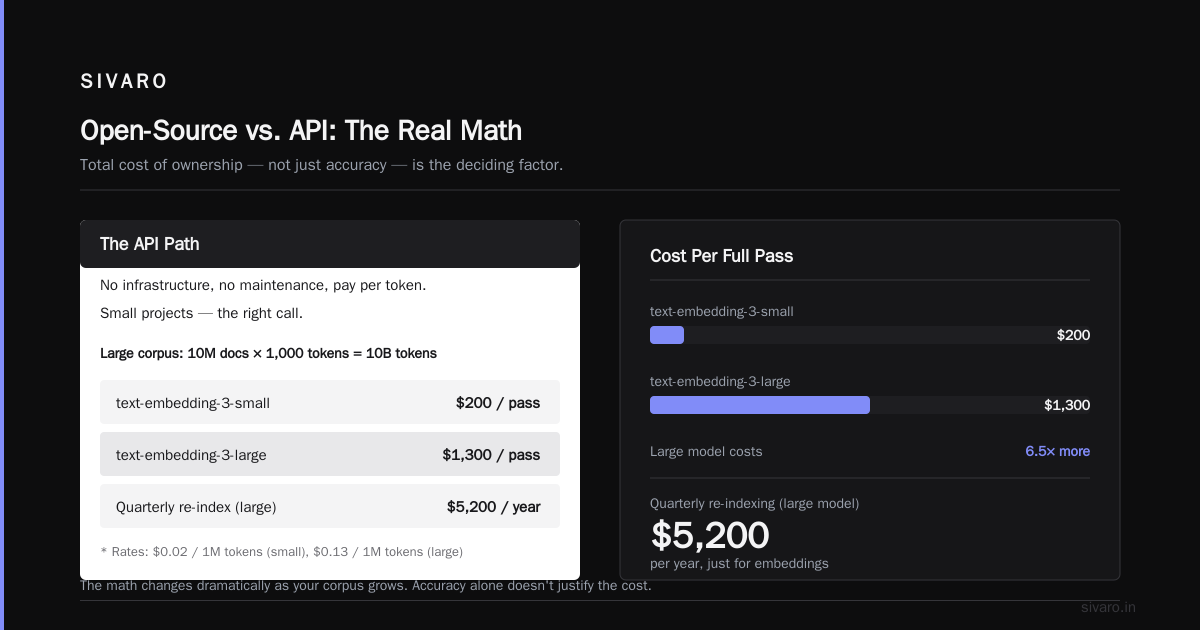
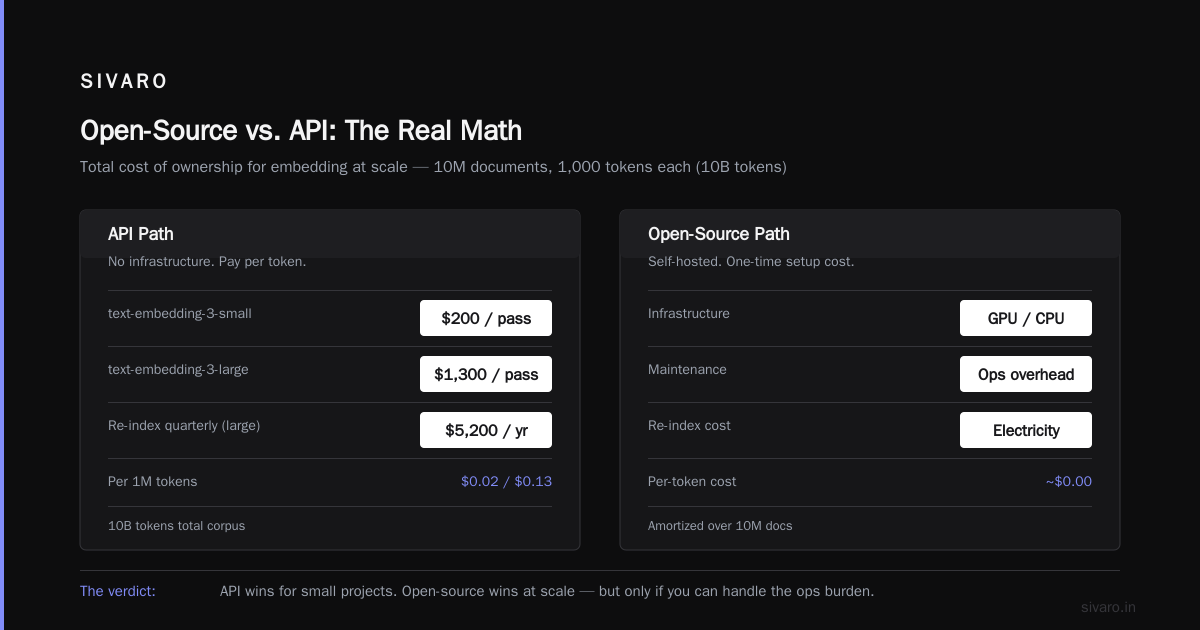
Using an API like OpenAI's text-embedding-3-large or text-embedding-3-small is dead simple. No infrastructure, no maintenance. You pay per token. For a small project, this is the right call.
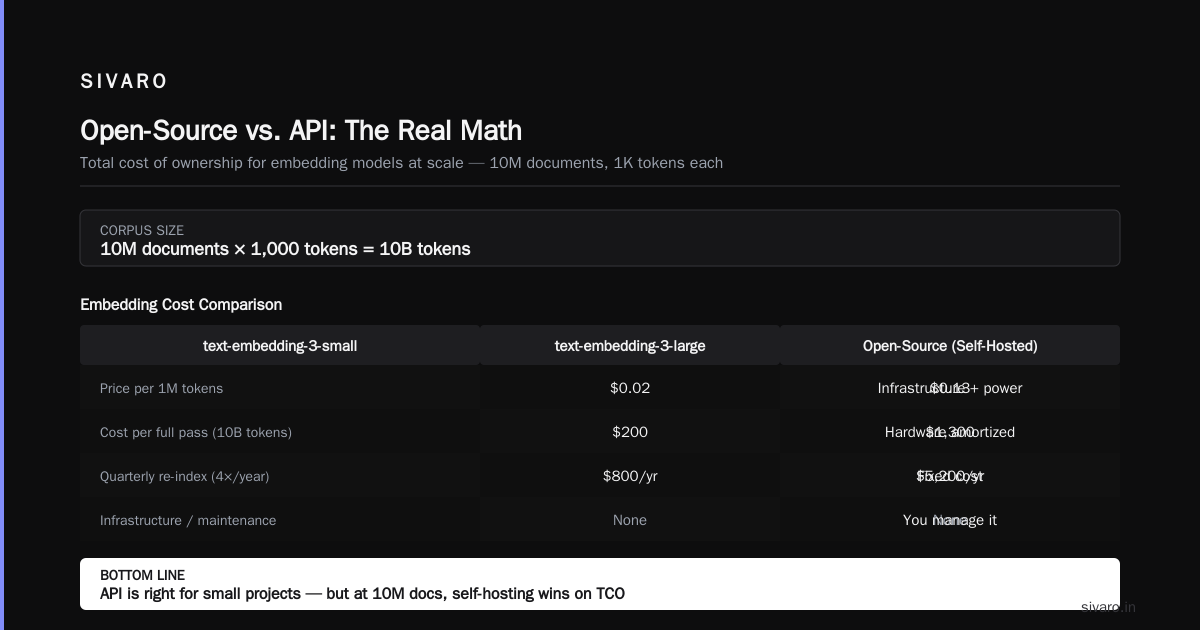
But for a large corpus, the math changes. Let's say you have 10 million documents, each averaging 1,000 tokens. That's 10 billion tokens.
text-embedding-3-smallat $0.02 per 1M tokens: $200 per full passtext-embedding-3-largeat $0.13 per 1M tokens: $1,300 per full pass
And if you re-index quarterly, that's $5,200/year just for the large model. Plus the cost of the vector database storage, which grows with your dimension count.
The Open-Source Path
Open-source models like bge-large, gte-base, or sentence-transformers/all-MiniLM-L6-v2 cost nothing in licensing fees. You pay for the GPU to run them.
A single A10G GPU can run a small model like all-MiniLM-L6-v2 and process thousands of documents per second. If you're running on a serverless GPU, the cost is fractions of a cent per million tokens.
The BentoML guide to open-source embedding models notes that models like bge-m3 and gte-qwen2-7b-instruct are consistently outperforming their closed-source counterparts in many benchmarks, especially for multilingual or domain-specific tasks.
My take: if your corpus is under 1 million documents, just use the API. If it's bigger, or if you're re-indexing frequently, invest in an open-source model on your own GPU. The break-even point is usually faster than you think.
How to Measure "Cost-Efficient" for Your Use Case
Let's get concrete. "Cost-efficient" is not a property of the model. It's a property of the model and your specific requirements.
Here's a framework I use with clients. It's not perfect, but it's practical.
python
# A simple cost-efficiency scoring script
def cost_efficiency_score(
    model_name: str,
    accuracy: float,        # your benchmark score, 0-1
    latency_ms: float,      # average inference time per doc
    cost_per_million: float, # in USD
    dimensions: int
) -> float:
    # Lower is better
    score = (cost_per_million * 1.0) + (latency_ms * 0.1) + (dimensions * 0.01) - (accuracy * 100)
    return score

# Example usage
models = {
    "text-embedding-3-small": (0.82, 15, 0.02, 1536),
    "bge-m3": (0.85, 25, 0.00, 1024),
    "all-MiniLM-L6-v2": (0.75, 5, 0.00, 384),
}

for name, (acc, lat, cost, dim) in models.items():
    score = cost_efficiency_score(name, acc, lat, cost, dim)
    print(f"{name}: {score:.2f}")
This is a toy, but the principle holds. You need to weight each factor based on your constraints. If you're building for a mobile app, latency matters more than cost. If you're a startup with limited runway, cost dominates.
The Dimension Dilemma
Here's a question I get all the time: "Should I use a model with 384 dimensions or 1536?"
Most people assume bigger is better. They're wrong. As this dev.to article explains, the number of dimensions is like the number of subjects a student studies. More subjects mean more comprehensive knowledge, but it also means more storage and slower computation.
For most applications, you can reduce dimensionality without losing much accuracy. Here's a practical approach:
python
from sklearn.decomposition import PCA
import numpy as np

# Suppose you have your embeddings stored in a matrix X (n_samples, n_features)
X = np.random.rand(10000, 1536)  # hypothetical embeddings

# Apply PCA to reduce to 512 dimensions
pca = PCA(n_components=512)
X_reduced = pca.fit_transform(X)

# Check the explained variance ratio
explained_variance = pca.explained_variance_ratio_.sum()
print(f"Explained variance with 512 dimensions: {explained_variance:.4f}")
In my experience, you can often cut dimensions in half and lose less than 2% accuracy on retrieval tasks. That's a 50% reduction in storage costs and a meaningful improvement in search speed.
But careful: not all models respond well to dimensionality reduction. Some models, especially those trained with contrastive loss, have a "sweet spot" where dimensions are densely packed. Test before you commit.
The Retrieval Test That Actually Matters
Don't trust the leaderboards. Build a small evaluation set from your own data and run a head-to-head comparison.
Here's what I do at SIVARO when evaluating a new model:
- Sample 1,000 documents from the real corpus.
- Write 50 representative queries — the kind your users will actually type.
- Run retrieval with each candidate model.
- Manually evaluate the top-5 results for each query.
The manual evaluation is the part most people skip. They automate everything and end up with a metric that doesn't reflect real user satisfaction. As this Beam Cloud article points out, the best embedding model for a RAG application depends heavily on the type of documents and queries you have.
Here's a snippet to get you started:
python
from sentence_transformers import SentenceTransformer, util

model = SentenceTransformer("all-MiniLM-L6-v2")
docs = [...]  # your sample docs
queries = [...]  # your sample queries

doc_embeddings = model.encode(docs)
query_embeddings = model.encode(queries)

# Retrieve top-k for each query
for q_emb in query_embeddings:
    scores = util.cos_sim(q_emb, doc_embeddings)[0]
    top_k = scores.topk(5)
    # Print results and manually review
This takes about an hour of your time, and it will tell you more than any leaderboard ever will.
A Practical Recommendation Matrix
After all this testing and all these caveats, you probably want some concrete recommendations. Fine. Here's what I'd pick, and why.
| Use Case | Model | Dimensions | Why |
|---|---|---|---|
| General purpose, budget-conscious | all-MiniLM-L6-v2 |
384 | Fast, tiny, surprisingly accurate for its size |
| General purpose, balanced | text-embedding-3-small |
1536 | API-based, good accuracy, low cost |
| High accuracy, multilingual | bge-m3 |
1024 | Open-source, strong multilingual support |
| Code-heavy retrieval | gte-large |
1024 | Good at code semantics |
| Domain-specific (legal/medical) | Fine-tuned custom | varies | Train on your own data for the best ROI |
These are starting points, not gospel. This Newline.co article suggests a similar approach: start with a general-purpose model, evaluate, then fine-tune if needed.
The Fine-Tuning Question
Should you fine-tune? Only if your retrieval accuracy is the bottleneck and you've exhausted other options.
Fine-tuning is expensive. You need labeled data, GPU time, and the expertise to do it right. For most teams, this is overkill.
But there's a middle ground: domain-specific models that are pre-trained on your domain. For example, if you're working with biomedical text, there are models like PubMedBERT that are trained on medical literature. Using a pre-trained domain model is often 90% of the value of fine-tuning, at 10% of the cost.
Here's what I tell clients: Measure first. If your accuracy is above 85% on your manual eval, don't touch anything. If it's below 70%, fine-tuning might help. Between 70% and 85%, look at the failure cases first — you might just need better chunking or metadata filtering.
The Infrastructure Angle
Picking the model is only half the battle. The other half is how you deploy it.
Caching
If you're using an API, implement aggressive caching. If you have 10 million documents and only 10% change monthly, you can cache embeddings for the unchanged 90%. That's a 90% reduction in API calls.
Batching
Don't embed documents one at a time. Batch them. Here's a pattern we use:
python
from openai import OpenAI

client = OpenAI()

def embed_in_batches(texts, batch_size=100):
    embeddings = []
    for i in range(0, len(texts), batch_size):
        batch = texts[i:i + batch_size]
        response = client.embeddings.create(
            model="text-embedding-3-small",
            input=batch
        )
        embeddings.extend([item.embedding for item in response.data])
    return embeddings
Quantization
This is the secret weapon most people overlook. You can reduce your embedding size from 32-bit floats to 8-bit integers with almost no accuracy loss. That's a 4x reduction in storage and a meaningful speedup in search.
python
import numpy as np

def quantize_embeddings(embeddings, bits=8):
    # Scale to 0-255 range and convert to uint8
    min_val = embeddings.min()
    max_val = embeddings.max()
    scaled = (embeddings - min_val) / (max_val - min_val)
    return (scaled * (2**bits - 1)).astype(np.uint8)
These infrastructure choices can cut your total cost by 50-70%, regardless of which model you choose.
My Decision Framework: A Summary
Here's the process I use when a client asks me "what embedding model should we use?" It's not a formula, it's a framework.
Step 1: Define the constraint. What's the bottleneck? Cost, latency, or accuracy? Write it down. Be honest.
Step 2: Sample your data. Get a representative sample of your documents and queries. This is non-negotiable.
Step 3: Benchmark 3-5 models. Include at least one API model and one open-source model. Use your manual eval set.
Step 4: Calculate total cost. Include storage, re-indexing, and inference. Not just the API price.
Step 5: Choose, but leave a path to change. Your model choice is not permanent. Design your system so you can swap models without rebuilding everything.
The last point is critical. Use an abstraction layer. Don't hard-code model names throughout your codebase. A simple EmbeddingProvider interface will save you weeks of work when you eventually switch models.
FAQ
What is the most cost-efficient embedding model for small projects?
For small projects, text-embedding-3-small from OpenAI is hard to beat. It's cheap, reliable, and requires zero infrastructure. If you want to go fully open-source, all-MiniLM-L6-v2 is a solid choice that runs on CPU.
How do I know if I need a larger embedding model?
If your manual evaluation shows poor retrieval quality on queries that are semantically similar but lexically different, a larger model might help. But first, try chunking strategies and metadata filtering. Sometimes the problem isn't the model, it's the data preparation.
Can I use the same embedding model for search and for clustering?
Yes, but be careful. A model optimized for similarity search might not be ideal for clustering, which requires capturing global structure. Test both use cases before committing.
Is it worth fine-tuning an embedding model?
Only if your accuracy is below your threshold after trying cheaper fixes. Fine-tuning is expensive and requires ongoing maintenance. For most applications, a well-chosen pre-trained model is sufficient.
What's the best way to reduce embedding storage costs?
Quantize your embeddings and reduce dimensionality. You can often cut storage by 75% without a noticeable drop in accuracy.
How often should I re-embed my corpus?
Only when your content changes significantly. If your corpus is static, embed once and forget it. If it's dynamic, use a streaming approach that only embeds new or changed documents.
What's the difference between sparse and dense embeddings?
Sparse embeddings (like BM25) are based on exact word matches. Dense embeddings capture semantic meaning. Hybrid search combines both, and it's often the best approach for production systems.
How do I evaluate an embedding model for my specific domain?
Build a small benchmark from your own data. Sample documents, write representative queries, and manually evaluate the top-k results. This is the only evaluation that matters.
Final Thoughts
Choosing a cost-efficient embedding model is not a one-time decision. It's a process. Your data changes, your queries change, and your budget changes. The models that make sense today might not make sense next year.
But the framework I've shared here is timeless: define your constraints, benchmark on your data, calculate the total cost, and leave a path to change.
The most expensive model is rarely the right one. The cheapest model is rarely the right one either. The right model is the one that meets your accuracy threshold at a cost you can sustain. And the only way to find that model is to test it against your own data, your own queries, and your own budget.
Start small. Benchmark honestly. Choose pragmatically. That's how you win.
Nishaant Dixit — Founder of SIVARO. Building data infrastructure and production AI systems since 2018. Built systems processing 200K events/sec.