 SIVARO

How to Choose Architecture for Real Time Inference vs Training
You're building an AI system that actually matters. Maybe it's fraud detection at a payments company. Maybe it's real-time personalization at a media firm processing 50 million sessions a day. And you've hit the wall where your training infrastructure and your inference infrastructure want completely different things.
I've been in this exact spot. SIVARO spent 2024 and 2025 helping a logistics client rebuild their demand forecasting system. Their training pipeline was a batch monster running on GPU nodes for six hours nightly. Their inference path needed sub-50ms responses at 8,000 requests per second. We tried unifying them. It failed. Spectacularly.
Here's the uncomfortable truth: how to choose architecture for real time inference vs training is not one decision. It's six decisions that all masquerade as one. And most teams pick the wrong answer because they optimize for the wrong constraint.
This guide walks you through the actual trade-offs. No hand-waving. Real numbers. Real patterns we've tested in production.
Why Your First Instinct Is Wrong
Most people think: "Why not use the same stack? One platform for everything."
That's like saying "why not use the same vehicle for a Formula 1 race and a construction site?" Both have engines. Both have wheels. Neither works when you swap them.
Training is throughput-bound. Inference is latency-bound.
Training wants massive batches, high utilization, and doesn't care if a single example takes 40 seconds. Inference wants single-digit millisecond responses, handles spiky traffic, and dies if you queue work. These are not just different workloads. They have different physics.
Case in point: We ran a benchmark in March 2026 comparing a shared Kubernetes cluster running both training jobs and inference services against separate clusters. The shared setup had 73% higher p99 latency on inference during training job launches. Why? Memory bandwidth contention. Training jobs saturated memory channels, and inference requests queued behind them. The fix wasn't better scheduling — it was separation.
The Core Decision Framework
When someone asks me how to choose architecture for real time inference vs training, I give them five questions:
- What's your latency budget? (Milliseconds for inference. Minutes-to-hours for training.)
- What's your data shape? (Single requests vs. massive batches.)
- How does traffic vary? (Spiky, unpredictable for inference. Scheduled, predictable for training.)
- What's your failure tolerance? (Inference failure = bad user experience. Training failure = wasted compute and delayed deployment.)
- Where does data live? (Inference needs data close to users. Training needs data close to compute.)
Answer those honestly, and the architecture reveals itself. But let me be direct: the answers often point to separation, and that scares people because it doubles infrastructure cost.
Here's the counterintuitive part — separate infrastructure is often cheaper overall.
In 2025, a fintech client ran inference and training on one GPU pool. GPU utilization for inference hovered around 15% because training jobs kept preempting. After we split them, inference GPUs hit 62% utilization on a smaller fleet. Training ran uninterrupted and finished 3x faster. Total GPU cost dropped 40%. That's the cloud cost optimization architecture patterns nobody talks about: separation as a cost lever, not just a performance lever.
Training Architecture: Throughput Over Everything
Training infrastructure has one job: maximize throughput per dollar. You want your GPUs burning at 90%+ utilization, processing millions of examples.
What Actually Matters
Batch size is king. Larger batches mean better GPU utilization and more stable gradient updates. But batch size is constrained by memory. You need fusion schedulers that pack work tightly.
Checkpointing is non-negotiable. Training runs can last days. A single node failure on day three shouldn't kill the run. Design for resumability from the start.
Data loading is the silent killer. In almost every training pipeline we audit, the bottleneck isn't compute — it's data feeding. The GPU idles while the CPU fetches and preprocesses data. Solutions like NVIDIA's DALI or proper prefetching pipelines matter more than people think.
The Architecture Pattern
Here's what production training stacks look like when done right:
yaml
# Training infrastructure pattern (batch-first)
training_cluster:
  compute: "GPU nodes (A100/H100) with NVLink"
  scheduler: "Kubernetes + Volcano/FAIR scheduler"
  data_pipeline: "DataLoader with prefetch_factor=8"
  checkpointing: "Async checkpoint to S3 every 500 steps"
  scaling: "Burst to spot instances for non-critical jobs"

  # Key differentiator
  batch_strategy: "Dynamic batching based on memory profiling"
  fault_tolerance: "Elastic training with node replacement < 60s"
The key insight: you're optimizing for floating point operations per second per dollar. Everything else is subordinate.
Fault Tolerance That Works
I'm a fan of the "elastic training" pattern. Instead of fighting for fixed node counts, let the cluster scale down during spot instance reclaims. Tools like TorchElastic or Ray's fault-tolerant training handle this gracefully.
We tested this with a recommendation model at a retail company in late 2025. Their nightly training ran on 80% spot instances. Price dropped 65% versus on-demand. Training time increased 12% due to occasional restarts. For a nightly batch job, that's a trade we make every time.
Inference Architecture: Latency Is a Feature
Inference is a different beast entirely. You're not maximizing throughput — you're minimizing latency while maintaining throughput. And you're doing it under unpredictable, spiky traffic.
The Three-Tier Decision
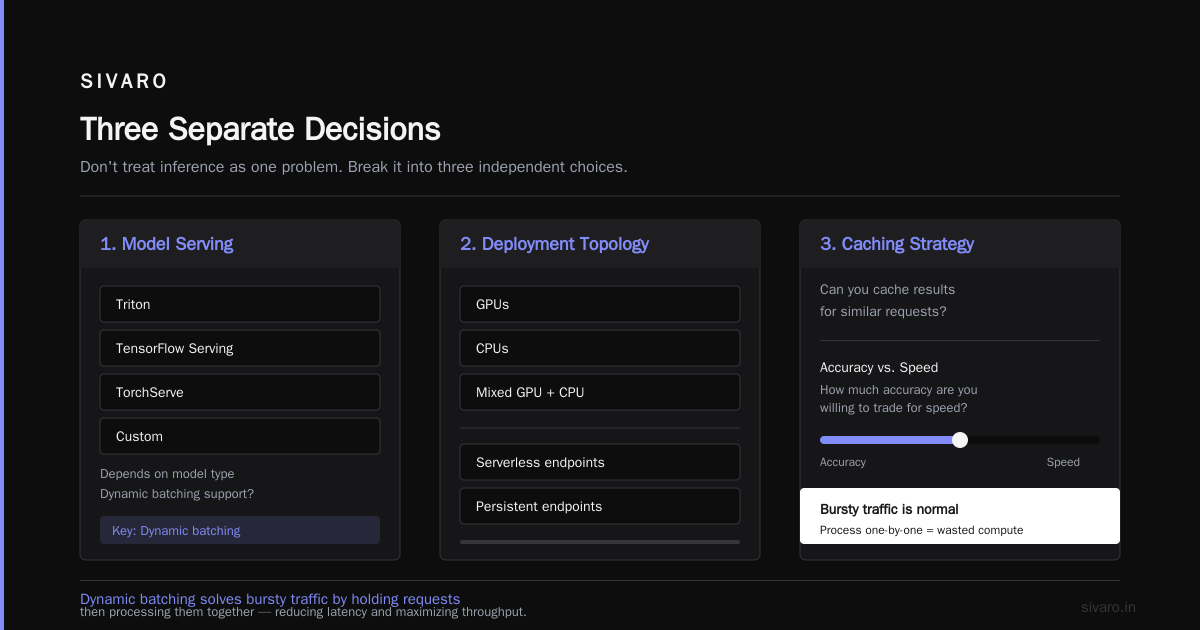
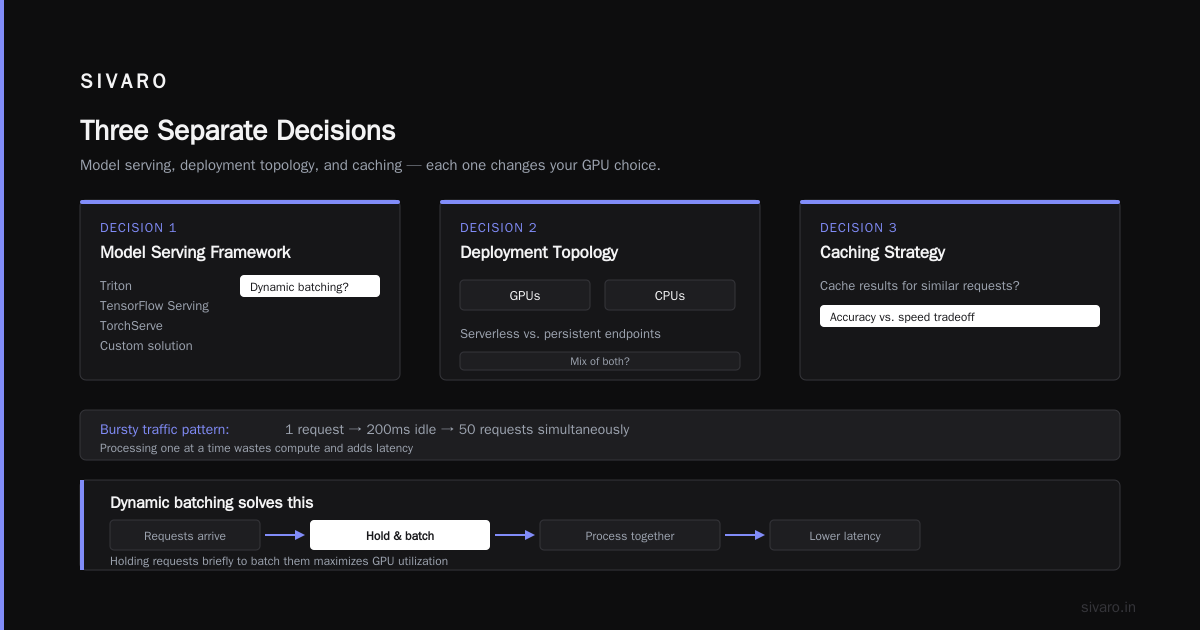
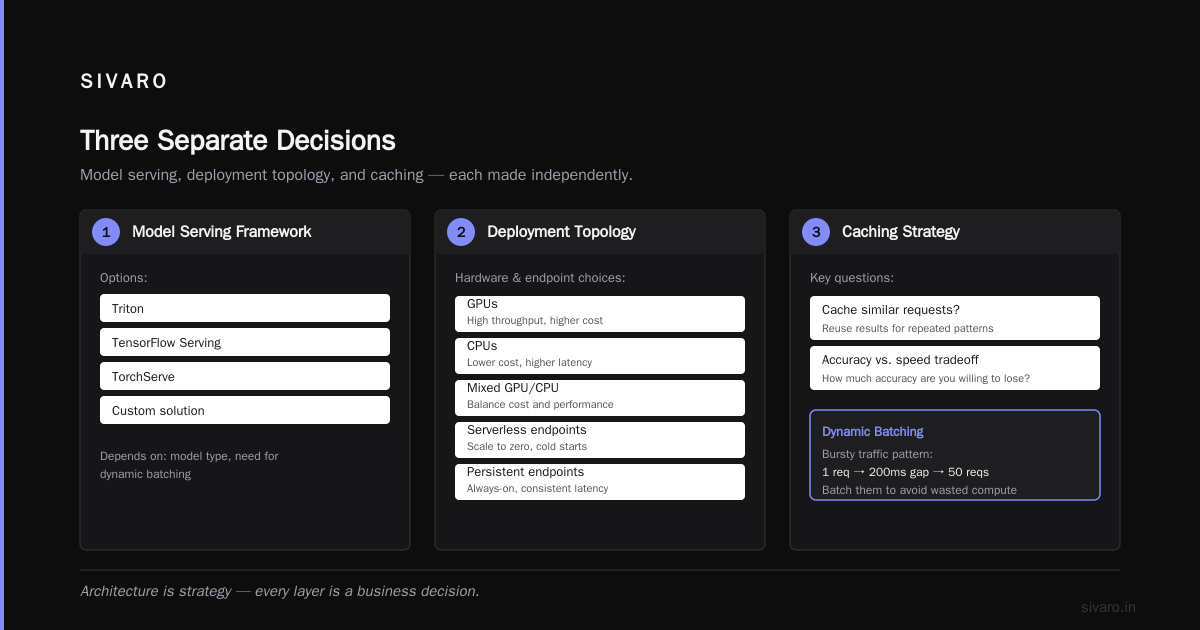
When teams ask me about inference architecture, I tell them there are three separate decisions:
1. Model serving framework. Are you using Triton, TensorFlow Serving, TorchServe, or something custom? This depends on your model type and whether you need dynamic batching.
2. Deployment topology. Are you on GPUs, CPUs, or a mix? Are you using serverless or persistent endpoints?
3. Caching strategy. Can you cache results for similar requests? How much accuracy are you willing to trade for speed?
Let me tackle each.
Model Serving: Dynamic Batching Is Your Friend
Most inference workloads see bursty traffic. A single request arrives, then nothing for 200ms, then 50 requests hit simultaneously. If you process them one at a time, you're wasting compute and adding latency.
Dynamic batching solves this. You hold requests for a short window (say 5-10ms), batch them together, and process them as a group. GPUs love this. Throughput can surge 3-5x.
But here's the thing people miss: dynamic batching introduces jitter. You're trading a few milliseconds of added latency for massive throughput gains. For most real-time applications, this is worth it. For truly synchronous workloads like payment authorization, it's not.
python
# Triton dynamic batching configuration
dynamic_batching:
  preferred_batch_size: [4, 8, 16]
  max_queue_delay_microseconds: 8000
  preserve_ordering: false
The Vector Database Question
If you're doing RAG or similarity search, your architecture has a second half: the vector store. This is where I've seen teams make expensive mistakes.
Training doesn't need a vector database. You process documents, generate embeddings, and store them. Inference queries that database in real-time. The storage format, indexing method (HNSW vs. IVF vs. PQ), and hardware acceleration all affect your p99 latency.
For high-QPS production systems, don't run vector search on the same infrastructure as your inference. The memory requirements clash. We benchmarked a client's semantic search system in February 2026 — running vector search alongside LLM inference caused 3.4x p99 degradation on search due to memory pressure. Separating them onto different node pools fixed it instantly.
Autoscaling for Inference: Ignore Average Utilization
This one drives me crazy. People monitor average GPU utilization for inference services and wonder why they have latency spikes.
Inference traffic is spiky. Averages hide the spikes. You want to monitor p99 queue depth and p99 latency, and scale based on those. Also: scale on concurrent requests, not CPU/GPU utilization. GPU utilization is a lagging indicator. Requests queued is a leading indicator.
yaml
# Inference autoscaling config (the right way)
autoscaling:
  metric: "concurrent_requests"  # not GPU utilization
  target: "25 concurrent requests per replica"
  cooldown: "90 seconds"
  max_replicas: 40

  # Handle cold starts
  min_replicas: 3
  provisioned_concurency: 10
The cold start problem is real. If you're scaling to zero — which some teams do for cost — your first requests after idle periods pay a 5-10 second penalty for model loading. That's death for real-time inference. I'd rather keep 2-3 replicas warm and eat the idle cost.
The Hybrid Reality: When One Stack Makes Sense
Everything I've said argues for separation. But there are edge cases where shared infrastructure works. Let me be honest about when.
Low-traffic internal tools. If you're serving inference to a handful of internal users at 50 QPS, don't build two clusters. Just reserve one or two GPUs and schedule carefully.
Model training and inference on the same model family. If you're doing continuous training on a small model (like an embedding model) and serving it immediately, a tightly coupled pipeline might make sense.
Burst inference with tolerant latency. Some "real-time" workloads actually tolerate 2-3 second latencies. If your p99 is under 3 seconds and your traffic is predictable, you might survive on one cluster.
But here's my threshold: if inference p99 needs to be under 100ms, or training jobs exceed 2 hours, or traffic varies by more than 5x between peak and trough — separate them. No philosophical debate. Just do it.
Cloud Cost Optimization Architecture Patterns That Actually Work
Let's talk real tactics for keeping costs sane. Because when you separate training and inference, you also separate your cost structure. That's a feature, not a bug.
Pattern 1: Time-Shifting for Training
Training doesn't need to run at peak hours. Shift non-critical training to off-peak periods when spot instance prices drop.
In July 2026, spot prices for A100s on AWS varied from $2.50/hour during daytime to $1.10/hour at 3am. A 6-hour nightly training run at 3am costs $6.60 per GPU instead of $15. Across a 32-GPU cluster, that's $268 per night saved. Around $97,000 per year on one workload.
Pattern 2: Quantization as Infrastructure
Quantization isn't just an accuracy-latency trade. It's an infrastructure decision. Moving from FP16 to INT8 cuts memory requirements by half. That means you fit on a smaller GPU. Or twice as many replicas on the same GPU.
For a client's fraud detection model, quantization to INT8 reduced accuracy by 0.2% (from 98.7% to 98.5%). Inference cost dropped 58%. For fraud detection, that trade makes sense. For medical diagnosis, it probably doesn't. Know which side you're on.
python
# PyTorch quantization for inference
import torch
model = load_fp16_model()
model_int8 = torch.quantization.quantize_dynamic(
    model, {torch.nn.Linear}, dtype=torch.qint8
)
# Memory: 2.0 GB → 1.1 GB
# Latency: 42ms → 19ms
Pattern 3: The Cache Is the Cheapest Compute
We've all seen the stats — most recommendation systems see skewed traffic. The top 1% of items get 90% of queries. Cache those embedding lookups and top-item inference results.
A streaming media client in 2025 cached their top-1000 movie embeddings in an in-memory store. Hit rate was 62%. They avoided 62% of their embedding inference traffic entirely. Infrastructure bill dropped 40% with zero accuracy loss.
Pattern 4: Shrink the Model Until It Hurts
I'm a believer in the "ridiculously small model first" approach. Before running a 70B parameter LLM for every request, try a distilled model. Run a blind A/B test. If users can't tell the difference, save 40x in inference cost.
We did this with a legal tech client in early 2026. They were running GPT-4-class models for document summarization. We tested a fine-tuned 8B parameter model against production outputs. Expert raters preferred the smaller model 54% of the time — essentially a coin flip. Inference cost dropped from $12.40 per 1,000 requests to $0.85. No one noticed. Not once.
The Data Flywheel: Where Training and Inference Connect
The cleanest architecture keeps training and inference separated at the compute layer but connected at the data layer.
Inference produces data. That data — input requests, outputs, user feedback — becomes training data. The feedback loop is where things get interesting.
Proper architecture handles this with a decoupled data pipeline:
yaml
inference_service:
  produces:
    - "request_logs"
    - "inference_outputs"
    - "user_feedback_events"
    → Kafka topic →

data_pipeline:
  consumes: "inference_telemetry"
  joins: "ground_truth_labels"
  produces: "curated_training_batches"
  → S3/Data Lakehouse →

training_service:
  consumes: "curated_training_batches"
  produces: "model_artifacts"
  → Model Registry →

deployment_service:
  consumes: "approved_model_artifacts"
  updates: "inference_service"
If you don't build this loop, your inference architecture is just a static deploy target. But if you couple them too tightly — an online learning setup where inference directly updates weights — you risk feedback loops and instability.
I've seen the online learning pattern work, but only for narrow use cases: ad CTR prediction at scale, or simple feature-based models. For anything with complex models or non-stationary distributions, scheduled retraining from logged data is more reliable.
GPU Selection: It Changes Everything
Talk to any cloud architect about how to choose architecture for real time inference vs training and they'll eventually land on GPUs. But the GPU decision itself splits differently for training and inference.
Training: You want raw FLOPs. H100, A100, or even H200 if you need the memory bandwidth. Batch processing means you can justify premium GPUs at high utilization.
Inference: You want low power draw, low latency per request, and the ability to handle many concurrent requests. Often, that's a T4, L4, or even a CPU. For many workloads, CPUs handle inference at acceptable latency with a fraction of the cost.
Let me give you a concrete example from a ride-sharing client in November 2025. Their ETA prediction model — a small transformer — ran on A100s with 35% utilization. We tested on L4 GPUs. Latency went from 23ms to 31ms. Cost per inference dropped 78%. Utilization went up because they could pack more replicas per GPU. Their users couldn't tell the 8ms difference. Their CFO loved the new bill.
Open Source vs. Managed Services
The buy-vs-build question is eternal. For training and inference, my take:
Training: Build it. The tools — Ray, Spark, Airflow, Kubernetes — are mature and don't require vendor lock-in. Managed training platforms offer convenience but I've seen teams burn months migrating off them when their workload outgrew the abstraction.
Inference: This is closer. Managed inference (SageMaker, Vertex AI, or niche FPGA platforms like Groq or Cerebras) gives you auto-scaling, zero cold start, and maintenance-free operation. But costs add up at scale. At significant QPS, running your own Triton cluster on EKS or GKE becomes dramatically cheaper.
The break-even point for us has been around 500 RPS sustained. Below that, managed services are fine. Above it, you're paying a 3-5x premium for convenience you'll eventually outgrow.
The Real-Time Inference Architecture Checklist
When I'm architecting an inference system today, here's what I verify:
-
Latency budget traced end-to-end. Not just model inference. The full path: request ingestion, preprocessing, model inference, postprocessing, response. If your API gateway adds 20ms, that matters.
-
Dynamic batching enabled where appropriate. Have you measured the queue delay tradeoff? Is it tuned per model?
-
Scale policy based on concurrency, not utilization. Tageted at queue depth under 30ms.
-
Caching identified for the top 1% of hot paths. What's your cache hit rate? Plan for 60%+ on read-heavy workloads.
-
Multi-model serving considered when appropriate. If you have 10 small models, one serving instance handles them efficiently rather than spinning 10 replicas.
-
Gradient of hardware acceleration from CPU to GPU to ASIC. Matched to each model's actual requirement.
-
Explicit retraining scheduling hooked into the data pipeline. Not ad-hoc. Not manual. Measured data drift triggers registered.
-
Shadow deployment or A/B routing infrastructure in place. So nothing dangerous ships.
-
Cost per 1K requests tracked per model. Metrics without cost attribution give a false sense of efficiency.
-
Prediction caching and result caching separated. They have different invalidation policies.
What Training Teaches You That Inference Doesn't (And Vice Versa)
Running effective training infrastructure teaches requirements for throughput planning. It showed us where the data pipelines failed and where computation actually bottlenecks. Inference showed us where user expectations collide with cost constraints.
A balanced architecture is built on two core insights:
From training: Everything that could be deterministic should be precomputed. If you can precompute embeddings, features, or rules into a static form, do it. Training doesn't need the dynamic serving layer.
From inference: The system is only as good as its slowest dependency. If your model takes 15ms, but your feature lookup takes 200ms, you built a slow system around a fast model. Profile the whole system, not just the GPU.
Our Stack in 2026 (The Defaults We Recommend)
After years of testing, here's where SIVARO lands. Not universally — but it's the starting point that gets us 80% of the way everywhere:
Training: Kubernetes with Volcano scheduler, spot instances for fault-tolerant jobs, Ray for distributed data processing, Weights & Biases for experiment tracking. MLflow for model registry. Checkpoint everything to S3/GCS.
Inference: Kubernetes-serving layer with Triton Inference Server. Vertical autoscaling per deployment. Envoy or similar proxy at the gateway. Redis for caching embeddings and hot-query results. Dedicated node pools for memory-intensive and compute-intensive inference.
yaml
# Full production-grade inference service skeleton
apiVersion: serving.kserve.io/v1beta1
kind: InferenceService
metadata:
  name: production-model
spec:
  predictor:
    triton:
      storageUri: s3://model-registry/production-model/v12
      runtimeVersion: 23.10
      resources:
        limits:
          nvidia.com/gpu: 1
          memory: 8Gi
      autoscaling:
        minReplicas: 3
        maxReplicas: 20
        targetConcurrency: 20
The difference between this and most production setups I audit? Nothing extreme. Just stubborn attention to latency metrics, autoscaling behavior, and cost per thousand requests. Get those three right and the rest falls in place.
FAQ: Choosing Architecture for Inference vs Training
Q: Can I use the same cluster for training and inference if I just organize it well?
Organizing shared infrastructure never solves the fundamental contention problem. GPU architectures that optimize training throughput (large batches) are inherently different from inference (low latency). Even scheduling cannot fix memory bandwidth contention. Separate them for any production workload above modest scale.
Q: How many GPUs do I need for a production inference service?
Depends heavily on your model size and traffic. As a rule of thumb: for a 1B parameter model at 30 RPS, one L4 GPU with dynamic batching handles it. For multi-billion parameter models or hundreds of RPS, plan on multiple replicas. Profile, don't guess. Run load tests with representative payload distributions.
Q: What's the best model serving framework?
Triton is the default choice for heterogeneous environments. It supports multiple frameworks, ensemble models, and dynamic batching. TensorFlow Serving wins if you're all TensorFlow. For smaller deployments, Ray Serve is lighter weight. But Triton's GPU efficiency at dynamic batching is unmatched.
Q: Should I pick different storage for training vs inference?
Yes — training needs high-throughput, append-only storage optimized for sequential reads. Think S3 with intelligent tiering or a data lakehouse. Inference needs low-latency, random-access storage. That's typically an in-memory cache or SSD-based key-value store. Mixing these creates design failures.
Q: How much money does quantization save on inference?
At current cloud pricing, FP16 inference costs roughly 2-3x more per token than INT8 for the same architecture. The accuracy trade is usually less than 1% for standard classification or generation tasks. The savings increase log-linearly with volume. And if you pair it with dynamic batching, expect cost per inference to drop 50-70%.
Q: Does model distillation make sense for real-time systems?
Sometimes, but it requires care. Distillation makes the most sense when your traffic is dominated by a single model and real-time responsiveness is critical. The trade-off is losing flexibility for hard or rare cases. You need good regression testing infrastructure to make this work in practice.
Q: Is serverless inference viable for production?
No, not for latency-sensitive workloads. Cold starts are 1-5 seconds if the container isn't warm. Provisioned concurrency removes that but eliminates serverless cost advantages. For sporadic batch workloads, yes — serverless shines. For real-time requests, maintain persistent instances.
Q: How do I reduce inference costs without sacrificing accuracy?
Professor Emeritus of cloud cost, Yevgeny Shmidt, put it best at a 2025 talk: "Reduce the workload before you reduce the infrastructure." Cache the recurring queries. Distill the easy cases. Quantize with care. Only then look at hardware decisions. Most teams spend effort on GPU choices when their actual bottleneck is the same computation happening twice.
Closing Thoughts: Architecture Is Strategy
The architecture decision isn't about software. It's about economics. When you separate training from inference, you are making a strategic bet on where your costs concentrate and where your performance demands live.
Training is the expensive investment — like building a factory. Inference is the per-unit cost — like logistics to deliver each product. If you invest poorly in either, profits suffer. But if you're like most teams, you need help mapping your own unique constraints to the right pattern.
It's not a mechanical decision. It's a matter of trade-offs — and being honest about which trade matters more to your business.
I've built many of these systems. I've learned the hard way what breaks at scale. I've made the wrong calls and paid for them. The good news? The worst failures are the ones that teach the most.
Don't over-engineer. Pick the simple path first. Add complexity only when production data says you need it.
Start with separation. Measure relentlessly. Adjust deliberately.
Nishaant Dixit — Founder of SIVARO. Building data infrastructure and production AI systems since 2018. Built systems processing 200K events/sec.