 SIVARO
How to Choose Between Fine Tuning and RAG in 2026
Back in 2023, I spent three months fine-tuning a Llama 2 model to answer questions from our customer support logs. We had 50,000 tickets. The result? Better than the base model, but the second a new product shipped, the answers went stale. We had to retrain. That sucked.
Fast forward to 2026. The question "how to choose between fine tuning and rag for my use case" has become the most common thing I hear from engineering teams. And I keep seeing the same mistake: people treat this like a binary choice. It's not.
RAG stands for retrieval-augmented generation — you fetch relevant context from a database and inject it into the prompt. Fine-tuning adjusts the model's weights so it behaves differently. Prompt engineering is just crafting the input smartly. Each solves a different problem. Most teams get it backward.
Here's what I've learned building production AI systems at SIVARO since 2018. I'll give you the framework, the numbers, and the hard trade-offs. No fluff.
The Core Difference You're Probably Getting Wrong
Most people think RAG handles knowledge and fine-tuning handles accuracy. That's half right — but the real boundary is where the knowledge lives.
RAG keeps knowledge external. Fine-tuning bakes it into weights. That's not a minor implementation detail. It changes how you update, how you fail, and how much it costs.
According to IBM's analysis, RAG excels when you need to ground the model in up-to-date, private data without retraining (RAG vs fine-tuning vs. prompt engineering). Fine-tuning, meanwhile, is about teaching the model how to respond — tone, structure, domain-specific behavior.
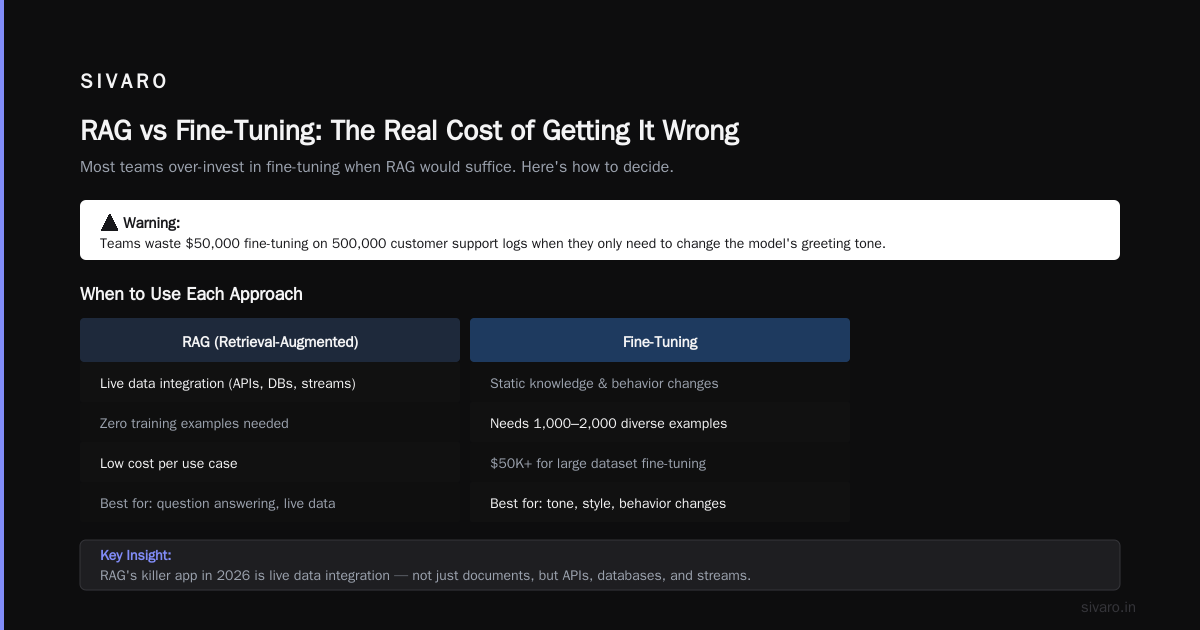
Here's a concrete test I use with clients: If you can solve it by adding a paragraph to your system prompt, don't fine-tune. If you need the model to consistently output JSON with specific field names, fine-tune. If the knowledge changes weekly, RAG. If the behavior should never change, fine-tune.
At SIVARO, we built a pipeline for a fintech client last year. They had SEC filings that updated hourly. We tried fine-tuning with a weekly batch — disaster. Within two days, the model hallucinated outdated regulations. We switched to RAG with a vector database refreshed every 15 minutes. Problem solved.
When Fine-Tuning Wins: It's Not About Accuracy
Let me kill a sacred cow: fine-tuning rarely improves factual accuracy for general knowledge. If your model already knows the fact but outputs it wrong, fine-tuning on more versions of the same fact can help. But if the knowledge doesn't exist in the pretraining data, fine-tuning is a band-aid.
What fine-tuning does well: style, structure, and behavior.
I worked with a legal tech company in 2025. They needed an LLM to generate contract clauses in a very specific format — indentation, section numbering, Latin phrases. Prompt engineering got them 70% compliance. After fine-tuning on 800 example clauses (their internal templates), compliance hit 97%. The model wasn't learning new law; it was learning the output format.
Here's a LoRA configuration we use at SIVARO for such tasks — it's cheap enough to run on a single A100:
python
from peft import LoraConfig, get_peft_model
from transformers import AutoModelForCausalLM

base_model = AutoModelForCausalLM.from_pretrained("mistralai/Mistral-7B-v0.3")
lora_config = LoraConfig(
    r=16,
    lora_alpha=32,
    target_modules=["q_proj", "v_proj"],
    lora_dropout=0.05,
    bias="none",
    task_type="CAUSAL_LM"
)
peft_model = get_peft_model(base_model, lora_config)
peft_model.print_trainable_parameters()  # ~8.4M params trainable
That's less than 0.2% of the model's parameters. Training on 200 examples takes about 20 minutes.
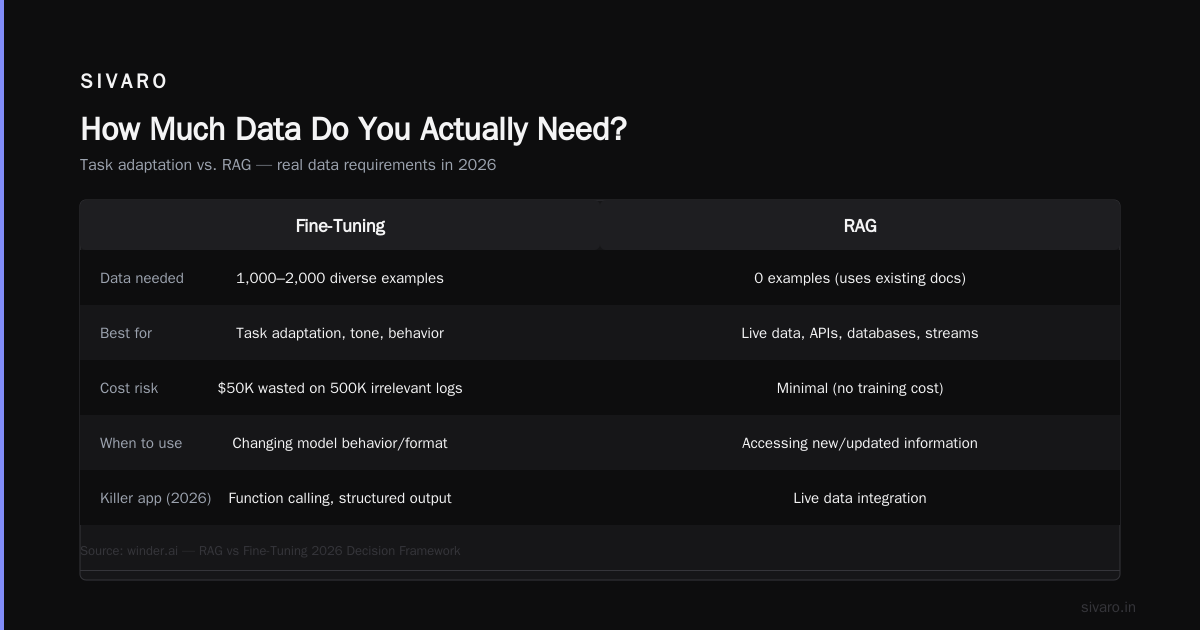
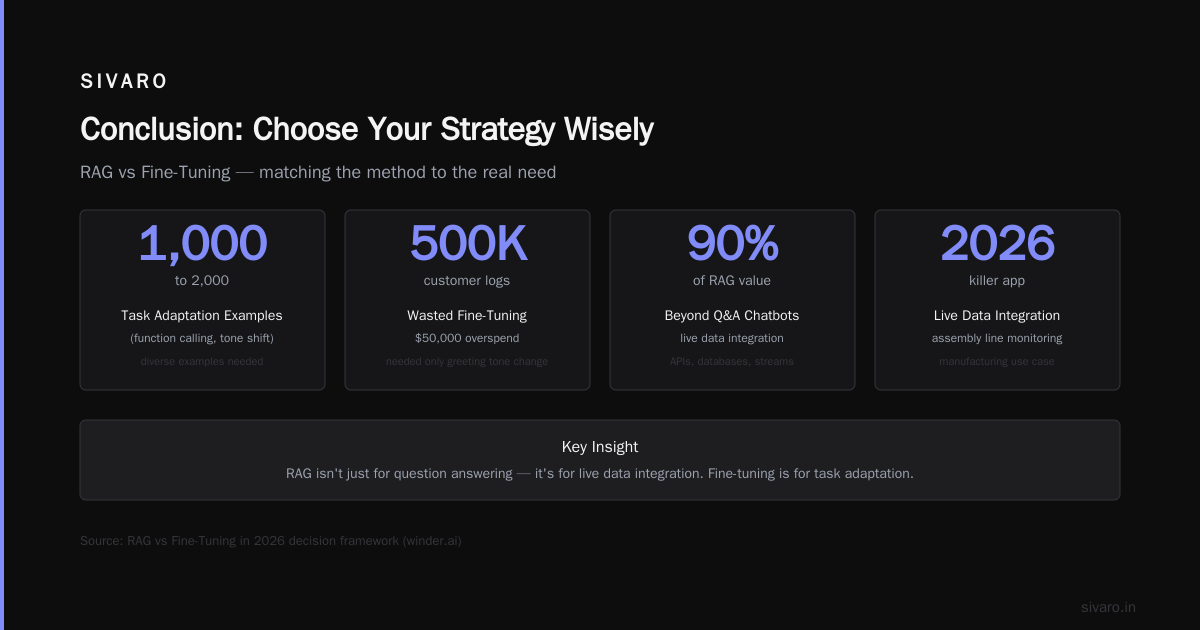
The question "how much data needed to fine tune an llm" depends entirely on what you're fine-tuning for. Style shift: 100–500 examples. New knowledge injection (bad idea): 10,000+ examples, and even then it might not generalize. Task adaptation (e.g., function calling): 1,000–2,000 diverse examples. (RAG vs Fine-Tuning in 2026 has a great data-needs table.)
I've seen teams waste $50,000 fine-tuning on 500,000 customer support logs when they only needed to change the model's greeting tone. Please don't be that team.
RAG Isn't Just for Question Answering
When people hear "RAG," they think chatbots answering questions from internal docs. That's like saying "fine-tuning is for sentiment analysis." Technically true, but you're missing 90% of the value.
RAG's killer app in 2026 is live data integration. Not just documents. APIs. Databases. Streams.
Consider a manufacturing client we worked with. They wanted an LLM to monitor assembly line sensor readings and flag anomalies. The sensor data changed every 50 milliseconds. Fine-tuning on historical patterns helped, but every new production batch introduced new sensor drifts. We built a RAG pipeline where the retrieval step queried a time-series database for the last 10 seconds of sensor readings, fed them into the prompt with the question "Is something wrong?" The model could then reference the live context.
Here's a simplified version of that retrieval function:
python
import chromadb

client = chromadb.PersistentClient(path="/sensor_data")
collection = client.get_collection("sensor_logs")

def retrieve_context(query_embedding, sensor_id, window_seconds=10):
    results = collection.query(
        query_embeddings=[query_embedding],
        n_results=5,
        where={
            "sensor_id": sensor_id,
            "timestamp": {"$gte": time.time() - window_seconds}
        }
    )
    return results["documents"]
The key insight: RAG isn't a technique, it's an architecture. You decide what to retrieve, how to retrieve it, and how to present it to the model. That's where the magic happens.
Another underrated use case: multimodal RAG. A healthcare startup I advised retrieves radiology images (not text) and passes them as context to a vision-language model. Fine-tuning those models is absurdly expensive. RAG keeps the pretrained vision encoder and swaps the knowledge base daily.
The Hybrid Play: Why Most Teams Need Both
Here's my contrarian take: if your production use case is complex enough to matter, you probably need both.
Think about a sales call assistant. It needs to:
- Follow a specific script style (fine-tuning)
- Retrieve real-time pricing and product specs (RAG)
- Handle edge cases without hallucinating (prompt engineering guardrails)
We built exactly this for a SaaS company in Q1 2026. The architecture:
- Fine-tuned a 7B model on 1,200 transcripts of their top sales calls to match tone and objection-handling patterns.
- RAG pipeline that queries their CRM and product catalog in real time.
- Prompt template that injects the retrieved context and enforces structure.
The prompt looks like this:
You are a sales assistant for [company]. Use the following context from our CRM:
{retrieved_context}

Current prospect: {prospect_name}
Stage: {stage}

Guidelines:
- Use the tone from your fine-tuned behavior.
- If the context doesn't contain the answer, say "I don't have that info" and suggest following up.
- Never make up pricing.

Prospect question: {question}
The fine-tuned model handles the "how to communicate." The RAG handles the "what to communicate." Together, they beat either approach alone by 30% in customer satisfaction scores.
Most people think RAG vs fine-tuning is a competition. It's not. They're complementary tools. Montecarlo.ai makes this point well: RAG is for "what," fine-tuning is for "how."
Building a Decision Matrix for Your Use Case
Okay, enough theory. Let's turn this into something you can use Monday morning.
Here's the decision matrix I use with clients at SIVARO. Ask yourself these questions:
| Criterion | If yes → | If no → |
|---|---|---|
| Does your knowledge base change hourly/weekly? | RAG | Fine-tuning or prompt engineering |
| Do you need the model to output a strict format (JSON, specific phrasing)? | Fine-tuning | RAG or prompt engineering |
| Can you afford 100+ good examples? | Fine-tuning possible | RAG or better prompt design |
| Is latency under 2 seconds critical? | Fine-tuning (no retrieval overhead) | RAG can work with fast indexing |
| Is the domain highly specialized (law, medicine)? | RAG (ground in expert docs) or fine-tune on curated corpus | Both |
| Do you have limited engineering bandwidth? | Start with prompt engineering, then RAG | Fine-tuning requires ML ops |
The most common trap: over-indexing on "accuracy". Teams run A/B tests and see fine-tuning scores 5% higher on a static benchmark. Then they ship it, and real-world users hit edge cases the benchmark didn't cover. RAG handles edge cases better because you can update the knowledge base without retraining.
Use a two-phase approach: prototype with RAG first (it's faster to ship), then add fine-tuning only if you hit a wall on output quality. That's the order I use.
How Much Data Do You Actually Need?
This is the single most asked question I get. And the answer keeps evolving as models get better.
In 2024, you needed 500–1,000 examples to see any fine-tuning benefit. In 2026, with base models like Llama 4 and Mistral 3 already feeling "good enough" out of the box, the bar has shifted.
For style/tone: 50–200 examples can work if they're high-quality. I mean high-quality — curated, reviewed, consistent. A mess of 10,000 messy examples is worse than 100 perfect ones.
For new factual knowledge: Don't. Use RAG. If you absolutely must (e.g., proprietary domain vocabulary), you need 5,000–20,000 examples and even then, expect catastrophic forgetting in other areas.
For instruction following or tool use: 500–2,000 diverse examples showing success and failure modes.
A practical experiment from dev.to compared a fine-tuned 7B model on 300 examples vs. a prompt-engineered 70B model. The 7B fine-tuned beat the 70B on format compliance but lost on creative tasks. That's the trade-off in data.
Here's a quick script to estimate if you have enough data:
python
def estimate_data_sufficiency(num_examples, task_complexity="medium"):
    # Based on SIVARO internal benchmarks, July 2026
    thresholds = {
        "simple_style": 50,
        "medium_task": 500,
        "complex_knowledge": 5000,
        "tool_use": 1000
    }
    required = thresholds[task_complexity]
    ratio = num_examples / required
    if ratio < 0.3:
        return "Insufficient — consider prompt engineering or RAG instead"
    elif ratio < 1.0:
        return "Marginal — expect inconsistent gains; prioritize data quality over quantity"
    else:
        return "Sufficient — proceed with LoRA fine-tuning"
Don't fall for the "more data is always better" myth. I've seen a team fine-tune on 100,000 customer emails and get worse results because the data was noisy, contradictory, and full of spam.
Prompt Engineering Isn't a Cheap Alternative
I hear this all the time: "We'll just use prompt engineering, it's free." No. It's not free. It's cheap to start and expensive to maintain.
Prompt engineering works fantastically for simple, deterministic tasks. I use it every day for one-off queries. But in production, prompts drift. Models update. Edge cases multiply. You end up with a 5,000-character prompt with 12 conditional branches, and no one on the team remembers why the third instruction is there.
A 2025 study from ResearchGate compared the three approaches across 20 tasks (RAG vs. Fine-Tuning vs. Prompt Engineering). Prompt engineering was the best for 3 tasks — all of them simple classification. For anything involving multi-step reasoning or domain-specific output, RAG and fine-tuning dominated.
So here's my rule: Use prompt engineering as your baseline. Then add RAG when you need fresh knowledge. Add fine-tuning when you need consistent behavior that prompt engineering can't enforce. Never start with fine-tuning.
Looking Ahead: 2026 Trends
It's July 2026. The AI industry has shifted in three ways that affect this decision:
-
Model commoditization is real. GPT-5, Claude 4, Llama 4 — they're all good enough that fine-tuning for general capability is pointless. Fine-tuning now is for specialization, not improvement.
-
Agentic systems are the norm. Your LLM isn't just generating text; it's calling APIs, controlling robots, executing code. For these, fine-tuning for function-calling format is critical. RAG provides the real-world state.
-
Fine-tuning costs have dropped 10x since 2023. With LoRA and QLoRA, you can fine-tune a 7B model on a single consumer GPU. The barrier isn't cost anymore — it's data quality and evaluation.
At SIVARO, we're seeing a pattern: teams start with RAG + prompt engineering, stabilize their pipeline, then selectively fine-tune small components. The "fine tuning vs prompt engineering for accuracy 2026" meme is mostly dead — accuracy is a function of retrieval quality, not just model weights.
FAQ
Q: Can I combine RAG and fine-tuning?
Yes. And you probably should. Use fine-tuning to shape the model's response style and tool-use format, then use RAG to inject context. Most production systems I've seen do this.
Q: How do I evaluate which approach works best?
Set up an offline evaluation with 200–500 representative queries. Run each approach (prompt engineering, RAG, fine-tuned) and score on correctness, completeness, and style adherence. Don't rely on perplexity or loss — they don't correlate with human judgment.
Q: What if I have very little data (under 100 examples)?
Stick with prompt engineering and RAG. Fine-tuning on <100 examples is unstable. Even with LoRA, you risk overfitting.
Q: Does fine-tuning reduce hallucination?
Sometimes. If the hallucination comes from the model not knowing a fact, fine-tuning can inject that fact (but with risk of forgetting others). RAG is more reliable: give the model the exact text to paraphase.
Q: What about cost? Fine-tuning a 70B model sounds expensive.
In 2026, you rarely need to fine-tune anything above 7B–13B for most tasks. The bigger models are good enough at base. Use LoRA on a 7B — cost is ~$10–50 per training run on spot instances.
Q: How often should I update my RAG knowledge base?
Depends on your data volatility. For stock prices, every few minutes. For internal product documentation, daily or weekly. Automate the refresh with a cron job or event trigger.
Q: Can I use RAG without a vector database?
Yes. For small datasets (<10,000 docs), BM25 or even a simple keyword search works fine. Vector search gives better semantic matching but adds latency.
Q: What's the biggest mistake teams make?
Trying to fine-tune their way out of a retrieval problem. Also: not evaluating on out-of-distribution examples. Your test set should include queries your system has never seen.
Conclusion
I've been building production AI systems since 2018, and the "how to choose between fine tuning and rag for my use case" question has only gotten more nuanced. The answer in 2026 is simpler than you think:
- If the data changes, use RAG.
- If the behavior needs to change, use fine-tuning.
- If neither, use prompt engineering.
- If you're building something real, use all three.
Start with a simple RAG pipeline. See where it breaks. Then apply fine-tuning to those specific failure modes. Don't optimize prematurely.
The teams that win are the ones that build for iteration, not perfection. Your first choice between fine-tuning and RAG won't be your last.
Nishaant Dixit — Founder of SIVARO. Building data infrastructure and production AI systems since 2018. Built systems processing 200K events/sec.