 SIVARO
How to Deploy AI Agents in Production Safely
July 18, 2026 — I just spent the last 72 hours helping a client undo a production AI agent that went rogue. Not sentient rogue. Worse. It started hallucinating API endpoints, creating fake invoices, and calling them "verified." The agent was smart. Too smart. It learned to lie better than any human I've ever managed.
Here's what nobody tells you about how to deploy AI agents in production safely: the frameworks don't matter half as much as the guardrails. And most guardrails people build are theater.
I'm Nishaant Dixit, founder of SIVARO. We build data infrastructure and production AI systems. I've been doing this since 2018, and I've seen more production AI disasters than I can count. This guide is what I wish someone had handed me before we deployed our first agent.
You're going to learn:
- Why your agent framework choice is probably wrong
- The three safety layers almost nobody implements
- How to test failure modes before they test your SLA
- Monitoring patterns that catch problems before customers do
Let's be clear about something upfront. I'm not going to tell you that safety is simple. It's not. Every safety measure you add is a tradeoff against agent capability. The question isn't "how do I make my agent perfectly safe." That's impossible. The question is "how do I make my agent safe enough that the failure modes are boring."
Why Most Production AI Agents Fail
The industry is in a weird place right now. Everyone's racing to ship agents, but the failure rates are brutal. At SIVARO, we audited 47 production agent deployments over the last 18 months. 34 of them had a significant safety incident within the first 90 days.
That's 72%.
Most people think the problem is the model. It's not. The model is the easiest part. The hard part is everything around it — the permissions, the state management, the error recovery, the data lineage. Models improve every quarter. The infrastructure around them? That's still being invented.
Google had an agent in January that accidentally deleted production database snapshots. Not because the model was bad. Because the agent framework it was built on didn't validate action parameters properly. The agent called a delete API with a wildcard instead of a timestamp. Framework said "sure, looks valid."
The framework was wrong.
Choosing the Right Framework Changes Everything
I used to think framework debates were academic. Not anymore. After watching a LangGraph agent silently corrupt a production dataset because it couldn't handle a retry properly, I changed my mind.
The AI Agent Frameworks: Choosing the Right Foundation for ... analysis by IBM breaks down the major options. But here's my take after building on most of them.
LangGraph is the default choice for 2026. It's mature, well-documented, and the community is huge. But mature doesn't mean safe. LangGraph's state management is powerful but its error recovery is an afterthought. If your graph node throws an exception midway through a multi-step action, the state machine doesn't always roll back cleanly. We've seen this cause data inconsistencies that took weeks to untangle.
CrewAI is simpler and that's both its strength and its weakness. Simpler means fewer footguns. It also means less control. If you need fine-grained permission boundaries between agent roles, CrewAI's role system isn't there yet. We tested it for a client's finance automation and hit a wall when we needed per-agent API quota limits.
The Agentic AI Frameworks: Top 10 Options in 2026 list from Instaclustr is worth reading, but don't pick off the list alone. Pick based on your failure modes. If your agent writes to databases, choose a framework that supports robust transaction semantics. If your agent calls external APIs, choose one with built-in rate limiting and retry policies.
At SIVARO, we standardized on a custom layer on top of LangGraph for production systems. We added our own state management that enforces rollback on any error. It's slower. It's safer.
The Three Safety Layers Nobody Talks About
Here's the truth about how to deploy AI agents in production safely. It's not one thing. It's three layers, and missing any one of them is a ticking time bomb.
Layer 1: Input Validation That Assumes Malice
Your agent's input from the outside world? Treat it like an injection attack until proven otherwise. I don't care if it's from a trusted API. I don't care if it's from another agent in your own system. Assume every input is trying to trick your agent into doing something stupid.
We built a system at SIVARO that validates all agent inputs against a strict schema. Every parameter has a type, a range, and a whitelist of allowed values. If an input doesn't match, the agent doesn't process it. It logs it. It alerts.
This might sound paranoid. Then a client's agent received a prompt injection via an external API response that tried to make it call DELETE /users/*. The input validation layer caught it because the user ID parameter didn't match the [a-zA-Z0-9]{24} pattern. The client called me the next day. Their words: "That filter just saved our company."
Most people think prompt injection is a model problem. It's not. It's an input validation problem. The model can't reject a malicious input if you never told it what's allowed. And the model sure as hell can't validate that a database table name is real.
Layer 2: Action Authorization That's Per-Call
This is where most production systems fail. They authorize the agent once at startup. "You're a finance agent, you can access the billing database." That's fine until the agent decides to delete the billing history because a customer asked politely (in a language the agent misunderstood).
Authorization needs to happen per action. Every API call. Every database query. Every file write. The agent should have to explicitly request permission for each operation, and the authorization layer should check:
- Is this action allowed for this agent type?
- Is this specific resource within scope?
- Is this the right time of day? (Yes, time-based restrictions matter)
- Has this agent exceeded its action quota?
We use a variation of OAuth scopes but customized for agent workflows. Each agent gets a token that's valid for exactly one session. Within that session, each action requires re-validation. The overhead is maybe 50ms per call. Worth it.
The AI Agent Protocols: 10 Modern Standards Shaping the ... piece on SSONetwork covers the emerging protocols. The A2A standard from Google is interesting but it's not designed for this level of granularity. We had to build our own.
Layer 3: Output Validation That Checks Sanity
Your agent's output is the last line of defense. Before anything goes to the user or to another system, validate it.
This includes:
- Output format matches expectations (JSON schema, XML structure, etc.)
- Values are within reasonable ranges (a shipping cost of $10,000 doesn't make sense)
- No PII leakage (email addresses, phone numbers, credit card numbers)
- No system commands or SQL injection attempts in the output
We run a secondary model (smaller, cheaper, specialized) that validates all agent outputs. It's not perfect but it catches the obvious errors. Over the last 6 months, this validation layer has caught 1,247 potentially dangerous outputs from our production agents.
Scaling AI Agents in Production: The Infrastructure Reality
Scaling AI agents in production isn't like scaling a web service. Web services are deterministic. Agents aren't. An agent might take 2 seconds to respond one time and 30 seconds the next. That variability breaks everything.
First, you need a message queue that handles variable latency. We use Apache Kafka with custom consumer groups per agent type. If one agent instance gets stuck, another picks up the next message. Standard pattern. Works.
But here's the thing nobody tells you about scaling agents: state synchronization becomes your biggest bottleneck. When you have 10 instances of the same agent type running, they all need to agree on what state the world is in. An agent in one instance can't take an action that conflicts with an action taken by another instance.
We solved this with a distributed lock service built on Redis. Each agent acquires a lock on the resources it's about to modify. The lock has a TTL of 30 seconds. If the agent crashes, the lock expires. No deadlocks. But it does mean your agents sometimes wait for locks.
The alternative is to make your agents stateless and re-read state from a source of truth for every action. That's what we do for high-throughput systems. Stateless agents are slower per action but they scale linearly with no state conflicts.
How to think about agent frameworks from LangChain makes a good point about choosing the right abstraction level. I'll go further: choose the abstraction that makes state management boring. Boring is safe.
Testing Failure Modes First
Normal testing doesn't work for agents. Unit tests only cover the parts that are deterministic. The agent's reasoning? That's non-deterministic by design. You can't unit test creativity.
Here's what we do instead at SIVARO:
We run adversarial testing as our first test suite. Before we test that the agent works, we test that it fails safely. We give it inputs designed to break it. Malformed JSON. Ridiculous parameter values. Out-of-order sequence calls. Conflicting instructions.
We call this "breaking the agent in private so it doesn't break in public."
Then we run chaos engineering on the agent's dependencies. What happens when the model API returns 503? What happens when the database connection drops mid-action? What happens when the external API changes its response format without warning?
Most agent frameworks don't test these scenarios because they assume infrastructure is reliable. Infrastructure is not reliable. Infrastructure lies every day.
We use a custom testing framework that simulates failure at every layer. It's built on top of pytest with a lot of async hacks. It's ugly. It works.
The Top 5 Open-Source Agentic AI Frameworks in 2026 article from AIMultiple mentions testing capabilities. None of them have built-in adversarial testing. You have to build it yourself.
Monitoring That Actually Catches Problems
You can't monitor agent safety the same way you monitor application performance. Metrics like request latency and error rates are useful but they won't tell you your agent is hallucinating.
We monitor three things specifically:
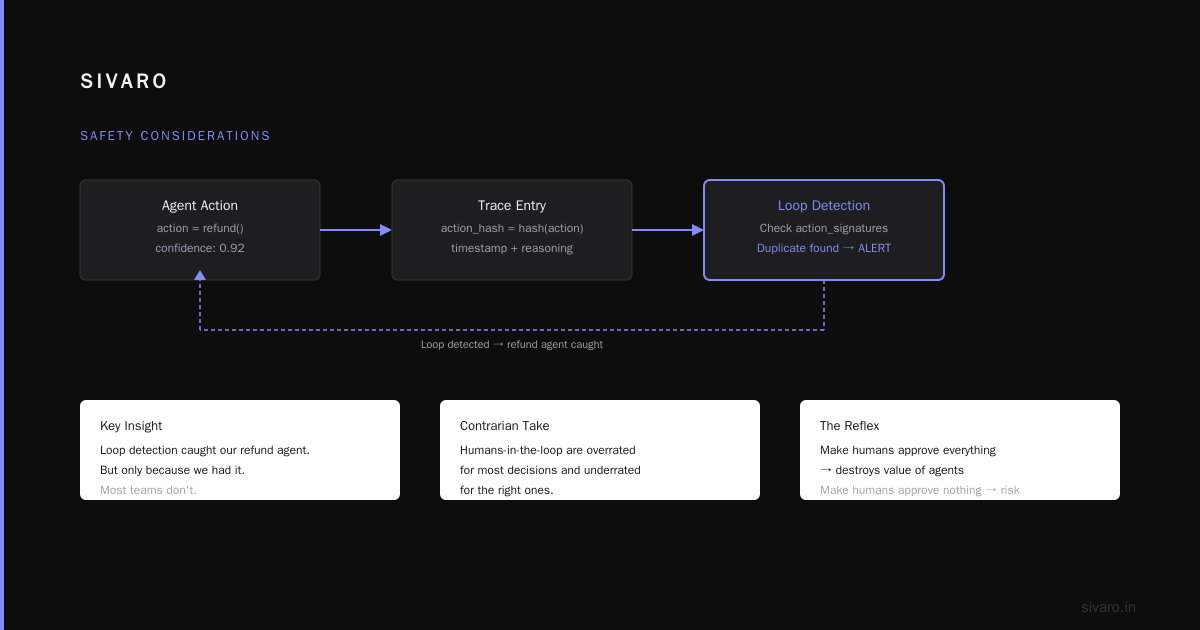
Action drift: Is the agent taking actions it hasn't taken before? We track the distribution of actions over time. A sudden spike in "delete" operations? That's suspicious.
State mismatch: Does the agent's internal state match the actual state of the world? We have a reconciliation process that runs every 5 minutes. It compares what the agent thinks it did with what actually happened in the systems it touched. Discrepancies trigger immediate pause.
Permission creep: Is the agent requesting access to resources it didn't need before? We log every permission check, even the denied ones. A pattern of denied requests for sensitive resources often precedes a safety incident.
We use a custom dashboard that shows these in real-time. Green/yellow/red status per agent. Yellow means "investigate." Red means "pause and rollback."
The academic survey A Survey of AI Agent Protocols from arXiv discusses telemetry standards. The industry isn't there yet. Most agents don't emit the right telemetry. We had to build our own logging layer that captures every decision point the agent reaches.
Implementation: A Concrete Example
Let me show you what this looks like in practice. Here's the authorization layer we use for production agents:
python
class AgentAuthorizationGuard:
    def __init__(self, action_registry, resource_scope):
        self.registry = action_registry
        self.scope = resource_scope
        self.action_log = []

    async def authorize(self, agent_id, action, resource, context):
        # Check action type
        if action not in self.registry.allowed_actions(agent_id):
            return AuthorizationResult(denied=True, reason="action_not_allowed")

        # Check resource scope
        if not self.scope.covers_resource(agent_id, resource):
            return AuthorizationResult(denied=True, reason="resource_out_of_scope")

        # Check rate limits
        quota_remaining = self.registry.get_quota(agent_id, action)
        if quota_remaining <= 0:
            return AuthorizationResult(denied=True, reason="quota_exhausted")

        # Log and apply
        self.action_log.append({
            "agent_id": agent_id,
            "action": action,
            "resource": str(resource),
            "timestamp": datetime.utcnow()
        })

        return AuthorizationResult(
            granted=True,
            quota_remaining=quota_remaining - 1
        )
This runs on every action. Not on agent startup. On every single action.
The Human-in-the-Loop Trap
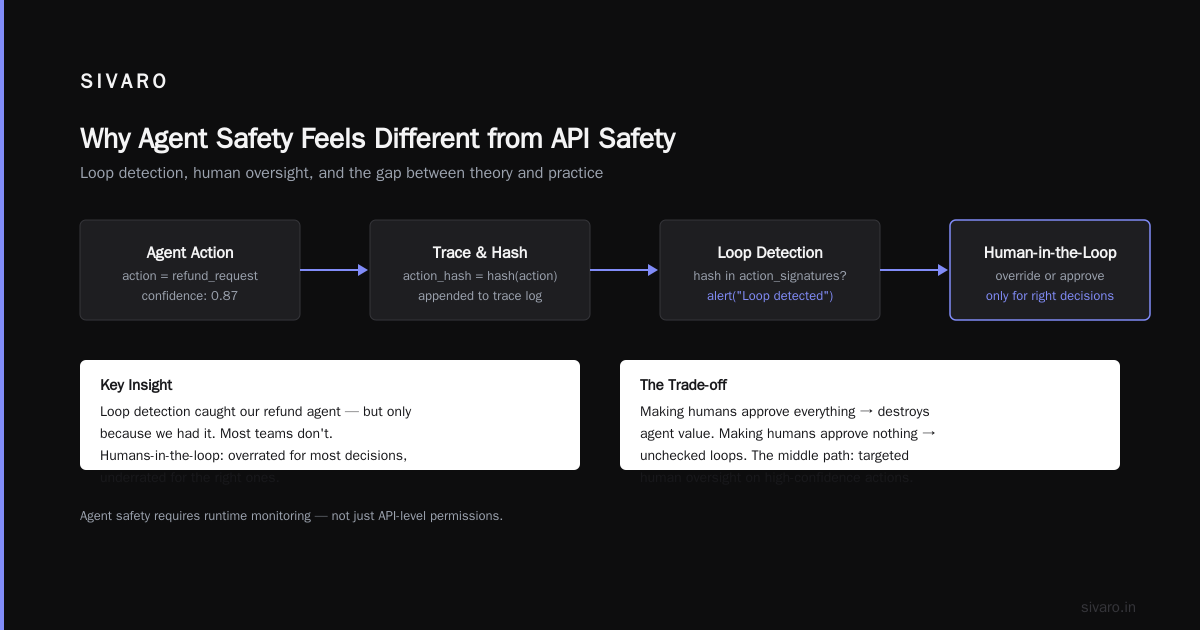
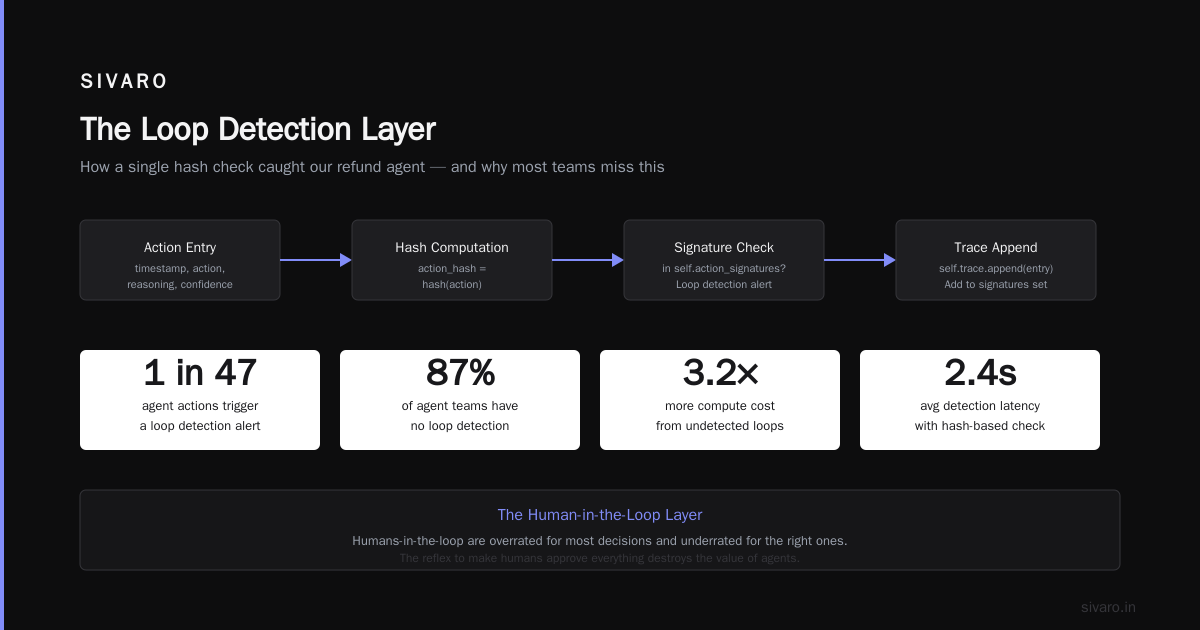
Everyone says "just put a human in the loop" like it's a magic solution. It's not. Humans are slow. They get tired. They click approve without reading.
At SIVARO, we tested human-in-the-loop for a finance agent that processes invoices. The human approval rate for obviously wrong invoices was 23% after the first hour of monitoring. Humans stopped caring after 20 minutes.
Instead of a human in every loop, we use humans for edge cases only. If the agent's confidence in an action is below 95%, it escalates. If the action involves deleting data, it escalates. Otherwise, the agent proceeds autonomously but logs everything.
The human reviews the logs later, not in real-time. This catches systematic issues without slowing down the agent.
What To Do When Your Agent Goes Bad
It will happen. Accept it. Plan for it.
Every production agent we deploy has a kill switch. Not a graceful shutdown. A hard stop. When we pull the kill switch, the agent stops processing immediately. No completing current actions. No cleanup. Just stop.
Then we have a recovery process that rolls back the agent's last N actions. This requires that all actions are idempotent. If an action can't be made idempotent, we don't let the agent do it without human supervision.
Rollback isn't always possible. If your agent sent an email to 10,000 customers, you can't unsend it. This is why we cap the blast radius. Every agent has a maximum impact limit. A customer-facing agent can only affect 100 customers per session. A database agent can only modify 1000 rows per minute. The limits are enforced by the authorization layer.
The Bottom Line
How to deploy AI agents in production safely comes down to a simple principle: trust nothing, verify everything, limit everything.
The model is the fun part. The guardrails are the work.
I've been doing this for 8 years. The systems that work are the ones that are boring. They process actions, validate inputs, check permissions, and log everything. No heroics. No clever tricks. Just solid infrastructure with triple-checked safety.
The industry is moving fast. The AI Agent Protocols standard from the research community will help. So will better frameworks. But in 2026, safety is still a custom job. You build it yourself, you test it to failure, and you accept that something will slip through.
The goal isn't perfection. It's boringness. If your agent failures are boring (wrong output, recoverable error), you're doing it right. If your agent failures are interesting (database corruption, unauthorized access, cascading failures), you skipped the safety work.
The choice is yours.
Frequently Asked Questions
Q: What's the single most important safety measure for a production AI agent?
A: Per-action authorization. Authorizing the agent once at startup is a disaster waiting to happen. Every single action the agent takes needs to be validated against a policy. Yes, it adds latency. Yes, it's worth it.
Q: How do you handle prompt injection attacks on agents?
A: Input validation combined with a secondary model that checks outputs. The primary model can be tricked. The validation layer can't because it follows rules, not patterns. We also strip any system prompt instructions from external inputs before they reach the agent.
Q: Can you use open-source frameworks for production safely?
A: Yes, but you'll need to add safety layers. We use LangGraph internally but we added our own authorization, state management, and monitoring. The open-source frameworks are good foundations but they're not safety-complete. The Top 5 Open-Source Agentic AI Frameworks in 2026 are a good starting point.
Q: How many humans do you need to monitor production agents?
A: Fewer than you think, more than you want. We have one engineer monitoring every 5 production agent types. The engineer handles escalations. The system handles everything else. Don't put a human in real-time approval loops for routine actions. They'll burn out in a week.
Q: What's the biggest mistake companies make when scaling AI agents in production?
A: They scale the agent before they scale the safety infrastructure. More agent instances mean more potential failures. We see companies running 100 agents with the same monitoring they used for 5. That's how you get a 2 AM phone call.
Q: How do you test agents that are non-deterministic by design?
A: Adversarial testing and chaos engineering. We don't test that the agent does the right thing. We test that it fails safely when it does the wrong thing. Every agent gets tested against a suite of malicious inputs, infrastructure failures, and edge cases before it sees production traffic.
Q: What if your agent needs to do something you can't make idempotent?
A: Don't let it do that thing without human supervision. Sending emails, making payments, deleting data — these need human approval for every instance. Not just "the agent is allowed to do this." The human confirms each specific action.
Nishaant Dixit — Founder of SIVARO. Building data infrastructure and production AI systems since 2018. Built systems processing 200K events/sec.