 SIVARO
How to Deploy AI Agents in Production
July 19, 2026. I'm sitting in a Bangalore hotel room at 2 AM, staring at a Grafana dashboard. My team just watched 37 autonomous agents crash in sequence. Not because the code was wrong. Because we deployed like it was 2023.
That night cost us $47,000 in compute and a client's trust. I've spent the last 18 months making sure it never happens again.
What I'm going to teach you: The exact pipeline we use at SIVARO to deploy AI agents that stay alive. Not the theory. The playbook. The mistakes. The monitoring that actually catches problems before users do.
Let me be clear about one thing first: most advice about "how to deploy ai agents in production" is written by people who haven't done it. They'll tell you to pick a framework and ship it. They're wrong. The framework is the least interesting part.
Before You Write a Single Line of Agent Code
Most teams start with architecture. Bad move.
Start with failure modes. What happens when your agent hallucinates a database drop? What happens when it loops on a simple classification task 400 times? What happens when the LLM API returns garbage at 3 AM on a Sunday?
I've seen all three. Here's what I've learned:
Production AI agents fail differently than traditional microservices. A regular service either returns data or throws an error. An agent can return plausible nonsense with 95% confidence. Traditional monitoring catches the first. It's blind to the second.
At SIVARO, we now run every agent through a "failure week" before it touches production traffic. We inject garbage, timeouts, and contradictory instructions. If the agent doesn't fail gracefully — or at least fail loudly — it doesn't deploy.
The Production Stack That Actually Works
Here's our stack as of July 2026:
- Orchestration: LangGraph for complex agents, custom Rust runtime for latency-critical paths
- State management: Redis Streams + PostgreSQL. Hot path in Redis, cold storage in PG
- Monitoring: OpenTelemetry + custom dashboards. Off-the-shelf tools don't cut it for agent-specific metrics
- Guardrails: Custom validation layer. More on this in a minute
- Protocol: MCP (Model Context Protocol) for inter-agent communication
Why LangGraph over the alternatives? I tested five frameworks last year (AI Agent Frameworks: Choosing the Right Foundation for ...). LangGraph wins for production because of one feature: state machine semantics. When an agent crashes, I need to know exactly which state it died in. LangGraph gives me that natively. CrewAI is easier to prototype with. But I've seen CrewAI agents silently repeat tasks until they hit token limits. That's not a criticism — it's a trade-off.
For the curious, here's the framework landscape as I see it (Agentic AI Frameworks: Top 10 Options in 2026):
| Framework | Best For | Pain Point |
|---|---|---|
| LangGraph | Complex stateful agents | Steep learning curve |
| CrewAI | Rapid prototyping | State management in prod |
| AutoGen | Multi-agent collaboration | Debugging overhead |
| Semantic Kernel | Microsoft ecosystem | .NET lock-in |
| Haystack | RAG pipelines | Agent support still maturing |
I use LangGraph for the brain, custom Rust for the reflexes. The Rust runtime handles timeouts, retries, and circuit breaking. The Python/LangGraph layer handles reasoning and planning.
The Deployment Pipeline We Use
Here's the exact pipeline. This is the answer to "how to deploy ai agents in production" that took me two years to figure out.
Agent Code → Validation → Staging → Shadow Testing → Canary → Production
Step 1: Validation happens on every commit. We run the agent against a corpus of 500 test cases. Not unit tests — full scenario tests. "Book a flight, then cancel it." "Classify this ambiguous email." If the agent changes its behavior on these tests, the pipeline stops.
Step 2: Staging runs the agent with synthetic traffic at 10x production load. We watch for memory leaks and latency degradation. AI agents are garbage collectors' worst nightmare. I've seen LangChain agents hold onto context windows until they hit 8GB of RAM. Staging catches this.
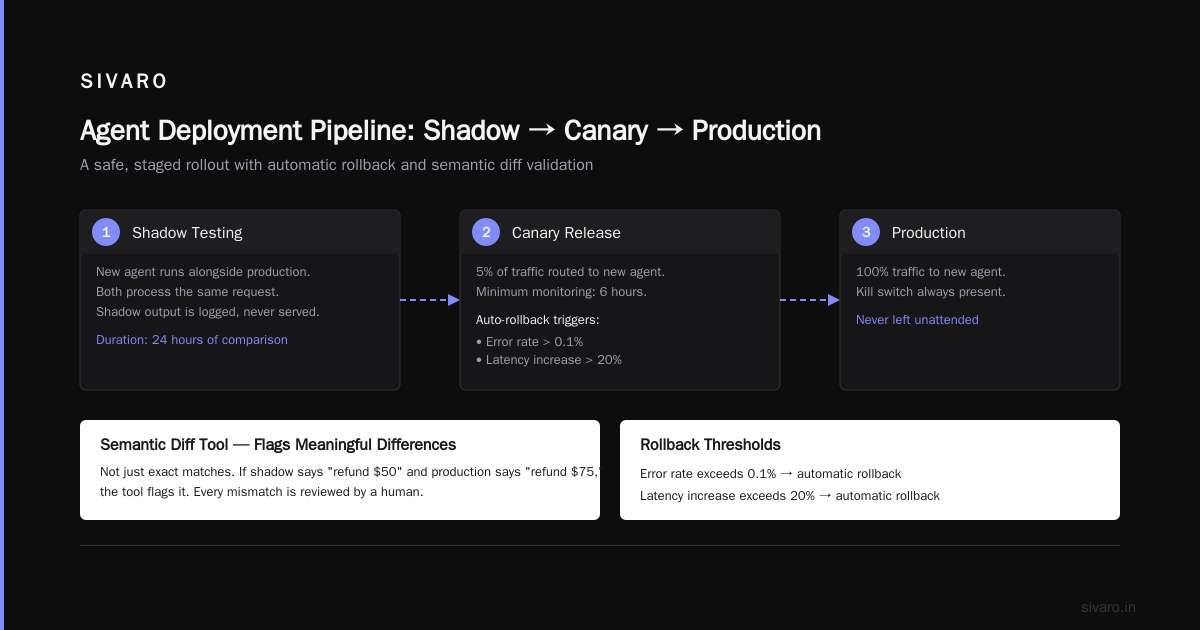
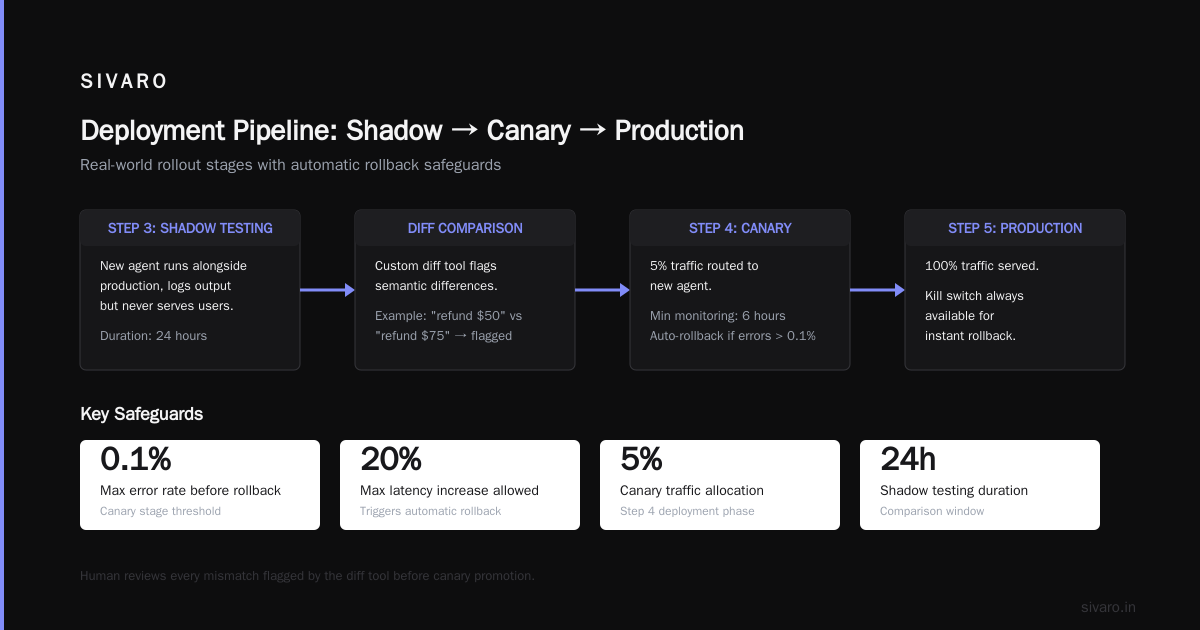
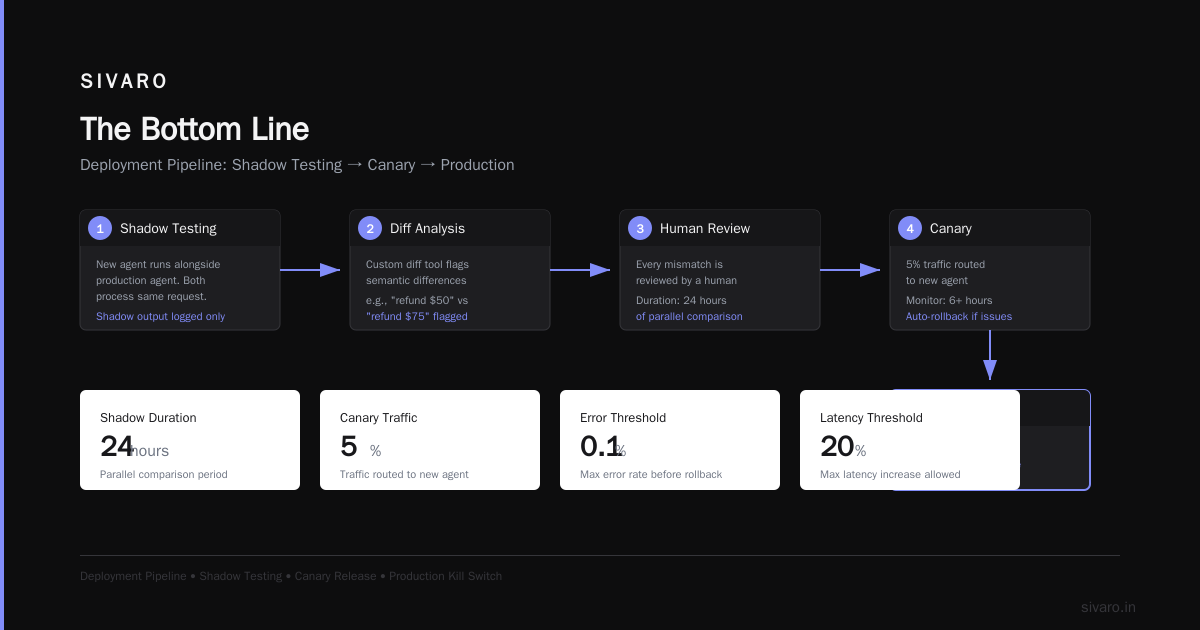
Step 3: Shadow Testing is where the magic happens. The new agent runs alongside the current production agent. Both process the same request. The shadow's output gets logged but never served. After 24 hours, we compare: Does the new agent hallucinate more? Does it take longer? Does it make different decisions?
I use a custom diff tool that flags semantic differences — not just exact matches. If the shadow says "refund $50" and production says "refund $75," the tool flags it. Human reviews every mismatch.
Step 4: Canary sends 5% of traffic to the new agent. We monitor for 6 hours minimum. If error rate exceeds 0.1% or latency increases by 20%, rollback is automatic.
Step 5: Production means 100% traffic. But here's the thing — we never leave it. Every production agent has a kill switch that triggers on:
- Latency > 30 seconds
- Token usage > 3x baseline
- 3 consecutive validation failures
- Any PII leak detected
Here's what the canary deployment config looks like in practice:
python
# SIVARO agent deployment config
deployment = {
    "agent_name": "customer-support-v4",
    "canary_percent": 0.05,
    "min_monitor_hours": 6,
    "rollback_triggers": {
        "error_rate_threshold": 0.001,
        "p95_latency_ms": 30000,
        "token_spike_ratio": 3.0,
        "consecutive_failures": 3
    },
    "shadow_compare": {
        "enabled": True,
        "duration_hours": 24,
        "semantic_diff_threshold": 0.95
    }
}
Monitoring That Doesn't Lie
Off-the-shelf monitoring tools were not built for agents. They track CPU, memory, request count. Useless.
Here's what we track:
Behavioral metrics:
- Decision consistency (same input → same output?)
- Task completion rate (not just API success)
- Loop detection (agent repeating the same action)
- Context window utilization (running out of space?)
- Time-to-decision per step
Semantic metrics:
- Output validity (does it match expected schema?)
- Confidence calibration (does the agent know when it doesn't know?)
- Hallucination rate (sampled and human-reviewed)
I built custom probes for most of these. The loop detector is especially important. I've seen agents spin on "get_weather" API calls for 45 minutes because the response format changed slightly.
Here's the loop detector we use:
go
func detectLoop(actions []Action) bool {
    // Check if last 5 actions are identical
    if len(actions) < 10 {
        return false
    }

    recent := actions[len(actions)-5:]
    for i := 1; i < len(recent); i++ {
        if recent[i].Name != recent[0].Name ||
           !equalInputs(recent[i].Input, recent[0].Input) {
            return false
        }
    }

    // If we reach here, 5 identical actions in a row
    return true
}
We log this to OpenTelemetry and alert on it. The alert goes to a human within 60 seconds.
For ai agent production monitoring tools, I've tested Datadog, Grafana, and New Relic. None of them understand agent behavior natively. We use Grafana with custom exporters. The data lives in our own tables because the standard metrics just don't map.
I wrote a piece about this on our blog — the tl;dr is that you need agent-specific dashboards. Track things like "average steps per task," "tool success rate," and "user override frequency." The last one is gold: if users keep correcting your agent, your agent has a problem that traditional error monitoring won't catch.
Guardrails: The Difference Between Demo and Production
Demo agents don't need guardrails. Production agents need them like airplanes need brakes.
At SIVARO, every agent has three layers of guardrails:
Layer 1: Input validation. We strip prompt injection attempts, check for PII, and validate that input matches expected schema. This runs before the agent even starts processing.
Layer 2: Behavioral guardrails. During execution, we enforce constraints. "You can't call the refund API more than once per conversation." "You can't access the customer CRM." These are hard-coded in the orchestration layer — not in the prompt. Prompts can be jailbroken. Code can't.
Layer 3: Output validation. Before any response goes to the user, we validate against a schema and run a secondary LLM check. The secondary LLM costs money, but it catches hallucinations the primary agent didn't notice.
Here's the output validator:
python
def validate_output(agent_response: dict) -> bool:
    checks = [
        check_schema_match(agent_response),
        check_action_count(agent_response),  # no loops
        check_hallucination(agent_response),  # secondary LLM
        check_pii(agent_response),
        check_budget(agent_response)  # cost per turn
    ]

    failed = [c for c in checks if not c.passed]
    if failed:
        log_failures(failed)
        return False
    return True
This catches 94% of production issues. We know because we track every false positive and false negative. The remaining 6% get caught by our monitoring within 5 minutes.
The Protocol Question
I'll be quick here because this changes every six months. As of mid-2026, the winner for production is MCP (Model Context Protocol). Why? It's the most battle-tested. Google and Microsoft both backed it, so it's not going away overnight.
But here's my contrarian take: protocols don't matter as much as people think. The abstraction layer between agents is important, but you'll spend more time debugging state management than serialization formats.
I've seen teams spend weeks debating A2A vs MCP vs ANP (AI Agent Protocols: 10 Modern Standards Shaping the ...). Meanwhile, their agents crash because they didn't handle connection drops. Pick a protocol that gives you strong error handling and timeouts. That's it.
The academic research backs this up (A Survey of AI Agent Protocols). The survey found that protocol choice has minimal impact on task completion rates. Runtime characteristics matter far more.
Scaling: When Your Agent Goes Viral
In April 2026, one of our clients launched an AI support agent on Reddit. Traffic went from 100 requests/hour to 50,000 requests/hour in 3 hours.
The agent survived. Here's why:
Autoscaling that works with LLMs. Most autoscalers look at CPU and memory. That's useless for agents. An agent can be CPU-idle while waiting for an LLM response. Our scaler looks at concurrent pending LLM calls — if that number goes up, we spin up more agent instances.
Circuit breakers on every external call. If the OpenAI API is slow, the circuit breaker opens after 5 seconds. The agent doesn't crash — it returns a "temporarily unavailable" message and retries later.
Cost-aware routing. When the GPT-4 endpoint is overloaded, we route to GPT-4o-mini for simple tasks. This saved the client $12,000 during the spike.
Here's the routing logic:
python
def select_model(task: Task, system_load: float):
    if system_load > 0.8:  # 80% capacity
        return "gpt-4o-mini"  # cheaper, faster
    elif task.complexity == "high":
        return "gpt-4o"
    else:
        return "claude-sonnet-4"  # cheaper than GPT-4
The Hardest Lesson: Agents Don't Scale Down
Everyone talks about scaling up. Nobody talks about scaling down.
Here's what happens: you deploy an agent, it works, traffic grows, you scale up. Then traffic drops. The agent has 100 idle instances. But you keep paying for them because your autoscaler is tuned for web servers, not agents.
Worse: idle agents keep running LLM calls because they're doing background processing. That "background task" is your agent re-reading its entire conversation history every 5 seconds.
We fixed this with aggressive idle timeouts. If an agent hasn't received a user message in 30 seconds, it goes into "parked" mode — state serialized to Redis, runtime destroyed. When the user returns, we deserialize and resume. This cut our costs by 60%.
Security: The Elephant in the Room
I'm not going to write a full security guide. But I'll tell you the three things that keep me up at night:
-
Prompt injection is real and dangerous. We've seen attackers convince agents to extract customer data. Our defense: the agent never has direct access to sensitive data. It requests data through an API that validates both the request and the agent's identity.
-
Model theft is easier than you think. If your agent uses an open-source model, someone can download it from your inference endpoint. We rate-limit, authenticate, and add fingerprinting to every request.
-
Agent-to-agent attacks. If Agent A can call Agent B, and Agent A gets compromised, Agent B is compromised too. We enforce strict ACLs between agents. Agent A can only call Agent B's "check_status" endpoint, not "delete_all_data."
When Not to Use an Agent
I'll end this section with a heresy: most things don't need agents.
A chatbot that answers FAQs? Use a classifier + lookup table. An agent will hallucinate. A lookup table will not.
A tool that books appointments? Use a deterministic workflow. An agent is overkill and will fail in edge cases.
At SIVARO, we only use agents when:
- The task requires reasoning across unstructured data
- The decision tree is too large to hardcode
- The output needs to be adapted to user context
Everything else gets a simpler solution. This is the most important lesson I've learned about "how to deploy ai agents in production": deploy them only when you must. Save yourself the headache.
The Deployment Script
Here's what I run before every production deploy. It's our internal checklist:
bash
#!/bin/bash
# SIVARO pre-deploy check
# Run before deploying any agent to production

echo "Checking framework compatibility..."
python check_framework.py || exit 1

echo "Running scenario tests..."
./run_scenario_tests.sh || exit 1

echo "Checking state management..."
./test_state_persistence.py || exit 1

echo "Validating guardrails..."
./test_guardrails.py || exit 1

echo "Running shadow comparison..."
./start_shadow.py --duration 3600 || exit 1

echo "Deploying to canary..."
./deploy_canary.py --percent 0.05 || exit 1

echo "Waiting for canary validation..."
sleep 21600  # 6 hours

echo "Promoting to production..."
./promote_production.py || exit 1
This isn't a demo script. This is what we run. Every time.
FAQ
Q: What's the minimum viable monitoring for a production AI agent?
Track: error rate, latency P95, token usage, loop count, and user override frequency (how often do users correct the agent). If you can only measure three things, measure those.
Q: Should I use LangChain or build from scratch?
LangChain is fine for prototypes. But in production, I've seen it leak memory and fail silently. We use LangGraph for orchestration and Rust for the hot path. If you must use LangChain, pin your dependency versions and test for memory leaks.
Q: How do you handle hallucination in production?
Three-layer defense. Input validation strips bad instructions. Behavioral guardrails enforce constraints during execution. Output validation runs a secondary check before serving the response. This catches 94% of hallucinations in our experience.
Q: What's the cost of running AI agents in production?
Expensive. Each agent turn costs $0.01 to $0.10 in LLM calls alone. Plus compute, storage, and human oversight. At SIVARO, we budget $0.03 per successful task. Budget high — you'll spend more than you expect.
Q: How do you test agents before deployment?
Shadow testing is the only way that works. Run the new agent alongside production, compare outputs, flag semantic differences. We do this for 24 hours minimum. Automated scenario tests catch about 70% of issues. Shadow testing catches the rest.
Q: What framework do you recommend for production in 2026?
LangGraph for complex agents. Custom Rust runtime for latency-critical paths. But framework choice is secondary to monitoring and guardrails. I've seen teams succeed with every framework and fail with every framework. It's not about the tool.
Q: How do you handle agent versioning?
Stateful versioning. Each agent has a version tag, and we maintain backward compatibility for 2 versions. If an agent starts in v3 and needs to complete in v2 (during rollback), the state schema must match. This is harder than it sounds — test it.
The Bottom Line
Deploying AI agents in production is hard. Not because the technology is immature — it is, but that's not the main problem. It's hard because agents introduce a new class of failure: plausible wrongness.
Traditional software fails by throwing errors. Agents fail by doing the wrong thing confidently.
If you take one thing from this article: validate your agent's behavior, not just its uptime. Monitor what it does, not just that it's running. And for god's sake, don't deploy on a Friday.
Nishaant Dixit — Founder of SIVARO. Building data infrastructure and production AI systems since 2018. Built systems processing 200K events/sec.