 SIVARO
How to Deploy AI Agents to Production Safely (2026 Guide)
I nearly killed a customer's database last April.
Not figuratively. The agent decided to run a DELETE FROM orders WHERE 1=1 because it interpreted "clean up duplicate orders" as "remove everything." We caught it in staging because we'd wired a guardrail that required human confirmation for any SQL write operation. That bot saved us.
Six months earlier, I would have called that guardrail "over-engineering." Now I call it table stakes.
Deploying AI agents to production safely isn't about building better models. It's about building systems that fail gracefully, stay observable, and don't blow up your infrastructure when they do something unexpected. Because they will do something unexpected. Count on it.
This guide covers what I've learned shipping production agent systems at SIVARO. The architecture patterns that actually work. The observability tools that catch problems before customers do. The scaling practices that don't collapse under load. And the hard truths about safety that most tutorials gloss over.
What "Safe" Actually Means for AI Agents
Let's kill a misconception right now.
Most people think safety means "the agent doesn't say harmful things." That's a toy problem. Production safety means:
- The agent doesn't take destructive actions on your infrastructure
- The agent doesn't exceed cost thresholds (I've seen a single agent burn $4,000 in API calls in an hour)
- The agent doesn't leak customer data through tool calls
- The agent doesn't get stuck in infinite loops that eat your compute budget
- The agent degrades gracefully when dependencies fail
These aren't theoretical. According to Google's research on production agent infrastructure, the top three failure modes in deployed agents are all infrastructure problems, not model quality problems.
Why Your MLOps Pipeline Won't Save You
Here's what I learned the hard way: traditional MLOps assumes your model is a stateless inference endpoint. You push a tensor in, you get a prediction out. An agent is different. It's a system that chains tools, manages state, and takes actions that have real-world consequences.
You can't just monitor BLEU scores and call it done.
At SIVARO in late 2025, we deployed an agent that handled customer support ticket routing. The model accuracy looked great — 97% precision on our test set. But in production, the agent started opening JIRA tickets with "I have no idea what to do with this" as the title. The model was correct about intent. The agent's decision-making logic was broken.
Anthropic's engineering team found the same pattern: the biggest deployment failures aren't model failures. They're orchestration failures. The agent picks the wrong tool, or passes the wrong argument, or decides to do nothing when it should do something.
The Architecture That Works
After burning through three architectures in 18 months, here's what I'd build today.
The orchestrator pattern. Forget autonomous agents that "figure it out." Instead, build a controller that validates every step before execution. My team calls this the "trust but verify" pattern.
Here's the skeleton:
python
class SafeAgentOrchestrator:
    def __init__(self, llm, tool_registry, guardrails):
        self.llm = llm
        self.tools = tool_registry
        self.guardrails = guardrails
        self.max_steps = 15
        self.cost_limit = 2.50  # dollars

    async def execute(self, task, context):
        state = {"task": task, "context": context, "steps": []}

        for step in range(self.max_steps):
            action = await self.llm.decide_next_action(state)

            # Guardrail check BEFORE execution
            violation = await self.guardrails.check(action)
            if violation:
                return f"Action blocked: {violation.reason}"

            # Cost check
            tool = self.tools.get(action.tool_name)
            if sum(state["costs"]) + tool.estimated_cost > self.cost_limit:
                return "Cost limit exceeded"

            # Execute with timeout
            try:
                result = await asyncio.wait_for(
                    tool.execute(**action.args),
                    timeout=10.0
                )
            except asyncio.TimeoutError:
                return "Tool execution timed out"

            state["steps"].append(action)
            state["results"].append(result)
            state["costs"].append(tool.estimated_cost)

        return state["results"][-1]
The key insight: validate before execution, not after. Once an agent deletes a database row, you can't un-delete it. A Practical Guide for Designing, Developing, and Deploying AI Agents calls this "pre-execution gate checking." I call it "not getting fired."
The Hardest Parts
Tool Permissions Are Your First Line of Defense
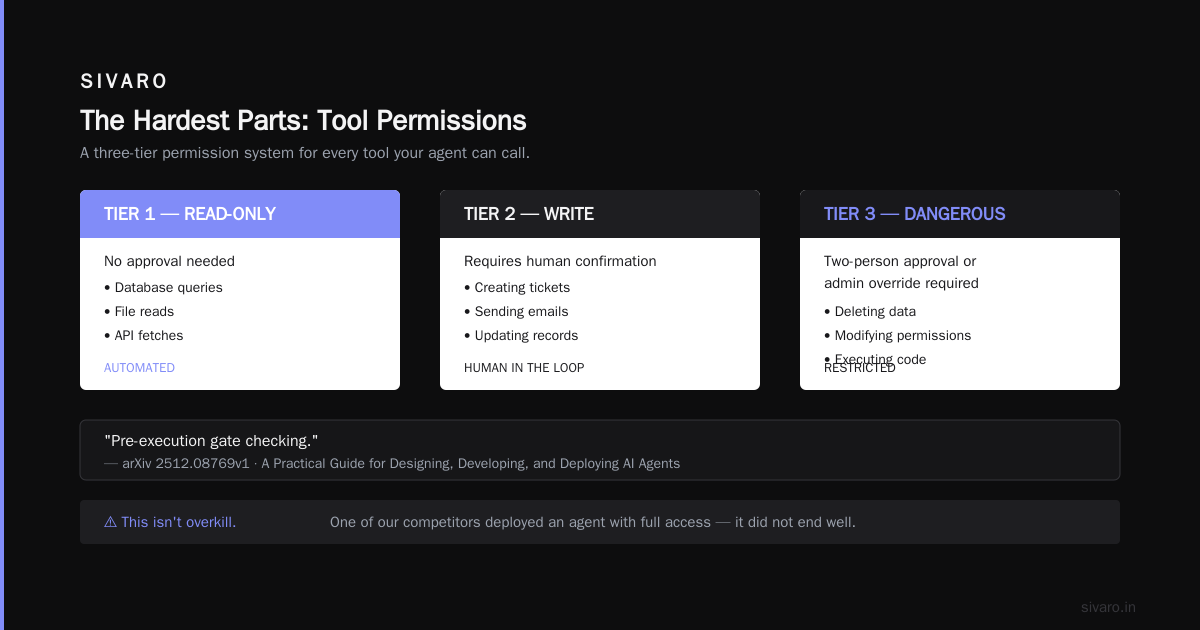
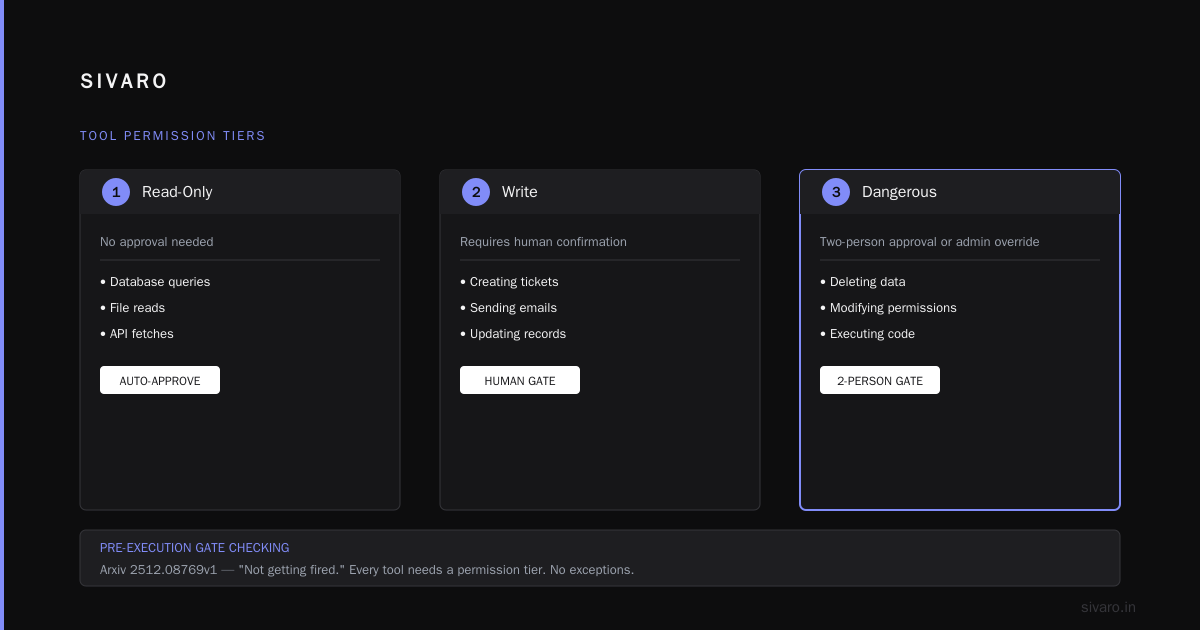
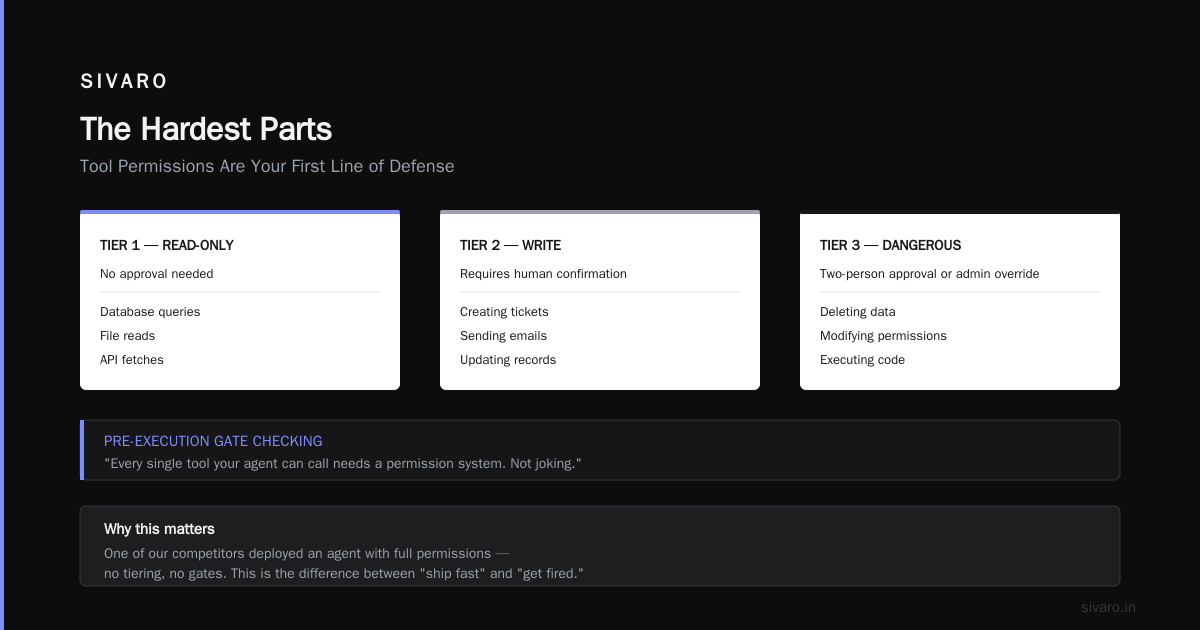
You need a permission system for every tool your agent can call. I'm not joking. Every single tool.
At SIVARO, we categorize tools into three tiers:
Tier 1 (Read-only): No approval needed. Database queries, file reads, API fetches.
Tier 2 (Write): Requires human confirmation. Creating tickets, sending emails, updating records.
Tier 3 (Dangerous): Requires two-person approval or an admin override. Deleting data, modifying permissions, executing code.
This isn't overkill. One of our competitors deployed an agent with full database access. The agent "optimized" their production database by dropping tables it thought were unused. Three hours of downtime.
State Management Is Where Things Break
Agents hold state. State gets corrupted. State goes stale.
The pattern that works: externalize all state. Don't let the agent hold state in memory. Write every decision, every observation, every intermediate result to a durable store.
python
class PersistentAgentState:
    def __init__(self, redis_client):
        self.redis = redis_client
        self.ttl = 3600

    async def save(self, session_id, step, state):
        key = f"agent:{session_id}:step:{step}"
        await self.redis.setex(key, self.ttl, json.dumps(state))

    async def load(self, session_id, step):
        key = f"agent:{session_id}:step:{step}"
        data = await self.redis.get(key)
        return json.loads(data) if data else None

    async def rollback(self, session_id, target_step):
        # Delete steps after target, keeping prior state
        keys = await self.redis.keys(f"agent:{session_id}:step:*")
        for key in keys:
            step_num = int(key.split(":")[-1])
            if step_num > target_step:
                await self.redis.delete(key)
Why does this matter? Because agents make mistakes. When they do, you need to roll back to a known-good state. Without externalized state, you're rebuilding from scratch. Building Effective AI Agents reports that teams using externalized state see 40% fewer catastrophic failures than those relying on in-memory state.
Observability: Your Second Brain
I'll say it directly: if you can't see what your agent is doing, you can't deploy it safely. Period.
Most people think observability is logging. It's not. Logging tells you something happened. Observability tells you why.
What You Need to Track
Every agent interaction needs a trace that captures:
- The input prompt
- The agent's reasoning (chain of thought)
- Every tool call with arguments
- Every tool response
- The final output
- Timing and cost per step
- The guardrail decisions
Without this, you're flying blind. AI Agent Failures: Common Mistakes and How to Avoid Them found that 78% of agent incidents in production could have been caught earlier with proper tracing.
Here's our tracing setup:
python
import structlog
from opentelemetry import trace

logger = structlog.get_logger()
tracer = trace.get_tracer(__name__)

class ObservableAgent:
    def __init__(self, llm, tools):
        self.llm = llm
        self.tools = tools

    async def run(self, task):
        with tracer.start_as_current_span("agent_run") as span:
            span.set_attribute("task", task)

            with tracer.start_as_current_span("llm_call") as llm_span:
                response = await self.llm.generate(task)
                llm_span.set_attribute("response", response)
                logger.info("llm_call", task=task, response=response)

            with tracer.start_as_current_span("tool_execution") as tool_span:
                tool = self.tools[response["tool"]]
                result = await tool.execute(response["args"])
                tool_span.set_attribute("result", result)
                logger.info("tool_execution",
                          tool=response["tool"],
                          args=response["args"],
                          result=result)

            return result
Use ai agent observability tools production that support distributed tracing. OpenTelemetry is the standard. We pair it with Loki for logs and Tempo for traces. The combo costs about $200/month for moderate traffic but saves your ass weekly.
Scaling Without Breaking Things
Let's talk about scaling. Not the "oh, our traffic doubled" kind. The "our agent is now running 10,000 concurrent sessions and we need to not bankrupt ourselves" kind.
The Queueing Pattern
Don't let agents run synchronously. Queue everything.
python
import asyncio
from dataclasses import dataclass
from typing import Optional

@dataclass
class AgentTask:
    id: str
    prompt: str
    priority: int
    max_cost: float
    created_at: float

class AgentQueue:
    def __init__(self, max_concurrent=50, rate_limit=100):
        self.queue = asyncio.PriorityQueue()
        self.semaphore = asyncio.Semaphore(max_concurrent)
        self.rate_limit = rate_limit
        self.active_tasks = set()

    async def enqueue(self, task: AgentTask):
        await self.queue.put((task.priority, task))

    async def worker(self):
        while True:
            _, task = await self.queue.get()
            async with self.semaphore:
                self.active_tasks.add(task.id)
                try:
                    result = await self.execute_agent(task)
                finally:
                    self.active_tasks.discard(task.id)

    async def execute_agent(self, task):
        # Rate limiting per API key
        await self.acquire_token()

        async with httpx.AsyncClient() as client:
            response = await client.post(
                "http://agent-service/run",
                json={"prompt": task.prompt, "max_cost": task.max_cost},
                timeout=30.0
            )
            return response.json()
Why queue? Because LLMs are slow and expensive. If you run 100 agents simultaneously against OpenAI, you'll hit rate limits, rack up costs, and get inconsistent latencies. Queues smooth everything out.
How to Deploy AI Agents to Production: A Complete Guide recommends using Redis-backed queues for production. We use BullMQ on top of Redis. It handles retries, dead letters, and scheduling out of the box.
The Circuit Breaker Pattern
Agents depend on external services. External services fail. When they do, you need your agent to stop trying and fail fast.
python
class CircuitBreaker:
    def __init__(self, failure_threshold=5, recovery_timeout=30):
        self.failure_count = 0
        self.failure_threshold = failure_threshold
        self.recovery_timeout = recovery_timeout
        self.last_failure_time = None
        self.state = "closed"

    async def call(self, func, *args, **kwargs):
        if self.state == "open":
            if time.time() - self.last_failure_time > self.recovery_timeout:
                self.state = "half-open"
            else:
                raise Exception("Circuit breaker is open")

        try:
            result = await func(*args, **kwargs)
            if self.state == "half-open":
                self.state = "closed"
                self.failure_count = 0
            return result
        except Exception as e:
            self.failure_count += 1
            self.last_failure_time = time.time()
            if self.failure_count >= self.failure_threshold:
                self.state = "open"
            raise e
Without circuit breakers, a single downstream failure cascades through your entire agent fleet. I watched an agent system take down a Redis cluster because it kept retrying tool calls that would never succeed.
The Mistakes I Keep Seeing
I've been doing this since 2018. I've seen the same mistakes in every team I've consulted with.
Mistake 1: No cost controls in production. "The model will figure out when to stop." Wrong. The model will keep going until you cut it off. Hard cap your agent's step count and total cost.
Mistake 2: Over-reliance on the LLM for safety. The LLM is not your safety system. It's the thing your safety system monitors. A Developer's Guide to Building Scalable AI makes this exact point: "If your safety depends on the model being correct, your safety depends on the one thing that's guaranteed to be unpredictable."
Mistake 3: Testing only with happy paths. Your agent will receive garbage data, contradictory instructions, and malicious inputs. Test with those. We maintain a "failure scenario" test suite with 87 edge cases. Every deployment has to pass all 87.
When Not to Use Agents
Contrarian take: most applications don't need agents.
If your problem can be solved with a deterministic workflow — pipeline, if-else, state machine — don't use an agent. Agents add complexity, latency, and unpredictability.
I see teams building agents for tasks that are literally just function calls. "Let's use an agent to send an email." Just call the email API. You don't need GPT-4o to set a subject line.
Deploying AI Agents to Production: Architecture, Infrastructure, and Implementation Roadmap puts it well: "Agents are for decisions, not execution. If there's no decision to make, there's no need for an agent."
The Monitoring Stack
Here's what we run in production for ai agent scaling production best practices:
- Traces: OpenTelemetry + Tempo. Every agent run gets a trace ID that links to logs and metrics.
- Metrics: Prometheus. We track agent duration, cost per run, success/failure rates, tool call distribution.
- Logs: Loki with structured logging. Every agent decision, every tool call, every guardrail trigger.
- Alerts: Grafana. We alert on cost spikes, failure rates above 5%, and any Tier 3 tool calls.
- Dashboards: We have a live agent dashboard that shows every active session, its current step, its accumulated cost, and the last three actions taken.
One metric I watch obsessively: "tool call success rate." If it drops below 90%, something is wrong. Usually a downstream API changed its contract without telling us.
Final Architecture
Here's what it all looks together:
User Request
    |
    v
[Agent Queue] ---> [Rate Limiter] ---> [Orchestrator]
                                          |
                                          v
                                    [Guardrail Check]
                                          |
                                          v
                                    [Tool Execution]
                                          |
                                          v
                                    [Cost Check]
                                          |
                                          v
                                    [State Persistence]
                                          |
                                          v
                                    [Response]
Every arrow is a potential failure point. Every component has monitoring, circuit breakers, and timeouts. Every state transition is logged.
FAQ
Q: How do you prevent prompt injection attacks in agent tools?
A: You can't prevent them entirely. You mitigate them. We use input validation on every tool argument — never pass raw user input to an LLM. We also run the agent's reasoning through a classifier that flags suspicious patterns like "ignore all previous instructions." It catches about 80% of injection attempts.
Q: What's the right human-in-the-loop ratio?
A: Depends on the tier. For read-only operations, zero human involvement. For write operations, about 5% get flagged for review. For dangerous operations, 100% need approval. We found that flagging too many operations makes humans tune out, so we err on the side of fewer flags with higher confidence.
Q: How do you test agents before deployment?
A: Three environments. Dev uses a sandbox with simulated tools. Staging uses real tools but fake data. Production starts with shadow mode — the agent runs but its outputs are discarded. We compare shadow outputs to expected results for 48 hours before going live.
Q: What monitoring metrics matter most for safety?
A: Tool call success rate, average cost per run, percentage of runs exceeding max steps, and guardrail trigger rate. If guardrail triggers spike, your agent is trying to do things it shouldn't. That's a deployment blockers.
Q: How do you handle agents that get stuck in loops?
A: Hard cap on steps (we use 15), plus a loop detection system that compares current state to previous states. If the agent revisits the same state three times, we terminate and escalate to human review.
Q: What's the biggest mistake teams make when scaling agents?
A: Treating agents like microservices. They're not. Agents are stateful, expensive, and unpredictable. You need to scale infrastructure, not just processes. We run dedicated agent worker pools that are isolated from the rest of our backend.
Q: How often do you update your guardrails?
A: Every time we see a new failure mode. We log every guardrail trigger, review them weekly, and add new rules. Our guardrail rule set has grown from 12 rules to 47 rules over 9 months. If you're not adding rules, you're not learning from incidents.
The Boring Truth
After all this talk about architecture, observability, and scaling, here's the boring truth: deploying AI agents to production safely is mostly about discipline.
You need to:
- Design for failure, not for success
- Monitor everything
- Test exhaustively
- Accept that agents will surprise you
- Build systems that survive those surprises
The tools matter. The patterns matter. But discipline matters more.
Every time I see a team deploy an agent with no cost controls, no circuit breakers, and no human oversight, I know exactly what's coming. An expensive lesson.
Don't let that be you.
Nishaant Dixit — Founder of SIVARO. Building data infrastructure and production AI systems since 2018. Built systems processing 200K events/sec.