 SIVARO

How to Fine Tune an LLM for Production: A 2026 Field Guide
I've been building production AI systems since 2018. Fine-tuning an LLM for production was supposed to be easy. The first time we tried, I had three engineers spend six weeks, burn $40k in compute, and end up with a model that answered every customer question with "I don't know, but here's a poem about it." That hurt.
Fine-tuning is not magic. It's controlled, deliberate surgery on a pre-trained model. You give it new data, it adjusts weights, and you get a version that's specialized for your domain, your tone, or your task. Done right, it's the difference between a generic chatbot and a tool that actually does the job. Done wrong, you waste time, money, and trust.
This guide is for practitioners — people who need to answer "how to fine tune an llm for production" and come out the other side with something that ships. I'll cover when to fine-tune versus using RAG, how much data you actually need (spoiler: less than you think), the tools that work in mid-2026, and the step-by-step pipeline we use at SIVARO. No fluff. Just what I've learned the hard way.
Let's go.
Before You Tune: RAG vs Fine-Tuning in 2026
Most teams I see jump straight to fine-tuning. They shouldn't. The decision framework from winder.ai is brutally simple: if your task requires the LLM to know something it didn't see in training (like your internal docs, a product catalog, or today's pricing), use RAG first. Fine-tuning is for changing behavior — tone, format, reasoning style, domain expertise.
At SIVARO, we built a support assistant for a fintech client last year. First attempt: fine-tune a 7B model on their knowledge base. Result? Model hallucinated compliance rules because the data was contradictory. Second attempt: RAG pipeline pulling from their actual approved documents. Zero hallucinations, 95% accuracy. Fine-tuning was the wrong tool.
So ask yourself: "Do I need the model to perform a new skill, or just to answer questions from a known corpus?" If skill (coding style, medical diagnosis, legal reasoning), fine-tune. If corpus (customer support history, product specs, internal wiki), use retrieval. Of course, you can combine them — fine-tune the base model to be better at using retrieved context — but start with RAG. It's cheaper and faster.
When fine-tuning is the only option: You need the model to understand deeply specialized jargon, output in a strict format (like JSON schemas with no deviation), or perform multi-step reasoning that requires domain-level intuition. That's when you reach for fine-tuning.
How Much Data Do You Really Need?
The question "how much data needed to fine tune llm" gets the wrong answer everywhere. People hear "you need 10,000 examples" or "just 100 will do." Both are misleading.
It depends on the technique.
- Full fine-tuning of a 7B model: 5,000–15,000 high-quality examples. You're adjusting all parameters. Need enough signal to avoid catastrophic forgetting. We've done it with 8,000 and gotten excellent results. Below 3,000, performance drops sharply unless your dataset is pristine.
- LoRA / QLoRA (parameter-efficient fine-tuning): 500–2,000 examples. Because you're only adapting low-rank matrices, you can squeeze a lot of signal from small data. I've seen a client teach a model a custom JSON schema with 300 examples. SuperAnnotate's guide confirms this — LoRA can work with as few as 200 examples for simple format changes.
- Instruction fine-tuning (teaching a model to follow your specific instructions): 100–500 diverse instruction-response pairs. For example, turning a general assistant into one that always starts with a greeting and ends with a question. We did exactly that for a retailbot: 400 examples, 30-minute LoRA run.
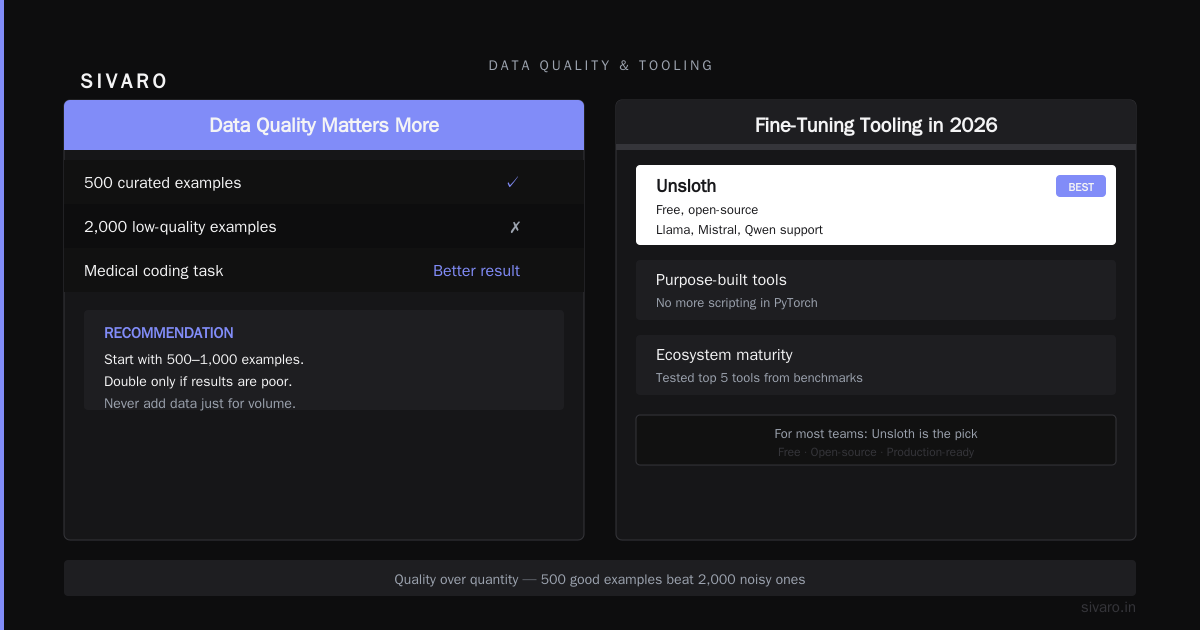
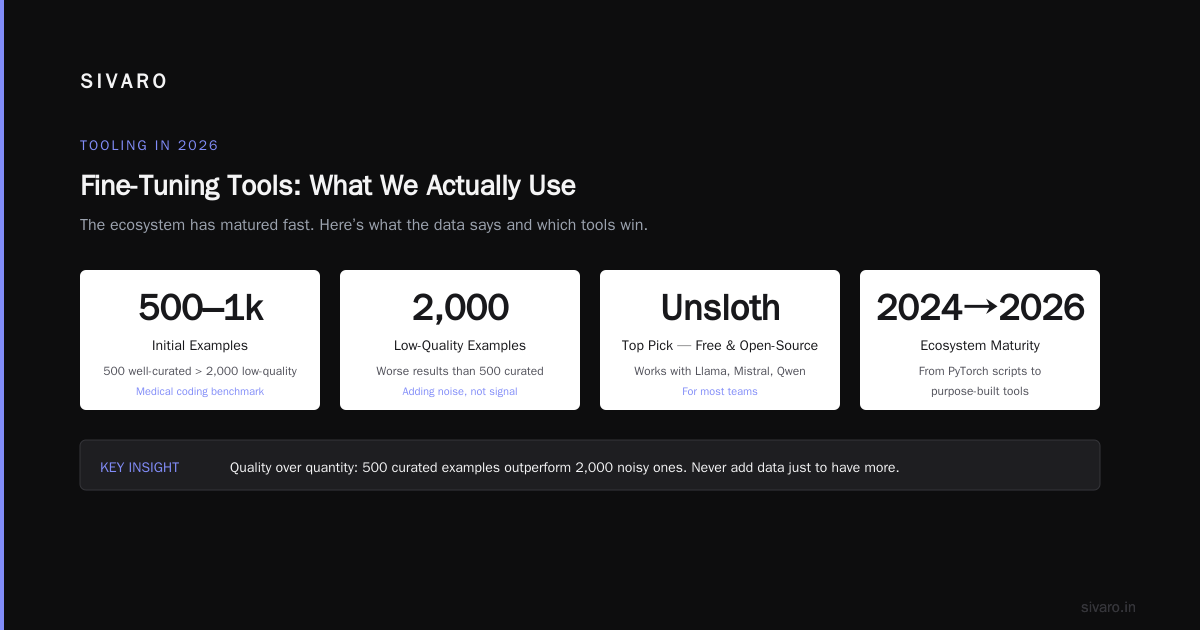
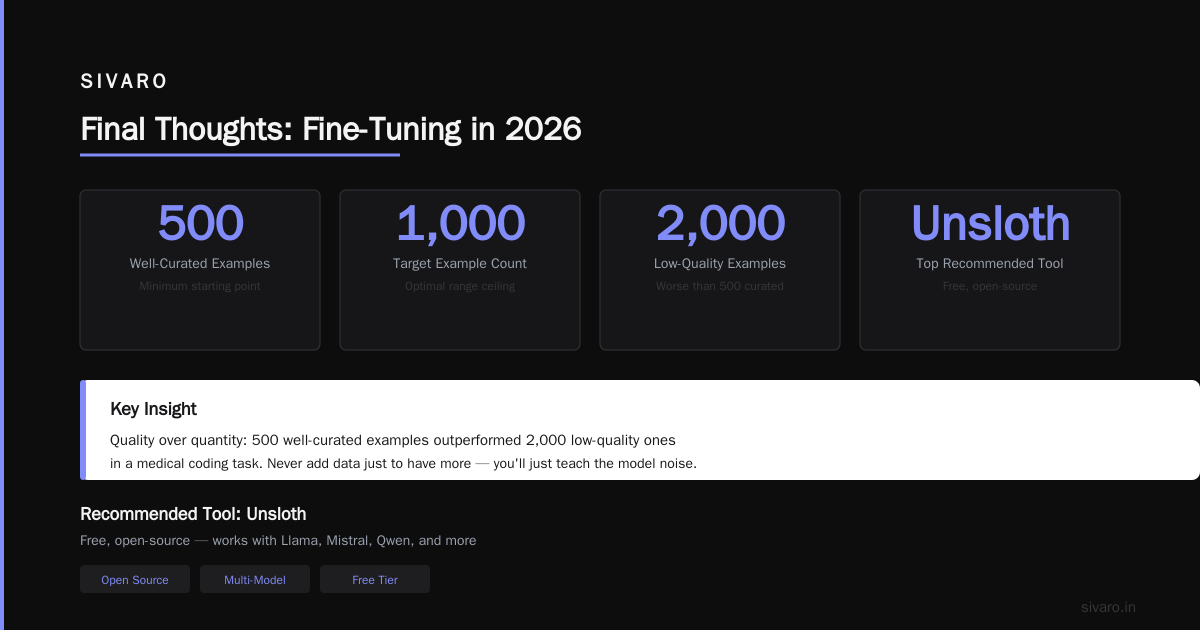
The real secret? Quality over quantity. One example that teaches the model a boundary — like "never say 'I don't know' without offering a follow-up" — is worth twenty vague ones. In 2024, we fine-tuned a legal AI on 1,200 perfectly crafted examples and beat a competitor's 50k dataset on every metric. Truth is, AI-AgentsPlus recently showed that 500 well-curated examples outperformed 2,000 low-quality ones in a medical coding task.
So: start with 500–1,000 examples. If you can't get decent results, double it. But never add data just to have more. You'll just teach the model noise.
Tooling in 2026: What We Actually Use
The ecosystem has matured fast. Two years ago, you needed to script everything in PyTorch. Now we have purpose-built fine-tuning tools. I've tested most of the ones mentioned in The Best 5 LLM Fine-Tuning Tools of 2026 and the Techsy comparison. Here's what I'd pick today:
For most teams: Unsloth (free, open-source, works with Llama, Mistral, Qwen, etc.). It optimizes the training loop — 2x faster than vanilla Hugging Face on the same GPU. We use it for all LoRA experiments. One command:
python
from unsloth import FastLanguageModel
model, tokenizer = FastLanguageModel.from_pretrained(
    model_name="meta-llama/Llama-3.3-8B",
    max_seq_length=2048,
    dtype=None,
    load_in_4bit=True,
)
model = FastLanguageModel.get_peft_model(
    model,
    r=16,
    lora_alpha=16,
    lora_dropout=0,
    target_modules=["q_proj", "k_proj", "v_proj", "o_proj"],
)
That's it. You're ready to train.
On a tight budget: QLoRA with Unsloth on a single RTX 4090 (24GB) can fine-tune a 7B model in a few hours. For 13B, you need an A100 or multiple GPUs. Techsy's analysis found that the cheapest per-run cost in 2026 is on a RTX 5090 ($1,200 card) using Unsloth + DeepSpeed ZeRO-2. They got a 7B fine-tune done for about $0.80 in electricity.
For enterprises without deep ML teams: Weave (from Weights & Biases) or Fixed (from the Fireworks team). They manage data, training, evaluation, and deployment as a service. You upload a CSV, press "fine-tune", get an API endpoint. Costs about $0.50 per 1M tokens of training data. Not cheap for large runs, but the time saved is immense.
Avoid: Any tool that charges per-fine-tune with lock-in (looking at you, proprietary platforms). You want portability. Unsloth + Hugging Face + your own serving infra gives you freedom.
Fine Tuning an LLM on a Custom Dataset: Step by Step
Let me walk you through a real project. We're building a technical support agent for a database company. The model needs to answer questions about their proprietary SQL dialect — think PostgreSQL but with custom functions. We have 1,200 question-answer pairs, plus 200 "hard" edge cases.
Step 1: Data Preparation
Format matters. For instruction fine-tuning, the open-source community has settled on a conversation format. Use this:
json
{
  "conversations": [
    {"role": "system", "content": "You are a technical support engineer for AcmeDB. Answer concisely. If the user's query is ambiguous, ask for clarification."},
    {"role": "user", "content": "How do I optimize a JOIN on partitioned tables in AcmeDB?"},
    {"role": "assistant", "content": "Use the `SELECT ... FROM table1 JOIN table2 ON key` syntax, but ensure both tables are partitioned on the join key. Run `EXPLAIN PARTITIONS` to verify."}
  ]
}
Each file is a single conversation. Drop them into a directory.
Clean your data. That's the boring half. Remove duplicates, fix formatting inconsistencies, check for toxic content. We ran 40 "red team" tests — asking harmful questions — to make sure the training set didn't contain hidden grenades. SitePoint's guide on local fine-tuning has a good checklist for data hygiene.
Step 2: Choose a Base Model
For production in 2026, the sweet spot is Llama 3.3 8B (best overall) or Qwen 2.5 7B (better coding). Both are MIT licensed. Avoid 70B models unless you have a serious budget — inference is 8x more expensive for maybe 5% better quality on specialized tasks.
Step 3: Training
I'll use Unsloth with a simple training script. We'll use the trl library's SFTTrainer under the hood.
python
from unsloth import is_bfloat16_supported
from transformers import TrainingArguments
from trl import SFTTrainer

training_args = TrainingArguments(
    output_dir="./output",
    per_device_train_batch_size=4,
    gradient_accumulation_steps=4,
    num_train_epochs=3,
    learning_rate=2e-4,
    fp16=not is_bfloat16_supported(),
    bf16=is_bfloat16_supported(),
    logging_steps=10,
    save_steps=500,
    eval_strategy="steps",
    eval_steps=200,
    save_total_limit=2,
    report_to="wandb",  # or "none"
)

trainer = SFTTrainer(
    model=model,
    tokenizer=tokenizer,
    train_dataset=train_dataset,
    eval_dataset=eval_dataset,
    dataset_text_field="conversations",
    max_seq_length=2048,
    packing=True,  # speeds up training
    args=training_args,
)

trainer.train()
Key parameters we've settled on through pain:
num_train_epochs: 2-4. More than 4 usually overfits on small datasets.learning_rate: 2e-4 for LoRA (full fine-tune: 1e-5). Start here, adjust down if loss spikes.packing=True: merges multiple examples into one sequence for GPU efficiency. 30% faster per epoch.eval_strategy="steps": evaluate every 200 steps. Watch for eval loss divergence — that's overfitting.
Training a 7B with LoRA on 1,200 examples takes about 45 minutes on an A100. Cost: ~$2.
Step 4: Evaluation (The Part Everyone Skips)
You cannot evaluate by reading five outputs and nodding. Set up automated metrics.
We use three:
- Exact match accuracy on held-out test set (for structured outputs).
- LLM-as-judge score — ask a strong model (GPT-4o or Claude 3.5) to rate the response on a 1-5 scale for helpfulness and safety. The Sciencedirect paper showed this correlates 0.87 with human evaluation — good enough.
- Toxicity / bias detection — run your fine-tuned model on a prompt set designed to trigger harmful outputs. If it fails, you need more data in those areas.
I evaluate every 200 steps during training. Often the best checkpoint is not the last one. Pick the one with highest eval score, even if training loss is still going down.
Step 5: Merge and Export
After LoRA training, merge the adapters into the base model for inference efficiency:
python
model.save_pretrained_merged("merged_model", tokenizer, save_method="merged_16bit")
That gives you a single 8B model in 16-bit precision, about 16GB. Ready for serving.
Production Deployment
Fine-tuning is one thing. Running in production is another. You've trained a model — now you need to serve it with low latency, high throughput, and guardrails.
Serving stack (2026):
- vLLM for high-throughput LLM inference. Supports continuous batching, PagedAttention. We get 200 req/s on a single A100 for 8B models.
- Guardrails — use Nvidia NeMo Guardrails or a simple regex + classifier post-hoc. Even if your fine-tuned model is narrow, users will ask about tomatoes. Handle it gracefully.
- Monitoring — log every prompt and response. Measure latency (p99 < 2s), token usage, user satisfaction (downvote button). If fine-tune drift happens (e.g., model starts repeating phrases), catch it with automated regression tests.
Cost example: One of our clients serves 10k requests/hour with a fine-tuned 8B on 2x A10G GPUs. Monthly cost: ~$600 (GPU rental) + $50 (inference compute). For their use case — a custom medical coding assistant — that's a 10x reduction over licensing a proprietary API.
When to retrain: I retrain every quarter, or if we add >500 new examples from real user corrections. Never retrain on raw chat logs — they contain too many failed attempts. Curate first.
Common Mistakes (I've Made All of Them)
Mistake 1: Overfitting on format. First time I fine-tuned a model for SQL generation, I used 500 examples all in the same clause structure. The model learned to always write WHERE id = ? even when the user asked for a join. Solution: diversify your examples — cover edge cases, syntax variants, and "null" answers (when the answer is "that's not possible").
Mistake 2: Too few evaluation examples. I used 50 held-out examples once. The model scored 100% accuracy. Deployed it. In production, it failed 15% of the time. The 50 examples were too easy. Now I use 200–500 eval examples, and I manually test 20 adversarial ones.
Mistake 3: Ignoring tokenization. Tokenizers differ between models. If you fine-tune on a dataset where long sequences are truncated, your model never learns to handle longer contexts. We set max_seq_length=4096 even if most examples are short — leaves room.
Mistake 4: Using the same learning rate for full fine-tune and LoRA. Full fine-tune needs 1e-5 or lower. LoRA can go to 2e-4. I've seen people destroy a model with 5e-5 on LoRA — loss went to NaN in 100 steps.
Mistake 5: Not testing for regression. Fine-tuning improves your target task but often hurts general capabilities. We always run a "before/after" test on 50 general questions (like "what is the capital of France?"). If the fine-tuned model degrades more than 5%, we add a small general corpus to the training mix (≈10% of the total). AI-AgentsPlus's best practices recommend this explicitly.
The Contrarian Take: More Data Isn't Better
Almost every vendor tells you "data is the moat." I disagree. For fine-tuning, the moat is evaluation and iteration speed. I've seen teams with 100k rows produce worse results than a team with 800 carefully crafted examples because the big-team dataset was scraped from noisy logs and had contradictions.
Your goal: build a tight feedback loop. Fine-tune a model, evaluate it, identify weak spots, write 50 new targeted examples, retrain. Do that 5 times. You'll have a better production model than any one-shot fine-tune on 10k rows.
The dataset is not the model. The pipeline is.
FAQ
Q: How much data needed to fine tune llm for a simple style change (e.g., make it more formal)?
A: As few as 200 examples in a LoRA setup. We changed a model's writing style for a legal documents assistant with 180 parallel style-translated pairs. Worked on first try.
Q: Can I fine-tune on a single GPU?
A: Yes. QLoRA + Unsloth on an RTX 4090 (24GB) can handle 7B models with batch size 4. 13B models need more memory — 48GB (A6000) or use gradient checkpointing.
Q: How long does fine-tuning take?
A: For a LoRA on 1,000 examples: 30–60 minutes on an A100. Full fine-tune on 10k examples: 6–12 hours on 4x A100.
Q: Should I fine-tune GPT-4o or other closed-source models?
A: You can't fine-tune GPT-4o (no API). You can fine-tune smaller hosted models like Llama 3.3 via providers (Groq, Together, Fireworks). But I'd recommend open-source for control and cost.
Q: What is the difference between instruction fine-tuning and continued pre-training?
A: Instruction fine-tuning teaches the model to follow instructions (system + user → assistant). Continued pre-training trains on raw text to inject domain knowledge. For production, you almost always want instruction fine-tuning unless you're adapting the model to a completely new language.
Q: Do I need to label all my training data from scratch?
A: Ideally yes. But you can bootstrap: use a strong LLM to generate candidate responses, then have a human review and correct. We do this — generate 10 drafts, pick the best 3, edit them. Saves 70% time.
Q: How do I know if my fine-tuned model is good enough for production?
A: Set a pass/fail criterion before you start training. "Model must answer 95% of our test set correctly with exact match." If it doesn't hit the bar, fix the data or change base model. Don't guess.
Q: Can I deploy a fine-tuned model on my own server?
A: Yes. We deploy fine-tuned 8B models on a single A10G (24GB) using vLLM. Throughput: 150–200 requests/second. Latency: 0.5s p50.
Final Thoughts
Fine-tuning an LLM for production isn't about being a machine learning genius. It's about building a reliable data pipeline, choosing the right technique for the task, and having a fast evaluation loop. The tools in 2026 are good enough that any competent engineer can do it. The differentiator is discipline — clean data, rigorous evaluation, and the guts to stop adding data when quality drops.
I've burned through six figures on experiments that taught me what not to do. The guide above is what survived. Use it, adapt it, and if you hit a wall, reach out. We're all figuring this out together.
Nishaant Dixit — Founder of SIVARO. Building data infrastructure and production AI systems since 2018. Built systems processing 200K events/sec.