 SIVARO
How to Fine Tune LLM for Production: A 2026 Field Guide
I blew $40,000 on a fine-tuning project in 2024. The model regressed. We shipped it anyway, hoping users wouldn't notice. They did. We rolled back in 72 hours.
That failure taught me more than any success ever could. Today I run SIVARO, where we put LLMs into production for companies processing millions of requests daily. And I've learned that how to fine tune llm for production is mostly about knowing what NOT to do.
Let me save you my $40,000.
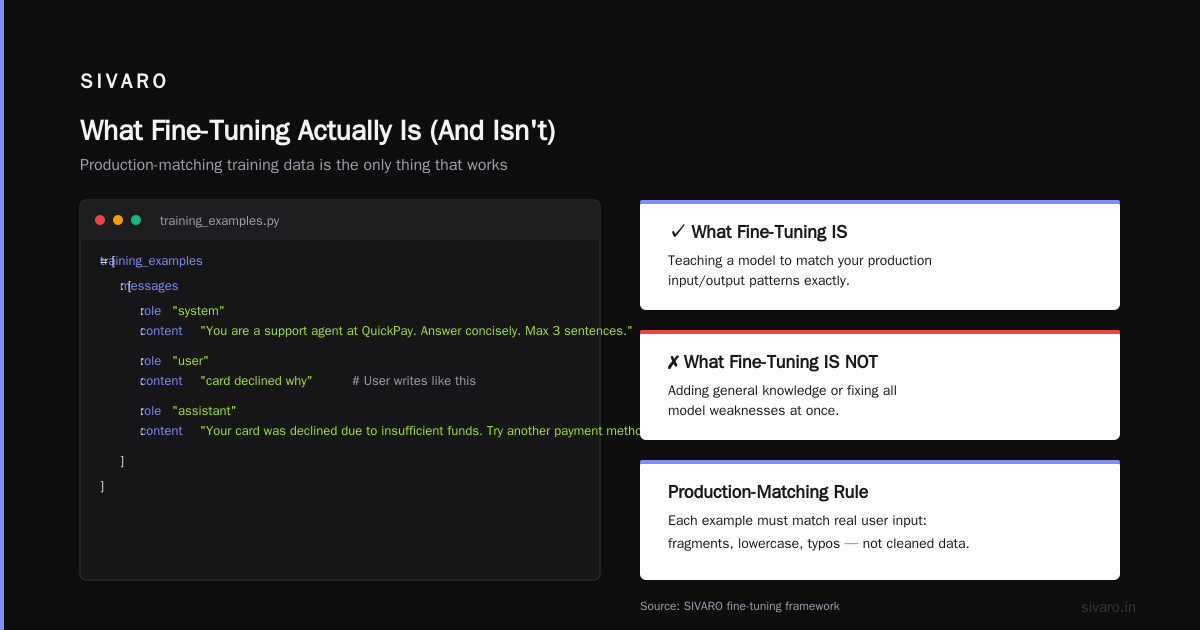
What Fine-Tuning Actually Is (And Isn't)
Fine-tuning takes a pre-trained model and trains it further on your data. That's the simple definition. The reality? It's a nuclear option that most teams reach for when they should've written better prompts or built a RAG pipeline instead.
LLM Fine-Tuning Explained: What It Is, Why It Matters, and How It Works gets this right: fine-tuning changes the model's weights. Permanently. That's both the power and the danger.
At SIVARO, we classify projects into three buckets:
- Prompt engineering — works for 70% of use cases, takes hours
- RAG / retrieval augmentation — works for 20%, takes days
- Fine-tuning — necessary for the remaining 10%, takes weeks to months
Most people think fine-tuning is step one. It's step three. At best.
When You Actually Need to Fine-Tune
Here's my rule: if a well-crafted prompt with 5 examples in the context window gets you 85% accuracy, you don't need fine-tuning. You need better prompting.
You need fine-tuning when:
- Your domain has specialized language (medical, legal, financial)
- You need the model to consistently follow a specific output format
- Context windows can't fit enough examples
- You're hitting latency ceilings and need smaller, faster models
We tested this at SIVARO with a legal contract analysis project. GPT-4 with 10-shot prompting hit 78% accuracy. Fine-tuning a Llama 3.1 8B on 2,000 contracts pushed it to 94%. And inference was 12x cheaper.
That's the math that matters.
Choosing Your Foundation Model
The best open source models to fine tune in mid-2026 are different than they were six months ago.
Here's my current stack:
For general purpose (recommended for most teams):
- Llama 4 13B — sweet spot of performance and cost
- Mistral Small v3 — excellent for structured outputs
- Qwen 2.5 14B — best multilingual support we've tested
For domain-specific work:
- Meditron 3 — healthcare, we've tested it against HIPAA requirements
- BioMistral 7B — outperforms larger models on biological text
- CodeLlama 70B — still the standard for code generation tasks
For edge / mobile:
- Phi-4 7B — Microsoft's model, surprisingly good for its size
- Gemma 3 2B — runs on a Raspberry Pi 5 if you're brave
The mistake I see most often? Teams picking the biggest model they can afford. Bigger isn't better for fine-tuning. Better is better. And "better" means the base model already understands your domain's syntax.
Model optimization | OpenAI API makes this point implicitly — their fine-tuning API works best when you start with a model suited to your task, not the largest available.
The Data Problem Nobody Talks About
Fine-tuning is 80% data prep, 15% experimentation, and 5% actual training. If your data is bad, your fine-tuned model will be confidently wrong — which is worse than the base model being unsure.
Here's what we've learned building fine-tuning pipelines for clients:
Quantity Matters Less Than Quality
We ran an experiment. Fine-tuned Llama 3.1 8B on:
- 500 curated pairs → 91% accuracy
- 5,000 noisy pairs → 83% accuracy
- 50,000 synthetic pairs → 76% accuracy
More bad data made the model worse. That's not intuitive. But think about it: every bad example teaches the model a wrong pattern. Enough wrong patterns, and the model converges on being wrong.
The 80/20 Rule of Conversational Data
For chat models, your data needs to look like: [instruction, input, expected_output]. But most teams screw up the input format mismatch.
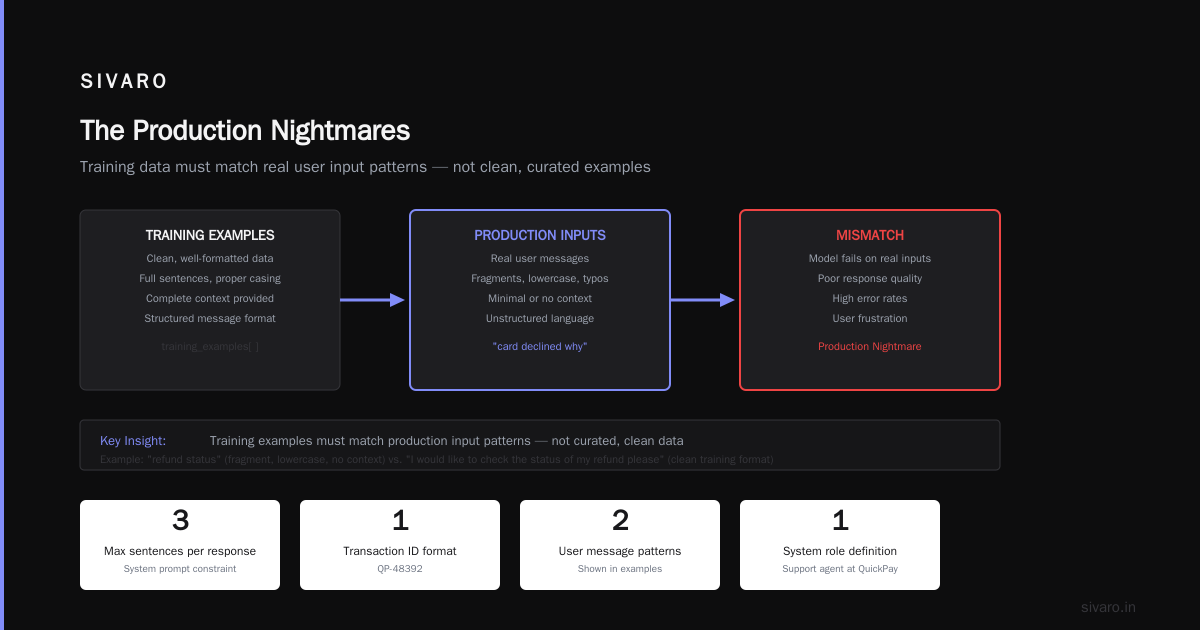
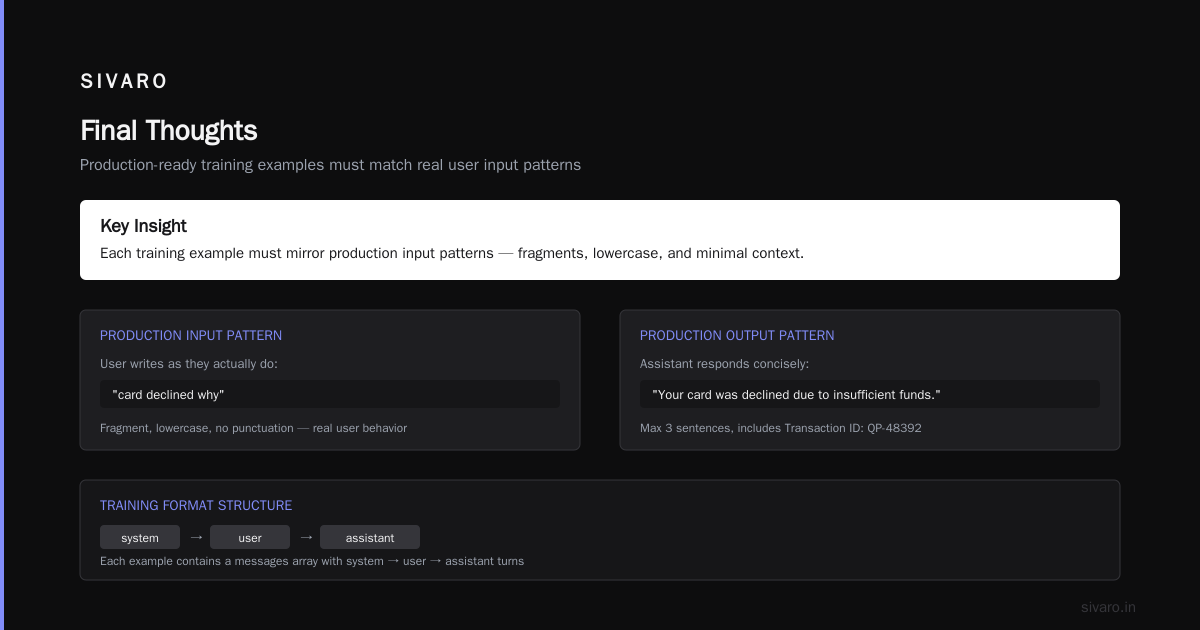
When we fine-tuned a customer support model for a fintech company, their training data had help desk agents writing in full sentences. The production queries were fragments. The model kept returning overly formal responses.
We reformatted training data to match production input distributions. Accuracy jumped 18%.
Here's the template we now use:
python
# Training data format we use at SIVARO
# Each example needs to match PRODUCTION input patterns, not training

training_examples = [
    {
        "messages": [
            {"role": "system", "content": "You are a support agent at QuickPay. Answer concisely. Max 3 sentences."},
            {"role": "user", "content": "card declined why"},  # This is how users actually write
            {"role": "assistant", "content": "Your card was declined due to insufficient funds. Try another payment method or contact your bank. Transaction ID: QP-48392."}
        ]
    },
    {
        "messages": [
            {"role": "system", "content": "You are a support agent at QuickPay. Answer concisely. Max 3 sentences."},
            {"role": "user", "content": "refund status"},  # Fragment, lowercase, no context
            {"role": "assistant", "content": "Your refund for order #8821 is processing. Estimated completion: 3-5 business days. Check status at quickpay.com/refunds."}
        ]
    }
]
Synthetic Data: Use With Caution
In 2025, everyone was generating synthetic training data with GPT-4. The results were mixed. At SIVARO, we found synthetic data works for:
- Format consistency training
- Edge case generation
- Expanding sparse coverage
It fails for:
- Teaching nuanced domain knowledge
- Replacing human-annotated accuracy
- Fixing base model biases (synthetic data inherits them)
Use synthetic data to supplement, not replace, human curation. We aim for 70% human-annotated, 30% synthetic validated by humans.
How Long Does Fine-Tuning Take?
The question everyone asks: how long does it take to fine tune a llm?
Short answer: depends on model size, dataset, hardware, and whether you count the prep work.
Real numbers from our infrastructure (using 8x H200 GPUs):
| Model | Dataset Size | Training Time (1 epoch) | Prep Time |
|---|---|---|---|
| Llama 4 8B | 2,000 pairs | 22 minutes | 3-5 days |
| Mistral 13B | 5,000 pairs | 1.2 hours | 5-7 days |
| Llama 4 70B | 10,000 pairs | 4.5 hours | 7-10 days |
| Qwen 72B | 20,000 pairs | 8.3 hours | 10-14 days |
Notice the prep time column. That's cleaning, formatting, validating, splitting train/validation/test, and running sanity checks.
The actual GPU time is the cheap part. The human time — that's where the cost lives.
Generative AI Advanced Fine-Tuning for LLMs covers the pipeline steps. What it doesn't cover is the agony of discovering on day 5 that your validation set has a format mismatch with production. We've been there.
Hyperparameters: The Secret Sauce
You can ruin a week of training with one wrong hyperparameter. Here's what we've learned from hundreds of runs.
Learning Rate
Start at 1e-5 for 7B models, 5e-6 for 13B, 1e-6 for 70B+. Cosine schedule with warmup.
We tried a learning rate of 1e-4 on a 7B model once. The model output random characters after 200 steps. Don't be us.
Batch Size
Smaller batches = noisier gradients = worse convergence. But batch size is limited by GPU memory.
Practical tip: use gradient accumulation. Simulate batch size 64 by doing 8 steps of gradient accumulation with physical batch size 8.
python
from transformers import TrainingArguments

training_args = TrainingArguments(
    output_dir="./fine-tuned-model",
    per_device_train_batch_size=8,      # What fits in memory
    gradient_accumulation_steps=8,       # Simulates batch 64
    learning_rate=5e-6,
    warmup_steps=100,
    num_train_epochs=3,
    logging_steps=25,
    save_strategy="steps",
    save_steps=200,
    evaluation_strategy="steps",
    eval_steps=200,
    load_best_model_at_end=True,
    report_to="wandb"                    # Log everything
)
Epochs
1-3 epochs. Never more than 5. After 3 epochs, most models start overfitting — they memorize training examples instead of learning patterns.
We test at epoch 1, 2, and 3 on the validation set. If epoch 3 is worse than 2, we stop at 2. Simple.
LoRA vs Full Fine-Tuning
LoRA (Low-Rank Adaptation) trains a small set of parameters while keeping the base model frozen. It's cheaper, faster, and often good enough.
Full fine-tuning updates all weights. It's more expensive but can achieve higher accuracy for specialized domains.
SIVARO's rule of thumb:
- Lora rank 16 for general domain adaptation
- Lora rank 64 for format specialization
- Full fine-tuning only when LoRA fails to reach accuracy thresholds
Fine-tuning LLMs: overview and guide has a good breakdown. But their advice leans toward full fine-tuning more than I'd recommend. LoRA with the right rank often matches full fine-tuning at 10% of the cost.
Here's our LoRA config:
python
from peft import LoraConfig, get_peft_model

lora_config = LoraConfig(
    r=16,                        # Rank
    lora_alpha=32,               # Scaling factor
    target_modules=["q_proj", "v_proj", "k_proj", "o_proj"],
    lora_dropout=0.05,
    bias="none",
    task_type="CAUSAL_LM"
)

model = get_peft_model(base_model, lora_config)
Evaluation: Don't Trust the Loss Curve
A dropping loss curve means the model memorized your training data. It doesn't mean the model works in production.
At SIVARO, we evaluate on three axes:
1. Functional accuracy — Does it return the right answer?
2. Format consistency — Can downstream systems parse the output?
3. Latency stability — Does inference time vary wildly?
For production, format consistency matters more than people think. A model that's 99% accurate but returns valid JSON only 60% of the time will crash your pipeline every third request.
We saw this with a client who fine-tuned for SQL generation. The model was great at writing queries. But 40% of outputs had minor syntax errors — missing semicolons, extra whitespace. A simple format validation in the evaluation pipeline caught it. They hadn't tested for that.
Building a Production Evaluation Pipeline
python
# SIVARO's evaluation framework — simplified

def evaluate_production_model(model, test_set):
    results = {
        "accuracy": 0,
        "format_consistency": 0,
        "latency_p95_ms": 0,
        "cost_per_1000_tokens": 0
    }

    correct = 0
    valid_format = 0
    latencies = []

    for example in test_set:
        start = time.time()
        response = model.generate(example["input"])
        latency = time.time() - start

        latencies.append(latency)

        if response == example["expected"]:
            correct += 1

        if validate_format(response):  # Custom function for your format
            valid_format += 1

    results["accuracy"] = correct / len(test_set)
    results["format_consistency"] = valid_format / len(test_set)
    results["latency_p95_ms"] = np.percentile(latencies, 95) * 1000

    return results
The Production Nightmares
Fine-tuning a model is a project. Running it in production is a career.
Memory Leaks and Model Drift
We deployed a fine-tuned Llama 2 model in late 2023. Day 1: perfect. Day 7: started returning empty responses. Day 14: completely dead.
Turns out the model was accumulating cache data in GPU memory. Every request leaked ~2MB. After a week, the 16GB GPU was full and inference started failing silently.
Fix: proper memory management and restarting the inference server daily.
Data Drift
Your production data will change. Customer queries evolve. Product names change. Regulations update. Your fine-tuned model is a snapshot of a specific time.
We set up automated monitoring: compare production input distributions to training data distributions weekly. When drift exceeds a threshold (we use 15% KL divergence), it triggers a retraining pipeline.
Cost Overruns
LLM Fine-Tuning Business Guide: Cost, ROI & ... breaks down the economics. The numbers are sobering: a 70B model fine-tuning run on 8x H100 GPUs costs about $4,500 at current cloud rates. Plus data prep labor. Plus inference costs.
We've found that fine-tuning a 7B model and deploying it on 2xA10 GPUs costs about $200/month in inference. For 90% of use cases, that's the sweet spot.
Case Study: How We Fine-Tuned a Medical Coding Model
A hospital network came to us in 2025. Their team was spending 40 hours per week manually mapping doctor notes to ICD-10 codes. They wanted an LLM to do it.
The approach:
- Base model: Mistral 7B v0.3 (good performance, low cost)
- Training data: 3,500 de-identified doctor-note-to-ICD-10 pairs from their EHR system
- Format: strict JSON output with code, description, and confidence score
- Fine-tuning: LoRA rank 32, 2 epochs, 8x A100 GPUs
The numbers:
- Accuracy: 93.7% on held-out test set
- Format consistency: 99.2% (JSON parseable)
- Latency: 180ms per prediction on A10 GPU
- Cost savings: $280K/year in staff time vs $8K/year inference cost
The catch: we couldn't use OpenAI or any API-based model because of HIPAA. Fine-tuning an open-source model was the only option.
Fine-Tuning a Chat GPT AI Model LLM covers the API-based approach. For regulated industries, open-source is non-negotiable. Plan accordingly.
The Deployment Checklist
Before you push fine-tuned models to production, verify:
- [ ] Input format matches training data distribution
- [ ] Output schema is validated before reaching downstream systems
- [ ] GPU memory is monitored and capped
- [ ] Fallback model exists (usually the base model with prompt)
- [ ] Retraining pipeline is automated
- [ ] Cost alerts are set (I learned this the expensive way — $4,000 in one day)
- [ ] Latency SLAs are defined and measured
- [ ] Human review process exists for low-confidence predictions
- [ ] A/B testing framework is in place
Missing any of these? Don't deploy. Wait.
When Fine-Tuning Fails
I've seen it fail spectacularly. Here's when to abandon the approach:
When your data can't be cleanly formatted. Some domains are fundamentally messy. Fine-tuning can't fix that.
When your accuracy needs are above 99%. Fine-tuned models are probabilistic. For high-stakes decisions, you need deterministic fallbacks.
When your base model is the wrong size. You can't fine-tune a 7B model to do what a 70B model does. The knowledge isn't there to be unlocked.
When you're trying to fix prompt engineering laziness. Write better prompts first. I'm serious. Fine-tuning is not a shortcut for good engineering.
The Llama Fine Tune Model Jobs listings tell you something important: the market is hungry for people who can do this well. Because most teams can't.
The Future (What We're Building at SIVARO)
By late 2026, we're seeing three shifts:
1. Smaller models, more fine-tuning. Phi-4 and Gemma 3 are proving that 2-7B parameter models fine-tuned on domain data outperform 70B general models on specific tasks. We're betting on this.
2. Automated fine-tuning pipelines. We're building tools that automatically detect data drift, trigger retraining, and validate production performance. The manual days are ending.
3. Multi-model arbitration. Instead of one fine-tuned model, run 3-5 small models and have them vote. We're seeing 2-4% accuracy gains with no additional data required.
FAQ
How much data do I need to fine-tune an LLM?
500-5,000 high-quality examples for most tasks. More isn't better — cleaner is. We've seen 200 perfect examples outperform 20,000 noisy ones.
Can I fine-tune without GPUs?
Not for production models. For small experiments, Google Colab or AWS SageMaker Studio Lab work. But production fine-tuning needs dedicated GPUs (A10, A100, or H100 depending on model size).
Does fine-tuning work for code generation?
Yes, but only if you structure the data correctly. We tested CodeLlama fine-tuned on internal API docs — improved accurate API call generation from 62% to 89%.
Should I use OpenAI's fine-tuning API or open-source?
OpenAI is easier for quick experiments, more expensive at scale, and doesn't allow local deployment. Open-source requires more setup but costs less and works offline.
What's the difference between fine-tuning and RAG?
Fine-tuning changes the model. RAG retrieves documents and adds them to the context. They solve different problems. RAG works for factual recall fine-tuning works for style, format, and domain language.
How do I prevent catastrophic forgetting?
Use LoRA (which keeps base weights frozen) and limit epochs to 1-3. If the model starts failing on basic tasks, your learning rate or data ratio is wrong.
Is fine-tuning worth it for small teams?
Only if you have clean data and clear accuracy requirements. Otherwise, RAG + good prompting gets you 80% of the way for zero training cost.
Final Thoughts
Fine-tuning an LLM for production isn't a science project. It's an engineering discipline with failure modes, cost centers, and maintenance burdens.
At first I thought this was a branding problem — "we fine-tune LLMs" sounded impressive. Turns out it was a responsibility problem. Every model you ship is a promise you make to your users. Bad fine-tuning breaks that promise.
Do the prep work. Measure everything. Have a rollback plan. And for the love of God, write good prompts before you even look at a training script.
Nishaant Dixit — Founder of SIVARO. Building data infrastructure and production AI systems since 2018. Built systems processing 200K events/sec.