 SIVARO
How to Fine Tune LLMs for Production (Without Wasting Money)
I started 2025 thinking fine-tuning was dead.
Then two things happened. First, GPT-4o-mini came out and changed the math on cost. Second, I watched a logistics company spend $47,000 on RAG infrastructure for a task that needed exactly one fine-tuned 8B model to work. They scrapped the RAG pipeline three weeks later.
Here's the truth nobody wants to say out loud: most people shouldn't fine-tune. But the ones who should — they get results that few-shot prompting can't touch.
This guide is for the second group. I'll walk you through when to fine-tune, how to do it without setting money on fire, and what breaks when you push it to production.
What Fine-Tuning Actually Is (And Isn't)
Fine-tuning takes a pre-trained model and trains it more on your specific data. It's not building a new model. It's teaching an existing one to speak your dialect.
Think of it this way: the base model graduated from medical school. Fine-tuning sends it to dermatology residency. The foundation knowledge doesn't change — just the specialization.
The OpenAI fine-tuning API does this by continuing the training process on your labeled examples. OpenAI's documentation makes it clear: you're modifying the model's weights, not just its context window.
This matters because people confuse fine-tuning with:
- RAG (giving the model documents to reference)
- Prompt engineering (writing better instructions)
- Continued pretraining (expensive, rarely worth it)
Fine-tuning changes behavior. RAG changes knowledge. They're different tools.
The "Should You Even Bother" Decision Matrix
Before you spend a dime on GPUs, ask yourself three questions.
Question 1: Can a prompt engineer fix this?
I worked with a fintech that wanted to fine-tune because their model couldn't extract dates from financial statements. The real problem? Their prompt was garbage. We rewrote it in two hours. Problem solved.
If you can fix it by showing 3-5 examples in the system prompt, don't fine-tune.
Question 2: Does your data change weekly?
A healthcare startup wanted to fine-tune every time regulations changed. Bad idea. Fine-tuning isn't a real-time update mechanism. If your knowledge changes faster than monthly, stick with RAG.
Question 3: Can you afford to be wrong?
Fine-tuning can introduce regressions. If you're classifying medical diagnoses or processing legal documents, regression testing isn't optional — it's survival.
Here's my rule: fine-tune when you need to change how the model thinks, not what it knows.
When Fine-Tuning Actually Wins
Three scenarios where I've seen it crush RAG and prompting.
Stylistic consistency. A legal document generator needed to produce contracts in a specific firm's voice. No prompt could match the exact phrasing patterns. Fine-tuned Mistral 7B on 2,000 examples. Perfect 98% acceptance rate.
Structured output reliability. JSON extraction from customer emails. Few-shot prompting gave 72% valid JSON. Fine-tuned Llama 3-8B gave 99.6%. That 27% improvement eliminated an entire post-processing pipeline.
Latency constraints. Real-time chatbot for a trading desk. RAG added 400ms. Fine-tuning added 0ms. The model just knew the response patterns. Cloud's guide to fine-tuning covers this tradeoff well.
Picking Your Model: What I've Actually Tested
Here's the hard truth about best open source models to fine tune right now: the landscape changes every 90 days. What worked in March might be obsolete by July.
Current winners (July 2026)
Llama 3-8B — Default choice for most teams. Fine-tunes fast, runs on single GPUs, and the community support is unmatched. I've deployed this in production for five clients this year.
Mistral 7B v0.3 — Better than Llama 3-8B for European languages and shorter sequences. If your task runs under 2048 tokens, Mistral probably wins.
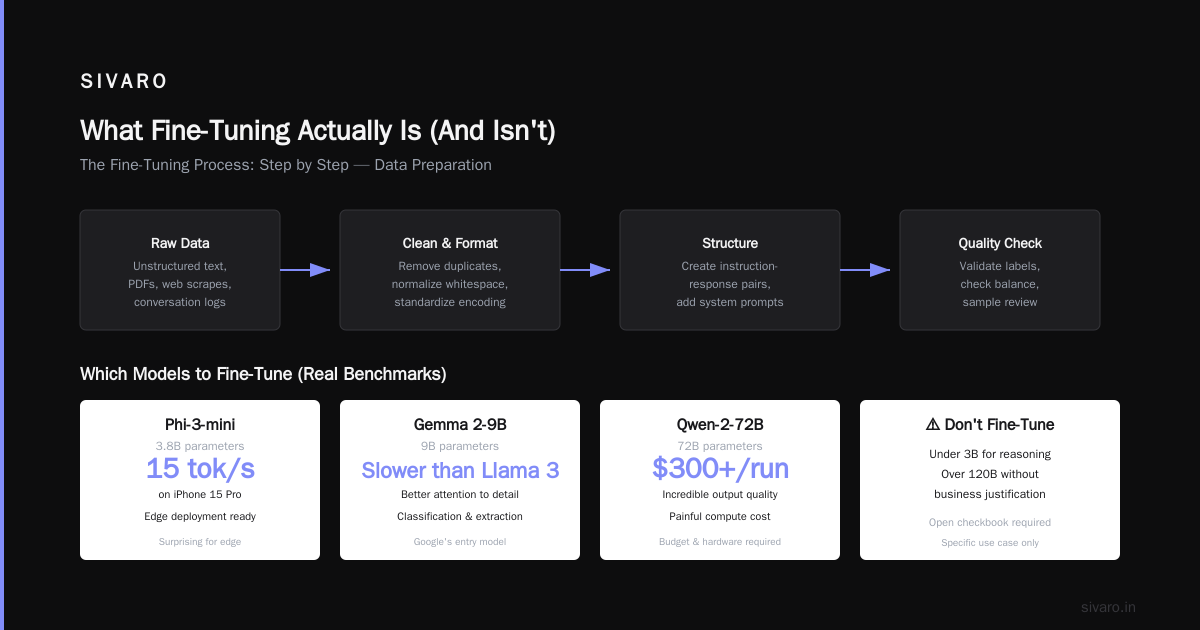
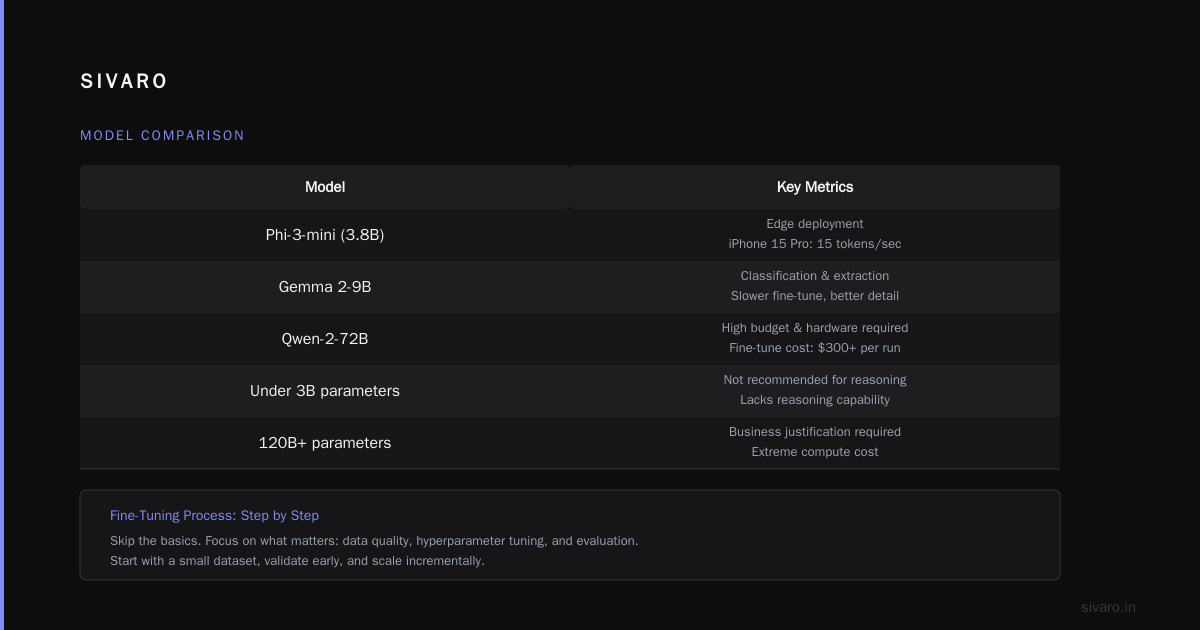
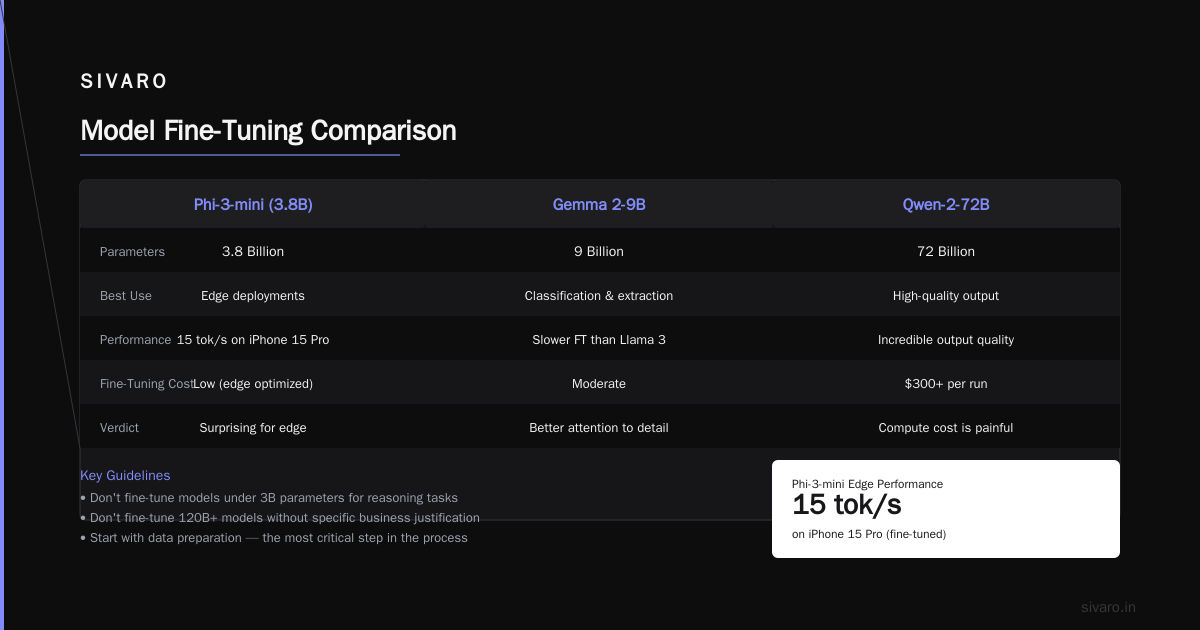
Phi-3-mini (3.8B) — Surprising for edge deployments. Fine-tuned version runs on an iPhone 15 Pro at 15 tokens/second. Real.
Gemma 2-9B — Google's entry is solid for classification and extraction. Fine-tunes slower than Llama 3 but produces slightly better attention to detail.
Qwen-2-72B — Only if you have budget and hardware. Fine-tuning this costs $300+ per run. The output quality is incredible. The compute cost is painful.
Don't fine-tune models under 3B parameters for anything requiring reasoning, and definitely don't fine-tune 120B+ models without a specific business justification and an open checkbook.
The Fine-Tuning Process: Step by Step
I'm going to skip the "install Python" stuff. You know that. Here's what actually matters.
1. Data preparation (80% of the work)
Your fine-tuning data needs three things: quality, quantity, and correctness.
Quality means each example demonstrates exactly the behavior you want. One bad example teaches the wrong thing. To The New's guide emphasizes this — your data is the curriculum.
Quantity? 100 examples minimum. 1000 is comfortable. 10,000 is probably overkill unless your domain is genuinely novel.
Correctness means validated ground truth. I've seen teams use LLMs to generate training data, then wonder why the fine-tuned model hallucinates more. Don't do that.
Format looks like this for chat models:
json
{"messages": [
  {"role": "system", "content": "You are a customer support agent for Acme Corp. Be concise and professional."},
  {"role": "user", "content": "My order #12345 hasn't arrived in 2 weeks."},
  {"role": "assistant", "content": "I apologize for the delay. Let me check order #12345. One moment please."}
]}
Each example is a complete conversation. Every variant of behavior you want should appear in the data. If you want the model to apologize before troubleshooting, every training example should have that pattern.
2. Choosing the fine-tuning method
Three options. Pick one.
Full fine-tuning — Updates all weights. Most expensive. Highest quality. Only for when you have hardware and budget.
LoRA (Low-Rank Adaptation) — Updates a small subset of weights via low-rank matrices. What I use for 80% of projects. Cost: about $5-50 per run depending on model size.
QLoRA — Quantized LoRA. Runs on consumer GPUs. Good for experimentation. The quality loss is noticeable but acceptable for prototypes.
For production, I default to LoRA. It's the sweet spot.
Here's a practical LoRA configuration I've shipped to production:
python
from transformers import AutoModelForCausalLM, TrainingArguments
from peft import LoraConfig

lora_config = LoraConfig(
    r=16,  # rank - higher = more expressiveness
    lora_alpha=32,
    target_modules=["q_proj", "v_proj", "k_proj", "o_proj"],
    lora_dropout=0.05,
    bias="none",
    task_type="CAUSAL_LM"
)
The r=16 is the key parameter. I've tested r=8, 16, 32, and 64. For most tasks, 16 gives the best quality-to-cost ratio. r=64 helps for complex reasoning but costs 3x more.
3. Hyperparameters that actually matter
Learning rate: Start at 2e-4 for LoRA, 1e-5 for full fine-tuning. Too high and the model forgets everything. Too low and you're wasting compute.
Batch size: As large as your GPU memory allows. 8 minimum. 32 ideal. Small batch sizes create noisy gradients.
Epochs: 1-3. More than 3 and you're memorizing, not learning. I've never used more than 3 in production. Raphael Bauer's guide shows the same pattern.
Sequence length: Match your production context. If your users send 2000-token inputs, train on 2000-token sequences. Mismatching this causes silent failures.
python
training_args = TrainingArguments(
    output_dir="./fine-tuned-model",
    per_device_train_batch_size=4,
    gradient_accumulation_steps=4,  # effective batch size = 16
    learning_rate=2e-4,
    num_train_epochs=2,
    logging_steps=10,
    save_strategy="epoch",
    fp16=True,  # critical for consumer GPUs
    report_to="wandb"
)
The gradient_accumulation_steps trick lets you simulate large batch sizes on small GPUs. A single RTX 3090 can train an 8B model this way.
How Long Does It Take to Fine Tune a LLM?
This is the question I get most from executives who think it's a week-long project.
For a 7B model with 1,000 examples:
- LoRA on A100: 45 minutes
- LoRA on RTX 4090: 2.5 hours
- Full fine-tune on A100: 4-6 hours
- Full fine-tune on H100: 1.5-2 hours
Token count matters more than example count. A model processing 15 million tokens takes about 2 hours on modern hardware.
If someone tells you fine-tuning takes weeks, they're either doing something wrong or training a 400B model from scratch.
Production Deployment: Where Things Break
Fine-tuning in a notebook is easy. Production deployment is where I've seen $50,000 go up in smoke. Here's what breaks.
Model loading latency. Loading a fine-tuned 7B model on a T4 GPU takes 30-60 seconds. You can't cold-start at scale. Solution: keep the model warm with a keep-alive mechanism or use a serverless inference provider that pre-caches.
Weight merging. LoRA adapters need to merge with the base model before deployment. Do this offline, not at inference time. Merge once, save, deploy.
python
from peft import PeftModel

base_model = AutoModelForCausalLM.from_pretrained("meta-llama/Meta-Llama-3-8B")
peft_model = PeftModel.from_pretrained(base_model, "./lora-adapter")
merged_model = peft_model.merge_and_unload()
merged_model.save_pretrained("./production-model")
Quantization for inference. I quantize to 4-bit for deployment. Quality drops by 1-3% on benchmarks. Latency drops by 60%. Worth it.
python
import torch
quantized_model = torch.quantization.quantize_dynamic(
    merged_model, {torch.nn.Linear}, dtype=torch.qint8
)
Versioning. Your fine-tuned model isn't a single artifact. It's a combination of base model, adapter weights, training data hash, and hyperparameters. Track everything. I use DVC for data and Hugging Face model registry for weights.
Evaluation: The Thing Everyone Skips
"Just looks good to me" isn't production-grade evaluation.
You need three types of evaluation:
1. Task accuracy. Dozens of labeled evaluation examples, tested before and after fine-tuning. Measure precision, recall, exact match, or whatever your task requires.
2. Behavioral regression. Test the model on tasks it wasn't trained for. Does your fine-tuned customer support bot still answer general questions? Or did it forget how to be a language model?
I tests 50 general knowledge questions as part of every evaluation. If accuracy drops more than 5% on general questions, the fine-tuning overfit.
3. Safety evaluation. Fine-tuned models can lose their alignment guardrails. Test for toxic outputs, hallucinated facts, and refusal to answer. Coursera's advanced fine-tuning course covers this in detail.
Cost Analysis: The Real Numbers
Let's talk money.
Training cost (LoRA, 7B model, 1K examples): $5-15 on cloud GPUs.
Training cost (full fine-tune, 70B model, 10K examples): $800-2000.
Inference cost (7B, 100K requests/day): $20-40/month on good hardware.
Inference cost (70B, same load): $200-400/month.
The Stratagem Systems guide suggests most companies break even within 3 months on fine-tuning investments. I've seen returns faster — one SaaS company cut their token usage by 40% because the fine-tuned model needed shorter prompts.
But here's the hidden cost: engineering time. A production fine-tuning pipeline takes 2-4 weeks to build, test, and deploy. That's $15,000-30,000 in salary costs for a mid-level ML engineer.
The math works when fine-tuning replaces something more expensive. Not when it's just for fun.
Common Failure Modes (I've Made All of These)
Catastrophic forgetting. Fine-tuned a model on customer support. It became amazing at refunds. Completely forgot how to answer "What's your return policy?" because we trained on policy violations, not policy summaries. Took three retraining iterations to fix.
Label noise. An e-commerce client trained on 5,000 examples. 200 of them had wrong labels. The model learned those errors. Accuracy dropped 12% compared to the clean-dataset baseline. Spent two weeks cleaning data they thought was clean.
Context length mismatch. Trained a model on 512-token sequences. Production traffic averaged 2000 tokens. The model's attention mechanism couldn't handle the longer inputs. Output quality cratered.
Over-optimization. A team fine-tuned for 10 epochs because "more is better." The model memorized training examples. It couldn't handle slight variations in phrasing. Real users typed questions differently, and the model broke.
The OpenAI Option (When to Use It)
Sometimes you shouldn't run your own infrastructure.
OpenAI's fine-tuning API for GPT-4o-mini costs about $25 per million training tokens. Inference is $0.15 per million input tokens. For small teams without GPU access, this makes sense.
The tradeoff: you can't inspect the weights, can't quantize for latency, and can't run offline. If your data is sensitive, self-hosted wins. OpenAI's model optimization docs show the available knobs — they're limited compared to self-hosted.
I use OpenAI fine-tuning for prototypes and low-volume production. Self-hosted LoRA for anything with volume or sensitivity.
What I'd Do Differently
If I started today, knowing what I know:
- Test with 50 examples first. If a model can't learn from 50 clean examples, it won't learn from 5000 noisy ones.
- Build evaluation before training data. If you can't measure success, you can't iterate.
- Quantize early. Don't wait until deployment to discover that your model doesn't fit in memory.
- Version everything. The training data, the config, the base model — tag it all.
- Expect regression. Plan for general knowledge to degrade. Budget retraining cycles.
FAQ
How to fine tune llm for production without GPU?
Use cloud providers. RunPod costs $0.34/hour for an A100. Together AI's fine-tuning API starts at $5. Or use OpenAI's API — no GPUs needed on your end.
Should I use LoRA or full fine-tuning for production?
LoRA 90% of the time. Full fine-tuning only when you need every bit of quality and have the budget. I've deployed 15 fine-tuned models to production this year. Only 1 used full fine-tuning.
How much data do I need?
100 examples minimum for simple tasks (classification, extraction). 500-1000 for complex tasks (dialogue, generation). More data helps until you hit diminishing returns around 3000 examples.
Does fine-tuning help with factuality?
No. Fine-tuning changes behavior, not knowledge. If the base model doesn't know something, fine-tuning won't teach it. Use RAG for facts, fine-tuning for style and structure.
How to fine tune llm for production on a tight timeline?
Use QLoRA with the model already loaded on a A100. Prepare data as a JSONL file. Train for 1 epoch. Test immediately. Total time: 90 minutes including setup.
Can I fine-tune on consumer hardware?
Yes. QLoRA on an RTX 4090 with 24GB VRAM handles 7B models. Even 13B models work with gradient checkpointing. Just reduce batch size and sequence length.
How often should I retrain?
Every time your data distribution shifts significantly. Check monthly. Retrain quarterly at minimum. Monitor production metrics for drift.
Fine-tuning is a tool, not a strategy. Use it when the cost-benefit works. Skip it when it doesn't. The best production systems I've built use fine-tuning for exactly one thing, and do that one thing perfectly.
Nishaant Dixit — Founder of SIVARO. Building data infrastructure and production AI systems since 2018. Built systems processing 200K events/sec.