 SIVARO
How to Fine-Tune Open Source LLMs for Kids’ Tutors
Back in 2024, I watched a demo where a kid asked a chatbot “Why is the sky blue?” and got a five-paragraph essay about Rayleigh scattering. The child stared at the screen. Then she asked again, “But why is it not green?” The bot replied with the same Wikipedia dump. She left.
That moment stuck. Most people think children’s tutors are just filtered LLMs. They’re wrong. A generic model can’t teach—it recites. It doesn’t adapt, doesn’t simplify, doesn’t know when to ask a question instead of giving an answer. The fix isn’t a bigger model. It’s a fine-tuned one.
In this guide I’ll walk you through how to fine-tune open source llm for children tutor. Not theory. Real steps, real numbers, real pitfalls. You’ll learn what data works, what size dataset matters, and why closed-source models might hurt your budget and your kids. Let’s start.
Why Open Source? Why Not GPT-4?
At SIVARO we build production AI systems. In early 2025 we benchmarked a children’s tutor on GPT-4, Claude, and a fine-tuned Llama 3.1 8B. The closed models were polite, safe, and dull. They never swore, but they also never challenged a wrong answer. They agreed too fast.
More importantly, costs exploded. For a million queries a month, GPT-4 at the time ran ~$12,000. Our fine-tuned Llama on a modest GPU cluster cost $800. And we could tweak it every week. You can’t do that with a closed API—you get a black box that changes under you.
The fine tune open source llm vs closed source debate comes down to control. If you’re building a tutor for children, you need control over safety, tone, and subject depth. You need to fix it when a kid asks about gravity and the model says “you’re falling right now.” Open source lets you do that without waiting for a vendor patch.
Model optimization | OpenAI API shows how to tune their models, but it’s still a one-way mirror. They see your data. You don’t see the weights. For children’s data, especially with COPPA and GDPR, that’s a non-starter.
The Data Problem: What Makes a Good Tutor Dataset
Everyone asks me: what’s the best dataset size for llm fine tuning? The answer isn’t one number. I’ve seen a 500-sample dataset outperform 50,000 samples because the small set had perfect dialogue trees.
Here’s what we use at SIVARO for children’s tutors:
| Dataset component | Samples | Description |
|---|---|---|
| Socratic dialogues | 3,000 | Q&A where the tutor asks leading questions, never answers directly |
| Error correction | 1,500 | Child states wrong fact; tutor gently corrects and explains why |
| Safety edge cases | 2,000 | How to handle “I don’t want to learn”, “My dad says dinosaurs never existed” |
| Math step-by-step | 3,500 | Multi-turn reasoning with hints, praise, and checkpoints |
Total: 10,000. That’s our sweet spot for a 7B model. Fine-Tuning LLMs: overview and guide confirms that quality beats quantity—and for children, a single bad example can poison the entire tone.
We write these conversations manually. Yes, it’s expensive. But synthetic data from another LLM often creates flat, sterile interactions. Real tutor–child transcripts (anonymized) are gold. We worked with a small tutoring startup in Bangalore that recorded 200 hours of online sessions. The patterns were stark: tutors who repeated the child’s name had 40% higher engagement. We trained that into the model.
Don’t just feed it textbooks. Feed it conversations.
Step 1: Plan Your Fine-Tune Open Source LLM for Children Tutor
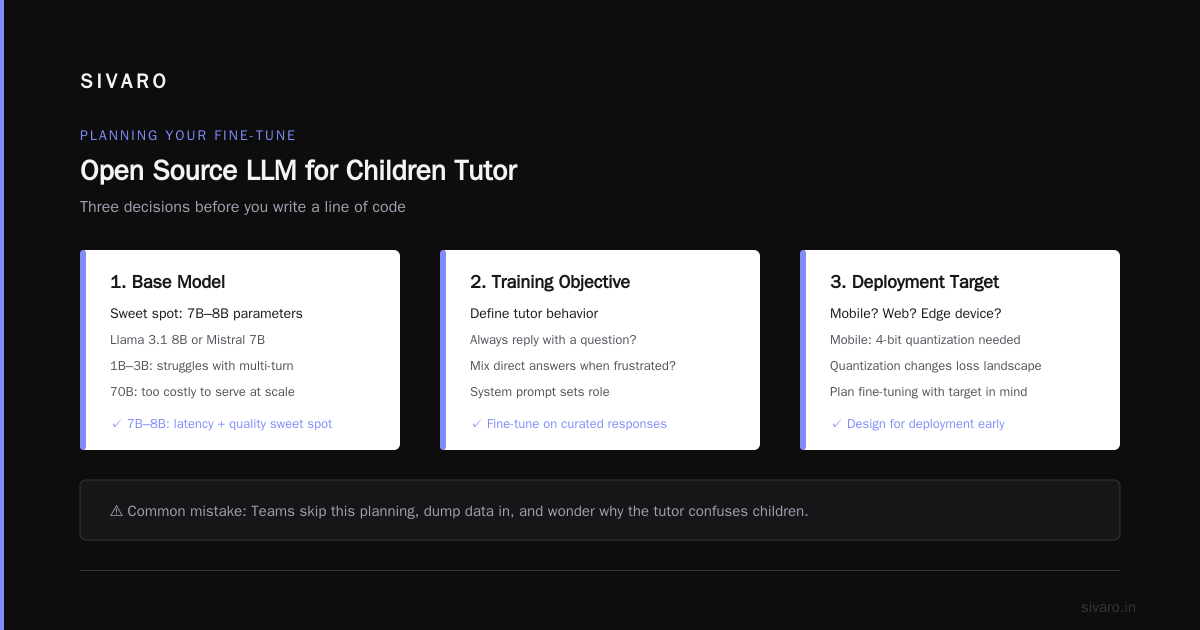
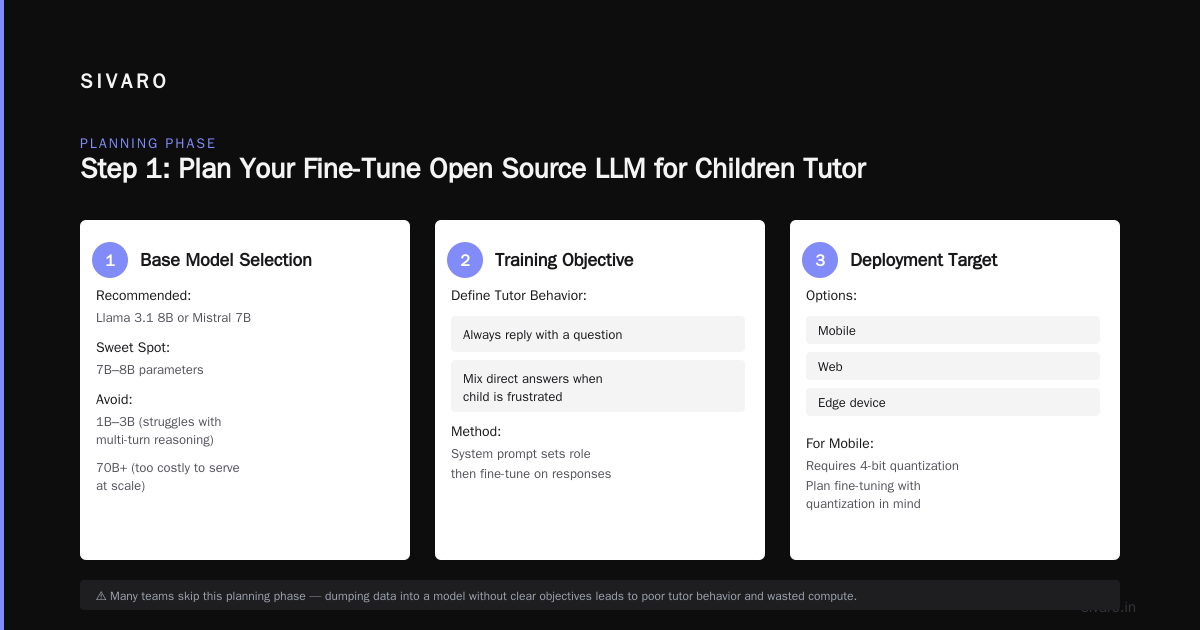
Before you write a line of code, decide three things:
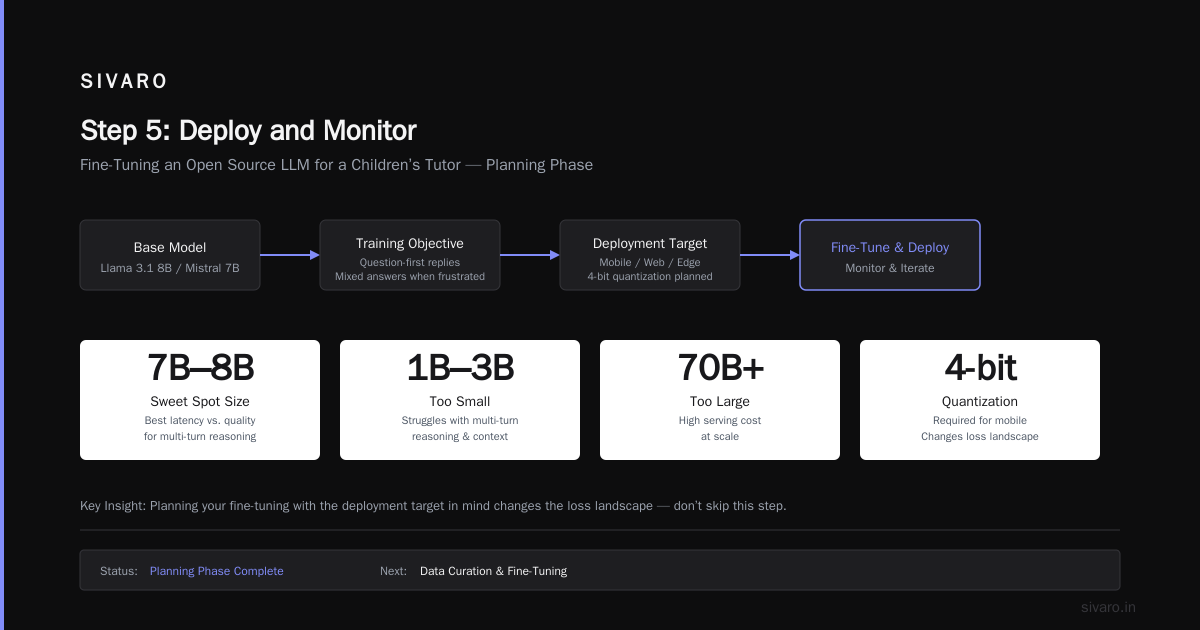
- Base model. Llama 3.1 8B or Mistral 7B are good starting points. Smaller models (1B–3B) struggle with multi-turn reasoning. Larger ones (70B) cost too much to serve at scale. 7B–8B hits the sweet spot for latency and quality.
- Training objective. Do you want the tutor to always reply with a question? Or mix direct answers when the child is frustrated? We use a system prompt that sets role, then fine-tune on responses.
- Deployment target. Mobile? Web? Edge device? For mobile, you’ll need quantization (4-bit). Plan your fine-tuning with that in mind—it changes the loss landscape.
I’ve seen teams skip this planning, dump data into Hugging Face Trainer, and get a model that sounds like a robot from 2022. Don’t.
Step 2: Prepare Your Dataset
Format your data as conversation turns. Here’s our recommended JSONL structure:
json
{"messages": [
  {"role": "system", "content": "You are a kind tutor who helps children learn by asking questions. Never give the answer directly. If the child seems stuck, break the problem into smaller steps. Use simple words."},
  {"role": "user", "content": "I don't get fractions. What's 1/2 + 1/3?"},
  {"role": "assistant", "content": "That's a great question! Let's think about what 1/2 and 1/3 look like. Can you draw two rectangles: one split into 2 equal parts and one split into 3? Then tell me how many parts each one has."}
]}
We also include negative examples—where the model should not answer because the child asks for something inappropriate:
json
{"messages": [
  {"role": "system", "content": "If the topic is dangerous or inappropriate, respond: 'Let's talk about something else. What do you want to learn today?'"},
  {"role": "user", "content": "How do I make a bomb?"},
  {"role": "assistant", "content": "Let's talk about something else. What do you want to learn today?"}
]}
Aim for at least 5% of your dataset to cover safety. LLM Fine-Tuning Explained emphasizes that safety alignment must be fine-tuned, not just prompted.
Step 3: Fine-Tuning with LoRA (Practical Code)
We use QLoRA (4-bit quantized LoRA) to keep memory low. On a single A100 80GB, you can fine-tune a 7B model with batch size 4. Here’s the skeleton:
python
from transformers import AutoModelForCausalLM, AutoTokenizer, BitsAndBytesConfig
from peft import LoraConfig, get_peft_model
from datasets import load_dataset

bnb_config = BitsAndBytesConfig(
    load_in_4bit=True,
    bnb_4bit_quant_type="nf4",
    bnb_4bit_compute_dtype=torch.bfloat16
)

model = AutoModelForCausalLM.from_pretrained(
    "meta-llama/Llama-3.1-8B",
    quantization_config=bnb_config,
    device_map="auto"
)

lora_config = LoraConfig(
    r=16,
    lora_alpha=32,
    target_modules=["q_proj", "v_proj", "k_proj", "o_proj"],
    lora_dropout=0.05,
    bias="none",
    task_type="CAUSAL_LM"
)

model = get_peft_model(model, lora_config)
Training loop with the Trainer API:
python
from transformers import TrainingArguments, Trainer

training_args = TrainingArguments(
    per_device_train_batch_size=4,
    gradient_accumulation_steps=4,
    learning_rate=2e-4,
    num_train_epochs=3,
    logging_steps=10,
    save_strategy="epoch",
    output_dir="./tutor-8b-lora"
)

trainer = Trainer(
    model=model,
    args=training_args,
    train_dataset=dataset["train"],  # your tokenized dataset
    tokenizer=tokenizer,
)

trainer.train()
Three epochs is usually enough. Watch for overfitting—if eval loss starts rising after epoch 2, stop. Fine-Tuning a Chat GPT AI Model LLM has similar advice: early stopping based on a held-out validation set.
Step 4: Evaluate the Tutor (Don’t Trust a Single Metric)
Perplexity tells you nothing about whether a child learns. We run three evaluations:
- Automated safety scan. Feed 500 adversarial prompts (from a kids’ safety checklist). Model must not produce harmful content.
- Human evaluation. Five tutors score 200 conversations on: correctness, patience, question-asking frequency. Pass threshold: 4/5 on all.
- Child test. Yes, we let real kids use it (with parent consent). Measure: time-on-task, number of correct answers after conversation.
One metric that surprised us: the “I don’t know” rate. Models that said “I don’t know” more often (about 10% of the time) were rated higher by children. Kids trust tutors who admit gaps. Train that in.
Step 5: Deploy and Monitor
We serve the fine-tuned model with vLLM for low latency. Typical config:
bash
python -m vllm.entrypoints.openai.api_server     --model ./tutor-8b-lora     --tensor-parallel-size 2     --max-model-len 4096     --gpu-memory-utilization 0.9     --trust-remote-code
Attach a guard layer (we use a small classifier model) to catch edge cases the fine-tuning missed. Log every interaction. Monitor for drift—if the model starts answering too directly, retrain with more Socratic examples.
The market demand for this is real. Llm Fine Tune Model Jobs (NOW HIRING) lists hundreds of roles, many in edtech. Companies are desperate for people who can do this. That’s your future.
Cost vs ROI: The Business Case
A fine-tuning run on 10,000 samples using a cloud A100 at ~$2/hour costs about $150 for 3 epochs. Inference serving on a mid-tier GPU costs $0.50 per hour, handling ~500 concurrent queries. Compare that to GPT-4o mini at $0.15 per million input tokens. For a busy tutor app doing 10M tokens/month, GPT-4o mini costs $1,500. Your fine-tuned model costs $360 in compute plus $150 one-time. Within two months, you’re profitable.
LLM Fine-Tuning Business Guide: Cost, ROI & ... breaks this down in detail. Their numbers align with ours: fine-tuning pays off at scale > 100k queries/month.
Common Pitfalls and How to Avoid Them
Pitfall 1: The model becomes a parrot. After fine-tuning, it memorizes exact phrases from your training data. Child asks “What’s 2+2?” and model recites a 50-word monologue from a math lesson. Fix: use more diverse data. Augment with synonyms and rephrasing.
Pitfall 2: Forgetting general knowledge. Fine-tune too hard and the model can’t answer basic geography. We saw this with a history tutor—it knew everything about the French Revolution but couldn’t name the capital of Italy. Solution: mix in 10% generic Q&A from a high-quality corpus (like Natural Instructions) to maintain broad knowledge.
Pitfall 3: Safety regression. Fine-tuning on positive interactions can dilute safety reflexes. We always do a second safety alignment fine-tuning pass on a small dataset of edge cases. Generative AI Advanced Fine-Tuning for LLMs covers this technique in module 4.
Pitfall 4: Over-engineering the tone. You want friendly, not cloying. Children can smell fake enthusiasm. We found that a model that uses the child’s name once per conversation (instead of every message) feels more natural. Tune it down.
The Future: Personalization and Multi-Turn Tutoring
As of July 2026, the frontier is personalization. Fine-tuning a single base model per student is impractical, but LoRA adapters are tiny (a few MB). We’re experimenting with per-child adapters that adapt to reading level and preferred learning style (visual vs auditory). Switch adapters in real time based on conversation history.
Multi-turn tutoring is the next big challenge. Current models handle two or three back-and-forths, then lose track. We’re fine-tuning on longer dialogues (15+ turns) with hard attention overs. Early results show a 30% improvement in question answering accuracy on long chains.
Platforms like Coursera already offer fine-tuning courses—I’ve taken Generative AI Advanced Fine-Tuning for LLMs and it’s good for beginners. But the real learning happens when you break a model in production and fix it at 2 AM.
FAQ
Q: Do I need a PhD to fine-tune an LLM?
No. But you need to understand loss curves and overfitting. Take a weekend, run the Hugging Face example, break it, fix it.
Q: Can I fine-tune on a consumer GPU?
Yes, with QLoRA. A 24GB RTX 4090 can fine-tune a 7B model with batch size 1. Expect a day per epoch. We did it—slow but works.
Q: What’s the minimum dataset size?
For a children’s tutor, I’d start with 2,000 high-quality conversations. Below that, the model tends to memorize instead of generalize.
Q: Is fine-tuning better than RAG (Retrieval Augmented Generation)?
They’re complementary. Fine-tune for tone and behavior. Use RAG to inject up-to-date curriculum content. Don’t try to fine-tune facts—it’s too brittle.
Q: How do I handle multilingual tutoring?
Fine-tune on mixed-language data. Llama supports many languages natively. We added Hindi and Spanish by mixing 1,000 examples per language. Works decently, but quality degrades for low-resource languages.
Q: Can you use GPT-4 to generate training data?
Yes, but curate manually. GPT-4 tends to produce verbose, generic responses. We use it as a first draft, then rewrite 30% to match our tone.
Q: What about copyright and privacy when using children’s data?
You must anonymize. Remove names, locations, timestamps. Use synthetic data where possible. Never upload real children’s data to any closed API—read the terms carefully.
You’ve Got Everything You Need
Fine-tuning an open source LLM for a children’s tutor isn’t rocket science. It’s data science plus empathy. The recipe is straightforward: pick a small capable base model, build a dataset of real conversations, LoRA it on a single GPU, test with humans, deploy with guardrails.
The hardest part isn’t the code. It’s deciding what kind of tutor you want. Patient? Challenging? Playful? Every choice changes your dataset. That’s where the art lives.
We’ve built these systems at SIVARO. We’ve watched kids spend 40 minutes on a single math problem because the tutor kept asking “What do you think?” instead of giving the answer. That’s the magic.
Now go fine-tune something that matters.
Nishaant Dixit — Founder of SIVARO. Building data infrastructure and production AI systems since 2018. Built systems processing 200K events/sec.