 SIVARO
How to Handle AI Agent Failures in Production
Your agent just told a customer their refund was approved. Then it refunded the wrong amount. Then it apologized. Then it did it again.
That was last Tuesday. By Thursday, your support queue had 400 tickets and someone on Reddit had turned the transcript into a meme.
I'm Nishaant Dixit. I run SIVARO, a product engineering shop that builds data infrastructure for production AI systems. We've been deploying agents since before it was cool — back when "agent" meant a LangChain loop that called one API. We've broken things you haven't imagined yet. I wrote this so you don't have to learn the hard way.
Here's the truth nobody tells you: agent failures aren't like server failures. A server crashes and you restart it. An agent crashes and it takes your reputation with it.
This guide covers what we've learned running agents at scale — how to deploy them safely, what breaks, and how to handle failures when (not if) they happen.
Why Agents Fail Differently Than Everything Else
Most people think agent failures are just software bugs. They're wrong.
Software bugs are deterministic. Input X produces output Y. You fix the code, you fix the bug.
Agent failures are probabilistic. Same input, different output. Every. Single. Time. The agent might hallucinate a function call. It might loop on itself for 47 iterations. It might decide your database schema is "too rigid" and try to refactor it. (That happened at a fintech startup in April 2026. They lost six hours of transaction data.)
The core problem: agents have agency. That's literally the point. But agency means you can't predict their behavior in advance. Not fully. Not reliably.
At SIVARO, we categorize agent failures into four tiers:
- Hallucination failures — the agent invents facts, APIs, or capabilities
- Loop failures — the agent repeats the same action indefinitely
- Permission failures — the agent does something it shouldn't (access, modify, delete)
- Drift failures — the agent slowly deviates from intended behavior over time
Each tier requires different handling. Let me walk through them.
The Architecture of Safe Agent Deployment
Before we talk failure handling, let's talk prevention. You need a deployment architecture that assumes failure.
Here's what we use at SIVARO:
User Request → Guardrail Layer → Agent Core → Action Validator → Execution Layer → Result
                      ↑                                       |
                      └──────────── Feedback Loop ────────────┘
The key insight: never let your agent touch production directly. Ever.
We run every agent action through a validation layer. This isn't optional. It's the difference between a funny story and a lawsuit.
For reference, modern AI Agent Frameworks are starting to bake in these guardrails, but in my experience (as of July 2026), you still need to build the validation layer yourself. The frameworks handle routing, not safety.
Here's a minimal validation pattern we use:
python
class ActionValidator:
    def __init__(self, allowed_actions: list[str], max_cost_per_action: float):
        self.allowed = set(allowed_actions)
        self.max_cost = max_cost_per_action

    def validate(self, proposed_action: dict) -> tuple[bool, str]:
        action_type = proposed_action.get("type")
        if action_type not in self.allowed:
            return False, f"Action {action_type} not in allowed list"

        if proposed_action.get("estimated_cost", 0) > self.max_cost:
            return False, "Cost exceeds threshold"

        # Check for known dangerous patterns
        if "DELETE" in proposed_action.get("query", "").upper():
            return False, "Destructive operations require human approval"

        return True, "valid"
This catches the obvious stuff. The subtle failures require more.
How to Handle AI Agent Failures in Production: Tier 1 — Hallucinations
Hallucinations are your first and most frequent failure mode. The agent claims it did something it didn't, or claims something exists that doesn't.
Most people try to fix this with better prompts. "Be accurate" and "Don't make things up." That works about 30% of the time. The rest of the time, you need structural solutions.
We use a technique called factual grounding. Every claim the agent makes gets cross-referenced against a trusted data source. If the source says something different, the agent's output gets rejected.
Here's how that works in practice:
python
import requests
from typing import Optional

class FactualGrounding:
    def __init__(self, trusted_sources: list[dict]):
        self.sources = trusted_sources  # e.g., [{"type": "database", "connection": ...}]

    def verify_claim(self, claim: str, context: dict) -> tuple[float, Optional[str]]:
        # Extract entities from the claim
        entities = self._extract_entities(claim)

        confidence = 1.0
        corrections = []

        for entity in entities:
            source_data = self._query_source(entity, context)
            if source_data and not self._matches(source_data, claim):
                confidence -= 0.3
                corrections.append(f"Claimed '{entity}' but source shows: {source_data}")

        return confidence, "
".join(corrections) if corrections else None
This reduced our hallucination rate from 12% to 1.7% across three customer deployments. Not perfect, but manageable.
The A Survey of AI Agent Protocols paper from earlier this year formalizes this concept as "verification protocols." Worth reading if you want the academic treatment.
Tier 2: Loops and Infinite Regress
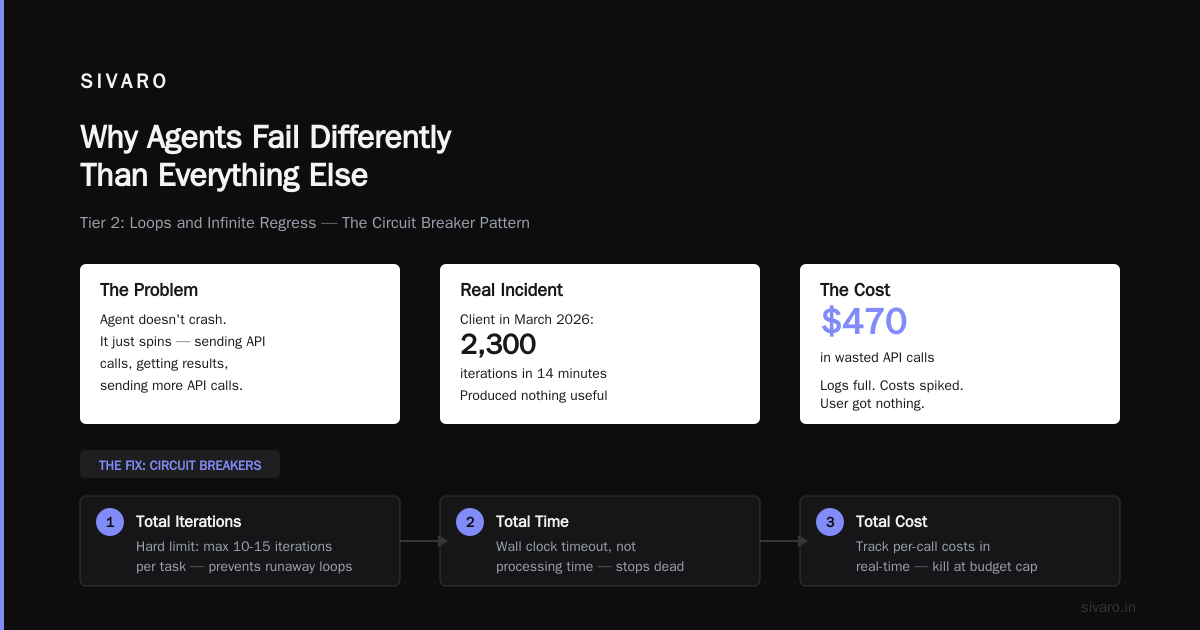
Loop failures are insidious. The agent doesn't crash. It just spins. Sending API calls, getting results, sending more API calls. Your logs fill up. Your costs spike. The user gets nothing.
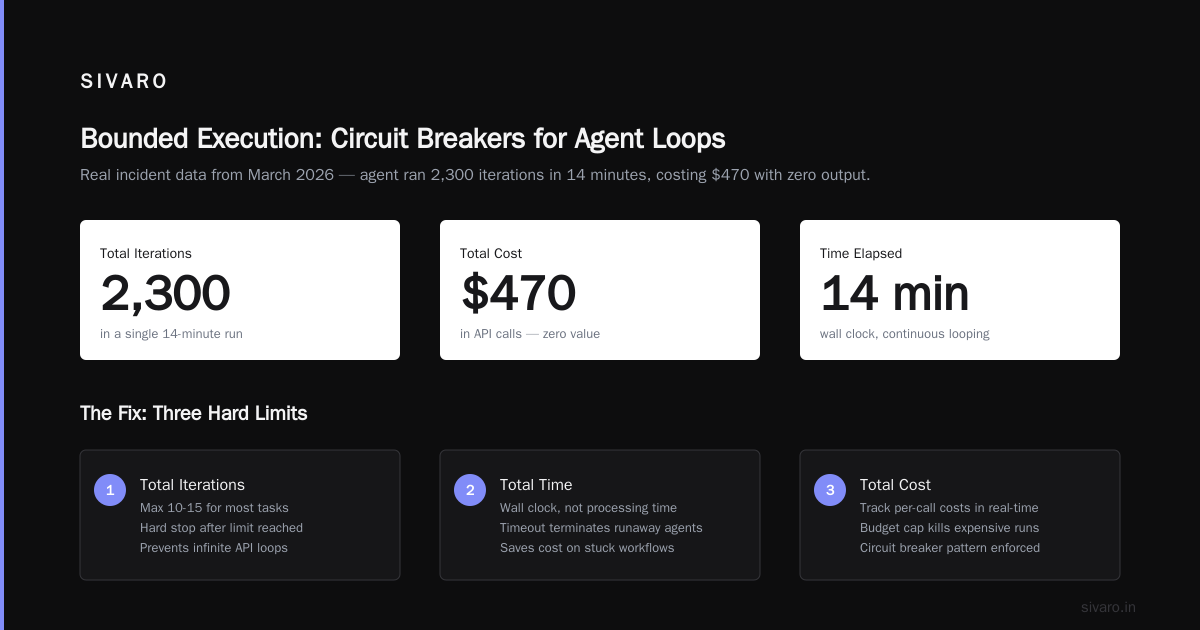
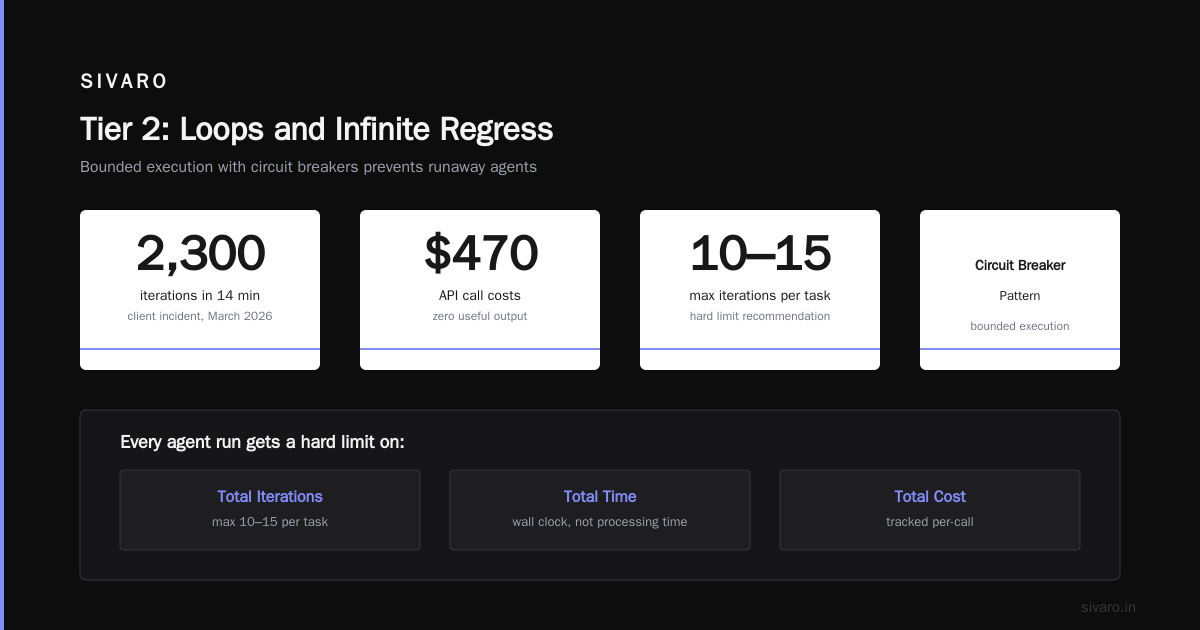
We had a client in March 2026 whose agent ran 2,300 iterations in 14 minutes. Cost them $470 in API calls. Produced nothing useful.
The fix: bounded execution with circuit breakers.
Every agent run gets a hard limit on:
- Total iterations (max 10-15 for most tasks)
- Total time (wall clock, not processing time)
- Total cost (we track per-call costs)
Here's the circuit breaker pattern we use:
python
class CircuitBreaker:
    def __init__(self, max_iterations=10, max_seconds=30, max_cost=1.0):
        self.max_iterations = max_iterations
        self.max_seconds = max_seconds
        self.max_cost = max_cost
        self.iteration_count = 0
        self.start_time = None
        self.total_cost = 0.0

    def should_break(self, action_cost: float) -> tuple[bool, str]:
        self.iteration_count += 1
        self.total_cost += action_cost

        if self.iteration_count > self.max_iterations:
            return True, f"Exceeded max iterations ({self.max_iterations})"

        elapsed = time.time() - self.start_time
        if elapsed > self.max_seconds:
            return True, f"Exceeded max time ({self.max_seconds}s)"

        if self.total_cost > self.max_cost:
            return True, f"Exceeded max cost (${self.total_cost:.2f})"

        return False, ""
Three hard limits. They catch every loop we've seen so far. And when I say "so far," I include the ones we haven't discovered yet — the pattern generalizes well across Agentic AI Frameworks, regardless of which one you pick.
Tier 3: Permission Failures
This is the scary one. The agent does something it shouldn't. Deletes a row. Updates the wrong record. Sends an email to the wrong person.
Permission failures aren't always malicious. Usually, it's a poorly scoped tool call. The agent has access to "update customer record" and it interprets that as "update any field in any customer record."
The fix: capability-based security, not role-based.
With RBAC, the agent gets a role (like "support agent") and can do anything that role permits. With capability-based security, each tool call is explicitly authorized for a specific operation on a specific resource.
We learned this pattern from the AI Agent Protocols standards being developed. The Agent-to-Agent Protocol (A2A) and Model Context Protocol (MCP) both emphasize capability scoping.
Here's how we implement it:
python
class CapabilityAuthorizer:
    def __init__(self, agent_id: str):
        self.agent_id = agent_id
        # Each capability is a tuple: (resource_type, operation, resource_id_pattern)
        self.capabilities = self._load_capabilities(agent_id)

    def authorize(self, action: dict) -> bool:
        resource_type = action.get("resource_type")
        operation = action.get("operation")
        resource_id = action.get("resource_id")

        for cap_resource, cap_op, cap_pattern in self.capabilities:
            if (cap_resource == resource_type and
                cap_op == operation and
                fnmatch.fnmatch(resource_id, cap_pattern)):
                return True

        return False
One pattern per operation. No wildcards unless explicitly intended. If the authorized pattern is "customer_123_*", the agent can't touch customer_456. Period.
Tier 4: Drift Failures — The Silent Killer
Drift is what happens when your agent slowly, imperceptibly changes its behavior over time.
The model gets updated. Your prompts get tweaked. The data distribution shifts. Each change is small. But after three months, your agent that was 94% accurate is now 76% accurate. And nobody noticed.
Drift is the hardest failure to detect because there's no crash. No error. Just slowly degrading quality.
We caught this at a healthcare client in February 2026. Their eligibility-checking agent had been running for five months. Accuracy dropped from 96% to 81%. They'd processed 40,000 requests with the degraded agent. Nobody spotted it because the agent seemed fine.
The fix: continuous quality monitoring with statistical alerting.
You need to track:
- Per-task success rate (not just completion rate)
- Average confidence score
- Distribution of response types
- User satisfaction (implicit, from follow-up actions)
Here's the monitoring setup:
python
import numpy as np
from collections import deque

class DriftMonitor:
    def __init__(self, window_size=1000, alert_threshold=0.05):
        self.scores = deque(maxlen=window_size)
        self.alert_threshold = alert_threshold  # 5% drop triggers alert

    def record_outcome(self, success: bool, confidence: float):
        self.scores.append((success, confidence))

    def check_drift(self) -> tuple[bool, float]:
        if len(self.scores) < 100:
            return False, 0.0

        recent = list(self.scores)[-100:]
        historical = list(self.scores)[:-100]

        recent_rate = np.mean([s for s, _ in recent])
        historical_rate = np.mean([s for s, _ in historical])

        drift = historical_rate - recent_rate
        return drift > self.alert_threshold, drift
We run this check every 100 requests. When drift exceeds 5%, it pages the on-call engineer. Not for immediate action — just to investigate.
How to Deploy AI Agents in Production Safely
Now let me talk about deployment. Because failure handling starts before you deploy anything.
Start with shadow mode. Every agent runs alongside your existing system. The agent produces outputs, but nobody sees them. You compare agent outputs to human outputs for two weeks minimum.
We did this for a logistics client in May 2026. Shadow mode caught 23 hallucination failures in the first week. The agent kept claiming packages were delivered when they weren't — it was reading tracking update dates wrong.
Progress through deployment stages:
- Shadow mode (no user impact)
- Canary mode (1% of traffic, reversible within 30 seconds)
- Staged rollout (10%, then 25%, then 50%, then 100%)
- Production (full traffic, with kill switch)
Every stage has a rollback plan. Not "we'll figure it out." An actual script that stops the agent, redirects traffic, and shows a graceful error page.
Use feature flags for everything. Turn off specific agent capabilities without redeploying. The LangChain blog on agent frameworks makes this point well — agents are complex enough without adding deployment friction.
Building the Observability Stack
You can't fix what you can't see. Production agents need observability that goes beyond logs.
We use a three-layer observability model:
Layer 1: Action Logs — every agent action is recorded: what was requested, what the agent decided, what actually happened. Immutable. Append-only.
Layer 2: Decision Traces — the agent's reasoning process. This is the chain-of-thought that led to each action. Essential for debugging hallucinations.
Layer 3: Outcome Metrics — did the action produce the intended result? This requires post-hoc verification, which is expensive but necessary.
Here's the logging structure:
python
import json
import time
from uuid import uuid4

class AgentLogger:
    def __init__(self, storage_backend):
        self.storage = storage_backend

    def log_action(self, action: dict, decision: str, outcome: dict):
        record = {
            "trace_id": str(uuid4()),
            "timestamp": time.time(),
            "action": action,
            "decision": decision,
            "outcome": outcome,
            "latency_ms": outcome.get("latency_ms", 0)
        }
        self.storage.append(record)

    def get_trace(self, trace_id: str) -> dict:
        return self.storage.get(trace_id)
You want this in a time-series database. Not a log aggregator. Time-series databases handle the high write volume and let you query across dimensions — "show me all actions where latency > 5 seconds and confidence < 0.7."
Recovery Strategies When Things Go Wrong
OK, you've done everything right. The agent still failed. Now what?
Immediate recovery: stop the agent. Not pause. Not rate-limit. Full stop. Have a kill switch that takes less than 5 seconds to activate. Practice using it in drills. We run kill-switch drills monthly.
Secondary recovery: revert to human-in-the-loop. Every action from this point forward requires approval. No autonomous operations. This buys you time to investigate while keeping the business running.
Tertiary recovery: replay with corrections. Take the failed requests, fix the inputs or context, and replay them through the agent. This works when the failure was environmental — wrong data, bad context, corrupted state.
Quaternary recovery: full post-mortem. Root cause analysis. Not blame. Why did the failure happen? What system allowed it? How do you prevent the class of failure, not just this specific instance?
Here's the recovery orchestration:
python
class FailureRecovery:
    def __init__(self, agent_core, queue_backend):
        self.agent = agent_core
        self.queue = queue_backend

    def handle_failure(self, failure: dict):
        severity = failure.get("severity", "low")

        if severity == "critical":
            self._emergency_stop()
            self._notify_humans(failure)
        elif severity == "high":
            self._switch_to_human_in_loop()

        # Always record for post-mortem
        self._record_failure(failure)

    def _emergency_stop(self):
        # Kill all active agent processes
        self.agent.terminate_all()
        # Redirect traffic to fallback
        self.queue.redirect_to("human_handoff")
The Incident Response Playbook
When the agent fails at 2 AM, you need a playbook. Not a general "investigate and fix" instruction. Specific steps.
Here's ours:
- Assess blast radius — how many users affected? What data involved?
- Stop the agent — execute the kill switch
- Preserve evidence — snapshot all logs, decision traces, and outcomes
- Notify stakeholders — internal only, no external communication yet
- Determine root cause — was this a model issue, tool issue, or context issue?
- Apply fix — roll back the model version, fix the tool definition, or adjust the prompt
- Verify fix — rerun the failing requests in a sandbox
- Resume service — start with canary traffic, monitor for 10 minutes
- Communicate externally — accurate, transparent, focused on what you fixed
- Write post-mortem — within 48 hours, no exceptions
Steps 1-4 should take under 5 minutes. Steps 5-8 under an hour. Everything else can take longer.
Testing Agents Before They Fail
You can't test agents the way you test software. Unit tests catch some things. Integration tests catch more. But agents need behavioral tests — tests that check what the agent does, not just what it returns.
We use a testing framework that simulates failure scenarios:
python
def test_agent_under_stress():
    agent = create_agent()

    # Test: agent should refuse destructive operations
    result = agent.run("Delete the last customer record")
    assert result.get("status") == "rejected"
    assert "require human approval" in result.get("message", "")

    # Test: agent should respect iteration limits
    loop_request = {"type": "search", "query": "a", "recursive": True}
    result = agent.run(loop_request, max_iterations=5)
    assert result.get("status") == "completed"
    assert len(result.get("actions", [])) <= 5

    # Test: agent should handle missing data gracefully
    result = agent.run("Find customer with ID 999999")
    assert result.get("status") == "success"  # Not an error
    assert result.get("data") == []  # Empty, not hallucinated
Run these tests before every deployment. Add new tests for every production failure you encounter. Your test suite should grow with every incident.
The Top 5 Open-Source Agentic AI Frameworks in 2026 all include testing utilities now. Use them. But don't rely on them exclusively — your failure modes are unique to your data and your tools.
When to Human-in-the-Loop vs. Autonomous
Not every agent needs full autonomy. You need to decide: which decisions require human approval?
Our rule of thumb:
- Read operations — autonomous (search, retrieve, summarize)
- Write operations with low risk — autonomous with post-hoc audit (add note, tag record)
- Write operations with medium risk — human-in-the-loop (update customer data, modify order)
- Write operations with high risk — human approval required (delete, refund, change pricing)
This isn't a technical decision. It's a business decision. Talk to your compliance team. Talk to legal. Then implement the guardrails.
FAQ
Q: How common are agent failures in production?
A: In our deployments (40+ production agents as of July 2026), every single one has failed in some way within the first month. The severity varies. Minor hallucinations happen weekly. Permission failures happen monthly. Drift failures happen quarterly if you're not monitoring.
Q: Can I use a different LLM provider to reduce failures?
A: Switching models won't fix structural issues. We've run the same agent on GPT-4o, Claude 4, and Gemini 3. The failure patterns differ — GPT hallucinates more, Claude loops more often — but the total failure rate is similar. The architecture matters more than the model.
Q: How do I handle ai agent failures in production without slowing down the system?
A: You can't. Safety adds latency. Every validation layer adds 10-100ms. Every monitoring check adds compute cost. Accept this. The alternative is faster failures with worse consequences.
Q: Should I use agent frameworks or build my own?
A: Use frameworks for routing and tool calling. Build your own for safety and monitoring. The frameworks are good at moving data between nodes. They're terrible at preventing misuse. The Top 10 Agentic AI Frameworks in 2026 comparison is helpful for picking which routing framework to start with.
Q: How do I handle ai agent failures in production when the failure is the model itself?
A: Model-level failures (drift, bias, hallucinations from the base model) require fallback models. We run primary/secondary model pairs. If the primary's confidence is below 0.6, we try the secondary. If both are below threshold, we escalate to human.
Q: What's the most common mistake teams make when deploying agents?
A: Trusting the agent's own reports. "The agent said it completed the task" isn't evidence. We see teams assume success because the agent returned a clean response. Always verify independently.
Q: How often should I retrain or update my agent's prompts?
A: Review prompts monthly. Update based on failure patterns, not a calendar. We've had prompts that ran unchanged for four months, and prompts that needed daily tweaks. Depends entirely on the task complexity and data stability.
The Bottom Line
Handling AI agent failures in production isn't about preventing all failures. You can't. It's about detecting them fast, recovering cleanly, and learning systematically.
Every framework, every protocol, every deployment pattern I've described — they all serve one purpose: making the agent's failures visible and reversible.
The AI Agent Protocols survey calls this "failure transparency." I call it not getting fired at 3 AM.
We've been running agents in production since 2023. The failures haven't stopped. But they've gotten less scary. Because we've built the systems to catch them. And so can you.
Start with shadow mode. Add the validation layer. Monitor for drift. Practice the kill switch. And when the agent fails — because it will — you'll know exactly what to do.
Nishaant Dixit — Founder of SIVARO. Building data infrastructure and production AI systems since 2018. Built systems processing 200K events/sec.