 SIVARO
How to Pass the GCP Associate Cloud Engineer Exam (2026 Guide)
I built SIVARO on Google Cloud. Started in 2018 with a single Compute Engine VM running a Django app. Seven years later, we process 200,000 events per second across Kubernetes clusters in three regions. That growth only happened because I learned the GCP services deeply — not by cramming for a cert, but by building real systems.
But here's the thing: the GCP Associate Cloud Engineer exam isn't a test of your production skills. It's a test of whether you can navigate the GCP console, remember command flags, and avoid the traps they set for people who only ever used AWS or Azure. I've trained over 40 engineers at SIVARO who've passed it. Let me tell you exactly how to pass, what most guides get wrong, and what you actually need to know in 2026.
Forget the "Three Pillars" Advice
Every blog post starts with "understand compute, storage, networking." Sure. That's like telling a pilot to "understand lift, thrust, drag." Technically true. Useless.
The exam tests you on specific GCP services and their quirks. Here's the real list:
- Compute: Compute Engine (VMs), GKE (Kubernetes), Cloud Run, App Engine (standard and flexible), Cloud Functions.
- Storage: Cloud Storage (object), Filestore (NAS), Persistent Disk (block), Cloud SQL (relational), Cloud Spanner (globally distributed), Firestore (NoSQL), Bigtable (wide-column).
- Networking: VPCs, subnets, firewall rules, Cloud NAT, Cloud Load Balancing (multiple types), Cloud VPN, Interconnect, Cloud DNS, Private Google Access, VPC peering, Shared VPC.
- IAM: Roles (primitive, predefined, custom), service accounts, policies, organization policies, conditions.
- Security: Cloud KMS, Secret Manager, Cloud Armor, Security Command Center, VPC Service Controls.
- Operations: Cloud Monitoring, Logging, Error Reporting, Cloud Trace, Cloud Debugger, Cloud Profiler.
- Data & AI: BigQuery (you must understand partitioning, clustering, and pricing), Dataflow, Pub/Sub, Cloud Dataproc, Vertex AI basics.
But memorizing that list only gets you halfway. The exam tests scenarios: "A company wants to reduce egress costs when moving data from Cloud Storage to Compute Engine in the same region. What's the best approach?" Answer: Use the same regional bucket and VM — no egress charge. But if you select "Use Cloud CDN," you'll fail.
I've seen engineers who built production pipelines on AWS (using S3, EC2, RDS) try to map directly to GCP services and bomb. This comparison guide from Google Cloud is actually good — they show that Cloud Storage corresponds to S3, but also that GCS has object versioning and lifecycle policies that work differently. Study that page end to end.
The Exam Is a "G Cloud Command" Test
Most people think the exam is purely theoretical. It's not. At least 30% of the questions hand you a scenario and ask which gcloud command or gsutil command solves it. Example:
You need to create a VPC with a custom subnet in us-central1. Which command?
If you can't type this from memory, you lose points:
bash
gcloud compute networks create my-vpc --subnet-mode=custom
gcloud compute networks subnets create my-subnet     --network=my-vpc     --region=us-central1     --range=10.0.0.0/24
I built a daily habit: run through the top 15 gcloud commands every morning for two weeks before my exam. Use gcloud help interactively. The official gcloud CLI cheat sheet is your bible.
Another common trap: gsutil for Cloud Storage. They'll ask about copying objects with specific ACLs, setting lifecycle policies, or using gsutil rsync. Practice this:
bash
gsutil cp file.txt gs://my-bucket/
gsutil acl ch -u [email protected]:R gs://my-bucket/file.txt
gsutil lifecycle set lifecycle.json gs://my-bucket/
Hands-On Labs Beat Reading Every Time
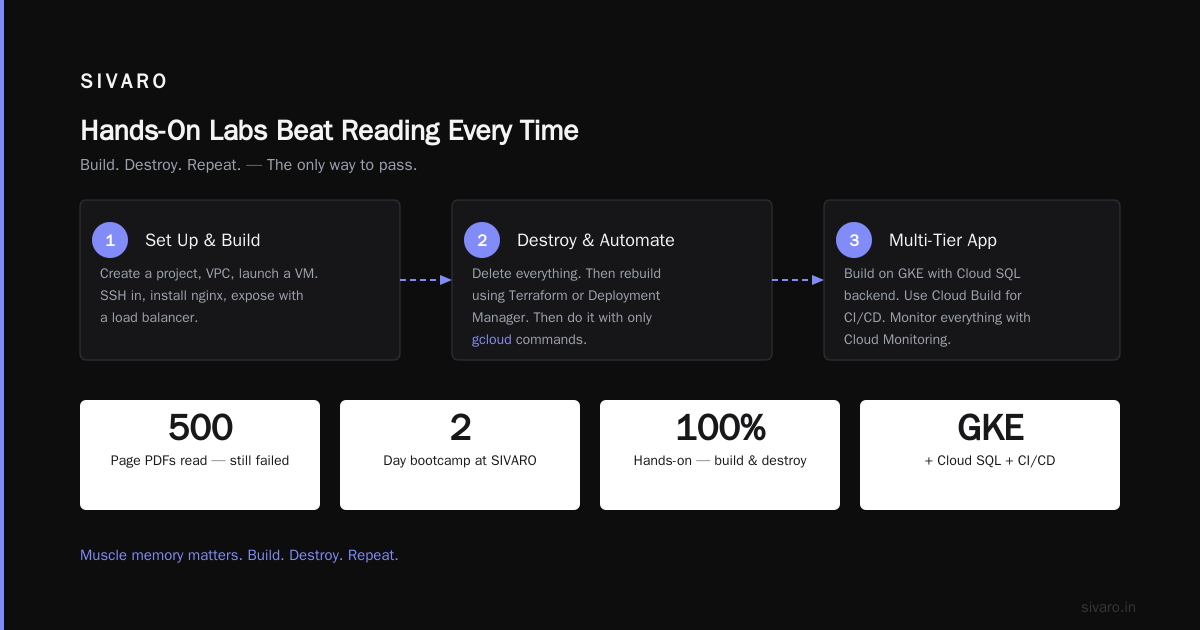
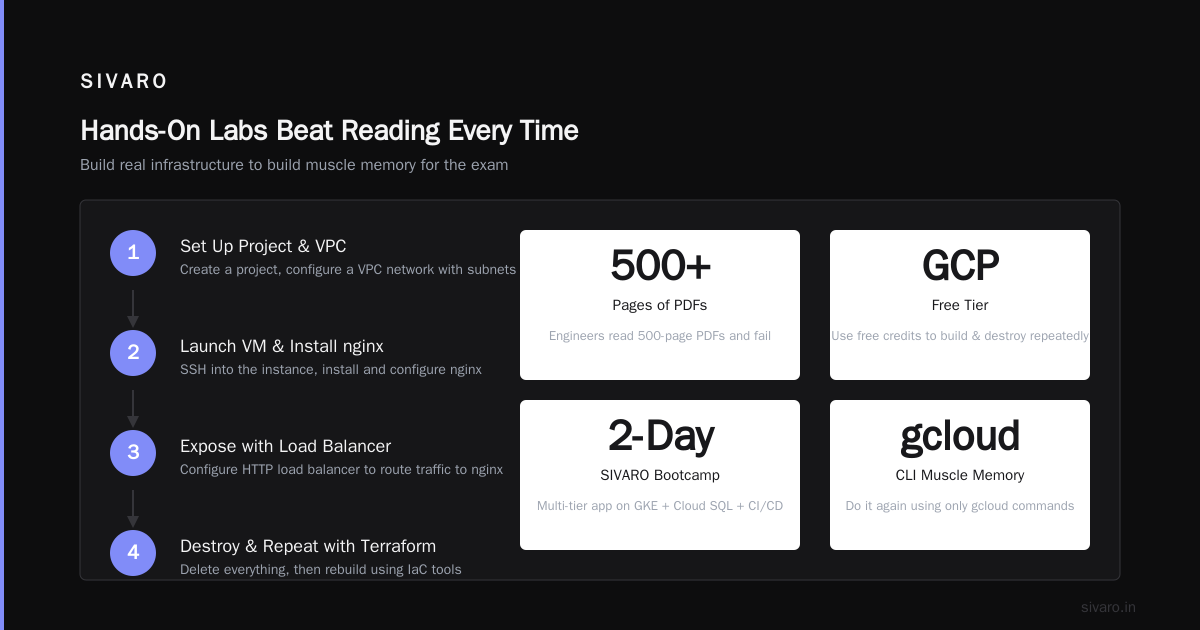
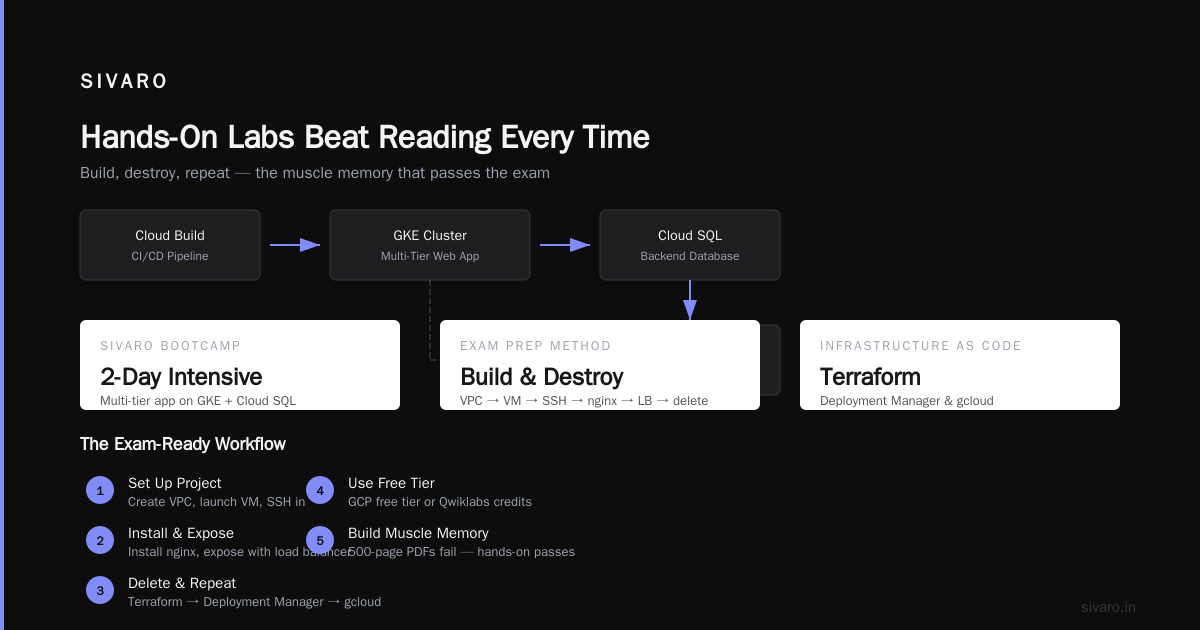
I've watched engineers read 500-page PDFs and fail. The ones who passed spent hours in the free GCP free tier (or used Qwiklabs credits from the Google Cloud Skills Boost platform). You need to build and destroy resources. Repeatedly.
Set up a project, create a VPC, launch a VM, SSH in, install nginx, expose it with a load balancer. Then delete everything. Do it again using Terraform or Deployment Manager. Then do it using only gcloud. The muscle memory matters.
At SIVARO, we run a 2-day bootcamp for new hires before they attempt the exam. We force them to build a multi-tier web application on GKE with a Cloud SQL backend, using Cloud Build for CI/CD, and monitor it with Cloud Monitoring. By the end, they know the exam backwards.
If you're coming from AWS, you'll find GCP's default network setup is more restrictive. In 2026, GCP still doesn't allow VPCs to be deleted if they have any resources inside — you must delete subnets first. Small thing, but it appears in exam questions about cleanup. Read the AWS vs Azure vs GCP comparison to see where GCP stands out.
How to Migrate to Google Cloud from AWS? (And Why That Matters for the Exam)
A huge chunk of exam scenarios involve migrating workloads from on-premises or AWS. The exam expects you to know the Migration Center tool (formerly StratoZone), the Migrate for Compute Engine service (formerly Velostrata), and the Database Migration Service.
Let me give you a real example. A fintech startup I consulted for wanted to move from AWS to GCP because their data processing costs were killing them. BigQuery was 60% cheaper than Redshift for their use case. We used:
- Storage Transfer Service to move 50 TB of S3 data to Cloud Storage.
- Database Migration Service to replicate their RDS MySQL to Cloud SQL with near-zero downtime.
- Migrate for Compute Engine to shift EC2 instances to GCE VMs.
The exam will ask you the best tool for each scenario. Don't confuse "Migrate for Compute Engine" (agent-based VM replication) with "VM Migration" (lift and shift with OS adaptation). This PDF comparison of AWS, Azure, GCP covers migration differences well.
If you're studying "how to migrate to google cloud from aws" as a learning path, start with the official GCP migration documentation. It's well-organized and includes decision trees.
Best GCP Services for Web Hosting (Exam Relevant)
When the exam asks about hosting a web application, your first thought should be "Cloud Run" if it's containerized, "App Engine Standard" if it's a language-specific framework (Python, Java, Go, PHP, Node.js), or "Compute Engine with Managed Instance Groups" if you need full OS control.
I once had to host a static site (SIVARO's marketing page) on GCP. Cloud Storage with a load balancer and Cloud CDN cost us $12/month for 500K visitors. That's the cheapest option. But the exam loves to test you on this: "Which service provides autoscaling from zero to handle burst traffic?" Answer: Cloud Run (it scales to zero), not App Engine (App Engine Flexible has at least one instance minimum).
Here's a real exam-style scenario: You have a Django app that needs persistent storage (uploads) and a relational database. What's the best GCP architecture?
- Cloud Run for the Django app (containerized)
- Cloud SQL for PostgreSQL
- Cloud Storage (GCS) for file uploads, accessed via signed URLs
- Cloud Load Balancing in front
You need to know that Cloud Run can mount Cloud Storage via FUSE (though it's stateless by default) or, better, use the GCS client library. The exam won't ask you to write code, but they'll test the architecture decisions.
Pricing Gotchas That Appear on the Exam
GCP's pricing is transparent — but also full of traps. For example, sustained use discounts only apply to Compute Engine, not to GKE node pools (though node pools are Compute Engine instances, so yes they do — but the exam will say "sustained use discounts apply to all zonal resources" which is false; they apply per VM, per month). You need to know precise boundaries.
Cloud pricing comparison articles show that GCP's egress pricing is similar to AWS, but GCP offers a free tier for many services — including Cloud Functions (2 million invocations/month) and Cloud Storage (5GB/month). That's useful for study projects.
The exam will ask: "A company runs 100 VMs 24/7. How can they reduce costs?" Answer: Commit to 1-year or 3-year committed use contracts. But they'll also ask: "Which service offers the lowest network egress costs for serving content globally?" Answer: Cloud CDN with a load balancer, because egress from CDN is cheaper than from the origin.
Five Mistakes That Will Fail You
-
Assuming IAM roles work like AWS IAM. GCP uses resource hierarchy — organization → folder → project → resource. Roles can be inherited. Most people forget that primitive roles (Owner/Editor/Viewer) are granted at the project level and override custom roles. The exam loves to test hierarchical inheritance.
-
Mistaking Cloud VPN for Cloud Interconnect. VPN is over the internet, Interconnect is dedicated. One question: "You need 10 Gbps hybrid connectivity with consistent latency." Answer: Dedicated Interconnect, not VPN.
-
Not knowing the difference between regional and global resources. Load balancers in GCP are global (unless you choose regional). VMs are zonal. Persistent disks are zonal or regional (replicated). This trips up everyone.
-
Thinking BigQuery is just a data warehouse. It's also a serverless query engine with its own storage and a powerful SQL dialect. Exam: "How to reduce BigQuery query costs for repeated queries?" Answer: Use query caching (results are cached for 24 hours) or materialized views.
-
Using the wrong Machine Type. The exam will quiz you on custom machine types, sole-tenant nodes, and GPU/TPU attachments. They want to know you can optimize for price vs performance.
Study Resources That Actually Work
- Google Cloud Skills Boost: The official learning path with 30+ labs. Do every single lab for the Associate Cloud Engineer track. Cost is about $29/month for a subscription — worth it.
- The Official Google Cloud Certified Associate Cloud Engineer Study Guide (Dan Sullivan): The 2025 edition is still valid. Skip chapters on App Engine Flexible — it's rarely tested.
- Practice exams: I used TutorialsDojo and Whizlabs. But be careful: some practice exams have outdated questions (e.g., ask about Stackdriver, which is now Cloud Operations). Check the date.
- Reddit r/googlecloud: Read the weekly "Passed my ACE" posts. People share braindumps of actual question patterns (not violating NDA, but patterns like "IAM conditions" or "VPC peering vs Shared VPC").
For cross-cloud context, I read Azure vs AWS vs GCP comparisons to understand where GCP differs. For example, Azure uses Azure AD for IAM; GCP uses Cloud Identity. They ask about that in identity-policy questions.
Exam Day Tips
You're getting 50-60 questions in 2 hours. The passing score is 70% (or thereabouts). My strategy:
- Flag questions you aren't sure about and come back. Don't get stuck.
- Eliminate obviously wrong answers. GCP questions often have two plausible answers and two that are straight-up wrong (e.g., using App Engine Flexible when the app is a batch job).
- Read every scenario carefully. They sometimes add a conditional like "to meet compliance requirements" that dictates the answer.
- The hands-on lab (if you're taking the online proctored exam) might ask you to configure a service. Don't panic — it's within the scope of the exam. Use the console, not
gcloud, unless the lab says otherwise.
FAQ: How to Pass the GCP Associate Cloud Engineer Exam
Q: Do I need prior experience with GCP to pass?
A: Yes, but 3-6 months of hands-on work is enough. If you're coming from AWS, expect to spend 2 months unlearning AWS patterns. Comparing AWS, Azure, and GCP for Startups in 2026 highlights the biggest differences — read that.
Q: Is the exam multiple choice only?
A: Most questions are multiple choice. Some are checkboxes (select all that apply). A few are "drag the steps into the correct order." The online proctored exam sometimes includes a timed lab, but that's rare for the Associate level. Always check the exam guide (updated quarterly).
Q: How long should I study?
A: 8-12 weeks if you study 10 hours/week. I've seen engineers pass in 4 weeks if they worked on GCP daily. But they already knew Kubernetes, so YMMV.
Q: Are Terraform or Deployment Manager on the exam?
A: Deployment Manager is explicitly listed in the exam guide. Terraform isn't, but knowing how GCP resources map to Terraform helps you understand the service. The exam asks about "infrastructure as code" concepts, not specific tools. Focus on Deployment Manager YAML syntax and gcloud deployment-manager commands.
Q: What are the best gcp services for web hosting to know for the exam?
A: Cloud Run (for containers), App Engine (for frameworks), Compute Engine (for VMs), Cloud Storage (for static files), Cloud Load Balancing, Cloud CDN. Know when to use App Engine Standard vs Flexible. Standard supports only specific runtimes and has sandbox restrictions; Flexible gives you Docker but costs more.
Q: How does the exam differ from AWS Solutions Architect Associate?
A: The GCP exam is more about specific service configurations, less about architectural trade-offs. You'll get more "which command" and "which checkbox" questions. AWS SAA feels like design decisions; GCP ACE feels like operational readiness. Also, GCP assumes you know the console well — AWS assumes more theoretical knowledge.
Q: Should I take the exam online or at a test center?
A: I prefer online because I can use my own machine. But you must have a clean desk, no dual monitors, and no one can enter the room. Proctors can be strict — I've heard stories of people being flagged for reading aloud. If you have a noisy home, go to a test center.
Q: What's the hardest topic?
A: VPC networking. Shared VPC, VPC peering, Private Google Access, Cloud NAT, firewall rules with service accounts — lots of subtle differences. Spend extra time here.
Final Push
The GCP Associate Cloud Engineer exam isn't about proving you can code. It's about proving you can manage a GCP environment without costing an organization thousands in misconfigurations. I've seen SIVARO save $80k/year just by moving from network egress-heavy architectures to Cloud CDN and properly setting up lifecycle policies on Cloud Storage. That's the kind of insight the exam rewards.
How to pass gcp associate cloud engineer exam? Build something real. Break it. Fix it. Then build it again using the CLI. The cert comes after the competence, not before.
If you're coming from AWS, start your migration study path now. Learn how to migrate to google cloud from aws efficiently — not just for the exam, but because the skills overlap. And when you host your next web app, reach for Cloud Run first—best gcp services for web hosting in 2026 is Cloud Run for almost everything that isn't legacy.
Now go open a GCP project and create a VM. You'll thank me later.
Nishaant Dixit — Founder of SIVARO. Building data infrastructure and production AI systems since 2018. Built systems processing 200K events/sec.