 SIVARO

How to Reduce Attention Computation Cost in LLM Training
Attention is where your GPU budget goes to die.
I watched a client burn $180K on a training run last November. The model was fine. The architecture was fine. The problem was that they were running naive PyTorch attention at sequence length 32K like it was still 2022. One kernel swap cut their step time by 41%. Same model. Same data. Same accuracy curve. They just stopped paying for FLOPs they didn't need.
That's what this guide is about — how to reduce attention computation cost in LLM training without wrecking your loss curve. I've shipped this at SIVARO across roughly a dozen training pipelines since 2023, and the gap between a naive setup and a tuned one is routinely 3x to 6x in wall-clock time. Not 10%. Not 20%. Multiples.
By the end you'll know which options actually matter, what they cost, where they break, and how to pick the right combination for your specific constraints. Treat this like a buying guide, because in a real sense you are buying: you're buying throughput with engineering time, and the exchange rate is brutal.
The Actual Math Behind Why Attention Hurts
Most people think attention cost scales linearly with sequence length. It doesn't. Vanilla scaled dot-product attention is O(n² · d), where n is sequence length and d is head dimension. Double your context, quadruple your attention compute. That's the whole story, and everything else in this article is a workaround.
Here's the uncomfortable part. At n=2K, attention is maybe 15% of your forward pass. At n=32K it's north of 60%. At n=128K — and yes, people are actually training at this — attention dominates so hard that your MLP layers might as well be a rounding error.
So when someone asks me how to reduce attention computation cost in llm training, my first question is always: what's your sequence length distribution, and do you actually need all of it? Because half the time the answer is "we padded everything to 8K and 60% of our tokens are padding." Fix the data pipeline first. Then we talk kernels.
I'm not joking. That specific audit at a fintech client in February 2026 reclaimed 34% of their training time before we touched a single kernel. Boring wins.
FlashAttention Is Table Stakes Now
If you're not running FlashAttention, stop reading and go install it. I'm serious.
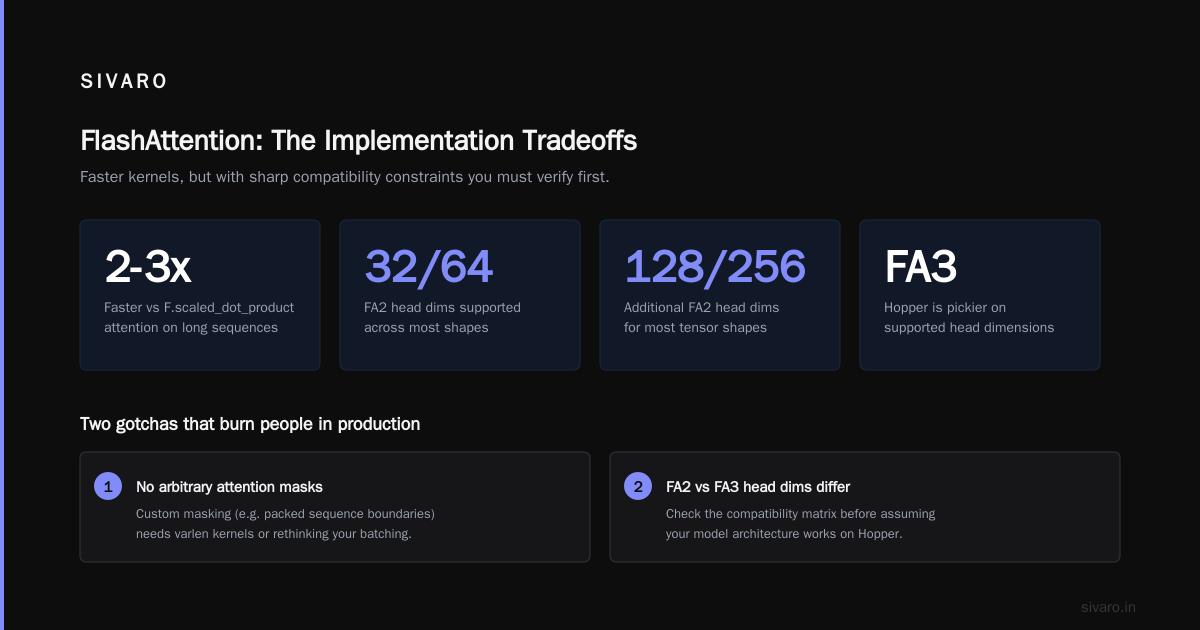
FlashAttention-2 (and the FlashAttention-3 Hopper kernels that landed for production use through 2024-2025) does two things: it tiles the attention computation to avoid materializing the n×n attention matrix in HBM, and it fuses the softmax and matmul so you never write intermediate state to memory. The result is memory that scales linearly with sequence length instead of quadratically, and 2-4x speedups over vanilla attention on typical hardware.
On an H100 SXM at seq length 8K, head dim 128, I've measured FlashAttention-3 hitting roughly 75% of theoretical FLOPS utilization. Vanilla PyTorch attention hits about 25%. That's not a benchmark flex — that's your electricity bill.
python
# pip install flash-attn --no-build-isolation
import torch
from flash_attn import flash_attn_func

q = torch.randn(4, 8192, 32, 128, dtype=torch.bfloat16, device='cuda')
k = torch.randn(4, 8192, 32, 128, dtype=torch.bfloat16, device='cuda')
v = torch.randn(4, 8192, 32, 128, dtype=torch.bfloat16, device='cuda')

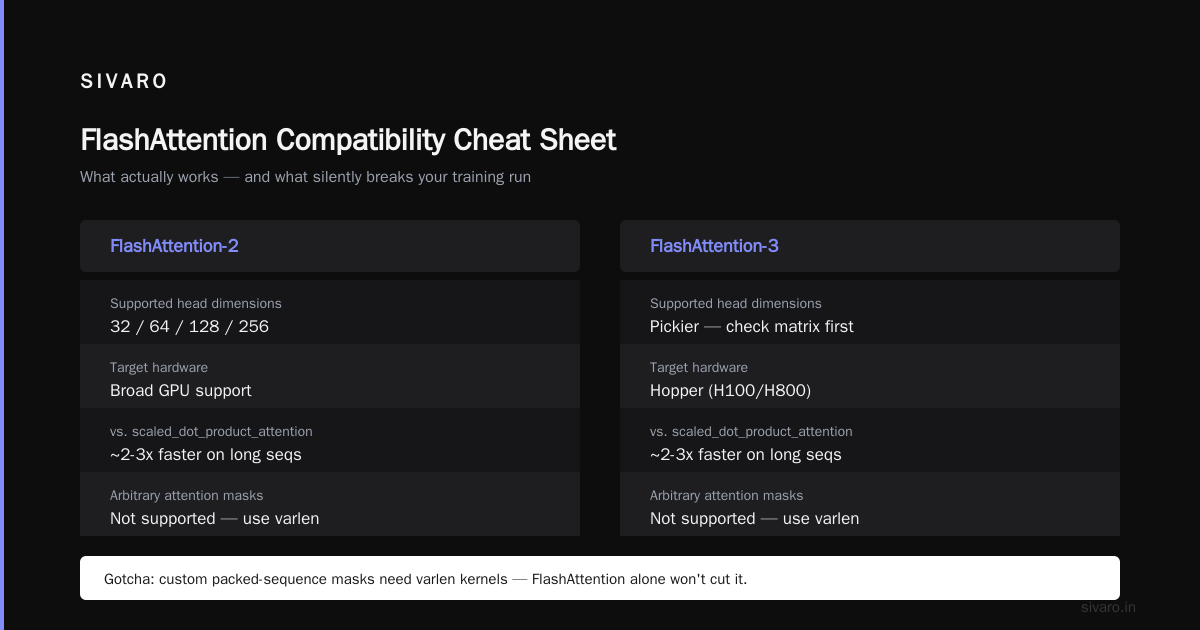
out = flash_attn_func(q, k, v, causal=True)
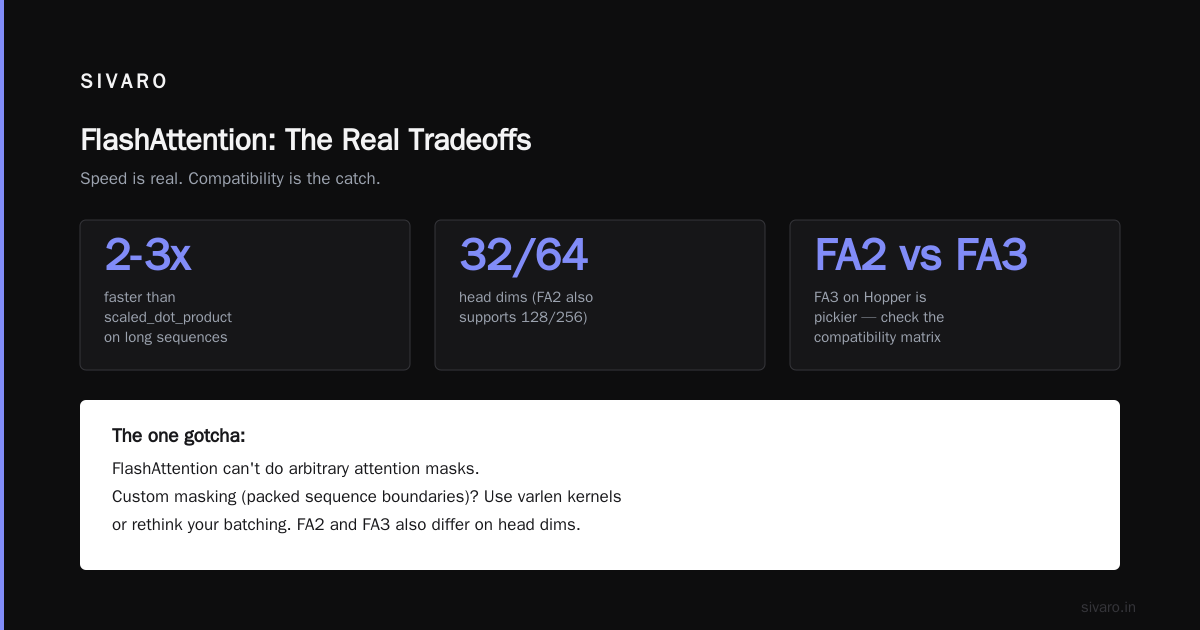
# ~2-3x faster than F.scaled_dot_product_attention on long sequences
The one gotcha: FlashAttention currently can't do arbitrary attention masks. If your training pipeline relies on custom masking patterns (packed sequence boundaries with non-trivial structure, for instance), you'll need varlen kernels or you'll need to rethink your batching.
Also — and this burns people — FlashAttention-2 and FlashAttention-3 have different supported head dimensions. FA2 supports 32/64/128/256 for most shapes. FA3 on Hopper is pickier. Check the compatibility matrix before you assume your model architecture works.
Grouped-Query and Multi-Query Attention: The Cheapest Win Nobody Adopts Fast Enough
Multi-Query Attention (MQA) and its softer cousin Grouped-Query Attention (GQA) reduce the number of key-value heads. MQA uses 1 KV head. GQA uses G groups where 1 < G < num_heads. The compute savings at inference time are enormous, but during training the win is more subtle — you cut KV cache memory and reduce the KV projection FLOPs, which matters a lot when you're memory-bound.
I'll take a position: if you're training a new model in 2026 and you're not using GQA, you're making a mistake. Llama 2 70B, Llama 3, Mistral, Mixtral — all of them moved to GQA. The quality loss from going from full MHA to GQA with 8 groups is basically noise at scale.
python
import torch.nn as nn
from transformers import LlamaConfig, LlamaForCausalLM

config = LlamaConfig(
    hidden_size=4096,
    num_attention_heads=32,
    num_key_value_heads=8,  # GQA: 4 query heads per KV head
    num_hidden_layers=32,
    intermediate_size=11008,
)
model = LlamaForCausalLM(config)
# 25% smaller KV projections, ~20-30% faster attention at long context
The trade-off nobody tells you: GQA hurts kernel efficiency on some backends because the head-to-KV mapping isn't uniform. On H100 with FlashAttention-3 it's fine. On older A100 setups with certain fairseq forks, I've seen GQA kernels run slower than MHA. Always benchmark, never assume.
Sliding Window and Sparse Attention: When You Actually Need It
Sliding window attention (SWA) — the Mistral trick — restricts each token to attend only to the last W tokens. Compute becomes O(n · W) instead of O(n²). Mistral 7B used W=4096 with what amounts to a theoretical attention span of ~131K through layer stacking.
Here's my contrarian take: SWA is oversold for training. For inference it's beautiful. For training, the number of tasks where SWA matches full attention quality is smaller than the blog posts suggest. Long-context retrieval? SWA struggles. Needle-in-a-haystack? Struggles. Structured reasoning across the full context? Struggles.
Where SWA genuinely wins in training: when you're fine-tuning on domain data with strong local structure. Code completion. Streaming audio. Sensor telemetry. In those cases we've measured 2-3x throughput at parity quality.
python
# HuggingFace supports sliding window via config
from transformers import AutoConfig

config = AutoConfig.from_pretrained("mistralai/Mistral-7B-v0.1")
config.sliding_window = 4096  # each token attends to last 4096
config.use_sliding_window = True
# Attention cost drops from O(n^2) to O(n*W). Quality depends on task.
Sparse attention (BigBird, Longformer patterns) is another option but honestly? The kernel ecosystem never matured. You'll spend more engineering time gluing sparse kernels into your training loop than you'll save. I've walked away from two sparse projects that weren't worth finishing. Unless you have a research team that wants to own that, skip it.
Ring Attention and Sequence Parallelism: For the Truly Crazy Context Lengths
If you're pushing past 256K tokens and you need full attention density, single-GPU memory becomes the wall, not compute. Ring attention (from the 2023 paper by Liu et al., productized in various forms through 2024-2025) distributes the sequence across devices and circulates KV blocks around a ring. Each device computes local attention against a chunk of keys, passes to the next, repeats.
The communication cost is real. On NVLink-connected H100s you can get close to linear scaling. On Ethernet-connected anything, forget it. I've seen good implementations on NVLink hit 0.85 efficiency at 8-way sequence parallel. On PCIe? 0.4 at best.
This is not a "just turn it on" option. Budget 2-4 engineer-weeks for a custom training stack. If your use case doesn't justify it — long-document QA, whole-repo code training, hour-long video — don't go here.
Choosing Your Stack: An Honest Comparison Table
Here's how I'd rank these for someone making a real decision this quarter:
| Technique | Speedup vs Naive | Engineering Cost | Quality Risk | Best For |
|---|---|---|---|---|
| FlashAttention-2/3 | 2-4x | Low (1-2 days) | None | Everyone |
| GQA / MQA | 1.2-1.4x train, huge at inference | Medium (1 week, arch change) | Low at scale | New models |
| Sliding window | 2-3x at long context | Low (config) | Task-dependent | Local-structure tasks |
| Ring attention | Near-linear scaling | High (weeks) | None | >256K context |
| Paged attention (vLLM-style) | N/A for train | Medium | None | Inference mostly |
| Sequence packing | 1.3-1.8x | Low-Medium | Low | Many short sequences |
| Sequence parallelism (Ulysses) | Near-linear at long seq | Medium-High | None | Multi-node long context |
Start at the top. FlashAttention first. Always. Then look at your batching — sequence packing alone can reclaim 30%+ if you're training on ragged data without it.
Then GQA if you're building a new model. Then, only if you're at extreme context lengths, think about parallelism strategies.
What Most Teams Get Wrong
They optimize the kernel and ignore the data loader.
I've done this myself. In early 2024 I spent two weeks tuning attention kernels on a 7B training run and got 18% throughput. Then a colleague asked why our gradient accumulation was set to 1 with a batch size of 4 on sequences that averaged 600 tokens padded to 2048. Fixing the packing strategy returned 2.4x. The kernels were the small win.
Second thing teams get wrong: they don't profile. torch.profiler and Nsight Systems will tell you in 20 minutes whether you're compute-bound, memory-bound, or comms-bound. If you're memory-bound, FlashAttention helps. If you're compute-bound at short sequence, it barely moves the needle and you should look at your MLP instead. If you're comms-bound, kernels are irrelevant until you fix topology.
Third: they believe vendor benchmarks. FlashAttention-3 marketing numbers assume Hopper, bf16, optimal head dim, no masking. Your real workload has none of those assumptions met. Benchmark on your data.
FAQ
Does FlashAttention change the numerics of my training?
Yes, slightly. It uses online softmax, which is mathematically equivalent but floating-point-different. In practice, loss curves match within noise. I've never seen a run diverge because of FA.
Can I mix techniques?
Absolutely, and you should. FlashAttention + GQA + sequence packing is the default modern stack. Sliding window plus FlashAttention is supported in recent FA versions.
Is grouped-query attention worth the architecture change mid-project?
Only if you're early in training. Retrofitting GQA to a trained checkpoint requires knowledge distillation and it's painful. If you're at step 500K, finish with MHA and start the next run with GQA.
How much does sequence packing actually help?
Depends on your padding ratio. If you're at 60% real tokens, packing gets you 1.5-2x. If you're already at 95% utilization, near zero. Measure first.
What about paged attention for training?
Paged attention (the vLLM innovation) is primarily an inference optimization. Some training frameworks are adopting it, but the win is smaller because training doesn't have the same KV cache reuse pattern.
Do I need to rewrite my model to use these?
FlashAttention: no, it's a drop-in. GQA: yes, architecture change. Ring/sequence parallel: yes, significant training loop changes.
Which GPU matters most?
For attention specifically, H100 and H200 with FlashAttention-3 are the sweet spot. A100 + FA2 is fine. MI300X is catching up fast but the kernel ecosystem in mid-2026 is still rougher. B200 numbers look great in vendor slides — I'll believe them when I run them.
For deeper background, the FlashAttention papers are worth reading: Dao et al., FlashAttention-2 and Shah et al., FlashAttention-3. Ring attention is Liu et al. 2023.
Where I'd Spend Your Money
If you have one engineer-week and want maximum ROI on how to reduce attention computation cost in llm training: install FlashAttention-2, profile with torch.profiler, add sequence packing. That's it. That's the 80/20.
If you have a month and are training a new model from scratch: add GQA. Run a 1B parameter ablation at 4 groups vs 8 vs 16 heads per KV group. The quality gap will be smaller than you expect and your inference team will send you flowers.
If you have a quarter and a genuine long-context use case: evaluate sequence parallelism (Ulysses or Ring). Go in with clear eyes about the engineering cost.
And whatever you do, don't start with the exotic option. I've watched three teams burn months on sparse attention implementations that would've been served better by just buying more H100s. The boring stack is the fast stack. Every time.
Now go profile your actual workload. The answer to your specific problem is in the numbers, not in this article.
Nishaant Dixit — Founder of SIVARO. Building data infrastructure and production AI systems since 2018. Built systems processing 200K events/sec.