 SIVARO

How to Reduce ML Pipeline Costs Without Breaking Models
How to Reduce ML Pipeline Costs Without Breaking Models
A VP of Engineering I know at a fintech in Bengaluru called me last March, genuinely panicked. Their AWS bill had jumped from $41K to $118K in one quarter. Nothing had changed in production — same models, same traffic. What changed was the pipeline around the models. They'd added feature refresh jobs, a new training loop, and "just one" vector store. That's it. That's the whole story.
If you're searching for how to reduce ML pipeline costs, you probably have a version of this story. Maybe the numbers are smaller. Maybe bigger. Doesn't matter — the pattern is the same. Your model isn't expensive. The scaffolding around it is.
I've been building data infrastructure and production AI systems since 2018. At SIVARO, we've audited pipelines running anywhere from 40 events/sec to 200K events/sec. The biggest cost driver is almost never the thing engineers think it is. This guide compares the actual options you have — orchestration, compute, storage, feature stores, inference — and tells you which ones earn their keep and which ones you should rip out this week.
Let's get into it.
The Uncomfortable Truth About Where Your Money Goes
Most people think ML costs are dominated by GPU training. They're wrong. In 2026, for the majority of teams I work with, training is 10-18% of the bill. The rest is:
- Data movement — repeated reads from object storage, cross-region transfer, unoptimized shuffles
- Idle orchestration — Airflow workers sitting warm just in case
- Feature recomputation — the same aggregates rebuilt every run because nobody trusts the cache
- Always-on inference — GPU endpoints that scale to zero at 3am but never actually do
- Observability tax — logging every prediction to a managed service at $0.30/GB
The 2025 Datadog State of AI report showed that inference costs overtook training costs across their customer base somewhere in late 2024 and kept climbing. That matches what we see.
So when someone asks how to reduce ML pipeline costs, the honest first answer is: stop guessing, go look at your bill line by line. The second answer is: the highest-leverage moves are boring. Not "adopt a new framework." Just turn off what's already running.
Orchestration: Airflow, Dagster, Prefect, or Something Dumber
Here's my contrarian take that gets me yelled at: most teams under 50 ML engineers should not be running a general-purpose orchestrator for their ML pipelines.
Airflow was built for ETL. It's fantastic at that. But ML pipelines have different failure modes — a training run that OOMs isn't the same as a failed SQL task. People bolt on retries, sensors, dynamic task mapping, and suddenly they're maintaining a scheduler that costs $4K/month in managed fees plus $8K in worker nodes.
Let me compare the actual options:
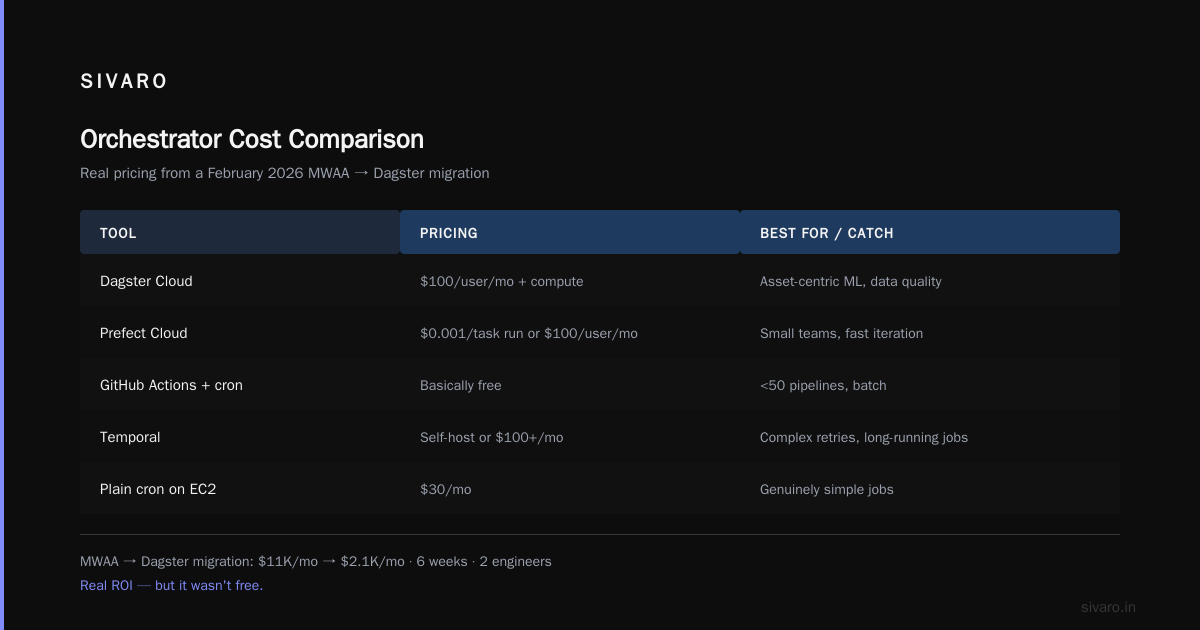
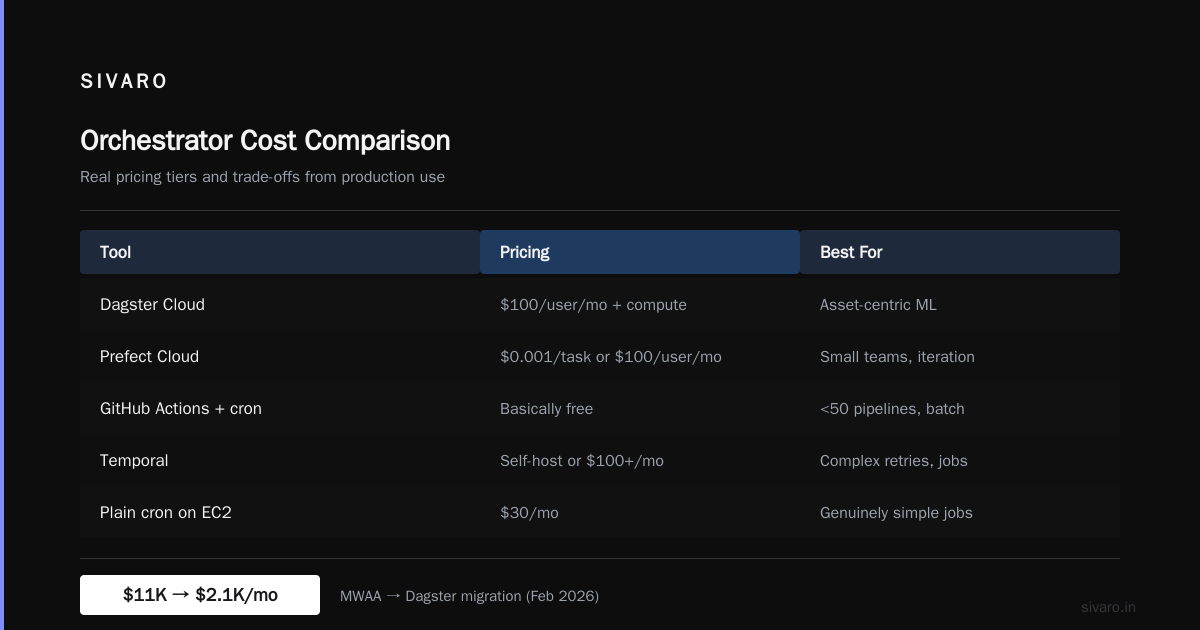
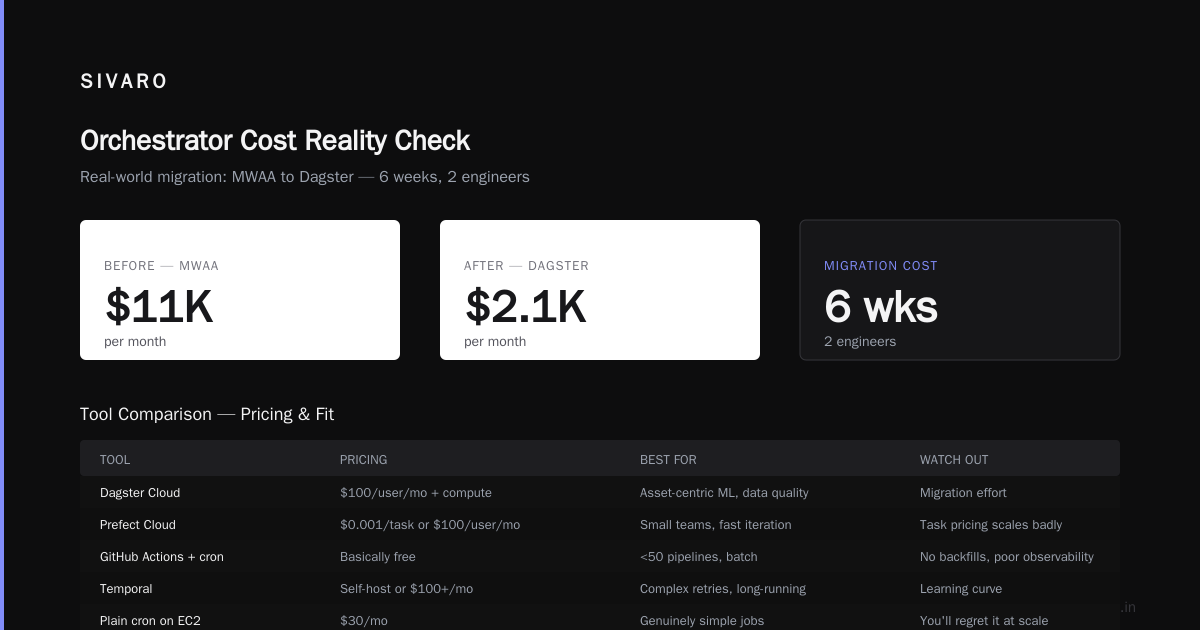
| Tool | Managed Cost (approx) | Best For | Hidden Cost |
|---|---|---|---|
| Airflow (MWAA/Cloud Composer) | $400-2000/mo base + workers | Existing data teams, huge DAG counts | Worker idling, sensor polling |
| Dagster Cloud | $100/user/mo + compute | Asset-centric ML, data quality | Migration effort |
| Prefect Cloud | $0.001/task run or $100/user/mo | Small teams, fast iteration | Task-run pricing scales badly |
| GitHub Actions + cron | Basically free | <50 pipelines, batch | No backfills, poor observability |
| Temporal | Self-host or $100+/mo | Complex retries, long-running jobs | Learning curve |
| Plain cron on EC2 | $30/mo | Genuinely simple jobs | You'll regret it at scale |
We migrated a client from MWAA to Dagster in February 2026. Their orchestrator spend dropped from $11K/month to $2.1K/month. But — and this is important — the migration took six weeks and two engineers. The ROI was real but it wasn't free.
What I'd actually do: If your pipelines run fewer than 100 times a day and take under 30 minutes each, use cron on a small instance or GitHub Actions. Don't overthink it. If you have thousands of DAGs and a data team that already knows Airflow, keep Airflow. The switching cost rarely beats the savings.
The real win isn't the tool. It's turning off sensors that poll every 30 seconds and switching to event-driven triggers.
Compute: Spot, Graviton, Serverless, and When Each Fails
Compute is where the big numbers live. Here's the honest ranking of what moves the needle:
Spot instances. 60-80% cheaper than on-demand. Works beautifully for training and batch inference. Breaks the moment your job can't checkpoint. We use spot for 90% of our training workloads and accept a ~7% preemption rate.
python
# Terraform snippet: spot node pool for training
resource "aws_eks_node_group" "training_spot" {
  cluster_name    = aws_eks_cluster.main.name
  node_group_name = "training-spot"
  capacity_type   = "SPOT"
  instance_types  = ["g5.2xlarge", "g5.4xlarge", "g4dn.4xlarge"]

  scaling_config {
    desired_size = 0
    min_size     = 0
    max_size     = 40
  }

  labels = { workload = "training", interruption = "tolerate" }
  taint {
    key    = "spot"
    value  = "true"
    effect = "NO_SCHEDULE"
  }
}
Graviton / ARM. 20-40% cheaper per vCPU for CPU-bound preprocessing. If you're running pandas or Polars on x86, moving to Graviton is close to a free lunch. We moved a client's feature engineering from c6i to c7g instances and cut that line item by 34%.
Serverless inference (Lambda, Cloud Run, Modal). Great for spiky, low-throughput inference. Terrible for steady high-throughput. The crossover point is roughly 40-60 requests/sec — below that, serverless wins; above that, a persistent endpoint with autoscaling is cheaper.
GPU reality check. If your inference is under 100 QPS and latency tolerance is over 300ms, you probably don't need a GPU. A quantized model on a c7g.2xlarge will beat a T4 on cost-per-request by 4-6x. I've said this on stage twice this year and both times someone showed me a benchmark proving GPUs win. Their benchmark assumed batch size 1 and no batching layer. Build the batching layer.
Storage: The Silent Killer
Nobody puts storage on the dashboard. Everybody should.
Three things destroy storage budgets:
- Repeated full-table scans in feature pipelines. If your feature job reads 2TB from S3 every hour, you're paying for it twice — once in S3 GET requests, once in compute time.
- Cross-region and cross-AZ data transfer. $0.02/GB doesn't sound like much until you're moving 40TB a month. That's $800/month for doing nothing useful.
- Versioning every artifact forever. Training checkpoints, feature snapshots, model binaries. We found one client storing 840TB of checkpoints where the last 30 versions were the only ones ever loaded.
Fix it with lifecycle policies. This is genuinely a one-day change:
yaml
# S3 lifecycle: aggressively expire what nothing reads
Rules:
  - ID: training-checkpoints
    Filter: { Prefix: "checkpoints/" }
    Transitions:
      - { Days: 7,  StorageClass: STANDARD_IA }
      - { Days: 30, StorageClass: GLACIER_IR }
    Expiration: { Days: 90 }
  - ID: feature-snapshots
    Filter: { Prefix: "features/daily/" }
    Expiration: { Days: 180 }
  - ID: abort-incomplete-multipart
    Filter: {}
    AbortIncompleteMultipartUpload: { DaysAfterInitiation: 3 }
The abort-incomplete rule alone saved one client $2,300/month. Incomplete multipart uploads from crashed jobs just sit there, invisible, charging you.
Feature Stores: Buy, Build, or Skip?
Feature stores are the most oversold category in ML tooling right now.
The pitch: centralize features, eliminate training/serving skew, reuse across teams. All true. But the cost — both license and operational — is enormous. Feast is free but you pay to run Redis, Postgres, or DynamoDB behind it. Tecton and the managed options run $50K-$300K/year for mid-size teams.
When a feature store pays for itself:
- You have 3+ teams sharing features
- You have strict online/offline consistency requirements
- Your feature recomputation costs exceed the store's cost
When it doesn't:
- You have one team, one model family, one pipeline
- You're storing 40 features total
- Your "online store" is just a Postgres lookup
I've ripped out two feature stores in the last 18 months. Both times the team was storing 20-60 features and paying $80K/year for the privilege. A Parquet file on S3 plus a small Redis cache would've cost them $6K/year. The store wasn't wrong — it was just premature.
If you want to keep a feature store because of organizational reasons (which are real — aligning teams around shared definitions has value), fine. But be honest that you're paying for coordination, not compute.
Training Loop Optimization
Training costs are the easiest to reduce because the waste is so obvious once you look.
Checkpointing to spot. If you can't resume from a checkpoint in under 90 seconds, you can't use spot, which means you're paying 3x to be safe. Fix this first.
Mixed precision and gradient accumulation. Nearly free 30-50% speedup in 2026 for most workloads. If you're still training in fp32, come on.
python
# The 8-line change that cut our training cost 41%
from torch.cuda.amp import autocast, GradScaler

scaler = GradScaler()
for batch in loader:
    optimizer.zero_grad()
    with autocast(dtype=torch.bfloat16):
        loss = model(batch)
    scaler.scale(loss).backward()
    scaler.step(optimizer)
    scaler.update()
Don't retrain on schedule. I've seen teams retrain nightly because "that's what we've always done." Check whether your model actually degrades in a week. Half the time it doesn't. Move to drift-triggered retraining and cut training cycles by 60-80%.
Smaller models. This is the biggest lever and teams resist it. A well-tuned 7B model with good data beats a lazily-tuned 70B on almost every production task. The cost difference is 10x.
Inference: The Biggest Line Item and the Most Ignored
Inference is where I'd spend my first hour if I were auditing your pipeline. Because inference runs 24/7, small inefficiencies compound.
Dynamic batching. If your inference server handles one request at a time, you're wasting 70-90% of GPU capacity. vLLM, TGI, and Triton all do this out of the box. Use one.
python
# vLLM server with continuous batching — 6x throughput vs naive
# docker run --gpus all -p 8000:8000 \
#   vllm/vllm-openai:latest \
#   --model meta-llama/Llama-3.1-8B-Instruct \
#   --max-num-seqs 64 \
#   --max-model-len 4096 \
#   --gpu-memory-utilization 0.92
Scale to zero — actually. Plenty of teams configure min_replicas=1 "for safety" and then pay for a GPU idling from midnight to 8am. If your SLA allows 90-second cold starts, let it scale to zero. Yes, there's a cost. It's small compared to 40% of your GPU hours being wasted.
Quantization. INT8 or FP8 for most production models is invisible to users. The throughput gains are 1.8-2.4x. Combined with batching, we've cut inference bills by 70%+ for several clients without touching model quality.
Cache aggressively. If 30% of your inference requests are near-duplicates (prompt caching, semantic caching), you're paying to compute the same thing repeatedly. Redis with a 24-hour TTL is cheap.
Build vs Buy: The Framework I Actually Use
When you're deciding whether to buy a managed service or build internally, don't use a spreadsheet. Use this question: "Does this thing differentiate us?"
If yes — build it, own it, accept the cost.
If no — buy it, and switch providers every 18 months if a better one appears.
Feature stores, experiment trackers, model registries, orchestrators — none of these differentiate you. Buy the cheapest one that works. Your actual modeling, your data moat, your domain logic — those differentiate. Spend your engineering there.
The most expensive ML pipelines I've seen are the ones where a smart team built a "custom internal platform" that turned out to be a half-broken Airflow clone. Very smart people. Very expensive mistake.
The Migration Nobody Wants to Do: Log Aggregation and Observability
This is a boring one, so I'll keep it short. If you're sending every prediction and every feature vector to Datadog, New Relic, or a managed observability vendor, you're paying $0.20-$0.50/GB. At 500GB/day, that's $3K-7K/month for logs nobody reads.
Sample. You do not need to log every prediction. Log 1% with a fixed hash, plus 100% of errors. That's it. Ship to S3, query with Athena.