 SIVARO
Ilya 30 Essential ML Papers: The Beginner's Roadmap I Wish I Had
I spent six months reading papers wrong.
Fresh out of college, I'd print them, highlight them, take pages of notes. Then I'd finish and realize I couldn't explain what I'd just read to anyone. Worse — I couldn't apply it. I was collecting knowledge, not building understanding.
Here's what nobody tells you about the "Ilya 30 essential ML papers beginner" list: it isn't about reading 30 papers. It's about reading the right 30 papers in the right order so each one builds on the last.
By the time you're done, you won't just know about transformers, attention, and scaling laws. You'll understand why things like GPT-5.6 Sol Terra Luna launch matter, what the GPT-5.5 Core Features: 400K Context in Codex, 1M API Context actually mean for production systems, and why Reasoning models are a different beast entirely.
This isn't a reading list. It's a curriculum. Built from what I've actually used building production AI systems since 2018.
Why 30 Papers? Why Ilya's List?
Most people think you need to read 100+ papers to understand modern ML. They're wrong because quality beats quantity when you sequence them right.
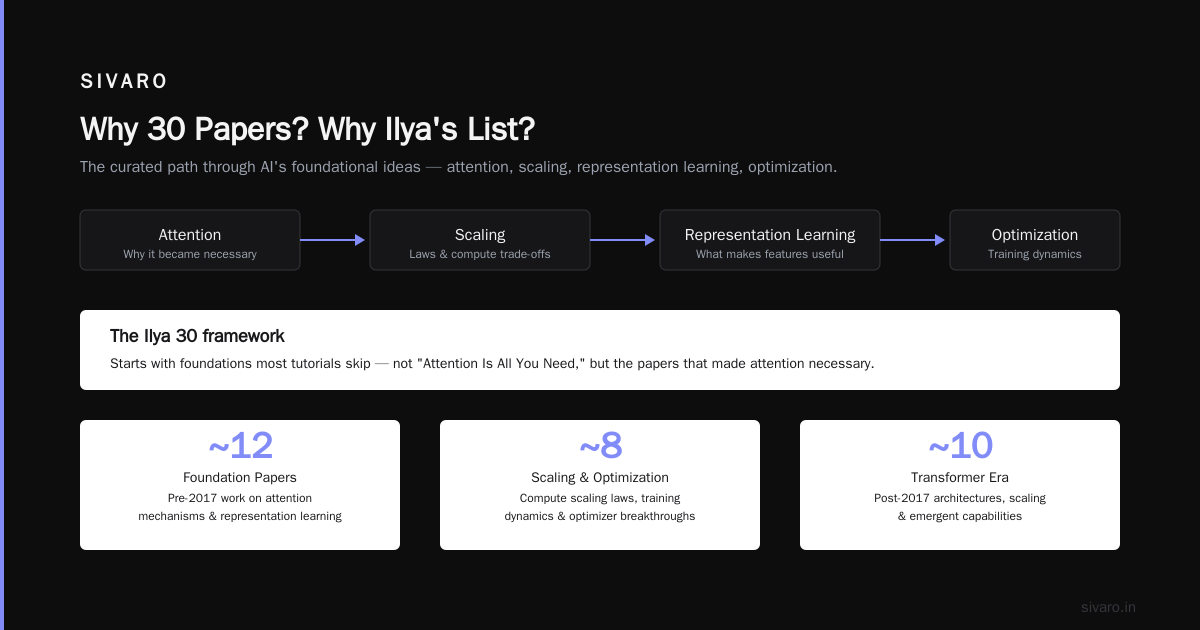
Ilya Sutskever's list — the one that keeps getting passed around — isn't a random collection. It's a carefully chosen path through the core ideas that make today's AI work. Attention. Scaling. Representation learning. Optimization.
The "Ilya 30 essential ML papers beginner" framework works because it starts with foundations most tutorials skip. You don't start with "Attention Is All You Need." You start with the papers that made attention necessary in the first place.
Let me show you exactly what matters and what doesn't.
The Three Pillars of Modern ML (Skip This, Fail Later)
Before you touch a single paper, you need a mental model. Everything in deep learning today rests on three ideas:
1. Representations matter more than architecture.
You can have the best transformer in the world. If your representations are garbage, your output is garbage. Word2Vec, GloVe, BERT — these aren't just models. They're proof that how you represent input determines what the model can learn.
2. Scale changes behavior non-linearly.
Here's a fact that still surprises people: nobody predicted emergent abilities. They didn't show up in small models. They appeared at scale. The Scientific Research and Codex: GPT-5.5 Reaches the Limits piece makes this explicit — we're hitting walls that 10x more compute doesn't fix the same way it used to.
3. Training dynamics aren't optional knowledge.
You don't need to derive backpropagation by hand. But you need to know why learning rate schedules matter, what gradient clipping does, and why batch size affects generalization. I've seen teams waste weeks because nobody understood why their loss wasn't converging.
The Papers — Grouped by What They Actually Teach You
I'm not listing all 30. That's what Google is for. I'm telling you the groups and the must-read from each.
Group 1: The Representation Revolution (Papers 1-5)
Must-read: "Efficient Estimation of Word Representations in Vector Space" (Mikolov et al., 2013)
This is Word2Vec. It's simple. It's elegant. And it's the paper that made me realize most of ML is about representation engineering, not algorithm design.
You'll see the same pattern repeated in every major breakthrough since: find a way to make representations capture something useful, then scale it.
Skip: "GloVe" if you're short on time. The core idea is the same, Word2Vec explains it better.
Group 2: The Attention Explosion (Papers 6-12)
Must-read: "Neural Machine Translation by Jointly Learning to Align and Translate" (Bahdanau et al., 2014)
Most people skip this and jump straight to "Attention Is All You Need." Big mistake.
Bahdanau's paper shows you why attention was invented — to solve the fixed-length context problem in RNNs. Without understanding the problem, the transformer solution feels like magic. It's not. It's engineering.
Read this. Then read "Attention Is All You Need." The second paper makes 10x more sense.
Group 3: Training at Scale (Papers 13-20)
Must-read: "Scaling Laws for Neural Language Models" (Kaplan et al., 2020)
This paper changed how I think about compute budgets. The key insight: model performance follows a power-law relationship with compute, data, and parameters. But only if you balance them right.
Most people miss the practical implication: adding more parameters without more data is wasteful. Adding more data without more compute is wasteful. You have to scale all three together.
We use this at SIVARO for capacity planning on every project. It's not academic — it's the difference between spending $50K on a training run that works and $500K on one that doesn't.
Group 4: The RL Reinforcement (Papers 21-26)
Must-read: "Playing Atari with Deep Reinforcement Learning" (Mnih et al., 2013)
Yes, it's Atari. No, it's not outdated. This paper introduces the core RL techniques — experience replay, target networks, epsilon-greedy exploration — that modern systems still use. Including RLHF.
If you want to understand why Reasoning models work differently from vanilla LLMs, start here. The same mechanics that taught a computer to play Breakout are driving chain-of-thought reasoning in 2026.
Group 5: The Modern Synthesis (Papers 27-30)
Must-read: "Training Language Models to Follow Instructions with Human Feedback" (Ouyang et al., 2022)
This is InstructGPT. It's the paper that made ChatGPT possible. And it's where most people's understanding of RLHF stops.
Here's what the paper doesn't tell you: RLHF is fragile as hell. Reward hacking is real. Distribution shift during fine-tuning kills performance if you're not careful. I've seen teams spend months on reward model training only to discover their base model forgot everything from pretraining.
How to Actually Read These Papers
Most people start at page one and read to the end. That's wrong.
Here's my process:
python
def read_paper_effectively(paper):
    """
    Step 1: Read abstract, conclusion, and figures only.
    Step 2: If still interested, read the method section.
    Step 3: Implement a toy version before reading results.
    Step 4: Only then read the full paper.
    """
    return "Understanding, not memorization"
The toy implementation step is non-negotiable. Here's what I mean — when I read the attention paper, I wrote this:
python
import numpy as np

def simple_attention(Q, K, V):
    """
    Bare-minimum attention mechanism.
    No masking. No multi-head. Just the core idea.
    """
    scores = Q @ K.T  # Dot product attention
    weights = np.exp(scores) / np.sum(np.exp(scores), axis=-1, keepdims=True)
    return weights @ V
That's it. 10 lines. But writing those 10 lines taught me more than reading the paper twice.
You don't need to reproduce the exact results. You need to understand the mechanism well enough that you could explain it to another engineer. If you can't write a minimal implementation, you don't understand it.
What Most Tutorials Get Wrong About the "Ilya 30 essential ML papers beginner" List
Wrong #1: You need to understand every detail.
You don't. Some papers have proofs you can skip. Some have ablations that are interesting but not essential. Focus on: what problem does this solve, what's the key insight, and what breaks if you remove it.
Wrong #2: Order doesn't matter.
It matters enormously. Reading "Generative Adversarial Nets" before understanding backpropagation is pointless. The list is structured as a dependency graph. Respect it.
Wrong #3: Reading is enough.
It's not. You need to code. You need to train something. Even if it's a tiny model on a toy dataset. Theory without practice is just trivia.
The Production Reality Check
Here's where I see people hit a wall. They read the 30 papers. They understand transformers, attention, RLHF. Then they try to build something in production and nothing works the way the papers said.
Why?
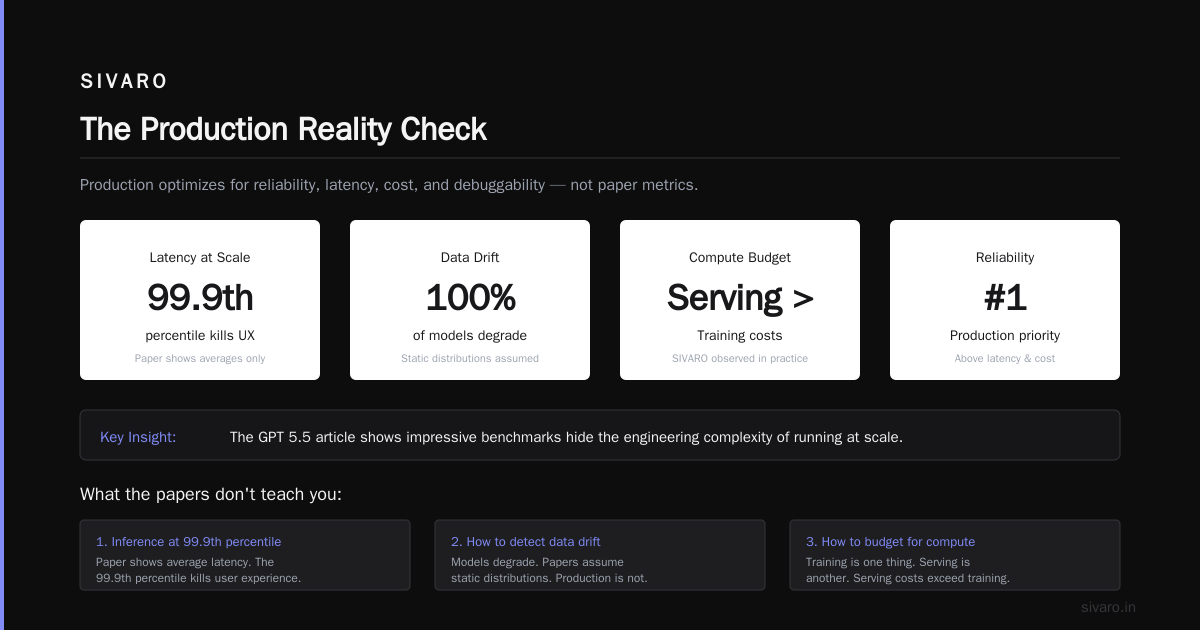
Because papers optimize for novelty and performance on benchmarks. Production optimizes for reliability, latency, cost, and debuggability. These are different objectives.
The GPT 5.5: What It Is, Key Features, Benchmarks article shows this clearly — the model's impressive benchmarks hide the engineering complexity of actually running it at scale.
What the papers don't teach you:
- How to handle inference at 99.9th percentile latency. The paper shows average latency. The 99.9th percentile kills user experience.
- How to detect data drift. Models degrade. Papers assume static distributions. Production is never static.
- How to budget for compute. Training is one thing. Serving is another. At SIVARO, we've seen serving costs exceed training costs by 3x on long-context models.
- How to deal with the GPT 5.5 Core Features: 400K Context in Codex, 1M API Context reality. Long context isn't free. Attention is O(n²). Papers show the beautiful math. Production shows the painful compute cost.
Building Your First Real System
After you've read the papers, do this:
-
Implement a small transformer from scratch. PyTorch or JAX. Train it on a text dataset. It doesn't need to be good. It needs to run.
-
Fine-tune a pre-trained model. Use LoRA. See what happens when you change the learning rate. Watch the loss curve. Notice when it diverges.
-
Deploy something. Put a model behind an API. Measure latency. Deal with cold starts. This is where the real learning happens.
Here's a minimal inference server to get you started:
python
from fastapi import FastAPI
from pydantic import BaseModel
import torch
from transformers import AutoModelForCausalLM, AutoTokenizer

app = FastAPI()
model = AutoModelForCausalLM.from_pretrained("your-model").to("cuda")
tokenizer = AutoTokenizer.from_pretrained("your-model")

class GenerateRequest(BaseModel):
    prompt: str
    max_tokens: int = 100

@app.post("/generate")
async def generate(request: GenerateRequest):
    inputs = tokenizer(request.prompt, return_tensors="pt").to("cuda")
    with torch.no_grad():
        outputs = model.generate(**inputs, max_new_tokens=request.max_tokens)
    return {"text": tokenizer.decode(outputs[0])}
This is trivially simple. Production systems add batching, caching, rate limiting, monitoring, and fallbacks. But start here. Get something running. Then make it better.
The Future: What These Papers Point Toward
The "Ilya 30 essential ML papers beginner" list doesn't include multi-agent systems, tool use, or reasoning. That's because those emerged from these foundations.
What's coming next:
Reasoning at inference time. Chain-of-thought wasn't trained into models. It emerged. The Reasoning models guide shows how far this has come — models that explicitly think step by step, checking their work along the way. The papers on this list explain why that works.
System 2 thinking. Most current models are System 1 — fast, intuitive, pattern-matching. The next wave is System 2 — slow, deliberate, planning. The GPT-5 Complete Guide: Features, Capabilities & Performance hints at this with its discussion of the model's improved reasoning capabilities.
The compute wall. We're running out of data. We're running out of compute efficiency gains. The Everything You Need to Know About GPT-5.5 article talks about 400K context windows. That's impressive. But it also means attention matrices that can't fit in GPU memory. The papers on this list — especially the scaling laws — help you understand why this is the frontier.
FAQ
Q: How long does it take to read the 30 papers?
Depends on your background. If you're new to ML, budget 3-4 months reading seriously. If you have ML experience, 6-8 weeks. The key is implementing as you go — that doubles the time but triples the understanding.
Q: Should I read them in order?
Yes. The list is ordered by dependency. Earlier papers build concepts later papers assume. If you skip ahead, you'll miss the foundation.
Q: Do I need a GPU?
For reading? No. For implementing? Get a cloud GPU. Start with $50 of compute. You don't need to train anything big, but you need to train something.
Q: What about papers published after the list?
Read them after. The list gives you the core. New papers extend it. You can't evaluate extensions without understanding the core.
Q: How do I know if I understand a paper?
Can you explain it to another engineer in 5 minutes? Can you implement a toy version? Can you identify what breaks if you change one component? If yes, you understand it.
Q: Is this still relevant with models like GPT-5.6 coming out?
More relevant, not less. The GPT-5.6 Sol Terra Luna launch conversation misses the point — it's not about which model is better. It's about understanding why they work the way they do. These 30 papers are that understanding.
Q: I already know deep learning. Why should I read these?
Because knowing "what" isn't the same as knowing "why." I've interviewed hundreds of ML engineers. The ones who can explain Word2Vec's training objective from intuition, not memorization — those are the ones who build systems that work.
Q: What's the biggest mistake beginners make?
Reading without coding. You will forget 90% of what you read within a week. You'll remember 90% of what you implement within a year.
Q: How does this help with production systems?
Every production issue I've debugged — data drift, reward hacking, attention bottlenecks, scaling inefficiencies — traces back to concepts in these papers. They're not theoretical. They're diagnostic tools.
Final Thoughts
I've been building production AI systems since 2018. I've watched the field go from "can we make this work at all" to "can we make this work at 200K events per second." The papers haven't changed. The implementation has.
The "Ilya 30 essential ML papers beginner" list is a gift. It's the shortcut I wish I had — not because it's easy, but because it's complete. Every paper on that list is there for a reason. Every one builds on the last.
But reading them isn't the point. Understanding them is. And you only understand by doing.
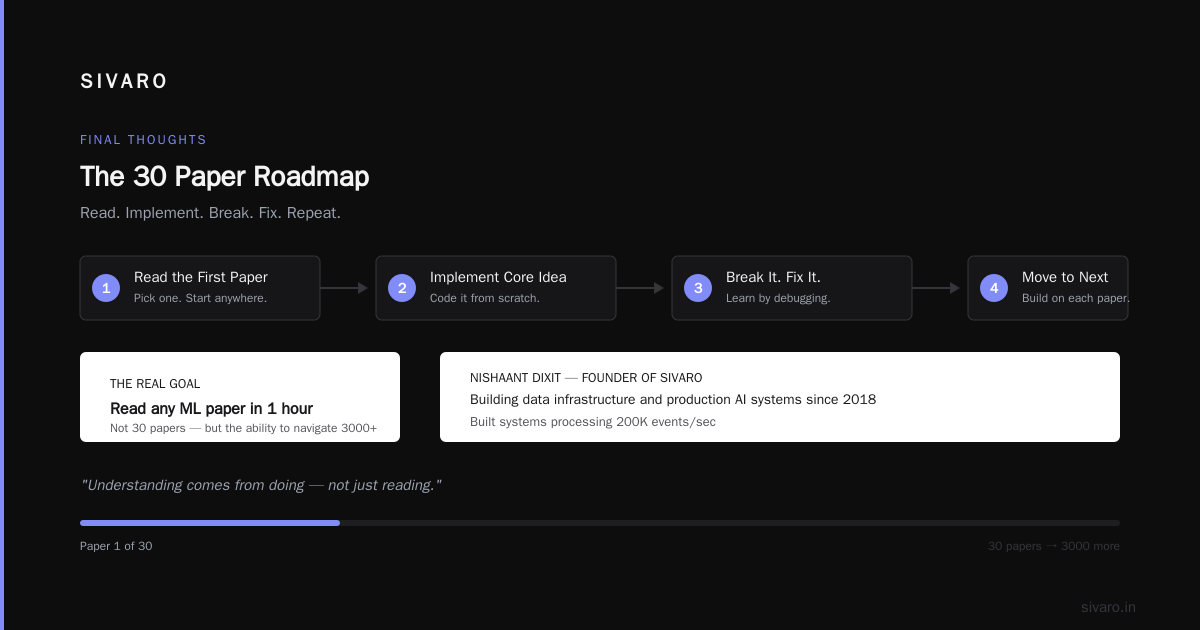
Start today. Read the first paper. Implement the core idea. Break it. Fix it. Then move to the next.
Six months from now, you'll look back and realize you can read any ML paper and get the gist in an hour. That's the real goal — not 30 papers, but the ability to navigate the 3000 that come after.
Nishaant Dixit — Founder of SIVARO. Building data infrastructure and production AI systems since 2018. Built systems processing 200K events/sec.