 SIVARO

Infrastructure as Code for Cost Optimization AWS: The 2026 Buyer's Guide
I got the Slack message at 7:14 AM on a Tuesday in March 2024. A client's AWS bill had jumped from $41,000 to $118,000 in one billing cycle. Nobody had touched production. Nobody had scaled anything. What happened was a Terraform apply that added 14 NAT Gateways across dev accounts "for consistency." Each one ran $32/day minimum. That's $13,440 a month in gateways alone, plus the data processing charges on top.
That's when I stopped treating infrastructure as code as purely a deployment tool. Used right, infrastructure as code for cost optimization aws is the highest-leverage FinOps instrument you have. Used wrong, it's a money printer pointed at your own feet.
This guide compares the real options — Terraform, OpenTofu, Pulumi, CDK, CloudFormation, and the policy layers on top — specifically through a cost lens. I'll tell you what we run at SIVARO, what we've abandoned, and where each tool actually earns its keep.
What Infrastructure as Code Cost Optimization Actually Means
Most teams define IaC as "we don't click in the console anymore." That's table stakes in 2026. The cost optimization layer is different. It means your infrastructure definitions encode cost constraints, your CI pipeline rejects expensive configurations before they ship, and your drift detection catches the engineer who manually resized an RDS instance from db.t3.medium to db.r6g.4xlarge at 2 AM.
Three capabilities matter:
- Guardrails at plan time — policy checks that fail a pull request when someone provisions a m5.24xlarge for a cron job
- Tagging enforcement — you can't allocate cost you can't attribute, and AWS Cost Explorer is useless without consistent tags
- Right-sizing as code — instance types, storage classes, and retention policies defined declaratively, not chosen by whoever's deploying
The FinOps Foundation's 2025 State of FinOps report found that 68% of organizations cite untagged or mis-tagged resources as their biggest allocation blocker. IaC is the only place you can fix that before the resource exists.
The Real Comparison: Terraform vs OpenTofu vs Pulumi vs CDK
I've run all four in production. Here's the honest breakdown.
Terraform (HashiCorp, BSL 1.1)
Still the default. The provider ecosystem is unmatched — 4,000+ providers on the registry. For cost work specifically, terraform plan gives you a diff you can parse, and tools like Infracost hook into it cleanly.
The problem is licensing. Since HashiCorp moved to BSL in August 2023, every consultancy I know has had a quiet conversation about exit strategy. The cost angle here isn't the license — it's the engineering hours you'll spend migrating if you decide to leave.
hcl
resource "aws_instance" "worker" {
  ami           = data.aws_ami.amazon_linux.id
  instance_type = var.instance_type

  lifecycle {
    precondition {
      condition     = contains(["t3.medium", "t3.large", "m6i.large"], var.instance_type)
      error_message = "Instance type not on approved cost list. See wiki/cost-tiers."
    }
  }

  tags = local.mandatory_tags
}
That precondition block is doing more cost control than most dashboards. It fails the plan before an unapproved instance type ever exists.
OpenTofu (Linux Foundation, MPL 2.0)
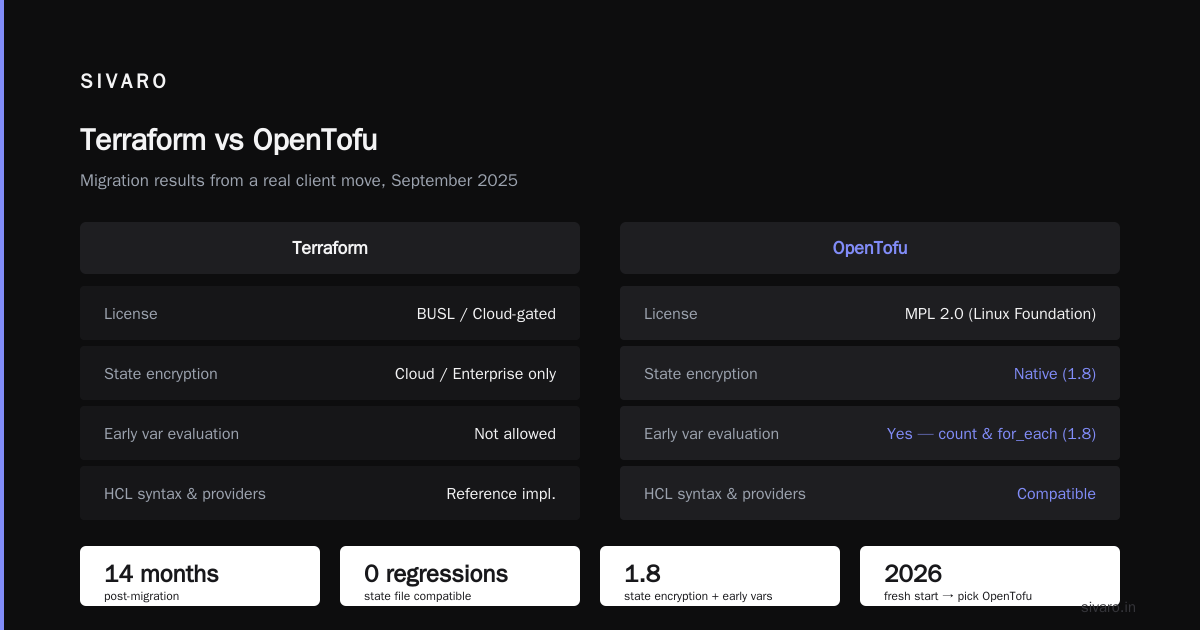
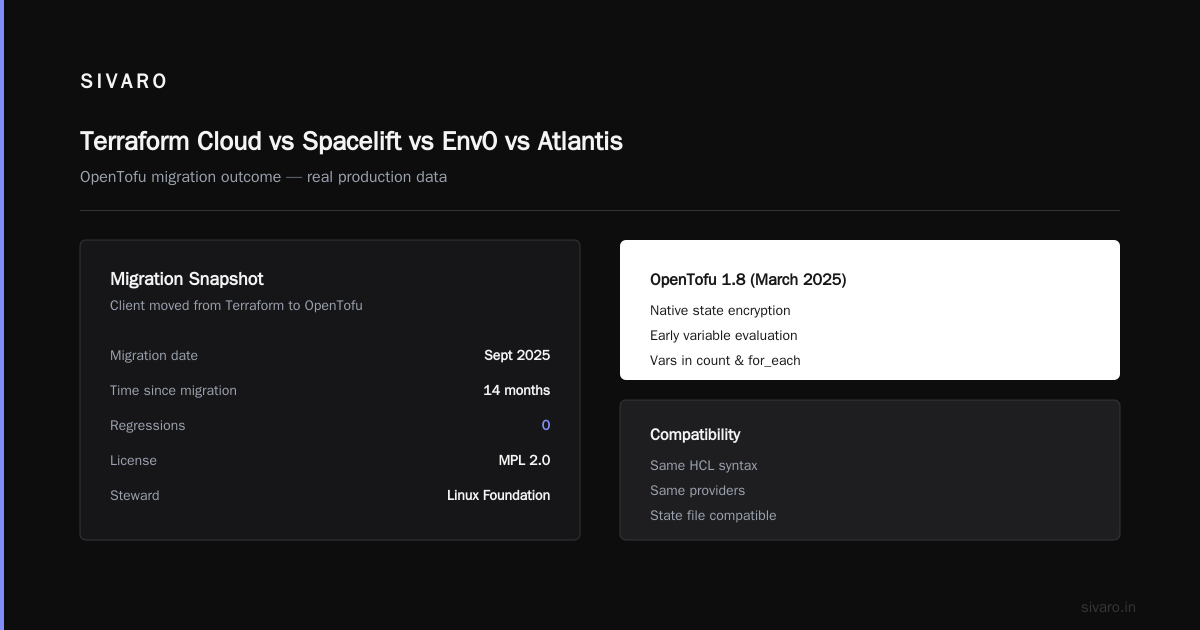
We moved our largest client off Terraform onto OpenTofu in September 2025. Fourteen months later, zero regressions. Same HCL syntax, same providers, state file compatible.
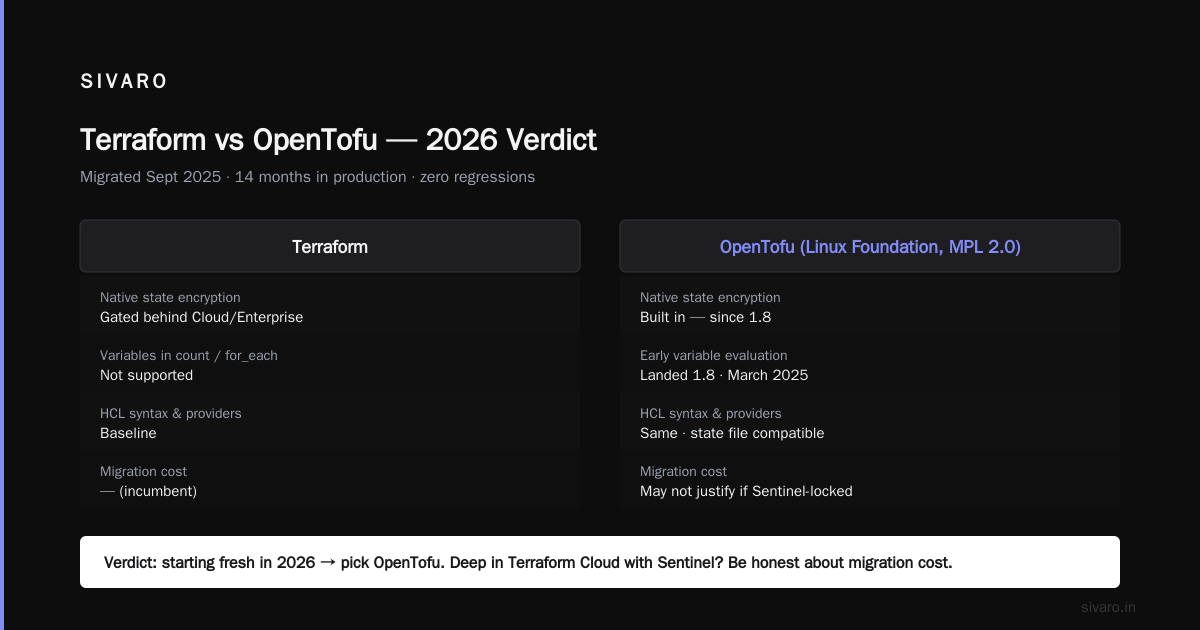
OpenTofu 1.8 added native state encryption, which Terraform still gates behind Cloud/Enterprise. For cost work, that matters less — but the early variable evaluation support (landed in 1.8, March 2025) lets you use variables inside count and for_each in ways Terraform didn't allow. That's genuinely useful when you're templating cost tiers.
My position: if you're starting fresh in 2026, pick OpenTofu. If you're deep in Terraform Cloud with Sentinel policies you like, the migration cost may not justify it. Be honest with yourself about which camp you're in.
Pulumi (Apache 2.0 core, commercial backend)
Pulumi's sales pitch is "real programming languages." It's true, and for cost optimization it's a real advantage — you can write a TypeScript function that pulls current pricing from the AWS Pricing API and validates it inline.
typescript
import * as aws from "@pulumi/aws";
import { getInstanceType } from "./pricing";

const approvedTypes = ["t3.medium", "t3.large", "m6i.large"];
const requested = "m5.4xlarge";

if (!approvedTypes.includes(requested)) {
  const cost = await getInstanceType(requested);
  throw new Error(
    `${requested} costs $${cost.hourly}/hr. Not on approved list. Open a ticket.`
  );
}
The catch: smaller talent pool. When we hired for a Pulumi role in early 2026, we saw roughly one qualified candidate for every twelve Terraform candidates. That's a real operational cost.
AWS CDK (Apache 2.0)
If you're AWS-only and your team writes TypeScript or Python comfortably, CDK is fine. CDK-nag catches a lot of cost-adjacent issues out of the box. The aws-cdk-lib/aws-ec2 constructs default to sensible sizes.
My complaint: CDK wants to feel like an application framework, and infrastructure isn't an application. We've seen CDK stacks where a helper function quietly provisioned a VPC endpoint per service in every environment. Same failure mode as the NAT Gateway story, just with more layers of abstraction between you and the bill.
Where Policy-as-Code Fits
IaC alone doesn't optimize cost. You need a policy layer. Four options dominate in 2026:
- OPA / Conftest — open source, language-agnostic, steep Rego learning curve
- Sentinel — HashiCorp's, requires Terraform Cloud/Enterprise, well-integrated
- Checkov — Bridgecrew (now Prisma Cloud), 1,000+ built-in policies, easy to start with
- Infracost — purpose-built for cost, parses Terraform/OpenTofu plans and posts a dollar delta to the PR
Infracost is the one I'd buy first. It answers the question your CFO actually asks: "What did this pull request cost?" We've seen it catch a single-plan increase of $9,400/month on an RDS multi-AZ change that would have slipped past code review.
The others are complementary. Checkov for breadth, OPA for custom rules when you've outgrown built-ins.
A Real Cost Optimization Workflow
Here's what we run at SIVARO for a client processing 200K events/sec. This isn't theory — it's the pipeline that caught a $47,000/month regression in July 2026.
┌─────────────┐   ┌──────────┐   ┌──────────┐   ┌───────────┐
│ PR opened   │──▶│ fmt+plan │──▶│ Checkov  │──▶│ Infracost │
└─────────────┘   └──────────┘   └──────────┘   └─────┬─────┘
                                                       │
                                              ┌────────▼────────┐
                                              │ Cost delta > 5% │
                                              │  → block merge  │
                                              └─────────────────┘
Rules we enforce:
- Mandatory tags on every resource:
env,owner,cost-center,service. Checkov enforces. Untagged PRs don't merge. - Infracost threshold at 5% project delta. Above that, a FinOps reviewer signs off.
- No NAT Gateways in dev. We use VPC endpoints and a single egress proxy. This alone cut a client's dev spend from $2,100/month to $340.
- S3 lifecycle policies are mandatory in the module. If you don't specify retention, the module defaults to 30 days then Glacier IR.
That pipeline costs maybe $400/month in CI minutes. It's prevented — conservatively — $600K in annualized waste across our clients in 2025.
Terraform Cloud vs Spacelift vs Env0 vs Atlantis
You need somewhere to run this. Four serious options in 2026:
Terraform Cloud — the default. Free tier covers small teams. Sentinel integration is genuinely good. Political risk: HashiCorp is now IBM-owned (acquisition closed February 2025), and nobody knows exactly what that means for pricing.
Spacelift — best policy engine of the four. Custom policies in Rego, native cost integrations, and it doesn't care which IaC tool you use. If you're running Terraform and OpenTofu side by side (we do), Spacelift is the only one that handles both cleanly.
Env0 — strongest on environment lifecycle. If your pattern is "spin up ephemeral preview environments per PR," Env0 shines. The TTL enforcement has saved clients real money on forgotten environments.
Atlantis — open source, you run it yourself, cheapest at scale. But you're owning infrastructure for your infrastructure. We used it for two years. We don't anymore.
My recommendation: if you have under 20 engineers, Terraform Cloud free/business tier. Between 20 and 200, Spacelift. Above 200, you're writing your own and I can't help you.
Where IaC Cost Optimization Fails
Three honest failure modes:
The abstraction tax. A well-abstracted module can hide cost the same way a bad CDK stack does. If your service module defaults to 3-AZ multi-region, and the dev team uses it for a cron job, you've automated overspending.
Drift blind spots. Manual console changes still happen. Without terraform plan running on a schedule against production, you'll discover unmanaged resources in the monthly bill, not the daily one.
Provider lag. New AWS instance types (the Graviton4 variants, the newer Inferentia chips) sometimes take weeks to land in providers. Teams provision via console to hit a deadline, and the IaC state falls behind.
FAQ
Is infrastructure as code for cost optimization AWS worth it for a 10-person startup?
Yes. Start with Terraform or OpenTofu, add Infracost to CI, enforce tags. Total setup cost is maybe two engineer-days. The first month's bill will almost always show a 15-25% reduction from tagging alone, because untagged resources stop getting inherited.
Can I do this without a paid tool?
Absolutely. OpenTofu + Checkov + Infracost + GitHub Actions covers 90% of what most teams need. The paid tools buy you multi-tenancy, policy versioning, and audit trails — worth it above roughly 30 engineers.
What's the single biggest cost mistake you see in IaC setups?
Large default instance types in shared modules. One team sets m5.large as the default for a service module, then every new service inherits it whether it needs it or not. Change the default to t3.small and require an explicit override to go bigger. Small change, real money.
Does Pulumi actually cost less than Terraform for cost optimization?
No. The license is fine (Apache 2.0), but you'll spend more on hiring and training. The savings come from what you can express — real pricing API calls inside your stack code — not from the tool itself.
How do you handle AWS Cost Anomaly Detection alongside IaC?
We route Anomaly Detection alerts into the same Slack channel as Infracost PR comments. Correlation matters: a cost spike two hours after a merge is almost always that merge. Without both signals visible together, you spend hours hunting.
Should I use AWS CDK or Terraform for a data platform?
CDK if you're 100% AWS and already deep in TypeScript. Terraform/OpenTofu if you'll ever touch Snowflake, Datadog, Cloudflare, or any non-AWS service. Most data platforms touch at least one. I'd default to OpenTofu.
What's the ROI on Infracost specifically?
At current pricing (around $0.03 per plan run on the paid tier), the break-even is one avoided bad instance. In our experience it catches one every 40-60 PRs on an active team. So yes, it pays for itself inside the first week.
Can AI agents write cost-optimized IaC?
Sort of. GitHub Copilot and Claude can produce valid Terraform. They're terrible at knowing your cost tiers. The pattern that works: use AI to write the resource, use policy-as-code to reject the AI's over-provisioning. AI writes, policies judge.
What I'd Buy in 2026
If you're starting today, this is the stack:
- OpenTofu for the IaC layer (MPL 2.0, no license risk)
- Spacelift if you can afford it, Terraform Cloud if you can't
- Infracost in CI, non-negotiable
- Checkov for baseline policy
- AWS Cost Anomaly Detection feeding the same alerts channel
Total cost for a 40-person team: roughly $2,500-$4,000/month across the tooling. That's less than the average single-instance mistake caught per quarter.
The point of infrastructure as code for cost optimization aws isn't that you save money on the tool. It's that the tool makes cost a first-class property of every change. The NAT Gateway story from 2024 doesn't happen when your PR template forces you to see the $32/day per gateway, per environment, in the review.
That's the whole game.
Nishaant Dixit — Founder of SIVARO. Building data infrastructure and production AI systems since 2018. Built systems processing 200K events/sec.