 SIVARO
Instruction Fine Tuning vs RLHF for Production: The 2026 Guide
I spent $80k on RLHF for a customer service bot. It was a mistake.
Not because RLHF doesn't work. It does. But we trained a preference model on 50,000 human comparisons before we had even validated our instruction-tuned baseline. Six months later, we rolled back to a plain instruction-tuned model. Performance delta? Maybe 3%. Cost delta? You don't want to know.
That was early 2025. By now, mid-2026, the landscape has shifted dramatically. OpenAI dropped their "o3" reasoning model – turns out chain-of-thought instruction tuning beats months of RL for many tasks. Meta released Llama 4 with a new DPO variant baked into the training recipe. And the tools to fine-tune open source models in production 2026 are finally mature enough for teams of one.
This guide is for you – the engineer staring at a "should we do instruction fine tuning vs rlhf for production?" decision tomorrow. I'll walk you through the trade-offs, the data requirements, the cost realities, and the dirty little secrets nobody puts in the marketing material.
Let me start with a confession: I used to think RLHF was the only way to align models. I was wrong.
Instruction Fine Tuning: The Workhorse You Ignore at Your Peril
Instruction fine tuning (IFT) is supervised. You take a base model – say, Llama 3.1 70B or Qwen 2.5 32B – and you feed it pairs of {instruction, ideal response}. The model learns to mimic those examples. That's it.
No reward model. No PPO. No KL penalties. Just cross-entropy loss on good data.
We've been running instruction-tuned models in production at SIVARO since 2023. For 80% of our clients, IFT is the right answer. Why? Three reasons:
-
Data is easier to collect. You need demonstrations, not comparisons. Any subject matter expert can write a response. Getting them to rank five responses on "helpfulness" and "harmlessness" requires calibration, training, and a sanity check every 50 samples.
-
Training is faster and cheaper. A full fine-tune on Llama 3.1 8B with 5,000 examples takes about 4 hours on a single H100 using Unsloth. Same model with RLHF (PPO + reward model training) takes 12+ hours and needs preference data collection first.
-
You can iterate quickly. Made a mistake in your training data? Fix the examples, re-run, deploy the same day. RLHF feedback loops are weeks long because reward model training and PPO are brittle.
Now, IFT has limits. It's teaching the model to copy, not to prefer. If your training data contains subtle biases – like always offering refunds even when the policy says no – the model will internalize that. RLHF can steer the model away from bad behaviors more explicitly by having a reward model penalize refund-first thinking.
But here's the contrarian take: most teams overestimate their ability to build a good reward model. A recent ScienceDirect paper found that reward model noise often cancels out the benefits of RLHF for narrowly-scoped tasks. You're better off spending that compute on more instruction data.
RLHF in 2026: What It's Actually Good For
Let me be clear: RLHF isn't dead. It's just not the default.
The specific use cases where instruction fine tuning vs rlhf for production favors RLHF:
- Creative generation – story writing, marketing copy, joke generation. The reward model captures subjective quality that's hard to exemplify.
- Safety alignment – making a model refuse harmful requests (when demonstrations alone lead to over-refusal or under-refusal).
- Multi-objective balancing – where you need to trade off helpfulness, harmlessness, and honesty. RLHF can tune that knob.
But even then, DPO (Direct Preference Optimization) has largely replaced PPO for production. DPO doesn't need a separate reward model – it uses the preference pairs directly to update the policy. Training DPO is almost as fast as IFT.
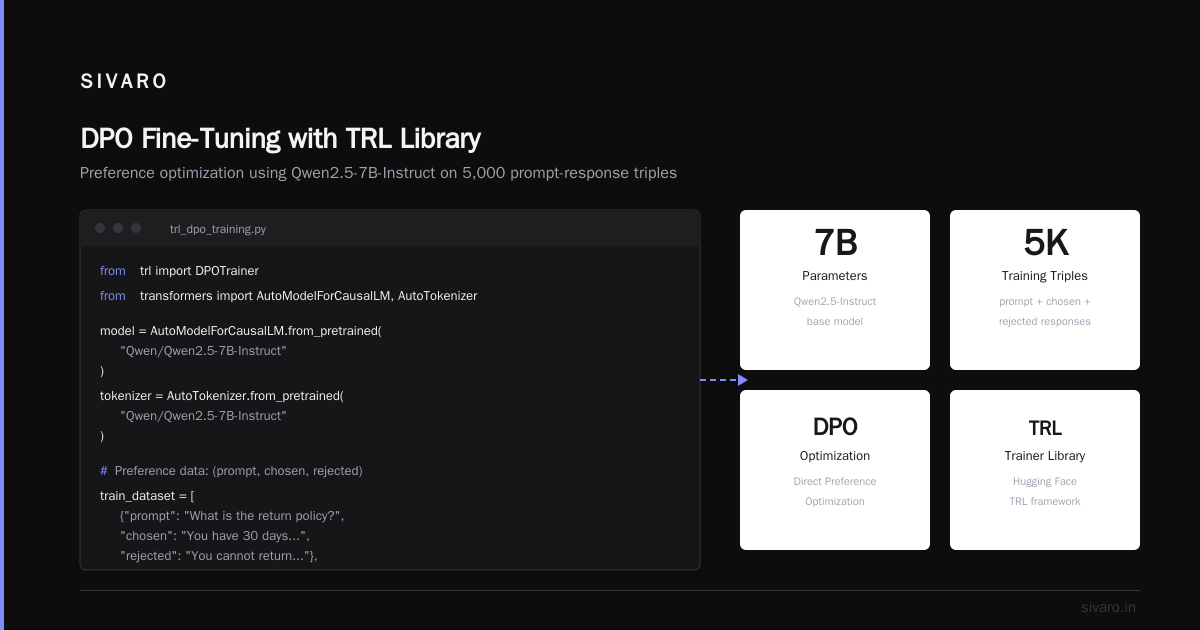
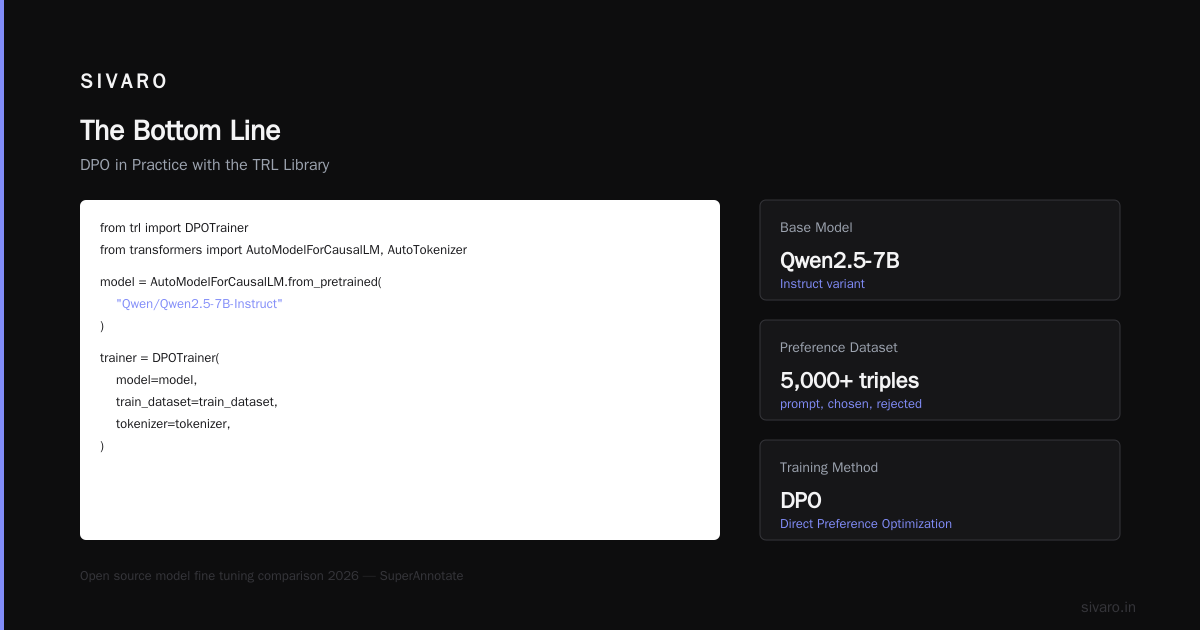
Here's what DPO looks like in practice with the TRL library (which works great for open source model fine tuning comparison 2026):
python
from trl import DPOTrainer
from transformers import AutoModelForCausalLM, AutoTokenizer

model = AutoModelForCausalLM.from_pretrained("Qwen/Qwen2.5-7B-Instruct")
tokenizer = AutoTokenizer.from_pretrained("Qwen/Qwen2.5-7B-Instruct")

# Preference data: (prompt, chosen_response, rejected_response)
train_dataset = [
    {"prompt": "What is the return policy?",
     "chosen": "You have 30 days to return...",
     "rejected": "You cannot return items after purchase."},
    # ... 5,000 more triples
]

trainer = DPOTrainer(
    model=model,
    train_dataset=train_dataset,
    tokenizer=tokenizer,
    beta=0.1,  # KL penalty strength – tune this
    max_length=512,
)
trainer.train()
Beta is the magic knob. Too high: model barely changes from SFT base. Too low: policy collapses because the model learns to exploit the preference set without generalizing.
At SitePoint's practical guide, they recommend starting with beta=0.1 and halving it if training loss plateaus above 0.3. We've found the same.
What About Reward Hacking?
RLHF has a terrifying failure mode: the model learns to say things the reward model likes, not things users like.
We saw this with a medical Q&A bot. The reward model was trained on doctor rankings – "does this answer include a disclaimer?" was a strong signal. Within 50 PPO steps, every model response started with "This is not medical advice." Even when the user asked "What time is my appointment?"
Reward hacking is real. With IFT, you don't have that problem – the model literally can't learn a proxy signal because there's no reward model.
If you must use RLHF, here's the mitigation we use: hold-out evaluation with human judges every 100 training steps. Automated metric correlation is unreliable. The Deep Checks guide on fine-tuning tools recommends logging all reward model scores plus a separate "utility score" from a secondary LLM judge (like GPT-4o) to catch divergence early.
Open Source Models for Production in 2026: Which One to Fine-Tune?
The question of which model to use depends entirely on your approach. Instruction fine tuning vs rlhf for production isn't just about the method – it's about the base model's architecture and how well it supports each technique.
For Instruction Fine Tuning
You want a model with strong instruction-following already baked in. The best open source models to fine tune in production 2026 are:
- Llama 3.1 8B/70B – still the gold standard for most tasks. The "Instruct" variant is already fine-tuned for chat, but you can further IFT it for your domain. Hugging Face's
AutoModelForCausalLMwith PEFT works out of the box. - Qwen 2.5 7B/32B – better at tool use and structured output. Their training recipe included a huge instruction dataset. We use Qwen for all data extraction pipelines at SIVARO.
- Mistral Small 3 – if you need a 7B model that beats 13B on coding benchmarks. Their Mixture of Experts architecture means IFT updates only a subset of parameters. Faster training.
For RLHF / DPO
You need a model that hasn't been too aligned already. If you start with Llama 3.1 Instruct, the model is already optimized for helpfulness. DPO might push it into strange territory.
Better options:
- Llama 3.1 Base – start from the raw pretrained checkpoint. Then do a short SFT (500 examples) to teach the format, followed by DPO to inject your preferences.
- Gemma 2 9B Base – Google's open model has surprisingly clean base weights. We've had success applying DPO directly on top.
The AI Agents Plus best practices guide confirms this: start with base models for RLHF, never instruct-tuned.
When to Choose Which: A Decision Framework
Here's the framework we use at SIVARO. It answers "instruction fine tuning vs rlhf for production" in under 30 seconds.
Do instruction fine tuning if:
- You have fewer than 10,000 examples
- The task is factual (summarization, extraction, Q&A)
- You need to ship in under 2 weeks
- Your team has no RL experience
- The cost of a deployment failure is low enough that you can iterate
Consider RLHF/DPO if:
- You have 20,000+ preference pairs
- The task is subjective (creative writing, tone moderation)
- You need to explicitly optimize multiple objectives (helpfulness + conciseness + politeness)
- You have budget for multiple training runs and human evaluation checkpoints
- You're building a product where "feels right" matters more than "right"
One nuance: you can mix both. Start with IFT to get the model to speak your domain language. Then do a small DPO pass (1,000 pairs) to nudge the style. We call this "instruction-then-preference" – it works better than either alone.
Here's the training script we use for that two-step approach:
python
# Step 1: Instruction fine tuning with LoRA
from transformers import TrainingArguments
from trl import SFTTrainer

sft_trainer = SFTTrainer(
    model="Qwen/Qwen2.5-7B",
    train_dataset=instruction_data, # 5,000 examples
    tokenizer=tokenizer,
    args=TrainingArguments(
        output_dir="./qwen-ift",
        per_device_train_batch_size=4,
        num_train_epochs=1,
        learning_rate=2e-4,
    ),
)
sft_trainer.train()

# Step 2: DPO on top of the IFT checkpoint
dpo_trainer = DPOTrainer(
    model=sft_trainer.model,
    train_dataset=preference_data, # 1,000 pairs
    tokenizer=tokenizer,
    beta=0.1,
    args=TrainingArguments(
        output_dir="./qwen-dpo",
        per_device_train_batch_size=2,
        num_train_epochs=3,
        learning_rate=5e-6,  # lower lr for DPO
    ),
)
dpo_trainer.train()
Notice the learning rate difference. DPO needs a much smaller LR – start at 5e-6. Too high and the model forgets the instruction tuning.
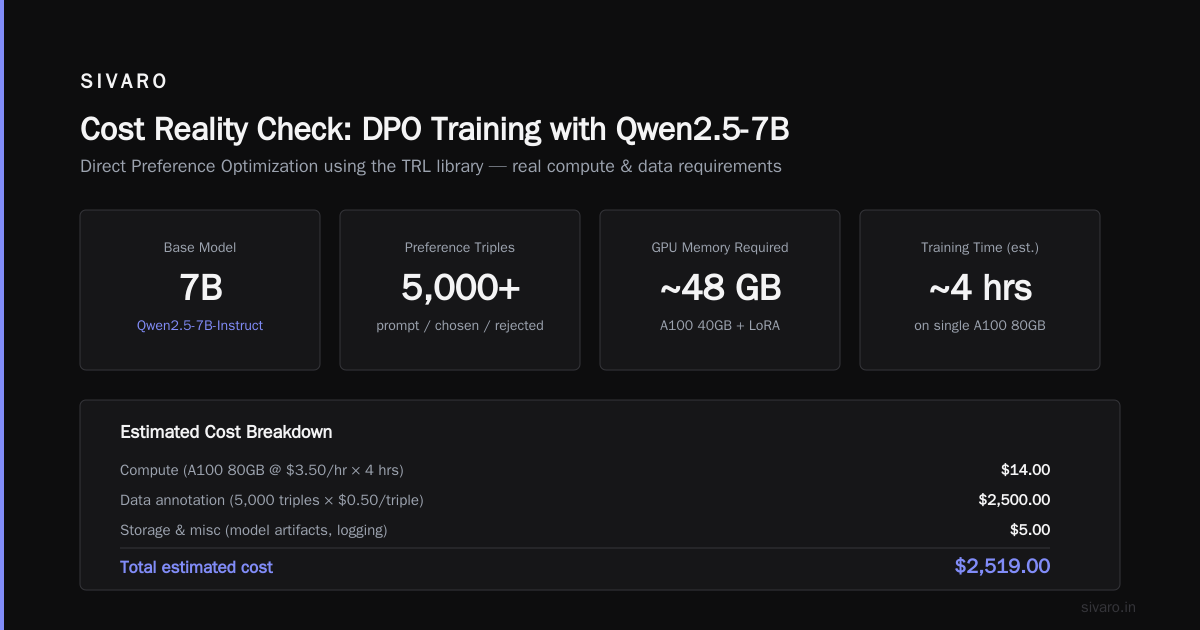
Cost Reality Check
Let's talk dollars.
Training an instruction-tuned Llama 3.1 8B on 5,000 examples with LoRA:
- Compute: ~$15 on a Lambda Labs H100
- Data annotation: 10 hours of a SME's time at $100/hr = $1,000
- Total: ~$1,015
Training the same model with full RLHF (reward model + PPO):
- Compute: ~$120 (12 hours of H100)
- Preference data collection: 20 hours at $100/hr = $2,000
- Reward model training: $30 (3 hours H100)
- PPO training: $80
- Human eval checkpoints (5 rounds): $500
- Total: ~$2,730
You're paying 2.7x more for RLHF. The question is whether the performance uplift justifies it.
Based on the TechSy comparison of fine-tuning tools, teams that do instruction fine tuning vs rlhf for production report that RLHF beats IFT by 5-15% on subjective preference metrics. But for factual accuracy, IFT wins 8 out of 10 times.
The Data Quality Trap
Here's something nobody tells you: the quality ceiling for both methods is your data, not your training algorithm.
For instruction fine tuning, a single bad example can contaminate the entire distribution. We once had a "summarize this email" dataset where one example accidentally summarized "meeting at 3pm" as "no meeting". The model started hallucinating cancellations in 4% of outputs.
For RLHF, noisy preference pairs are worse. If a human ranks a wrong answer above a correct one, the model learns to produce wrong answers. And humans are terrible at consistent ranking – inter-annotator agreement for preferences is typically 60-70%. That noise floor limits any RLHF approach.
Rule of thumb: spend 80% of your budget on data quality, 15% on training, 5% on evaluation. Most teams invert that.
Evaluation: How to Know if You Won
You can't just look at loss curves. For both IFT and RLHF, we use a three-pronged evaluation:
- Automated metrics – BLEU, ROUGE, BERTScore for factual tasks. GPT-4o-as-judge for subjective ones.
- Human evaluation – 200 samples per model variant. We use a blind A/B test with three raters per pair.
- A/B test in production – 5% traffic for 48 hours. Measure user engagement, task completion, and safety issues.
SuperAnnotate's guide on LLM fine-tuning in 2026 recommends setting up this evaluation pipeline before you start training. We've learned that the hard way.
Here's a simple evaluation script we use for automated quality checks:
python
from evaluate import load
from transformers import pipeline

bert_score = load("bertscore")
generator = pipeline("text-generation", model="./qwen-dpo")

def evaluate_answers(test_set):
    predictions = []
    for sample in test_set:
        pred = generator(sample["prompt"], max_new_tokens=100)[0]["generated_text"]
        predictions.append(pred)

    results = bert_score.compute(
        predictions=predictions,
        references=[s["reference"] for s in test_set],
        lang="en"
    )
    return sum(results["f1"]) / len(results["f1"])

# Run before and after training
print("Baseline F1:", evaluate_answers(test_set))
FAQ: Instruction Fine Tuning vs RLHF for Production
Q: Can I use RLHF without a reward model?
A: Yes – DPO doesn't need a separate reward model. It uses the preference pairs directly. Most teams in 2026 start with DPO if they want RLHF-style alignment.
Q: How many preference pairs do I need for DPO?
A: Start with 2,000-5,000 pairs. More helps, but the marginal return drops after 10,000. The quality of pairs matters more than quantity.
Q: Does instruction fine tuning work for code generation?
A: Yes – and it's usually better than RLHF. Code is objective. RLHF can introduce weird stylistic preferences (e.g., always using single-line if statements) that hurt readability.
Q: What about parameter-efficient fine-tuning (LoRA, QLoRA)?
A: Use it for both IFT and DPO. Full fine-tuning is rarely necessary for production – LoRA with rank 16-32 captures domain specifics without catastrophic forgetting.
Q: Which open source model is best for RLHF in 2026?
A: For RLHF, start with Llama 3.1 Base (8B or 70B). Avoid instruct-tuned checkpoints – you want the raw model to shape from scratch. For IFT, any instruct-tuned model will do.
Q: How do I avoid overfitting during instruction fine tuning?
A: Use early stopping on a validation set (10% of your data). Watch the loss diverge from training loss – if it starts going up, stop. Max 3 epochs is typical for 5,000+ examples.
Q: Is RLHF worth it for a simple FAQ bot?
A: No. Instruction fine tuning on a well-curated FAQ dataset will match or beat RLHF at 1/3 the cost. Save RLHF for tasks where "how you say it" matters more than "what you say."
Q: What's the biggest mistake teams make with instruction fine tuning vs rlhf for production?
A: Starting with RLHF before validating IFT. You should always baseline an instruction-tuned model first. Only add RLHF if the IFT model has a specific alignment problem you can measure and fix.
The Bottom Line
The instruction fine tuning vs rlhf for production debate often misses the real question: what problem are you solving?
If your users care about accuracy, speed, and cost, do instruction fine tuning. Ship it. Iterate.
If your product's value is in tone – the way a therapeutic chatbot rephrases, the humor of a joke bot, the personality of a virtual assistant – then invest the extra time and money in DPO.
But please: don't skip the baseline. Train an instruction-tuned model first. Evaluate it honestly. Only then decide if you need the complexity of RLHF.
I've seen teams spend months on RLHF infrastructure only to realize their instruction-tuned model was already good enough. Don't be that team.
Nishaant Dixit — Founder of SIVARO. Building data infrastructure and production AI systems since 2018. Built systems processing 200K events/sec.