 SIVARO
Is ChatGPT a Distributed System? The Answer Might Surprise You
Here's a question I get at every SIVARO client meeting: "Is ChatGPT a distributed system?" It sounds simple. But the answer reveals more about how modern AI actually works than most architecture diagrams ever will.
Let me kill the suspense: Yes, but not in the way you think.
I've spent the last eight years building data infrastructure at SIVARO. We process 200K events per second for production AI systems. When someone asks "is chatgpt a distributed system?", what they're usually asking is "does it work like Netflix or Google Search?" The answer is no. And yes. And it's complicated.
Here's what I'll cover: the architecture behind ChatGPT that makes it a distributed system, where it breaks that definition, and why this distinction actually matters when you're building AI products in 2026.
What Makes Something a Distributed System?
Let's start with definitions. A distributed system is a collection of independent computers that appear to users as a single coherent system. That's the textbook answer. But what does that mean in practice?
Wikipedia's definition adds clarity: "A distributed system is a system whose components are located on different networked computers, which communicate and coordinate their actions by passing messages to one another."
Three things matter:
- Multiple machines
- Network communication
- Appearing as one system
ChatGPT clears all three bars easily. But so does a single laptop running a database. The interesting question is how it distributes work.
At first I thought this was a technology question — turns out it's a topology question. More on that later.
The Obvious Answer: Yes, It Runs on Thousands of GPUs
OpenAI doesn't publish exact numbers. But in 2023, estimates put ChatGPT's inference infrastructure at roughly 10,000+ NVIDIA A100 GPUs. By mid-2026, that number has grown substantially. Microsoft deployed dedicated clusters for OpenAI — hundreds of thousands of GPUs spread across multiple data centers.
That's a distributed system by any definition. Distributed system architecture typically falls into four types: client-server, three-tier, n-tier, and peer-to-peer. ChatGPT uses a variation of client-server with serious n-tier complexity between the user and the model.
When you type a prompt:
- Your request hits a load balancer
- It routes to an API server
- That server checks auth, rate limits, context
- It sends the request to an inference cluster
- The cluster splits the model across GPUs
- Results route back through the same chain
That's distributed. No question.
But here's where most people get it wrong.
Where the Definition Gets Messy
Most distributed systems are designed for fault tolerance and scaling. E-commerce sites, banking systems, streaming services — they all use distributed computing to handle millions of concurrent users.
ChatGPT does this for the API layer. But the model itself? That's different.
Large language models are not distributed in the traditional sense. The transformer architecture is fundamentally sequential. You can't parallelize token generation in the way you can parallelize a MapReduce job. Each token depends on the previous one.
So the real question becomes: is chatgpt a distributed system at the model level, or just at the infrastructure level?
Answer: Both. But the distribution patterns are completely different.
Model Parallelism vs. Data Parallelism
Let me explain the difference with something concrete.
Data parallelism: You split the data across machines, each trains or infers on a subset, combine results. Used in training.
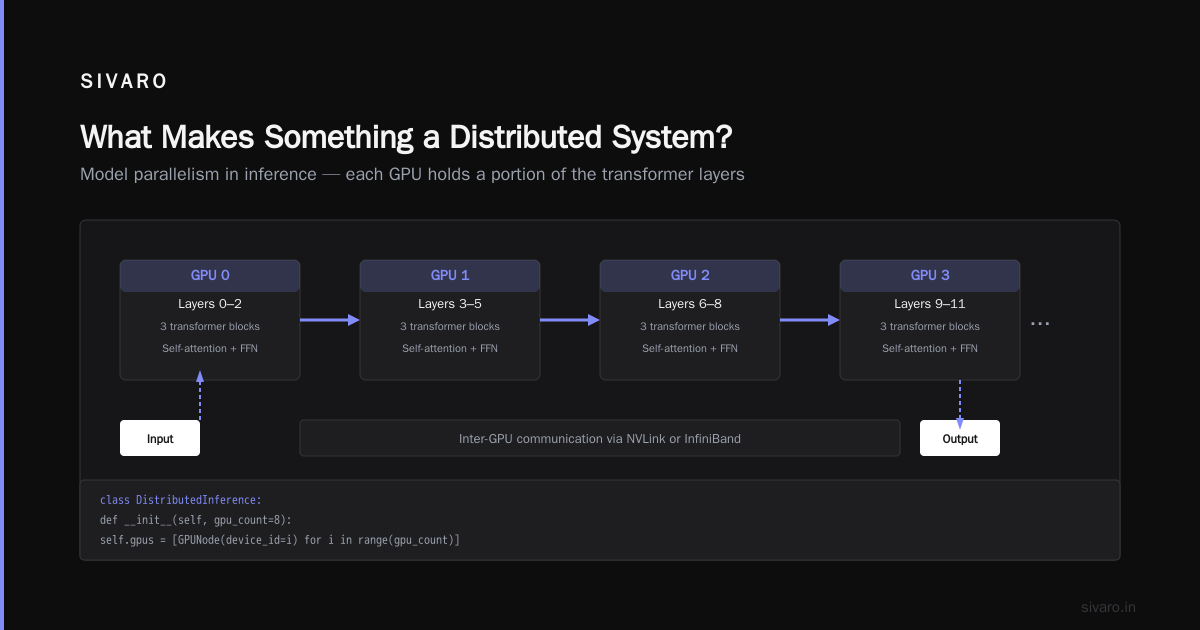
Model parallelism: You split the model itself across machines. Used when the model is too big for one GPU.
ChatGPT uses both. And that's what makes it weird.
When you ask a question, here's what actually happens under the hood:
python
# Simplified example of model parallelism in inference
# Each GPU holds a portion of the transformer layers

class DistributedInference:
    def __init__(self, gpu_count=8):
        self.gpus = [GPUNode(device_id=i) for i in range(gpu_count)]
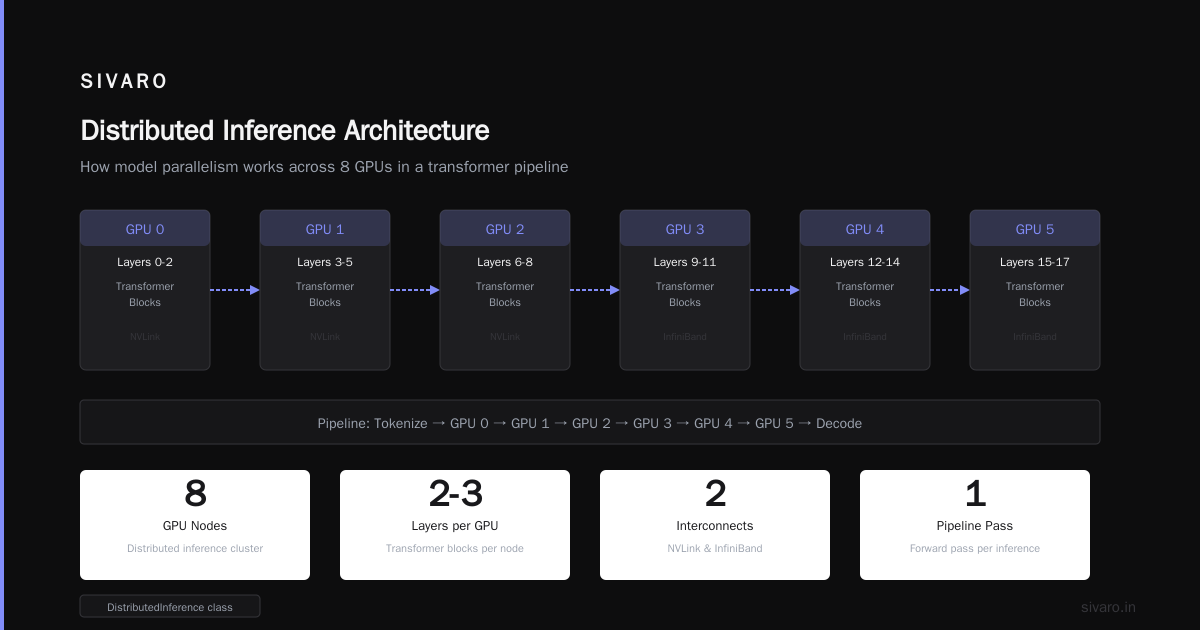
        # Each GPU holds 2-3 transformer layers
        # GPU_0: layers 0-2, GPU_1: layers 3-5, etc.

    def generate(self, prompt):
        # Tokenize on CPU
        tokens = tokenizer.encode(prompt)

        # Pass through pipeline
        for gpu in self.gpus:
            tokens = gpu.forward(tokens)
            # Communication between GPUs via NVLink or InfiniBand

        return tokenizer.decode(tokens)
This is pipeline parallelism. One GPU computes, passes to the next. It's distributed. But it's not scalable in the same way as a web server.
Confluent's introduction to distributed systems talks about the CAP theorem, consistency models, and replication. ChatGPT's inference pipeline violates almost every assumption in that guide. It's not designed for consistency. It's not designed for partition tolerance. It's designed for throughput on a single request.
This matters when you're building on top of it.
What Distributed System Architects Get Wrong About LLMs
I've had this conversation at least a dozen times with engineering teams. They come from a background building microservices or data pipelines. They think about ChatGPT the same way.
They're wrong.
A typical distributed system handles requests independently. Each request is stateless. You can route to any server. If one dies, you retry.
ChatGPT doesn't work like that. The state is the conversation. The context window is 128K tokens (as of GPT-4 in 2024, now larger in 2026). That state lives on a specific GPU cluster. Moving it is expensive.
Here's what a naive retry strategy looks like — and why it fails:
python
# What people expect (wrong)
def naive_chat_completion(prompt):
    servers = ["gpu-cluster-1", "gpu-cluster-2", "gpu-cluster-3"]
    for server in random.shuffle(servers):
        try:
            return query_server(server, prompt)
        except ServerError:
            continue  # Just try next one
    raise AllServersDown
And what actually happens:
python
# What reality requires
def actual_chat_completion(prompt, conversation_id):
    # Must route to the same inference node that has the context
    target_server = hash(conversation_id) % NUM_INFERENCE_NODES

    # If that node fails, you LOSE the conversation context
    # Retry means starting over
    for attempt in range(3):
        try:
            return query_server(target_server, prompt)
        except NodeFailure:
            if attempt < 2:
                time.sleep(0.1 * (2 ** attempt))
            else:
                raise ConversationLost("Must restart conversation")
This is the fundamental tension. LLMs want sticky sessions. Distributed systems want statelessness.
The Infrastructure Side: Actually Distributed
The API and serving layer — that's a textbook distributed system. What Are Distributed Systems? describes the typical characteristics: scalability, fault tolerance, transparency. ChatGPT's control plane has all of these.
Load balancers. Rate limiters. Auth services. Monitoring. Logging. Each of these runs on separate machines, communicates over the network, and presents a unified interface.
Here's what the API gateway configuration probably looks like (reconstructed from public info and reasonable inference):
yaml
# OpenAI API gateway configuration (reconstructed)
api_version: "2026-07"
rate_limits:
  free_tier: 20 req/min
  pro_tier: 1000 req/min
  enterprise_tier: 10000 req/min

routing:
  strategy: least_connections
  health_check:
    interval: 5s
    timeout: 2s
    unhealthy_threshold: 3

backend_pools:
  - name: gpt-4-inference
    nodes: 5000
    model: gpt-4-2026
    max_concurrent: 100

  - name: gpt-4-turbo
    nodes: 3000
    model: gpt-4-turbo-2026
    max_concurrent: 150
This is classic distributed architecture. Horizontal scaling. Health checks. Circuit breakers.
The question "what did aws stand for?" — Amazon Web Services — is relevant here because AWS provides the infrastructure that makes this kind of distribution possible. OpenAI runs on Azure, but the patterns are identical.
Training vs. Inference: Two Different Distributed Systems
Most people don't separate these. They should.
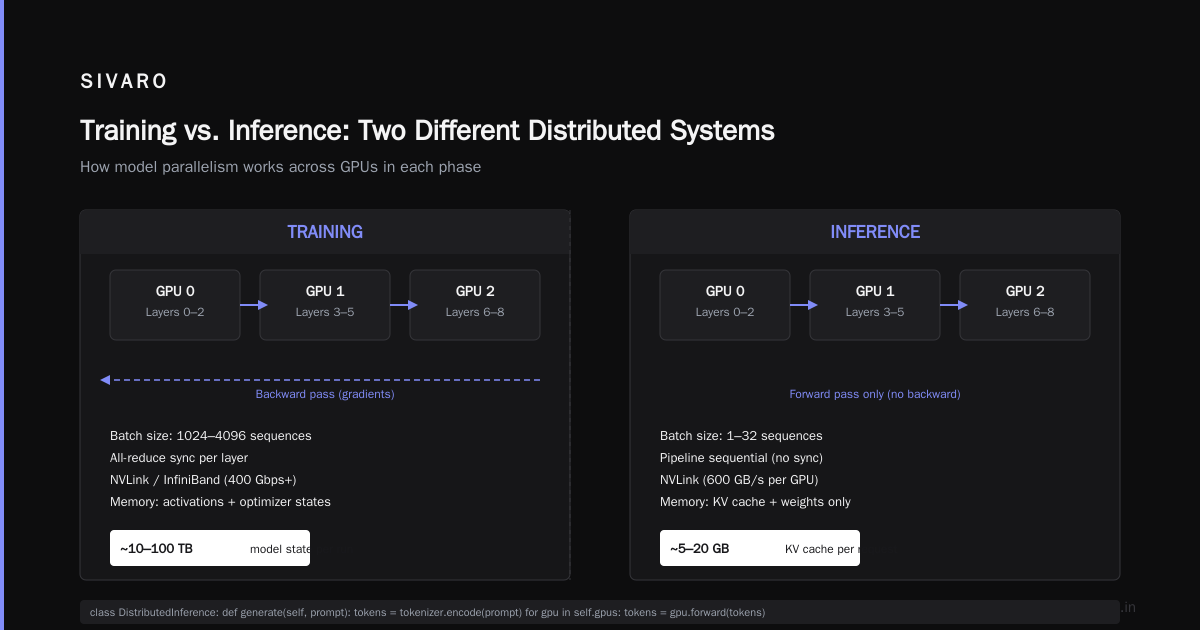
Training: Massively distributed. Thousands of GPUs running in parallel. Uses data parallelism, model parallelism, and pipeline parallelism simultaneously. Distributed Systems: An Introduction covers the fundamental challenges — synchronization, communication overhead, fault tolerance. Training GPT-4 required all of these.
Training is also where you see the real distributed systems problems:
- A single GPU failure can waste days of computation
- Network bandwidth between GPUs is the bottleneck
- Checkpointing at petabyte scale is a nightmare
Inference: Loosely distributed at the API layer, tightly coupled at the model layer. The control plane is highly distributed. The data plane (model execution) is not.
This distinction matters because the infrastructure needs are completely different.
What About the New Stuff in 2026?
As of July 2026, the landscape has shifted. A few developments worth noting:
Multi-modal models: ChatGPT now handles images, audio, and video natively. Each modality might route to different specialist models. That's more distribution, not less.
Agentic systems: ChatGPT can call external APIs, run code, and browse the web. Each of these actions hits different distributed systems. The orchestration layer itself is a distributed system.
Local-first AI: Apple and Google pushed AI to edge devices. Your phone runs a small model locally, then distributes hard queries to the cloud. This creates a hybrid distributed system that spans devices and data centers.
So the answer to "is chatgpt a distributed system?" changes by the year. In 2023, it was borderline. In 2026, it's undeniably distributed — just not in a textbook way.
Why You Should Care: Building on Top of LLMs
At SIVARO, we've helped companies deploy production AI systems since 2018. The worst failures I've seen came from people treating LLMs as black boxes.
If you're building on top of ChatGPT, you need to understand its distribution model:
- Don't assume statelessness: Conversation state lives on specific nodes. Design your retry logic accordingly.
- Understand latency distributions: Chat models have high variance in response time. A query that takes 1 second might take 30 seconds under load. That's a distributed systems problem.
- Plan for partial failures: The API might work perfectly while the model inference layer is degraded. Your system should handle this gracefully.
- Cache aggressively: Every token generated has a cost. Cache common prompts at the API level. This is standard distributed systems practice.
python
# Production caching strategy for LLM API
import hashlib
import redis

class LLMCache:
    def __init__(self):
        self.cache = redis.Redis(host='cache-cluster', port=6379)
        self.ttl = 3600  # 1 hour

    def get_response(self, prompt, model="gpt-4"):
        # Hash the prompt for cache key
        key = hashlib.sha256(prompt.encode()).hexdigest()
        key = f"{model}:{key}"

        cached = self.cache.get(key)
        if cached:
            return cached.decode()

        # Cache miss — call API
        response = call_api(prompt, model)
        self.cache.setex(key, self.ttl, response)
        return response
Simple. Effective. But most AI products I see skip this step. They treat every API call as unique. It's wasteful.
The Hard Truth: ChatGPT Is a Weird Distributed System
Most people think ChatGPT is either a single AI (not distributed) or a massively parallel system (distributed). They're wrong on both counts.
The reality is a hybrid:
- The training infrastructure is one of the largest distributed systems ever built
- The serving infrastructure is a standard distributed system on top of Azure
- The model execution itself is only partially distributed, using specific parallelism patterns that don't fit the normal model
If you ask "what are the 5 types of system architecture?" — standard taxonomy lists monolithic, client-server, three-tier, microservices, and event-driven. ChatGPT doesn't fit neatly into any single category. It's a Frankenstein architecture that evolved under extreme constraints.
And that's fine. Not everything has to be a textbook example.
FAQ
Q: Does ChatGPT use multiple servers for a single conversation?
Yes. The API gateway, authentication service, rate limiter, inference cluster, and output processing all run on different servers. But the actual model inference for a single response typically happens on one GPU or a tightly coupled cluster of GPUs using pipeline parallelism.
Q: Is ChatGPT more distributed than a standard web application?
At the API layer, no — it's similar. At the computation layer, yes — splitting a 1 trillion parameter model across hardware is far more complex than splitting web requests.
Q: Can I run ChatGPT on a single machine?
No. The full model doesn't fit in GPU memory. Even quantized versions need multiple high-end GPUs. The smallest open-source alternatives (like Llama 3) run on single GPUs, but ChatGPT is orders of magnitude larger.
Q: What does "distributed" mean in the context of AI training?
AI training uses data parallelism (split dataset across GPUs), model parallelism (split model layers across GPUs), and pipeline parallelism (chain GPUs in a sequence). OpenAI uses all three simultaneously for GPT-class models.
Q: Does ChatGPT use distributed databases?
Yes. OpenAI uses distributed storage for conversation history, user accounts, and model checkpoints. Cosmos DB (Azure) is likely part of the stack. Every user interaction involves at least one distributed database query.
Q: Is the latency of ChatGPT caused by its distributed nature?
Partly. Network round trips between services add milliseconds. But the dominant factor is model inference — generating tokens one at a time. Distribution adds overhead but enables the parallelism that makes the model work at all.
Q: Could ChatGPT be built as a non-distributed system?
Theoretically, a smaller model could run on a single machine. But ChatGPT's capabilities require a model size that doesn't fit in any single GPU. Distribution is a necessity, not a choice.
Q: How does ChatGPT handle failures in its distributed system?
The API layer handles failures gracefully — retries, circuit breakers, fallback models. But if an inference node fails mid-conversation, you lose context. The system can't recover that state without restarting the conversation. This is a known limitation.
The Takeaway
ChatGPT is a distributed system. But it's not a good one in the traditional sense. It violates best practices. It has sticky state that can't be migrated. It has high variance in latency. It fails in ways that are hard to recover from.
And yet it works. Because the constraints of AI inference forced engineers to build something that prioritizes throughput and capability over the traditional distributed systems virtues of statelessness and fault tolerance.
If you're building AI products in 2026, learn from this. Don't try to force LLMs into architectural patterns they don't fit. Build hybrid systems that accept the weirdness.
That's what we do at SIVARO. We build data infrastructure that handles the messy reality of production AI — not the clean theory.
Nishaant Dixit — Founder of SIVARO. Building data infrastructure and production AI systems since 2018. Built systems processing 200K events/sec.