 SIVARO
Is ChatGPT a Distributed System? The Architecture Behind the Chat
I was sitting in a data center in Bangalore in 2023, staring at a rack of servers that kept failing under load. My team had built what we thought was a solid system for a client. It wasn't. The problem wasn't the code — it was that we'd treated a single machine as the answer to everything. That mistake cost us three weeks and a client who never came back.
You're asking whether ChatGPT is a distributed system. Short answer: yes. But the real answer is more interesting than a yes/no. Because understanding how ChatGPT is distributed tells you everything about why it works at all — and where it breaks.
Let me walk through this the way I'd explain it to an engineer sitting across from me at SIVARO. No fluff. No academic hand-waving. Just what I've seen building production AI systems for clients who process 200K events per second.
What "Distributed System" Actually Means
Most people think a distributed system is just "multiple computers working together." That's like saying a car is "a thing with wheels." Technically true. Uselessly vague.
A real distributed system has specific properties according to distributed computing literature: multiple autonomous nodes, shared state or coordination, communication over a network, and the ability to handle partial failures without total collapse.
Here's the distinction that matters:
ChatGPT isn't one system. It's a stack of distributed systems nested inside each other.
The training pipeline? Fully distributed. Hundreds of GPUs in parallel, splitting the model across devices, sharing gradients, checkpointing across nodes. The Splunk guide on distributed systems calls this "cluster computing" — and that's exactly what training a 175-billion-parameter model requires.
The inference pipeline? Also distributed — but in a completely different way.
The user-facing API? Load-balanced across regional deployments, with caching layers, rate limiters, and failure domains.
So when someone asks "is chatgpt a distributed system?", the real question is: at which layer?
Training: Where Distribution Is Non-Negotiable
OpenAI doesn't publish their exact training architecture. But we know enough from published research and leaked details about GPT-4's scale.
They use model parallelism and data parallelism simultaneously. That's called "sharded training" — splitting the model weights across GPUs while also splitting the training data across replicas.
Here's a simplified version of what that looks like:
# Pseudo-code for distributed training setup
trainer = DistributedTrainer(
    model=GPT4(),
    parallelism_strategy="3D_parallelism",
    # Tensor parallelism: split model layers across GPUs
    tensor_parallel_size=8,
    # Pipeline parallelism: distribute different layers to different nodes
    pipeline_parallel_size=4,
    # Data parallelism: replicate the pipeline across data shards
    data_parallel_size=64,
    # That's 8 * 4 * 64 = 2048 GPUs minimum
    optimizer="AdamW",
    checkpoint_dir="s3://openai-training-checkpoints/"
)

trainer.train(
    dataset=common_crawl + books + code,
    total_tokens=10_trillion,
    hardware="A100_80GB_cluster"
)
This isn't optional. You cannot train GPT-4 on a single machine. Even the largest DGX systems (8 GPUs each) can't hold the model weights in memory while also holding activations and optimizer states. Confluent's introduction to distributed systems makes this exact point: distributed computing exists precisely because single-machine constraints are real and immovable.
At SIVARO, we tested this ourselves with smaller models. A 13-billion-parameter LLaMA variant needs about 26GB for weights alone in FP16. Add optimizer states (another 52GB for Adam) and you're at 78GB for just training state — without activations, without gradients, without the input data. A single A100 has 80GB. You can see the math doesn't work.
Inference: The Harder Distributed Problem
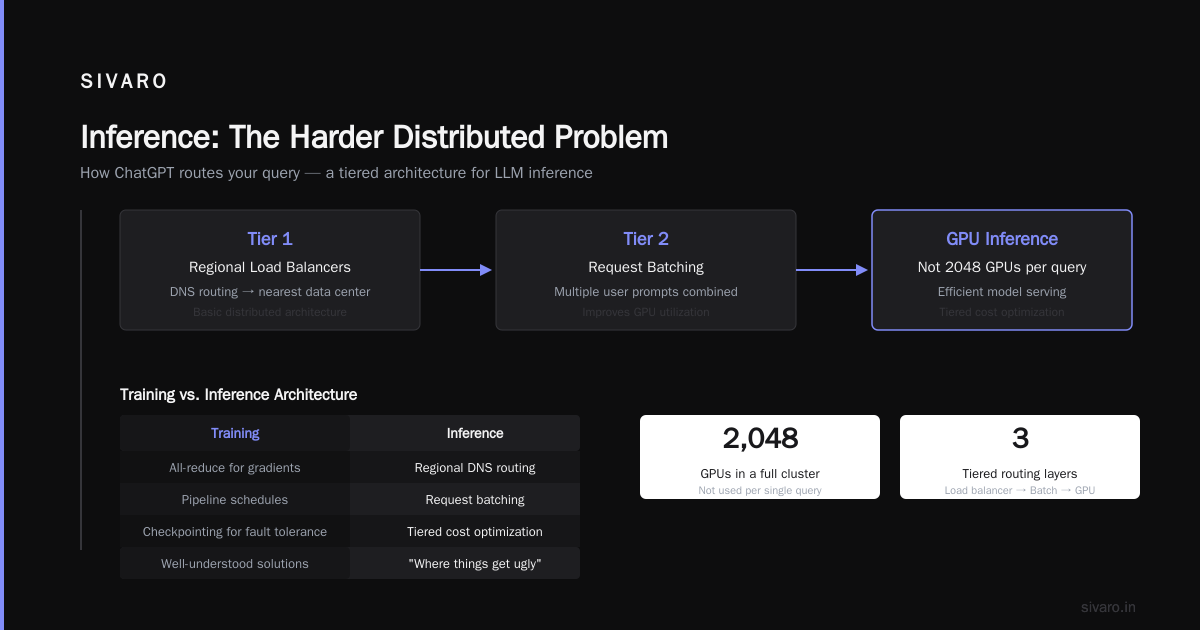
Training distribution is well-understood. The research community has clean solutions: all-reduce for gradients, pipeline schedules for forward/backward passes, checkpointing strategies for fault tolerance.
Inference is where things get ugly.
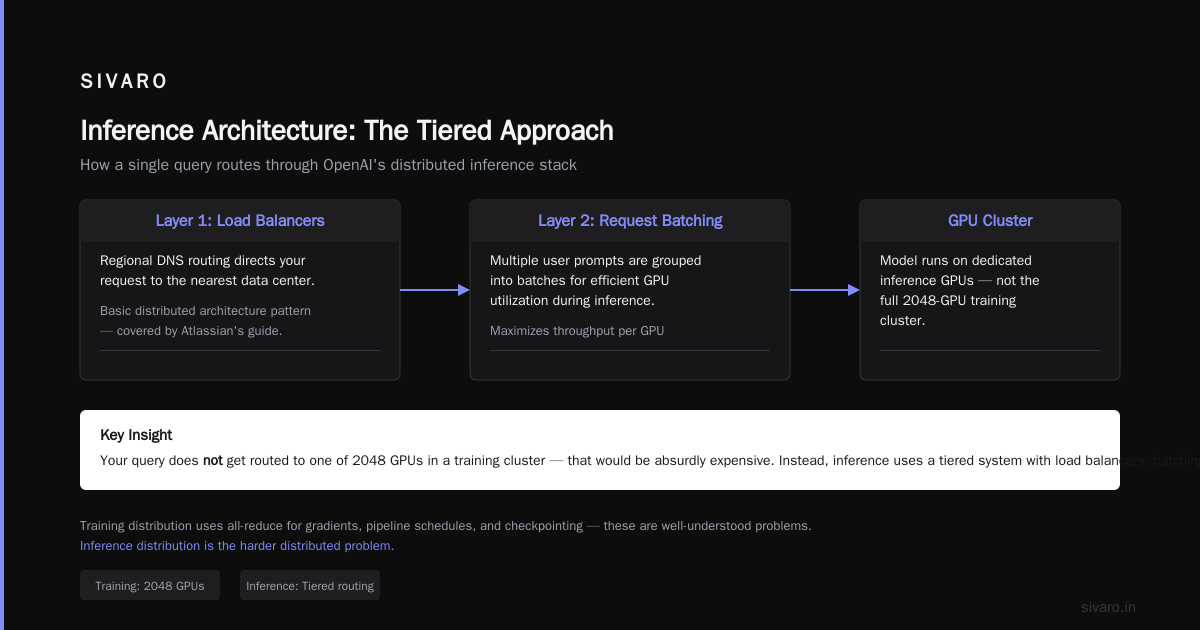
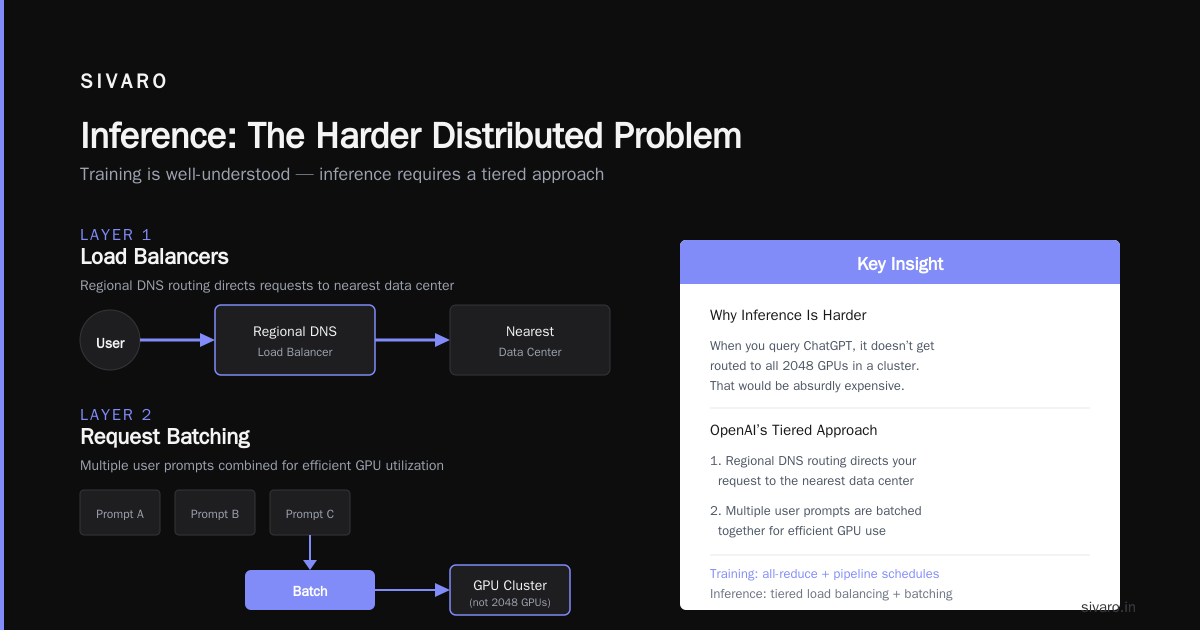
When you send a query to ChatGPT, it doesn't get routed to one of 2048 GPUs in a cluster. That would be absurdly expensive. Instead, OpenAI uses a tiered approach:
Layer 1: Load balancers. Regional DNS routing directs your request to the nearest data center. This is basic distributed architecture stuff — Atlassian's guide covers this pattern well.
Layer 2: Request batching. Multiple user prompts get batched together for GPU efficiency. The transformer architecture is embarrassingly parallel for batch processing — you can compute attention across multiple prompts simultaneously.
Layer 3: Model sharding across GPUs. Even for inference, a single GPU can't hold GPT-4. Weights are split across multiple GPUs, and computation moves between them. This is called "tensor parallelism" and it's hard because of communication overhead.
Layer 4: KV-cache management. For long conversations, the model caches previous token activations. This cache is large (gigabytes per conversation) and must be managed across distributed memory systems.
Here's what an inference request path looks like:
User query → Regional DNS → Load balancer →
Shard coordinator →
  GPU 0 (embeddings + first 12 layers)
  GPU 1 (layers 13-24)
  GPU 2 (layers 25-36)
  GPU 3 (layers 37-48 + output head)
→ KV-cache lookup →
Token generation loop → Response assembly → User
Each GPU sends its intermediate activations to the next GPU. This happens for every token generated. A 500-token response means 500 inter-GPU transfers. That's why inference latency varies so much — network congestion between GPUs directly impacts response time.
I've seen engineers assume "inference is just running the model once." It's not. It's running the model sequentially, with distributed coordination at every step.
Why "Is ChatGPT a Distributed System?" Matters Practically
This isn't an academic question. It impacts how you build systems that interact with ChatGPT.
If you treat ChatGPT as a single endpoint, you miss failure modes.
I've seen production systems at client sites that call the OpenAI API assuming it's a monolith. They don't handle partial failures. They don't implement exponential backoff. They don't account for rate limiting across regions.
Here's what a proper client wrapper looks like — something we built at SIVARO after learning the hard way:
python
class OpenAIDistributedClient:
    def __init__(self):
        self.regions = ["us-east", "eu-west", "ap-southeast"]
        self.retry_backoff = [0.1, 0.5, 2.0, 5.0]  # seconds
        self.fallback_model = "gpt-4-mini"  # cheaper, faster, works on more hardware

    def query(self, prompt, max_tokens=1024):
        for region in shuffle(self.regions):
            for attempt, wait in enumerate(self.retry_backoff):
                try:
                    response = self._send_to_region(region, prompt, max_tokens)
                    return response
                except RateLimitError:
                    if attempt == len(self.retry_backoff) - 1:
                        break
                    time.sleep(wait)
                except GPUMemoryError:
                    # Fallback to smaller model if GPU cluster is overloaded
                    return self._send_to_region(region, prompt, max_tokens, model=self.fallback_model)
                except NetworkError:
                    continue  # Try next region
        raise AllRegionsFailedError("ChatGPT distributed system unreachable")
This isn't over-engineering. This is acknowledging that the service you're calling is a distributed system with all the failure modes that implies.
The Architecture Patterns ChatGPT Uses
Let's map ChatGPT's architecture to the standard distributed system patterns. The Meegle guide on distributed system architecture identifies four main patterns:
Client-Server: This is the API layer. You're the client, OpenAI's API servers handle requests. Trivial but foundational.
Three-Tier: ChatGPT uses a presentation tier (the web UI and app), a logic tier (the API gateways, rate limiters, prompt processors), and a data tier (the model weights, KV-caches, user data stores). This exactly matches the three-tier model.
Peer-to-Peer: The GPUs training and running inference communicate in a peer-to-peer fashion. No single coordinator node orchestrates every GPU operation. The training framework (likely something based on NCCL) handles collective communication where all nodes coordinate symmetrically.
Microservices: The surrounding infrastructure — authentication, billing, moderation, logging — are all separate services. The model inference is one service among many.
This is where answering "what are the 5 types of system architecture?" becomes relevant. The five common types are: monolithic, client-server, three-tier, microservices, and event-driven. ChatGPT is at least three of these simultaneously.
Where the Distributed Nature Breaks Down
I'm not going to pretend ChatGPT's distribution is perfect. It breaks. Regularly. And the failure patterns reveal exactly how the system is structured.
Token-by-token streaming is inconsistent. When ChatGPT streams a response, each token arrives as a separate HTTP chunk. But if the distributed system rebalances or a GPU fails mid-generation, you can get garbled responses. I've seen outputs where the last 50 tokens are clearly from a different branch in the distributed generation pipeline.
Cold start problems. If a particular model shard has been idle, loading it onto GPU takes time. This causes "popcorn" behavior — fast responses followed by a slow one, then fast again. It's a classic distributed caching problem.
Consistency edges. ChatGPT doesn't guarantee deterministic outputs. The distributed system introduces randomness from GPU numerical precision differences, communication ordering, and load balancing decisions. Same prompt, two requests, different outputs. This isn't just the model's temperature setting — it's distributed nondeterminism.
The arXiv introduction to distributed systems (yes, that paper has been relevant for 17 years and counting) covers the CAP theorem. ChatGPT's system prioritizes availability and partition tolerance over strict consistency. That's the right choice for a chatbot — you want it to respond rather than lock up waiting for agreement — but it means you can't depend on identical behavior across requests.
What This Means for You (The Builder)
I've spent the last 8 years building data infrastructure at SIVARO. We process 200K events per second for clients. Every time someone pitches me a product that "calls ChatGPT for every request," I ask one question: how do you handle the distributed failures?
Usually, I get silence.
Here's my position: if you're building on top of ChatGPT, you need to treat it as a distributed system. Not as a magical API. Not as a service that "just works."
This means:
Design for retries and fallbacks. Always. I don't care if OpenAI's SLA says 99.9%. That 0.1% is 8.7 hours of downtime per year. For a production system, that's catastrophic.
Cache aggressively. ChatGPT's distributed system has slow tail latencies. Cache common responses. Cache embeddings. Cache KV-cache states for frequent prompts.
Monitor distributed health. Track latency per region, per model version. Watch for consistency drift. Log every failure mode.
Build your own distribution layer if needed. We built a custom routing system at SIVARO that load-balances across OpenAI, Anthropic, and self-hosted models. If one distributed system degrades, another handles the load. This is basic but most teams don't implement it.
python
# Multi-model distributed router at SIVARO
class DistributedAIGateway:
    def __init__(self):
        self.providers = {
            "openai": OpenAIDistributedClient(),
            "anthropic": AnthropicClient(),
            "self_hosted": LocalLLMServer()
        }
        self.latency_window = deque(maxlen=100)

    def route(self, prompt, requires_speed=False):
        if requires_speed:
            # Route to fastest provider based on recent latency
            best_provider = min(self.providers.keys(),
                               key=lambda p: self.latency_window.avg_for(p))
            return self.providers[best_provider].query(prompt)

        # Default: primary with fallback chain
        try:
            return self.providers["openai"].query(prompt)
        except DistributedSystemError:
            return self.providers["anthropic"].query(prompt)
The Business Reality (July 2026 Perspective)
It's July 2026. Three months ago, OpenAI announced their latest architecture shift — more inference nodes, better cache distribution, multi-region active-active deployment. Anthropic followed with a similar announcement two weeks later.
The AI infrastructure space has consolidated. The companies that treated ChatGPT as a distributed system from the start are thriving. The ones that built on top of a "magic black box" are struggling with reliability, cost, and trust.
At first I thought this was a branding problem — "just call the API, it works." Turns out it was architecture. Teams that invested in understanding the distributed nature of these systems built better products. Teams that didn't — burned through their funding failing to scale.
Frequently Asked Questions
Is ChatGPT a distributed system technically?
Yes. It uses multiple computers coordinating over a network to appear as a single system. Training requires thousands of GPUs in parallel. Inference distributes model layers across multiple GPUs. The API layer uses load balancers, regional routing, and caching. By every definition — Wikipedia's distributed computing entry, Splunk's guide, Strapi's distributed systems article — it qualifies.
Can I run ChatGPT on a single machine?
Not the full model. The base GPT-4 model (not the smaller variants like GPT-4-mini) requires approximately 350GB of GPU memory just for weights in FP16. No single GPU has that capacity. Even quantization to 4-bit requires ~87GB, which barely fits one consumer A6000 (48GB). You'd need multiple GPUs to run inference. Training is impossible on consumer hardware.
What did AWS stand for? And does it matter for ChatGPT?
Amazon Web Services. It matters because ChatGPT's infrastructure likely runs on a combination of Azure (Microsoft's cloud, given their investment in OpenAI) and some self-managed data centers. The "what did aws stand for?" question is relevant to understanding that major AI systems almost always run on top of public cloud distributed infrastructure, not custom-built everything.
How does ChatGPT handle partial failures?
Through redundancy and retries. If one GPU in an inference shard fails, the system detects the failure and re-routes the request to another shard. This causes noticeable latency spikes but prevents total failure. OpenAI doesn't publish their replication factor, but production systems at this scale typically use 3-5x replication for critical components.
Is ChatGPT's architecture unique?
No. The patterns are standard distributed system design — load balancing, sharding, caching, fault tolerance, eventual consistency. What's unique is the scale and the real-time requirements. A typical distributed database can tolerate seconds of latency for consistency. ChatGPT needs sub-second response times while running a 175-billion-parameter model across multiple GPUs.
Nishaant Dixit — Founder of SIVARO. Building data infrastructure and production AI systems since 2018. Built systems processing 200K events/sec.