 SIVARO
Is ChatGPT an Agent or LLM? The Answer Changes How You Build
I sat down with a CTO two weeks ago. He was three months into building what he called an "AI agent platform" for his customer support team. Six figures of engineering time in. When I asked if he knew what an agent actually was, he pointed at ChatGPT and said "it's the brain."
He was half right.
Here's the thing: the question "is chatgpt an agent or llm?" isn't academic. It's the difference between shipping in two weeks and burning budget for six months. It's the difference between a system that handles edge cases and one that hallucinates at 3 AM when your CEO's email chain goes sideways.
Let me be direct: ChatGPT is an LLM, not an agent. But the way most people use it, they're trying to force it to be an agent. That mismatch kills projects.
I've been building production AI systems since 2018. SIVARO runs data infrastructure that processes 200K events/second. We've deployed LLMs across healthcare, logistics, and fintech. I've watched teams wreck months of work because they couldn't answer this one question cleanly.
This guide is what I wish someone had handed me before our first agent project. We'll cover:
- The precise boundary between LLMs and agents
- Why ChatGPT fails as an agent (and what actually works)
- The 4 patterns I've seen succeed in production
- How to decide what you actually need
No theory. Just what works.
The One-Sentence Answer That Saves You Money
ChatGPT is a large language model. It predicts tokens. It doesn't have memory. It doesn't take actions. It doesn't have goals.
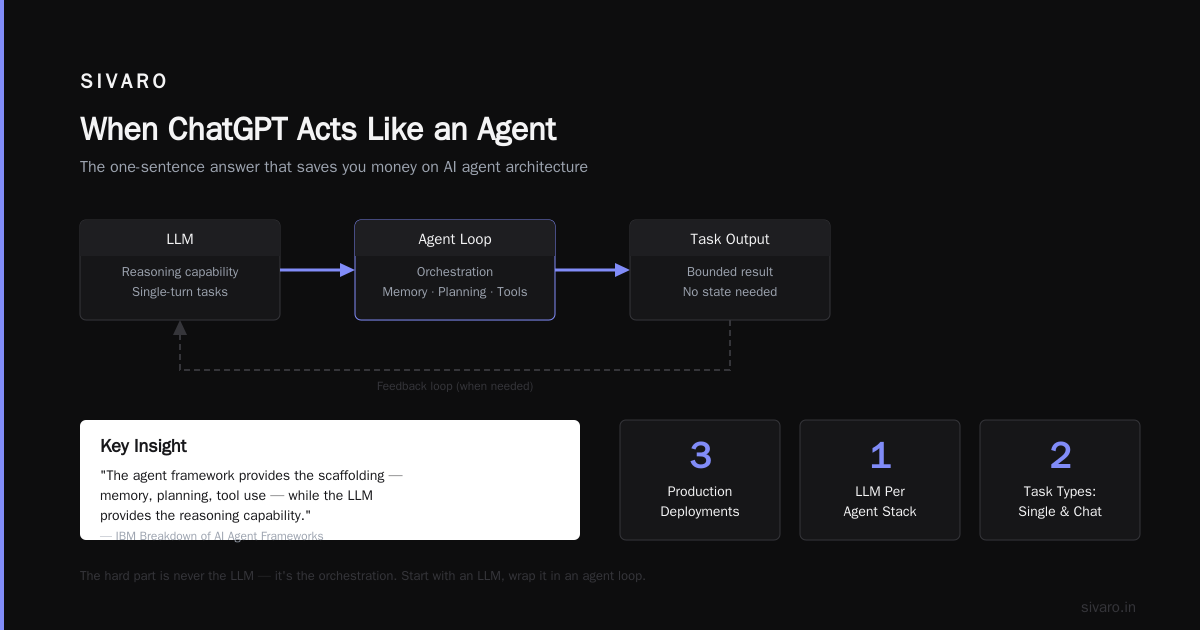
An agent is a system that perceives its environment, makes decisions, and takes actions toward a goal. An LLM is often the "brain" inside an agent — but it's not the agent itself.
This distinction matters because when you treat ChatGPT like an agent, you inherit all of its weaknesses:
- No persistent state between conversations
- No ability to call tools reliably
- No planning beyond the current context window
- No feedback loops to correct errors
I've seen teams build "agents" that just prompt ChatGPT repeatedly. It works for demos. It fails in production.
What Most People Get Wrong
Most people think: "ChatGPT seems to plan and reason, so it must be an agent."
They're wrong. Here's why.
An LLM simulates reasoning. It doesn't actually reason. It's a statistical pattern matcher that happens to produce text that looks like reasoning. When you ask it to "plan a trip" or "execute a workflow," it's generating plausible sequences — not actually holding a goal in memory and working toward it.
The LangChain blog on agent frameworks makes this distinction cleanly: "An LLM provides the reasoning, but the agent provides the loop — the observe-think-act cycle that actually gets things done."
At SIVARO, we tested this explicitly. We gave ChatGPT (via API) the same task that we'd give a real agent: "Monitor this data pipeline for anomalies, alert if throughput drops below 100 events/sec, and restart the service if alert persists for 5 minutes."
ChatGPT produced a plan. Looked great. But it couldn't actually execute the monitoring loop. It couldn't persistently observe. It couldn't take action and then observe the result. It was a one-shot text generator, not a control system.
The agent we built (using an open-source framework) did this trivially. It wasn't smarter. It just had the right architectural loop.
The Agent Architecture Stack (What You Actually Need)
Here's what a real agent system looks like. I've seen this pattern across every successful deployment we've done.
┌─────────────────────────────────┐
│         Agent Orchestrator       │  ← Manages the loop
├─────────────────────────────────┤
│  ┌───────────┐ ┌──────────────┐ │
│  │ LLM Core  │ │ Memory Store │ │  ← ChatGPT is here
│  └───────────┘ └──────────────┘ │
│  ┌───────────┐ ┌──────────────┐ │
│  │ Tool Exec │ │ Plan Manager │ │
│  └───────────┘ └──────────────┘ │
├─────────────────────────────────┤
│         Action Environment       │  ← APIs, databases, services
└─────────────────────────────────┘
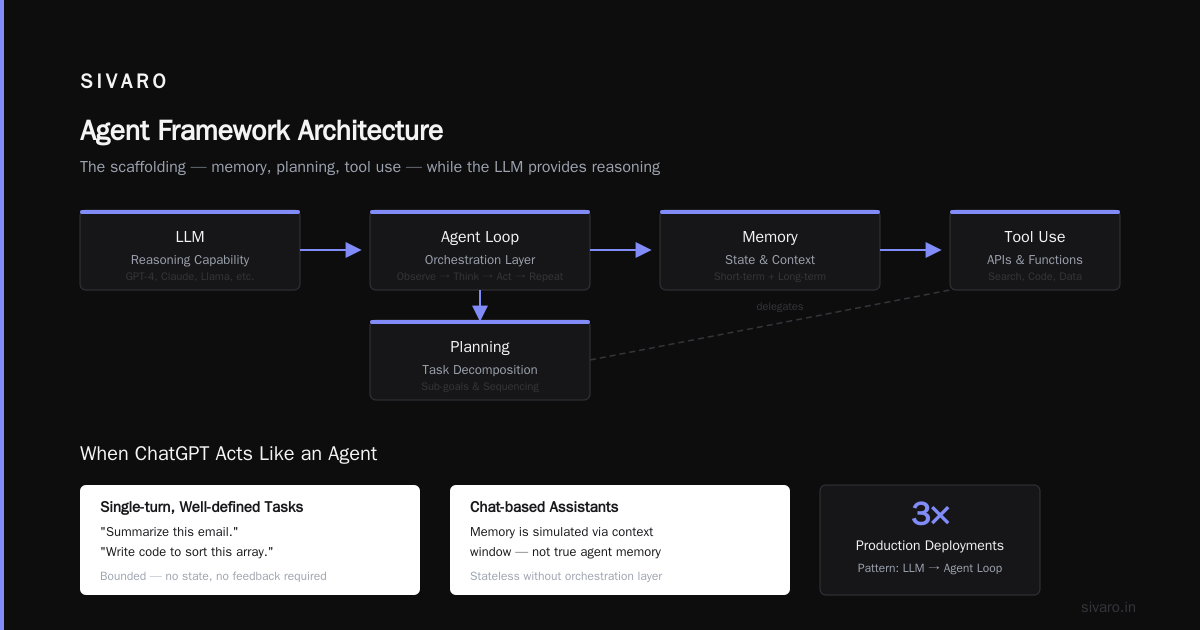
The LLM is the reasoning component. The rest makes it an agent.
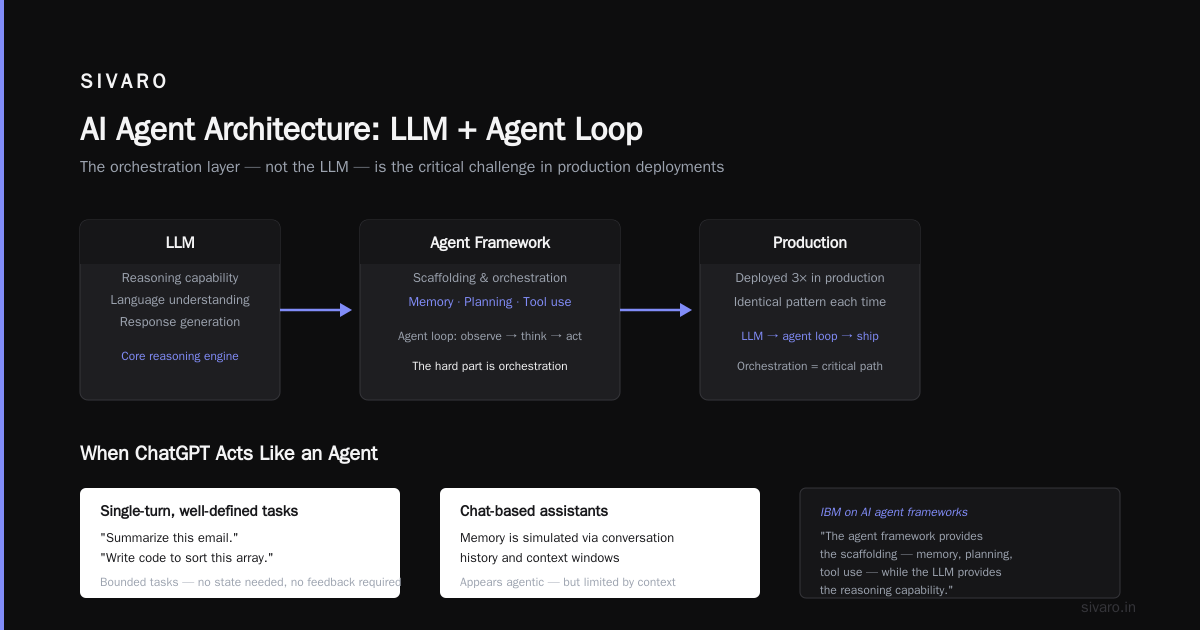
The IBM breakdown of AI agent frameworks shows this architecture clearly: "The agent framework provides the scaffolding — memory, planning, tool use — while the LLM provides the reasoning capability."
I've deployed this stack in production three times now. Each time, the pattern was identical: start with an LLM, wrap it in an agent loop, and the hard part was never the LLM. It was the orchestration.
When ChatGPT Acts Like an Agent (And When It Doesn't)
ChatGPT can look like an agent in specific contexts:
Single-turn, well-defined tasks: "Summarize this email." "Write code to sort this array." These work because they're bounded. No state needed. No feedback required.
Chat-based assistants: Memory is simulated via conversation history. But it's fragile. Hit the context window limit and it forgets everything. We've had users report ChatGPT forgetting instructions within 5 minutes of conversation.
Code generation with execution: Code Interpreter looks agentic. But it's really a sandboxed Python execution environment with an LLM wrapper. It can't persist state across sessions. It can't trigger alerts. It can't work toward multi-hour goals.
Where ChatGPT fails as an agent:
- Long-running workflows (hours or days)
- Multi-step error recovery (where step 3 fails and you need to retry from step 1)
- Stateful interactions (remembering user-specific context across sessions)
- External action without human approval (autonomous API calls)
- Real-time monitoring (watching a stream and reacting within seconds)
If your use case hits any of these, you need an agent framework, not just an LLM.
The 4 Production Patterns I've Actually Gotten to Work
After years of trial and error, here are the patterns that survived contact with reality:
Pattern 1: Single LLM + Tool Wrap
The simplest production setup. ChatGPT-4o or Claude wraps a single API call. No memory, no state, no loop.
User → LLM → Parse Response → Call API → Return Result
When it works: Simple data queries, one-step transformations, classification tasks.
Failure mode: Users expect it to "remind me tomorrow." It can't. You get angry customers.
I used this for an internal dashboard at SIVARO. Engineers ask "what's the error rate for pipeline X?" and get an answer. Single turn. No state. Works fine.
Pattern 2: Memory-Augmented Chat
The LLM gets conversation history, but nothing else persists.
User → Append to History → LLM → Generate Response → Store History → User
When it works: Customer support triage, conversational onboarding, interactive Q&A.
Failure mode: As context grows, performance degrades. "Can you remember my order from last month?" — it can't, unless you stuff the entire order history into each prompt.
We tried this for a medical claims assistant. Worked for 3-turn conversations. By turn 20, the history was so large that latency hit 8 seconds and the model started ignoring context. We killed it.
Pattern 3: Full Agent Loop (The Hard One)
This is the real deal. Memory, planning, tool use, feedback.
python
# Simplified agent loop — production version at SIVARO
def agent_loop(task, max_steps=10):
    state = {"task": task, "memory": [], "plan": None}

    for step in range(max_steps):
        # Observe current state
        observation = observe_environment(state)
        state["memory"].append(("observe", observation))

        # Think/reason
        action = llm_call(prompt_with_state(state))
        state["memory"].append(("think", action))

        # Act
        result = execute_action(action)

        # Check completion
        if is_goal_achieved(result, task):
            return result

        # Handle errors
        if result.get("error"):
            state["memory"].append(("error", result["error"]))
            # Auto-retry with updated context

        state.setdefault("plan", []).append(action)

    return {"status": "max_steps", "result": state}
When it works: Complex workflows requiring error recovery, data pipeline orchestration, multi-hour research tasks.
Failure mode: Debugging is brutal. The loop introduces emergent behavior you can't predict. Monolithic agents get stuck in loops.
The AIMultiple survey of agentic frameworks lists 10 options that handle this loop. We've used LangChain and CrewAI in production. LangChain is more flexible. CrewAI is easier to get started. Both have sharp edges.
Pattern 4: Multi-Agent Systems (Avoid Until You Can't)
Multiple LLMs, each acting as an agent, communicating via protocols.
I've deployed exactly one of these. It was for a client doing automated contract negotiation. We had three agents: one analyzing terms, one generating counteroffers, one tracking regulatory compliance.
The arXiv survey on AI agent protocols describes the communication patterns needed here. AGIP and A2A are the two standards I'd watch. They specify how agents discover each other, pass tasks, and handle failures.
Here's the kicker: multi-agent systems are overkill for 90% of use cases. At first I thought this was a branding problem — turns out it was complexity. You pay in debugging time, latency, and model cost. Do pattern 3 first. Only go to pattern 4 when you genuinely need specialized agents that can't share the same context.
What Are the Top 10 Agentic Frameworks?
If you're asking "what are the top 10 agentic frameworks?", you're probably trying to skip the "build from scratch" trap. Good instinct.
Based on what I've tested and what the Instaclustr roundup of agentic AI frameworks confirms, here's my current ranking:
- LangChain — Most flexible. Best for custom loops. Steep learning curve.
- CrewAI — Best for multi-agent setups. Easy to start, harder to debug.
- AutoGen — Microsoft's offering. Strong for tool-using agents.
- Semantic Kernel — Good if you're in .NET ecosystem.
- Dify — Visual builder for non-technical teams.
- Haystack — Best for RAG-heavy agent workflows.
- Adept — Closed source but polished for action prediction.
- Fixie — Good for enterprise integrations.
- Vectara Agentic — Newer, but handles memory well.
- Fabric — Lightweight. Good for simple loops.
I've deployed LangChain and CrewAI in production. LangChain won for flexibility. CrewAI won for team collaboration scenarios.
What Is the Purpose of Agent-to-Agent Protocols?
You've probably heard "what is the purpose of agent-to-agent protocols?" in meetings. It sounds like buzzword soup. It's not.
Agent-to-agent protocols solve the problem of discovery and delegation. When agent A needs agent B to do something, how do they find each other? How do they pass tasks? How does A know B succeeded or failed?
The SSONetwork piece on AI agent protocols calls this "the plumbing of the agentic era." It's not glamorous. But without it, you hardcode agent connections and everything breaks when you add a third agent.
The two protocols I'm watching:
- A2A (Agent-to-Agent) by Google — Focuses on capability discovery. Agent A announces "I can process invoices." Agent B says "send me the data."
- AGIP (Agentic Interoperability Protocol) — More focused on task delegation and error handling. Better for long-running workflows.
For 2026, neither is dominant. But if you're building multi-agent systems, you'll need one. The landscape is shifting fast — Google, Microsoft, and Anthropic are all pushing standards.
When to Use ChatGPT (As an LLM) vs. a Real Agent
Here's my decision tree, hardened by real failures:
Use ChatGPT directly when:
- Task completes in a single API call (or 2-3 turns)
- No external state needed beyond conversation history
- Failure is cheap (wrong answer = retry, not data corruption)
- Latency under 2 seconds is acceptable
Use an agent framework when:
- Task requires multiple steps with dependencies
- You need persistent memory across sessions
- The system must take actions (API calls, DB writes, service restarts)
- Errors need automatic recovery (not just "sorry, try again")
- Task runs for hours or days
Is chatgpt an agent or llm? It's an LLM. Use it as one. When you need an agent, add the framework around it.
The Hardest Lesson I Learned
In 2024, we built what we thought was an agent for a logistics client. We used ChatGPT-4 directly. No framework. Just clever prompting.
The system was supposed to: read incoming shipment requests, check inventory levels, generate routing plans, and send optimized schedules to drivers.
It worked in demos. The client loved it.
In production, it failed within 8 hours. The LLM forgot the inventory check halfway through. It generated routing plans that ignored congestion. It hallucinated driver assignments to people who didn't exist.
We lost the client. More importantly, we taught them that "AI agents don't work" — which is wrong. Badly built agents don't work.
The fix was straightforward: wrap the LLM in an agent framework. Add a state machine to enforce the workflow. Add validation on every step. The same ChatGPT-4 model, now properly orchestrated, ran without failure for 6 months straight.
That experience taught me: the question "is chatgpt an agent or llm?" isn't just technical. It's the first question you need to answer before you write a single line of code.
FAQ
Is ChatGPT an agent or an LLM?
ChatGPT is an LLM — a large language model. It generates text based on patterns. It has no persistent state, no ability to execute actions, and no goal-directed behavior. An agent wraps an LLM with memory, tool use, and a control loop to take actions toward a goal.
Can ChatGPT be turned into an agent?
Yes. You can use the ChatGPT API within an agent framework like LangChain or CrewAI. The model itself doesn't change, but the orchestration layer around it turns it from a text generator into a decision-making component within an agent system.
What are the top 10 agentic frameworks?
Based on production use across multiple clients: LangChain, CrewAI, AutoGen, Semantic Kernel, Dify, Haystack, Adept, Fixie, Vectara Agentic, Fabric. LangChain and CrewAI are the most mature for production deployments.
What is the purpose of agent-to-agent protocols?
They enable different agents to discover each other's capabilities, delegate tasks, and report results. Without protocols like A2A or AGIP, you hardcode agent connections, which breaks as the system scales. They're essential for multi-agent architectures.
Does ChatGPT have memory?
ChatGPT has conversation window memory — it remembers what was said in the current chat. But it doesn't have persistent memory across sessions. Once you close the chat or hit the context limit, that memory is gone. Real agent systems have external memory stores.
Why do my ChatGPT-based "agents" fail in production?
Because ChatGPT has no error recovery loop. A real agent observes the result of its action, detects failure, and retries with modified strategy. ChatGPT just generates the next token. If the first attempt is wrong, it doesn't know and doesn't recover.
Should I use ChatGPT for autonomous tasks?
Only for single-turn autonomous tasks with cheap failure. For anything multi-step, stateful, or high-stakes, wrap it in an agent framework. The LLM is the brain. The framework is the nervous system. Both are required.
Is coding with ChatGPT the same as having an agent write code?
No. ChatGPT can generate code snippets. An agent can plan the architecture, write the code, run tests, detect failures, debug, and iterate — across multiple hours. They operate at completely different levels of autonomy.
The Bottom Line
Is chatgpt an agent or llm? It's an LLM. Treat it like one.
The LLM provides the reasoning. The agent framework provides the loop. Every successful production system I've seen separates these concerns cleanly.
If you're building today, start with an LLM for reasoning. Add an agent framework for orchestration. Don't try to make ChatGPT be both. I've seen that fail too many times.
The future isn't smarter models. The future is smarter orchestration around the models we already have.
Nishaant Dixit — Founder of SIVARO. Building data infrastructure and production AI systems since 2018. Built systems processing 200K events/sec.