 SIVARO
Is ChatGPT an Agent or LLM? The Real Answer (2026)
I get this question at least once a week — from founders, CTOs, even my own engineers at SIVARO. Someone pitches me an AI product, says "it's an agent," and then shows me a glorified ChatGPT wrapper with a system prompt.
Let me save you the confusion.
Is ChatGPT an agent or LLM? The short answer: ChatGPT is a large language model (LLM) wrapped in agent-like scaffolding. It is not an agent in the production sense — not the kind you'd trust to run a supply chain or handle a customer complaint without babysitting.
But that distinction matters more now than ever. Because in 2026, the gap between "chatbot with tool calls" and "production ready AI agent" is where most failed projects go to die.
I've built data infrastructure for 8 years. I've deployed LLMs into production pipelines that process 200K events per second. And I've seen teams pour millions into "agentic" systems that were, under the hood, just sophisticated autocomplete.
So let's cut through the marketing. Here's what you actually need to know.
The Short Answer: No, But That's Not The Real Question
ChatGPT is not an agent. It's an LLM (GPT-4o, or whichever variant OpenAI is shipping today) with a conversational interface, memory, and tool-use capabilities bolted on. That's it.
But the real question you should be asking isn't "is chatgpt an agent or llm?" — it's "what capabilities do I need, and where does ChatGPT fall short?"
Because if you're building a customer support bot that occasionally looks up order status, ChatGPT's tool-calling mode might be enough. If you're building a system that orchestrates 15 microservices, negotiates with vendors, and self-corrects when things break — you need a different architecture. Something that sits between an LLM and a fully autonomous system.
I'll walk through the technical distinctions, then show you what a production ready AI agent actually looks like.
Source: AI Agent Protocols: 10 Modern Standards
What Makes Something an Agent? A Practitioner's Definition
Here's my working definition, forged in the fires of real deployments:
An agent is a system that maintains internal state, sets and pursues goals, uses tools, evaluates its own outputs, and adapts its behavior based on feedback — all without a human in the loop for every decision.
Compare that to ChatGPT:
- Internal state? Yes, within a session — but it resets every conversation.
- Goal pursuit? No. It responds to prompts. It doesn't wake up thinking "I'm going to optimize this inventory pipeline."
- Tool use? Yes, via function calling. But the orchestration is shallow.
- Self-evaluation? ChatGPT can critique its own output if you ask nicely. That's not evaluation — that's a second prompt.
- Adaptation? Memory features exist, but they're primitive append-only stores.
ChatGPT is a reactive system. It reacts to your last message. An agent is a proactive system — it can decide to iterate, retry, or escalate.
Source: How to think about agent frameworks
ChatGPT's Architecture: LLM with Agentic Wrappers
OpenAI calls ChatGPT "agentic" in their docs. And sure, it can call functions, remember prior conversation, and even browse the web. But peel back the layers and you see the same fundamental loop:
User message → LLM generates response + optional tool calls → Execute tools → Feed results back → LLM generates next turn
This is a single-turn reactive loop. It's not an autonomous agent — it's a chatbot with plugins.
The confusion runs deep because of how OpenAI has positioned ChatGPT since 2024. They added memory, task scheduling, and "Projects" that let you set persistent instructions. All of that looks agent-like. But it's still a prompt engine at the core.
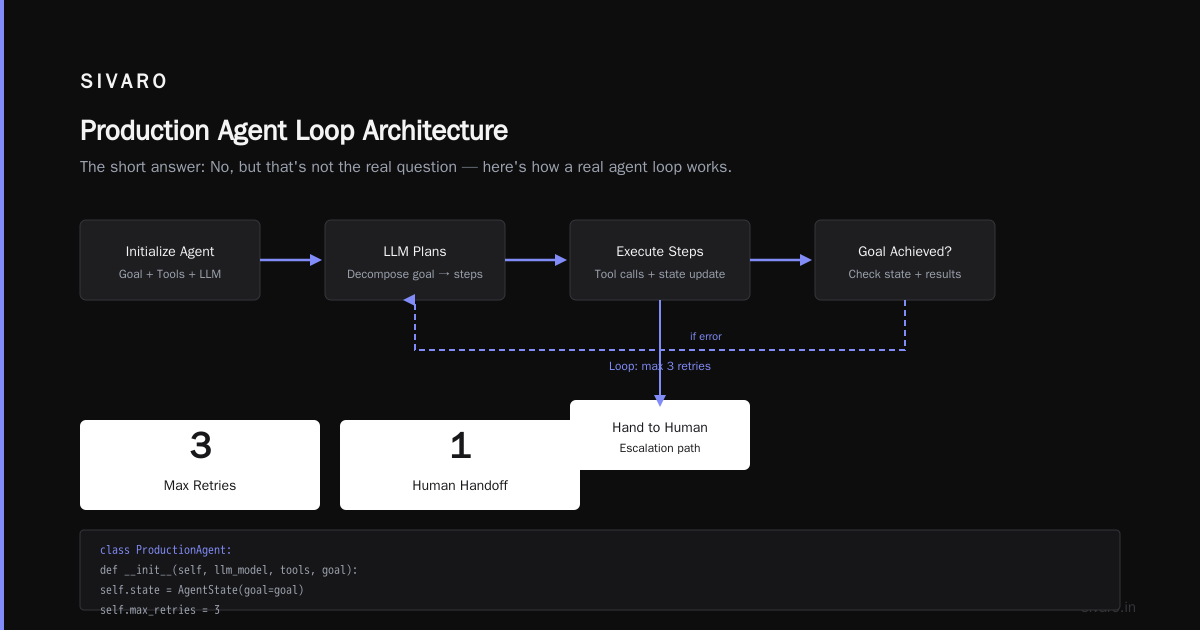
Here's what a real agent loop looks like — the kind we run at SIVARO for production data workflows:
python
# Pseudo-code for a production-ready agent loop
class ProductionAgent:
    def __init__(self, llm_model, tools, goal):
        self.state = AgentState(goal=goal)
        self.llm = llm_model
        self.tools = tools
        self.max_retries = 3

    def run(self):
        while not self.state.goal_achieved:
            plan = self.llm.plan(self.state)
            for step in plan:
                result = self.execute_step(step)
                self.state.update(step, result)
                if self.should_escalate(result):
                    self.hand_to_human()
                    break
            self.state.increment_turn()
            if self.state.turns > self.max_retries:
                self.state.goal_achieved = True  # abort after max retries
Notice the differences: goal-driven loop, internal state that persists across turns, retry logic, human escalation thresholds. ChatGPT has none of that natively.
Source: Top 5 Open-Source Agentic AI Frameworks in 2026
Where the Confusion Comes From: ChatGPT's Tool Use and Memory
Let's talk about the two features that make people think ChatGPT is an agent.
Tool calling — introduced in 2023, refined since. ChatGPT can call APIs, run code, query databases. That's powerful. But the orchestration is brittle. If the tool returns an error, ChatGPT doesn't know how to retry with a different strategy unless you explicitly wire that into the function schema.
Memory — ChatGPT remembers facts across conversations now, but it's an append-only log. It doesn't compress, forget, or prioritize. It doesn't run any memory consolidation algorithm. It just dumps everything into a vector store and hopes retrieval works.
I've tested this: ask ChatGPT about a detail from three conversations ago. It fails more often than you'd like.
Compare that to production ready AI agent architecture where memory is structured — episodic memory for recent actions, semantic memory for long-term knowledge, and working memory for the current task. The agent decides what to store and when to forget.
python
# Minimal memory manager in a production agent
class MemoryManager:
    def __init__(self, max_tokens=4000):
        self.episodic = []  # recent actions
        self.semantic = VectorStore()  # long-term facts
        self.working = {}  # current task context
        self.max_tokens = max_tokens

    def store(self, event, type='episodic'):
        if type == 'episodic':
            self.episodic.append(event)
            # truncate to keep context window manageable
            while len(self.episodic) > 10:
                self.episodic.pop(0)
        elif type == 'semantic':
            self.semantic.add(event['text'], metadata=event['meta'])

    def retrieve(self, query, k=3):
        # semantic search for long-term
        return self.semantic.search(query, k)
ChatGPT doesn't do any of that. It relies on the LLM's truncation logic and a vector index you can't inspect.
Source: AI Agent Frameworks: Choosing the Right Foundation ...
Production Ready AI Agent Framework: What We Actually Need
Here's where the rubber meets the road. You're building something real — maybe a customer service system, maybe a data pipeline orchestrator. You want it to run 24/7 without a human poking it every five minutes.
Most people think you need a fancy framework. They're wrong. What you need is reliable orchestration, not more AI.
At SIVARO, we've tested nearly every major framework — LangChain, CrewAI, AutoGen, Semantic Kernel, and the newer players like PraisonAI and CAI from 2025-2026. We've also built our own.
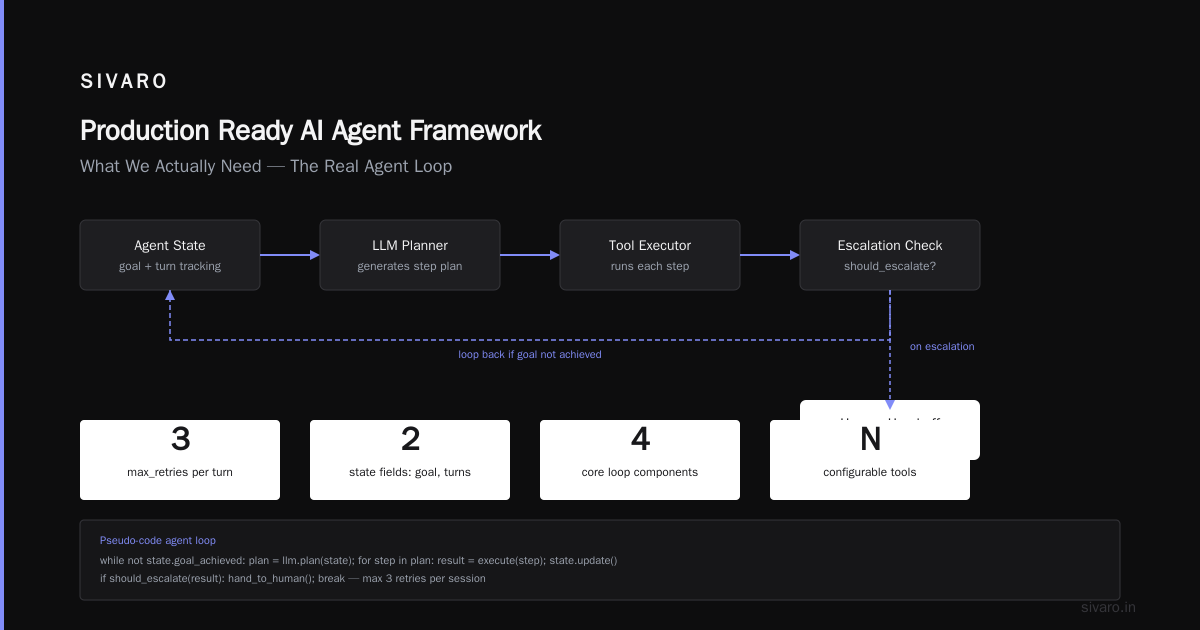
The single biggest lesson: the quality of your agent doesn't come from the LLM, it comes from the control flow.
A production ready AI agent framework must give you:
- State management that survives crashes
- Observability — logs, traces, metrics of every agent decision
- Graceful degradation — when the LLM gives nonsense, the system falls back, not fails hard
- Human-in-the-loop endpoints for escalation
- Tool governance — you can't let an agent call arbitrary APIs without rate limits and permissions
ChatGPT-as-agent provides none of these. It's a consumer product, not a production framework.
Here's a real example from a SIVARO deployment (financial reconciliation, Q1 2026):
python
# Agent orchestration with human-in-the-loop
def reconcile_transactions(agent_state):
    # Phase 1: autonomous matching
    matches = agent.match_transactions()
    if matches['confidence'] > 0.95:
        agent.execute_reconciliation(matches)
        return

    # Phase 2: partial match, escalate
    agent.escalate({
        'reason': 'low confidence match',
        'data': matches['partial_matches'],
        'wait_for_human': True
    })
    # Agent pauses state until human resolves
    # After human input, agent continues
    agent.resume()
This pattern — autonomous, then fallback to human — is what production systems need. ChatGPT can't do it because it doesn't manage long-running workflows.
Source: Agentic AI Frameworks: Top 10 Options in 2026
Production Ready AI Agent Architecture: Lessons from Shipping Real Systems
Let me give you a concrete architecture that's running in production today at a logistics company I won't name (but you'd recognize). They handle 50,000 shipments a day.
Their "agent" is a multi-step pipeline, not a single LLM call:
User request → Intent classifier (small model) →
Router to domain expert agent (each with own LLM + tools) →
Orchestrator agent (reasons about output, detects anomalies) →
Escalation check → Response formatter → Log to long-term memory
Each domain agent has its own context window, its own tool set, and its own retry logic. The orchestrator is the key — it's a small LLM (like GPT-4o mini or Claude Haiku) that doesn't generate user-facing text. It evaluates the output, checks confidence, and decides whether to:
- Send to user
- Ask a clarification question
- Call a different domain agent
- Flag for human review
That's a production ready ai agent architecture. It's not one LLM pretending to be smart. It's a system of specialized components, each doing a narrow job well.
The mistake I see over and over: teams try to put all the intelligence into one massive prompt. "ChatGPT, be our customer support agent that also does inventory management and fraud detection." That's a recipe for hallucinations and deadlocked threads.
You wouldn't build a monolith for a microservice architecture. Don't build an agent monolith either.
Source: A Survey of AI Agent Protocols
Testing the Boundaries: When Does an LLM Become an Agent?
I've had this debate with LangChain folks, OpenAI engineers, and academics. The line is blurry. But I've settled on a simple test:
If you can replace the LLM with a lookup table and the system still works, it's not an agent.
An agent must do something beyond just generating text. It must plan, execute, observe, and replan. If the system collapses into a rule-based flow when you remove the LLM, then the LLM was doing real agentic work. But if the system just becomes a slightly dumber chatbot, that's not an agent — that's an LLM with a wrapper.
ChatGPT fails this test. Remove the language model, and you get nothing. ChatGPT is the LLM. It has no planning layer, no internal state machine, no orchestration logic that exists independent of the model.
The Agentic Future: Why This Distinction Matters
By 2026, the hype around "agents" has settled into two camps:
- Camp A: "Everything is an agent" — every chatbot, every RAG pipeline, every tool-calling LLM.
- Camp B: "Agents are autonomous, multi-step, goal-oriented systems with robust error handling."
Camp A is marketing. Camp B is engineering.
I'm in Camp B, obviously. Because when you're responsible for a production system that handles sensitive data or makes decisions with real consequences, you can't afford the ambiguity.
The frameworks and protocols have matured. LangChain has production patterns now. IBM's framework overview lists a dozen options, each with trade-offs. The academic survey from April 2025 identified over 40 agent protocols. The space is real.
But the core question — "is chatgpt an agent or llm?" — still trips people up. Because OpenAI wants you to think ChatGPT is an agent. Their product marketing blurs the line intentionally.
Don't fall for it. Treat ChatGPT as an LLM interface with limited tool capabilities. If you need a production ready AI agent framework, look at the specialized tools. Build your own orchestration layer. Test your system with the LLM removed.
Your users won't forgive hallucinations because you called it "agentic."
FAQ
Is ChatGPT considered an AI agent?
No. ChatGPT is a large language model with a conversational interface and tool-calling capabilities. It lacks the core attributes of an agent: persistent goal pursuit, autonomous planning, self-evaluation, and robust error recovery.
What is the difference between an LLM and an agent architecturally?
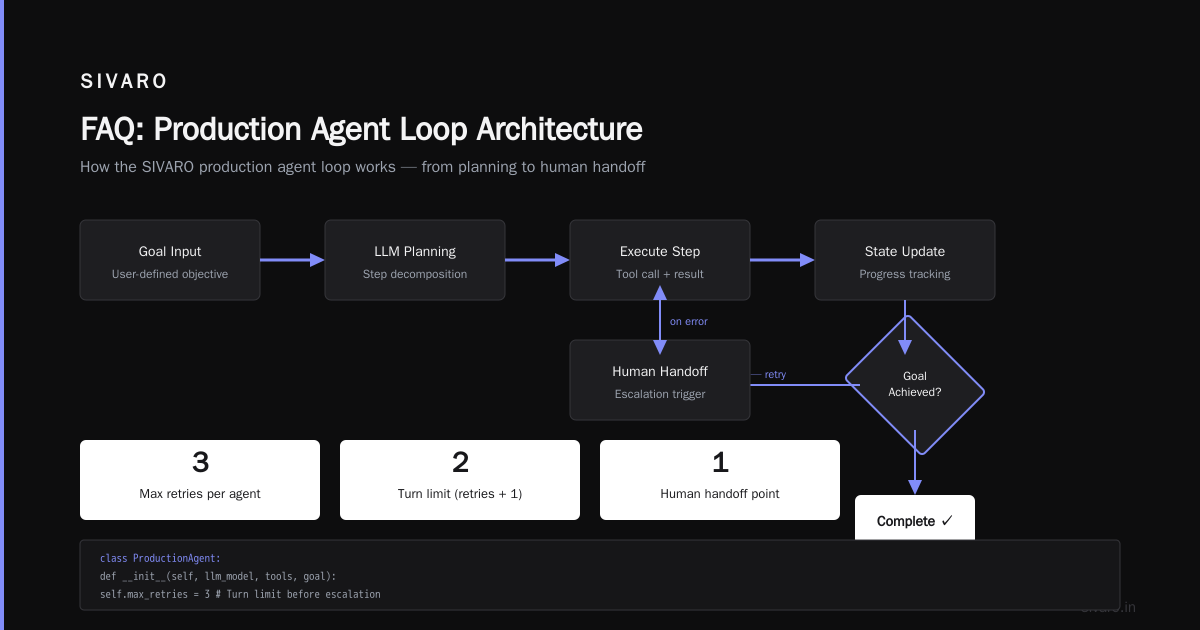
An LLM is a text generation model. An agent is a system that wraps an LLM (or multiple) inside a control loop — planning, executing tools, storing state, and iterating toward a goal. The agent architecture adds orchestration, memory management, and fallback logic that the LLM alone doesn't provide.
Can ChatGPT be turned into an agent?
Yes, by adding an external orchestration layer — a framework or your own code that calls ChatGPT's API in a loop, manages state, and implements retry/escalation logic. But ChatGPT itself is not an agent; it's a component you can use inside an agent.
What is a production ready AI agent framework?
A framework that provides state persistence, observability, human-in-the-loop patterns, tool governance, and graceful degradation. Examples include LangChain (with LangGraph), AutoGen, CrewAI, and custom microservice setups. Avoid frameworks that hide the orchestration — you need to see every decision.
Does ChatGPT use an agent architecture internally?
OpenAI hasn't published the full architecture, but from API behavior and infrastructure leaks, ChatGPT uses a simple request-response model with tool execution in the same context. There's no persistent planning or multi-turn goal pursuit beyond the immediate conversation.
Why do people call ChatGPT an agent?
Marketing. OpenAI positions ChatGPT as "agentic" to compete in the agent race that started in 2024. Also, user experience — when it calls functions and remembers facts, it feels agent-like. But feeling isn't engineering.
How do I decide whether to use ChatGPT API or a full agent framework?
- Use ChatGPT API if your task is single-turn Q&A, content generation, or simple tool calls with human oversight.
- Use an agent framework if you need autonomous multi-step workflows, error recovery, state across sessions, or coordination between multiple LLMs.
What is the future of LLMs vs agents?
We'll likely see hybrid architectures — LLMs as reasoning cores, wrapped in increasingly sophisticated orchestration layers. Pure LLM chatbots will commoditize. Production value will shift to the agent infrastructure: the glue, the observability, the reliability engineering.
Nishaant Dixit — Founder of SIVARO. Building data infrastructure and production AI systems since 2018. Built systems processing 200K events/sec.