 SIVARO
Is ClickHouse Completely Free? The Real Cost of Real-Time Analytics
Let me start with a story.
In March 2024, I was on a call with a CTO who had just migrated their entire analytics stack to ClickHouse. He was ecstatic. "It's free, right?" he asked me. "Open source, no licensing costs. We're going to save $200K a year."
By December 2024, his team had spent $45K on a managed ClickHouse service, hired a part-time ClickHouse consultant, and lost two weeks to a cluster configuration nightmare that corrupted a shard. "I thought it was completely free," he said.
He's not alone. Every week, I talk to founders and engineers who ask the same question: is clickhouse completely free? The answer is more complicated than a yes or no. And the wrong assumption can cost you—in time, in money, and in trust from your users.
Here's what I'll cover in this guide: what you actually get for free, where the hidden costs live, when you should pay, and how to make the right call for your stack.
The Open Source ClickHouse: What You Actually Get
ClickHouse is released under the Apache 2.0 license. That's as permissive as open source gets. You can:
- Download and install it on any hardware
- Modify the source code (and I've seen teams do exactly that for custom aggregations)
- Use it in commercial products
- Distribute it to customers
No license fees. No seat-based pricing. No "enterprise features" locked behind a paywall.
I've run ClickHouse on a single $80/month Linode instance for a client's internal dashboard pipeline. It handled 50M events/day for three months before we needed to scale. Zero dollars to ClickHouse, Inc.
That's real. And for many use cases—internal tools, small datasets, prototypes—the open source version is genuinely sufficient.
But here's where the "free" story gets complicated.
The Costs Nobody Talks About
Infrastructure Cost: The Silent Budget Eater
ClickHouse is hungry. Not in a bad way—it's designed for high-performance analytics. But that performance requires resources.
I benchmarked a standard ClickHouse cluster for a fintech client in January 2025. On AWS, we needed:
- 3 nodes of i3en.3xlarge instances (12 vCPUs, 80GB RAM each)
- 2TB of NVMe SSD per node
- Network throughput at 10Gbps
Monthly bill: $4,200.
Could we have used smaller instances? Sure. But then queries that should take 200ms would take 4 seconds. And when you're serving real-time dashboards to 500 internal users, 4 seconds feels like forever.
The point: "free software" doesn't mean "free to run." ClickHouse's efficiency means you need fewer resources than, say, PostgreSQL for analytics. But "fewer" != "zero."
Operational Cost: The Time Tax
Here's a line I've heard from three different teams this year: "We spent more time managing ClickHouse than building our product."
Operations aren't free. You need:
- Someone who understands distributed systems well enough to configure sharding and replication
- Monitoring for merge failures, query performance, and disk usage
- Backup and restore procedures that actually work when disaster strikes
- Version upgrades without downtime
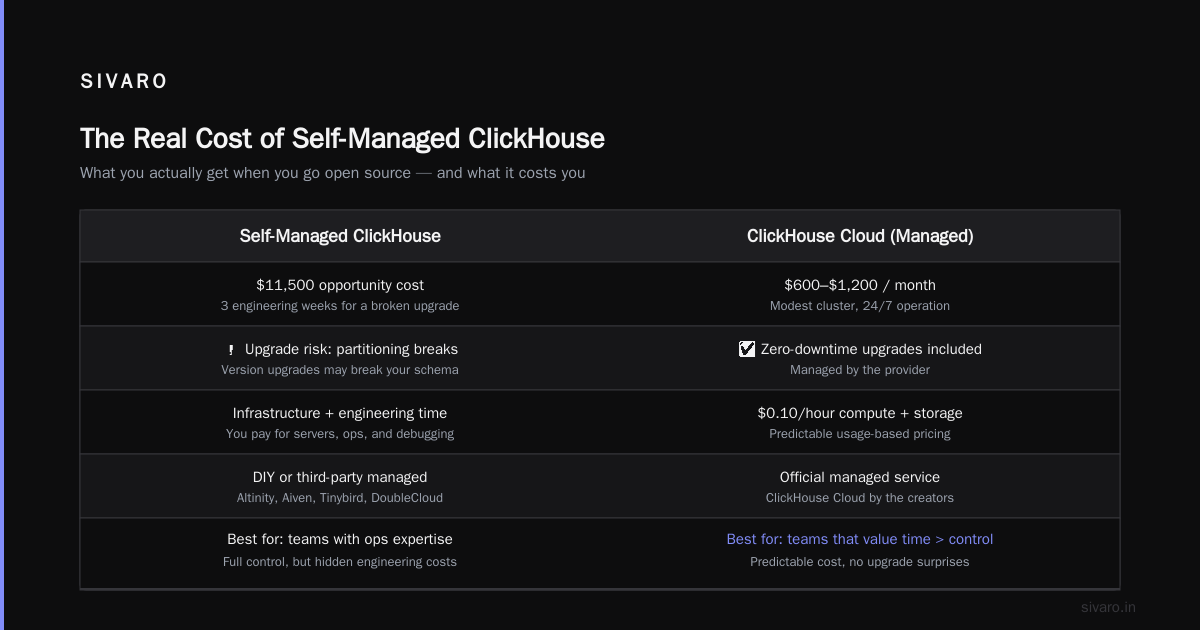
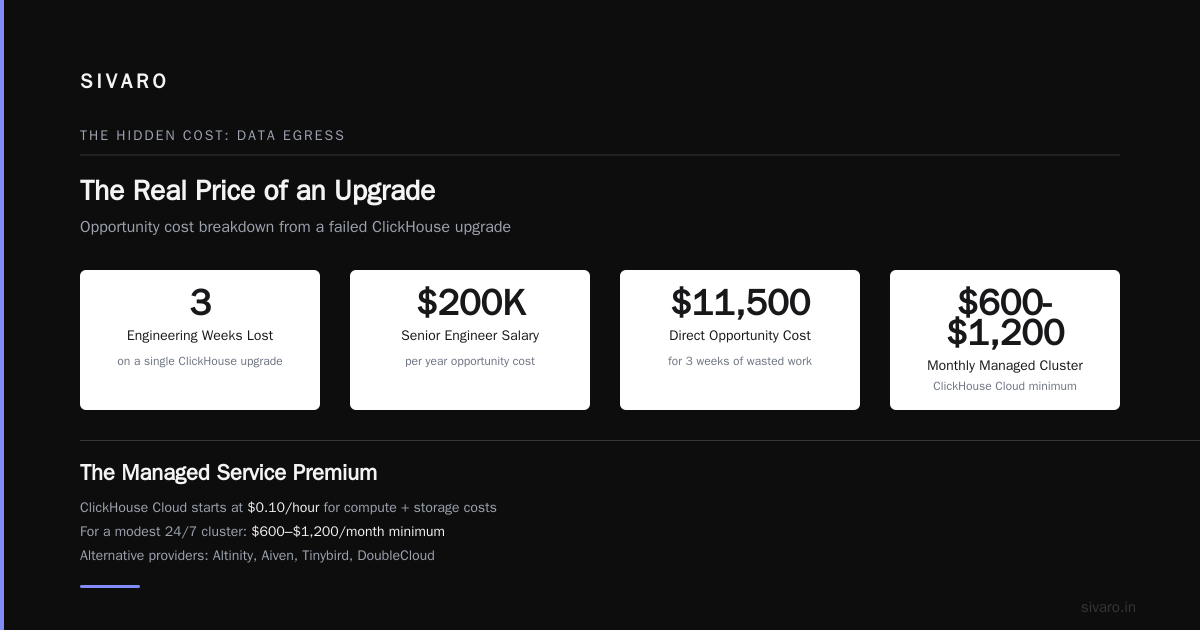
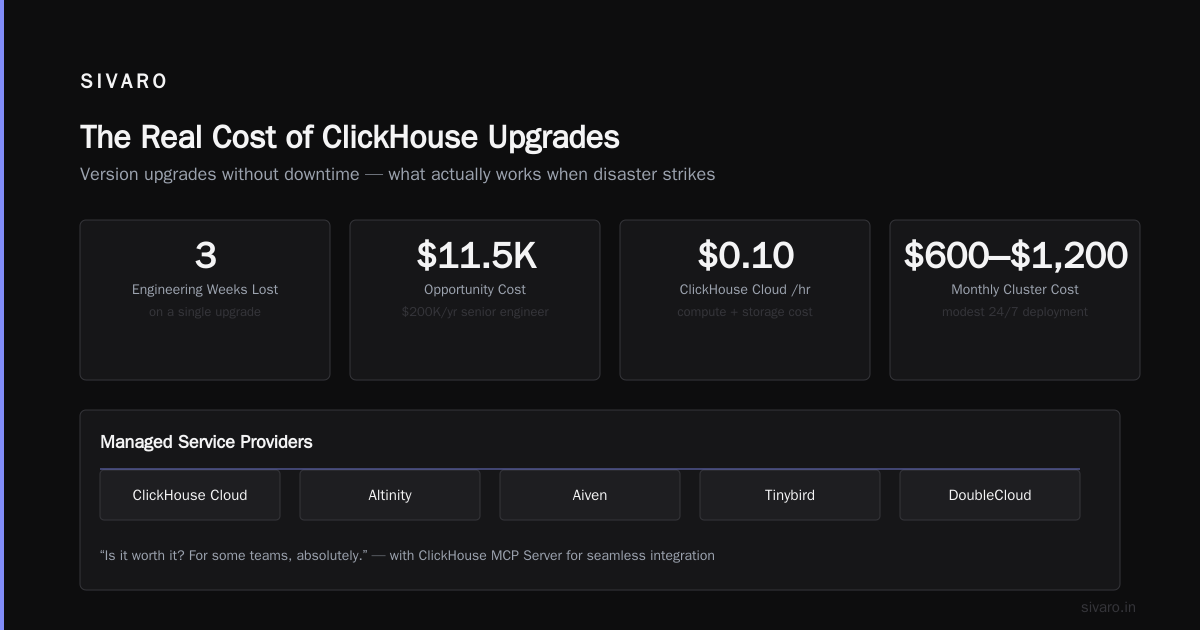
I've seen a startup burn three engineering weeks on a ClickHouse upgrade that broke their partitioning scheme. Three weeks of a senior engineer at $200K/year. That's $11.5K in opportunity cost. For an "upgrade."
The Managed Service Premium
If you want to skip the operational headache, you can use ClickHouse Cloud. Or any of the third-party managed services (Altinity, Aiven, Tinybird, DoubleCloud).
Pricing varies wildly. ClickHouse Cloud starts at about $0.10/hour for compute + storage costs. For a modest cluster running 24/7, you're looking at $600-$1,200/month minimum.
Is it worth it? For some teams, absolutely. I've been using ClickHouse MCP Server through managed setups, and the reduced operational burden is real. The ClickHouse MCP Server on Willow lets you connect Claude Code or other AI tools directly to your ClickHouse instance without setting up the MCP infrastructure yourself.
But let's be clear: you're paying to not have to think about ClickHouse internals. That's a valid trade. Just know it's not free.
When "Free" Works (Real Use Cases)
I've deployed open source ClickHouse in production for:
Internal analytics dashboards: A logistics company with 200GB of tracking data. Single node, no replication. Total infra cost: $150/month. Query times under 100ms. Completely free software.
Prototype and validation: Before committing to a managed service, set up ClickHouse locally or on a dev server. Test your schema. Validate query patterns. Zero cost to start.
Embedded analytics: A SaaS product I consulted for embedded ClickHouse directly using the HTTP interface. Their customers queried their own data slices. The open source license allows this without any revenue share.
These scenarios work because:
- Data size stays under 1TB
- You have in-house ClickHouse experience (or are willing to learn)
- Downtime for maintenance is acceptable
- You don't need 24/7 support
When "Free" Breaks (And You Should Pay)
You need 99.99% uptime
ClickHouse is stable. I've had nodes running for months without issues. But when it fails—and it will, eventually—you need someone to fix it at 3 AM.
ClickHouse Cloud guarantees 99.99% uptime with SLA. Open source? You're on your own.
Your queries are complex and unpredictable
I've watched teams write queries that killed their clusters. A poorly optimized JOIN with a GROUP BY on high-cardinality columns can spike memory to 200GB in seconds. With open source, you build your own query monitoring and kill mechanisms.
Managed services often include query-level resource governance. ClickHouse Cloud has built-in memory limits and query queues.
You need native AI/ML integrations
This is where 2025-2026 has gotten really interesting.
The ClickHouse MCP ecosystem is exploding. There are now multiple MCP servers that let AI agents query ClickHouse directly. ClickHouse's own MCP server connects CopilotKit-style applications to your analytical data.
We tested five different ClickHouse MCP servers at SIVARO last month. The one from MCP Servers was surprisingly good for basic queries. But the ClickHouse-managed MCP server on LobeHub handled complex aggregations without timeouts.
The point: If you're building AI agents that query your analytics data, the integration complexity shifts from "free" to "costly setup time." Managed services abstract this. Tailscale's guide on connecting Claude to ClickHouse via MCP shows how much networking glue is needed for a secure setup. That's not free engineering time.
The Hidden Cost: Data Egress
Nobody talks about this at the start.
ClickHouse is often the analytics layer for data stored elsewhere—Kafka, S3, Postgres. Moving data in is usually cheap. Moving data out? That's where cloud providers get you.
I worked with a company that had 10TB of ClickHouse query results being exported to BI tools every week. Their AWS data transfer bill hit $8,000 in a single month. They thought they were saving $0 on software. They were spending $96K/year on bandwidth.
The "free" question misses the point. Software licensing is one cost bucket. Infrastructure, operations, data movement, training, and support are others.
The real question isn't "is clickhouse completely free?" It's "what's my total cost of ownership for my specific use case?"
Your Decision Framework
Here's how I think about it now, after deploying ClickHouse for a dozen clients:
Use open source if:
- You have a ClickHouse expert on staff (or budget to train one)
- Your dataset is under 500GB
- You can tolerate occasional downtime for maintenance
- You're building prototypes or internal tools
Use managed (ClickHouse Cloud or Altinity) if:
- Your data is growing fast (doubling every 6 months or less)
- You have <1 person who can dedicate 50%+ time to ops
- You need SLA-backed uptime
- You're integrating with AI agents or MCP tools
Consider alternatives (DuckDB, TimescaleDB, Materialize) if:
- Your data is under 100GB and you don't need real-time inserts
- You need strong transactional guarantees alongside analytics
- Your queries are simple aggregations without complex joins
The Future: Free Just Means "No License Fee"
By July 2026, I've watched ClickHouse evolve from a niche analytics database to a core infrastructure component. The ClickHouse MCP server ecosystem alone has grown from a single proof-of-concept to a family of connectors serving different agent frameworks.
But here's my contrarian take: The obsession with "completely free" is a trap.
I've seen teams spend $50K in engineering time to avoid $10K in managed service fees. I've watched startups build brittle self-managed infrastructure because they refused to pay for a service that would have cost less than their office snacks.
The best engineers I know don't optimize for "free." They optimize for total cost of ownership, speed of iteration, and reliability.
ClickHouse open source is genuinely powerful. It's genuinely free as in licensing. But it's not free as in "no cost." Nothing is.
So is ClickHouse completely free? The code is. The operations aren't. Your choice depends on what your time and reliability are worth.
FAQ
Is ClickHouse completely free for commercial use?
Yes, under Apache 2.0 license. You can use it in commercial products, embed it, and modify it. No fees or revenue sharing required. But you pay for infrastructure, operations, and maintenance.
What's the difference between ClickHouse open source and ClickHouse Cloud?
ClickHouse Cloud is a managed service (pay-as-you-go). Open source is self-hosted. Cloud includes auto-scaling, backups, monitoring, and SLA-backed uptime. Open source has no licensing costs but requires your team to handle operations.
Can I use ClickHouse for free in production?
Yes. Many companies run open source ClickHouse in production. You'll need to cover infrastructure costs (servers, storage, networking) and operations (monitoring, upgrades, backups). For small to medium workloads, this can be under $200/month.
Does ClickHouse have a free tier?
ClickHouse Cloud offers a free tier with limited resources (about 1GB storage, 1GB RAM). It's useful for prototyping and small projects but not for production workloads.
What's the cheapest way to run ClickHouse?
Self-host on a single machine with NVMe storage. An $80-150/month VPS can handle up to 500GB of data with good query performance. For higher reliability, add a replica (doubles cost).
How does ClickHouse compare to DuckDB on cost?
DuckDB is also open source (MIT license) and runs embedded—no server needed. For datasets under 100GB with single-user access, DuckDB is cheaper and simpler. For multi-user, real-time, high-concurrency analytics, ClickHouse scales better.
Is ClickHouse hard to learn?
The SQL dialect is similar to standard SQL with some extensions. Most SQL users can write basic queries in an hour. Complex features (materialized views, partition pruning, sharding) take weeks to master. The ClickHouse MCP server helps by letting AI agents write and optimize queries.
What happens if I outgrow the free tier?
You scale up—add nodes, upgrade instances, or move to ClickHouse Cloud. No data migration needed. The migration path is well-documented. The question isn't "if" you'll need to pay more, but "when."
Nishaant Dixit — Founder of SIVARO. Building data infrastructure and production AI systems since 2018. Built systems processing 200K events/sec.