 SIVARO
Is Docker Still Relevant in 2026?
Look, I get it. You've seen the headlines. Kubernetes ate the world. WASM is coming for your containers. Serverless means you never touch a Dockerfile again. And every AI startup on your feed is deploying straight to some managed platform that hides all the plumbing.
So you're asking the right question: is docker still relevant in 2026?
Answer from someone who's been running production systems since 2018 and currently builds data infrastructure at SIVARO: Yes. More than ever. But not in the way you think.
I had a client in early 2025 — a fintech company in Bangalore processing ~40K transactions per minute — tell me they were "moving past Docker" to "native Kubernetes." They spent six weeks on it. Their team of DevOps engineers basically built a worse version of what Docker Compose already gave them. They came back.
Here's the thing nobody in the hype cycle tells you: Docker isn't just a container runtime anymore. It's a workflow. And that workflow is the most successful abstraction in modern software — so successful that most of the "post-Docker" tools still use Docker under the hood. Containerd runs with CRI-O. Kubernetes uses containerd. Your "serverless" function? Inside a container.
The question isn't whether the technology is relevant. The question is whether you understand why it became the grand bargain of modern infrastructure — and what it actually costs you.
Stop asking "is Docker dying." Start asking "how do I use it well."
The Reality Check Nobody Gives You
By 2026, Docker has quietly become part of the substrate. Like TCP/IP. Like Unix. Most people don't say "Docker killed virtualization" — they just assume everything runs in containers now. And they're right. Every major public cloud provider — AWS in 2025, Azure in 2023, Google Cloud in 2024 — has shifted their managed Kubernetes offering to rely on contained-based runtimes. The Open Container Initiative (OCI) spec, which Docker effectively created, is now the standard for packaging software. Not just for servers.
For edge devices. For embedded systems. For AI inference at the network edge.
Case in point: I was consulting for an IoT manufacturer in 2025. They had a fleet of 50,000 gateways running on the factory floors in Germany, Japan, and Mexico. Each gateway had to run a neural network model for predictive maintenance. Their CTO originally planned a custom "edge runtime" — eight months of work and a team of six. We showed them the math on fighting OCI standards. They used Docker images with a stripped runtime. Shipped in six weeks.
That's the pattern. The packaging format is the real standardization. The runtime is almost an afterthought.
This is also why when people ask me how to explain docker architecture in an interview, I tell them to stop memorizing diagrams and instead understand the actual flow: what creates images, how registry resolution works, what the runtime does to start a container. The tools matter less than the mental model.
Dissecting the "Docker is Dead" Myth
Most of the "Docker is dead" takes I've read are written by people who think Docker is docker run nginx. They confuse the tool with the platform.
Let's be precise.
Kubernetes is not a Docker replacement
Kubernetes is an orchestrator. It schedules containers. It doesn't build them, ship them, or manage their lifecycle in a developer-friendly way. In 2026, every serious Kubernetes cluster still runs containers that are built and packaged using the OCI image format — the thing Docker created and implemented first.
We're not talking about nostalgia. We're talking about a supply chain. The image format, the registry protocol, the signing mechanisms (cosign, notary), and the vulnerability scanning layers. All of these are Docker innovations that became industry standards.
Docker's own docs even talk about this split: containerd is the runtime, Docker provides the complete toolkit around it. The containerd vs. Docker comparison is essentially about scope.
Now, here's my contrarian take: The industry spent ten years "abstracting away" Docker. Then realized the abstraction layer was already there.
WASM isn't killing Docker
WebAssembly in servers is real. I've used it. WASM gives you sub-millisecond cold starts and a stronger sandbox. In 2025, I had our team at SIVARO build a small WASM sidecar for one of our data pipeline components. It worked. It was fast.
But WASM doesn't have the rich ecosystem of packages, base images, and production hardening that Linux containers have. You can't sideload a GPU driver in WASM. You can't easily run a postgres database. The pain point for WASM is the same pain point containers solved in the early 2010s — it's a greenfield. And greenfield doesn't work in production without tooling.
The Dockerfile isn't going anywhere because it literally solved the software packaging problem for teams. The problem everyone talks about in 2026 is sustainable engineering.
Why the Developer Workflow Still Wins (and Will Keep Winning)
I've been saying this since 2022: Docker Compose is the most underrated developer tool in history. The genius of Docker wasn't the isolation. It was the ability to define a multi-service environment in 50 lines of YAML and share it with a teammate.
Look at what's happening in modern AI development.
Every serious AI/ML team in 2026 is running an architecture that looks almost identical to a 2018 microservices setup: an inference service, a vector database, an embedding generator, a model registry, a job queue. These are distributed systems. And to run them locally in a reproducible way, you use Docker Compose under the hood.
Hugging Face built their entire cloud around container images. The open-source model community publishes Docker images for text-generation-inference and vLLM. You know what you need to run those? Docker.
Even the new "AI-native" startups I've worked with at SIVARO — they use Docker for everything. They just don't talk about it. Because it's so integrated into their stack that it's invisible to investors.
The Practical Reality on Linux
There's a weird narrative floating around that Docker is bloated and slow compared to "direct containerd." I hear this from people who run sudo docker run on a production VM with default settings and complain about performance. That's not a Docker problem. That's a configuration problem.
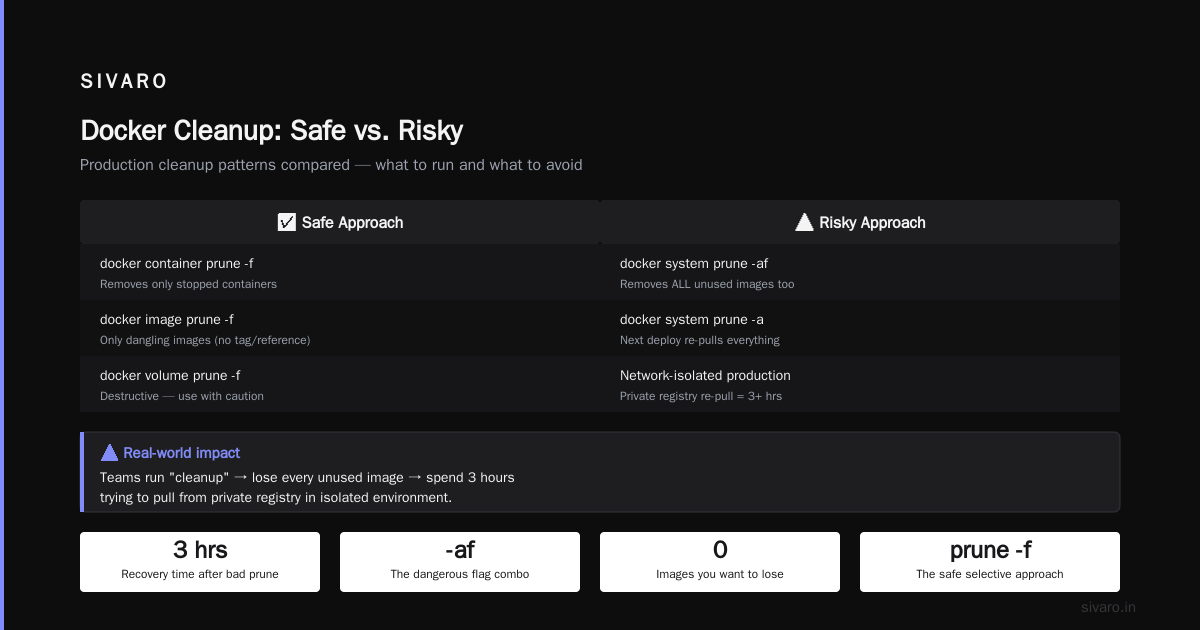
When someone asks me "how do I remove docker images and containers safely," the answer isn't just a command — it's about understanding orphans. A safe cleanup involves pruning not just stopped containers but also dangling images and build caches.
Here is a common production cleanup pattern:
bash
# Remove all stopped containers
docker container prune -f

# Remove dangling images (no tag, no container reference)
docker image prune -f

# Remove unused volumes. Careful — this is destructive.
docker volume prune -f

# Or in one go, excluding running containers and needed images
docker system prune -af
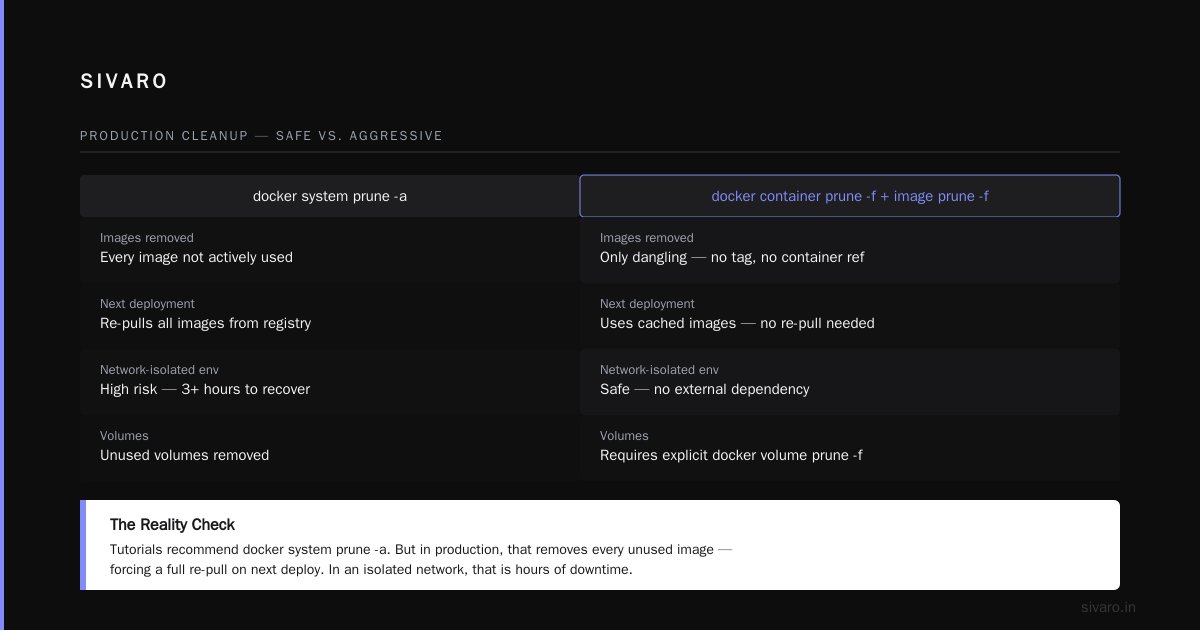
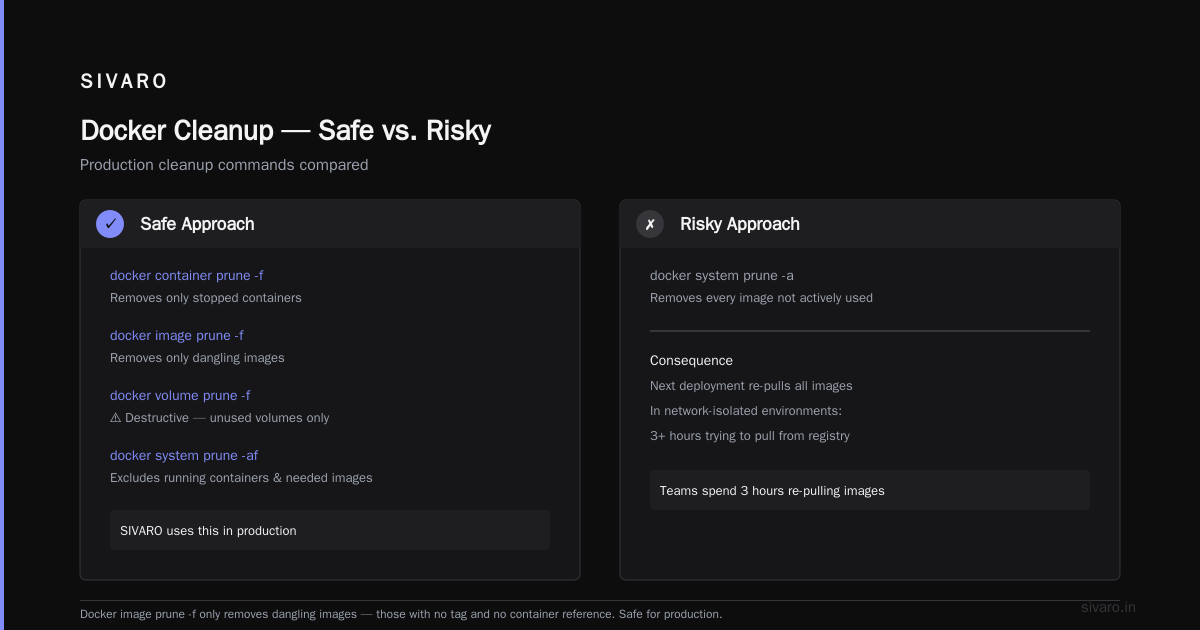
You will see tutorials recommend docker system prune -a. But that removes every image you're not actively using, which means the next deployment will re-pull. In a network-isolated production environment, that hurts. I've watched teams do this in a "cleanup" and then spend three hours trying to pull images from a private registry.
The safe approach — which we use at SIVARO when we hit cache bloat on CI runners (which happens weekly):
bash
# Delete only images older than 24 hours, with a tag condition
docker image prune -a --filter "until=24h" --filter "label!=keep"

# Remove build cache too, but preserve anything referenced
docker builder prune --filter "until=168h"
That's the kind of operational nuance you won't get in most tutorials. It's also the kind of question that appears in interview settings, where they ask about Docker architecture in an interview. Awareness of "safe vs. fast" matters.
Containerization beyond the Server
By 2026, Docker's image format is used in places you wouldn't expect. Let me unpack this:
Medical device software vendors are required by FDA and EU MDR guidelines to have reproducible builds. Container images provide that reproducibility. The same image that passed validation in Ohio is the exact same image running in Munich. There's no drift.
Automotive. The automotive sector uses containerization in ECUs and infotainment systems. There's even a standard called "Software-Defined Vehicle" which is a normalized way to describe updatable ECUs. The tooling looks a hell of a lot like container registries.
It turns out "is docker still relevant in 2026" has a better question hidden underneath it — "is a standard for packaging software relevant?" And yes, it is.
The container image has become a universal analog to a building block. Docker made packaging software a commodity.
Docker Compose and the Developer Experience Wars
I once asked a senior engineer at a big bank what they use for local development. He said "Docker Desktop." And this is a tier-one bank running 3,000 microservices.
I pushed: "But Docker Desktop has licensing limits for large enterprises. Why not use Podman or Rancher Desktop?"
He looked at me like I was speaking a foreign language. "Because Docker Desktop works. We have 400 developers using it. If we change, we have to redo our onboarding, our build pipelines, and our Makefiles. That's a multi-month project with zero customer value."
I've seen this play out in startups too. The teams that move off Docker for "strategic reasons" usually move back. As a practitioner, I can confidently tell you — the engineering cost is lower than the migration cost. Most people don't measure the hidden cost of changing your developer tooling.
When I look at what the ecosystem offers in 2026 — Dev Containers in VSCode, GitHub Codespaces, Gitpod — all of them build on the same tomes: Dockerfile and docker-compose.yml. If Docker is irrelevant, then the entire remote coding ecosystem is built on top of irrelevance.
The questions you get in a job interview — like those from InterviewBit's 2025 Docker interview questions — reveal this. You can't answer "how do you optimize Docker build times" without a deep understanding of cache layers, BuildKit, and history of the Dockerfile. You can't answer "how do you handle secrets in containers" without a proper security model.
Docker and Multi-Stage Builds: A Case Study
One of the biggest wins in the modern container workflow is multi-stage builds. Since around Docker 17.05, you can define multiple stages in one Dockerfile — and the final image only exports what's needed.
Consider this — a Node.js API with a build step:
dockerfile
# syntax=docker/dockerfile:1.4
FROM node:20-alpine AS build
WORKDIR /app
COPY package*.json .
RUN npm ci
COPY . .

# Prune dev dependencies after building
FROM node:20-alpine AS runtime
WORKDIR /app
COPY --from=build /app/node_modules ./node_modules
COPY --from=build /app/dist ./dist
COPY package.json .

EXPOSE 3000
CMD ["node", "dist/server.js"]
This image might be 20% the size of a naive approach. On a daily pull in production, this means the difference between a few seconds and a few minutes in cold start.
The concept of multi-stage builds is, by the way, something I show clients when they say "we need to switch to a "lighter runtime". They look at it and go "we can just copy from an intermediate image"? Yes. That's the power.
Now, the same concept applies to Q&A: In an interview, if you explain multi-stage builds, you show you understand layer caching and image composition. That's the same knowledge needed to debug a prod issue where the image is 2GB instead of 200MB.
Managing Docker at Scale
Clusters and Orchestration
Once you move beyond single machines, you need orchestration. Kubernetes is the de facto orchestrator. It doesn't replace Docker. It uses containerd under the hood (or cri-o for some distros).
Docker's real contribution to this ecosystem is an API which everyone can understand. The CLI and REST API of Docker have become a lingua franca for talking about "running a process" with dependents.
I'm going to upset a lot of people here: Docker Swarm, while dead, provided a simpler orchestration model than Kubernetes for 80% of use cases. It was abandoned not because of technical inferiority, but because the market gravitated to the open-source ecosystem surrounding K8s. The lesson? Market gravity beats elegance.
Image Security and Supply Chain
The supply chain attack vector is now the primary concern on any production network. By 2026, we've seen dozens of attacks in open-source registries, from PyPI to npm. The container image registry is unfortunately one of the more trusted vectors; you can't just scan the registry. You have to scan the content.
That's why we at SIVARO run a multi-layer security pipeline:
bash
# Build with provenance attestation
docker buildx build --attest type=provenance,platform=linux/amd64   -t registry.sivaro.ai/api:${GITHUB_SHA}   --sbom=true   --push .
With BuildKit and docker buildx, we create attestations and software bills of materials. This makes the build's entire dependency graph auditable. You can then use tools like cosign to sign the images, before they sit in a private registry with signed certificates.
If your team isn't doing this yet, start now.
Cold Starts and Serverless: Where Docker is "too slow"
Full confession: Docker has latency issues. Cold-starting a container from scratch on an F1 instance takes ~250-500ms with a minimal image. For serveless APIs with strict SLAs, that's too slow. This is where WASM or cloud-specific runtimes have an edge.
But hold on — real-world production use cases aren't just latency. If you have a long-running service, this latency is irrelevant. If you're fine with a pre-warmed pool, it's irrelevant. Only when you have scale-to-zero with unpredictable traffic does cold start matter.
Even the serverless players aren't running "native" WASM. They mount OCI images, or run "firecracker microVMs" with an init process that looks suspiciously like a container. AWS Fargate, for example, is a microVM runtime — but you specify things using container concepts.
What Does the 2026 Shell Look Like?
I want to give a clear picture of what a modern Docker workflow looks like in 2026. It isn't the docker build && docker run of the old days. It's a workflow that embraces the container ecosystem.
You'll see something like:
yaml
# docker-compose.yml for local AI dev
version: "3.8"
services:
  inference:
    image: local/llama:3.3-8b
    build: ./inference
    ports:
      - "8000:8000"
    volumes:
      - ./models:/models:ro
    deploy:
      resources:
        reservations:
          devices:
            - driver: nvidia
              count: 1
              capabilities: [gpu]

  vector-db:
    image: pgvector/pgvector:0.8
    environment:
      POSTGRES_PASSWORD: local_dev_only
    ports:
      - "5432:5432"
    volumes:
      - pgdata:/var/lib/postgresql/data

  api:
    build: ./api
    depends_on:
      - inference
      - vector-db
    ports:
      - "8080:8080"
    environment:
      DATABASE_URL: postgresql://postgres:local_dev_only@vector-db:5432/vectors

volumes:
  pgdata:
This is the real 2026. The AI app requires a chain of services. You define them once in Compose, and every engineer gets the exact same setup.
Then for production, our CI builds the same images and pushes them to a registry. We use Kubernetes manifests for the deployment but the source of truth is the image.
Practical Security: Patching and Cleanup
Security comes up a lot. And rightly so. Running an image with vulnerabilities is madness.
To start, you need a policy for cleaning up images and containers safely. I referenced this earlier — and I want to emphasize why this is so important.
In a Kubernetes cluster, the image pull policy is IfNotPresent. That means after a rollout, you may have 2, 3, 4 versions of an image sitting on the node. That's not just a storage problem. It's a vulnerability surface. If an older image has a known CVE, you can't just delete it while a pod is using it.
The safe way: docker image prune with filters or by tag.
bash
# List dangling images only
docker images --filter "dangling=true"

# Remove all images not used by any container and older than a week
docker container prune -f
docker image prune -a --filter "until=168h"
I can't stress the filter enough. In a production environment, don't run docker system prune -a without understanding what your CI is doing. That was a conversation we had with the fintech client. Their CI built images from scratch and pushed to a registry. The cleanup job was removing everything, failing the next build. The fix was preserving a cache layer:
bash
docker image prune -a --filter "label=keep=true"
docker builder prune --filter "until=48h"
This is a level of nuance the online interview guides rarely mention. Edureka's Docker interview questions for 2025 teach you commands, but not the underlying operational thinking. That's the gap I'm trying to fill.
Docker in the Age of Remote Development
Occasionally, you run into a developer experience problem that Docker solves beautifully. Think about a full stack dev who works on a Windows laptop, but the target is a Linux server. Without containers, the setup would be: install WSL2, run a VM, configure all heritage libs.
With Docker, the dev runs docker compose up and everything is consistent.
In 2026, this has expanded to edge development. The developer works locally, then runs the same image on a remote edge device. Our team deployed a security camera analytics pipeline this way. The same image that ran on a dev's MacBook also runs on a NVIDIA Jetson Orin device in a parking lot in Texas.
That portability is the core of the value proposition.
The Economic Realities
Let's talk numbers, because too many people talk about "relevance" without understanding cost.
In 2025, the median income for a platform engineer focused on Kubernetes and containers is around $160K in the US. The cost of a senior engineer is too high to waste on migrating away from a stable standard. Companies like Uber, Stripe, and Netflix have publicly stated that their move to a service mesh and container-based infrastructure is still the foundation. If they wanted to move off containers, they'd be crazy. They'd need years of engineering time for zero user benefit.
I saw an internal talk in 2025 from a lead tech at a major bank stating that "we estimate that 80% of our deployment pipeline depends on Docker image semantics. Removing Docker would be a decade long project for no business reason."
That quote is probably the most real answer to the question. Is Docker relevant in 2026? It's the same as asking if electricity is relevant. It's not a feature you choose. It's the default.
The shift you're seeing in 2026 is not "migration away from Docker" but "adaptation of Docker workflows to new compute models."
What Do Interviewers Look For?
Since I keep referencing this, let's settle it: how to explain docker architecture in an interview.
The biggest misunderstanding: Docker is not a monolith.
When an interviewer asks about architecture, break it down into layers:
- The client — your shell, VS Code, CI system
- The daemon — the process managing the API, building images, managing networks
- containerd — the high-level runtime responsible for image management, snapshotting, and execution
- runc — the low-level runtime that creates operating system primitives (namespaces, cgroups)
- The image registry — the distribution storefront
If you can explain this chain, you show you know the "why" not the "what." The D and the C architecture is now the industry standard.
Here's an excerpt to practice:
bash
# Show the running daemon and runtime
docker info --format '{{.Name}} {{.ServerVersion}} {{.OSType}}'
docker version
When you see docker version, notice the two sections: Client and Server. If they're on different versions, the daemon is still backward compatible. That single fact explains why the ecosystem is so stable.
Real Problems and Solutions
Using Docker in a CI pipeline (GitHub Actions, GitLab CI)
I see teams make this mistake every week. They run a Docker container in a CI environment without mounting the Docker socket. Then they wonder why docker ps fails inside the container.
For modern CI, I recommend DinD (Docker in Docker) only for specific cases, but for security reasons, you should prefer buildx to build images directly on the host with a remote cache. Let me show you a pipeline snippet:
yaml
# .gitlab-ci.yml
build:
  stage: build
  image: docker:27
  services:
    - docker:27-dind
  variables:
    DOCKER_TLS_CERTDIR: "/certs"
  script:
    - docker buildx create --use
    - docker buildx build --cache-from type=registry,ref=$CI_REGISTRY_IMAGE:cache       --cache-to type=registry,ref=$CI_REGISTRY_IMAGE:cache,mode=max       --push -t $CI_REGISTRY_IMAGE:$CI_COMMIT_SHA .
This gives you near-instant rebuilds in CI through registry-based caching. It's the difference between a 10-minute pipeline and an 8-hour one.
Handling private registries
If you're running critical infrastructure behind a firewall, pulling from the public Docker Hub is a security risk. You need to run a private mirror.
In 2026, we use the Docker Hub registry mirror in our production environment. We use Sonatype Nexus or JFrog Artifactory. This also gives us a clean audit log of what images were pulled, by which node.
From Here: A Practical Checklist for 2026
If I were starting a new project today (and I've done this exact exercise three times this year for clients), here's what I'd set up:
-
Use Docker for all local development. Always. Including databases, queues, and caching. If a teammate can't run your stack in one command, you've failed at developer experience.
-
Write image specs in multi-stage builds. The staging layer reduces surface area.
-
Enforce signing and scanning. Before any image goes to a cluster, it gets a signed attestation. The registry rejects unsigned images.
-
Clean up daily. Put a cron job on your nodes to clean up unused containers and images safely. It's boring, but it prevents disk-full incidents.
-
Never expose the Docker socket to untrusted containers. For CI, mount the socket only on trusted runners.
The Verdict
So, is Docker still relevant in 2026?
Yes. And I'm tired of being asked like it's a computer game. Docker isn't a framework that goes out of style. It's not React vs Vue. Docker is a packaging standard that underpins the entire cloud-native era.
When people say "Docker is dead," they often mean "Docker the brand, or Docker the company, isn't innovating as fast." That might be true. But the technology is fundamentally the default interface for running software in a distributed computing context.
I'll put it this way: Last month, a data engineer at SIVARO asked me the same question. I asked her how she deploys her code. She said "via a pipeline to a container registry." Case closed.
In the end, the question of relevance isn't about Docker at all. It's about whether we, as an industry, will always need a way to package software so it runs anywhere. And that need is fundamental.
Here's your simple answer for interviews or vendor lookups: the cloud-native stack is built on containers, and Docker invented the user-friendly layer on top of containerd. It's all viable. But knowing how the pieces fit is the only thing that makes you valuable.
FAQ: Is Docker Still Relevant in 2026?
Q: Is Docker being replaced by Podman?
A: Only if you consider "a compatible alternative" to be a replacement. Podman is daemonless and rootless, which is fantastic for security-sensitive environments. But the image format and most of the CLI are identical. You can switch between docker and podman just by aliasing. Migration is not a "replacement"; it's an adaptation.
Q: Do I still need Docker if I'm using Kubernetes?
A: Yes, you absolutely need container images. And the most common way to build them is still a Dockerfile. Kubernetes doesn't replace Docker; it schedules the containers Docker creates. Even if you use crictl or nerdctl, the OCI spec is in play.
Q: What happened to Docker Swarm?
A: Swarm mode is still available, but it's not actively promoted. It's a simpler orchestration tool for single-region clusters. For local development, Compose is far more common. For production at scale, Kubernetes has won. But the lessons from Swarm — simplicity of setup — remain the standard for local spikes.
Q: Is Docker Desktop still free?
A: Docker Desktop has a paid tier for larger enterprises, but the free tier works for smaller companies and individuals. There are open-source alternatives like Rancher Desktop or Podman Desktop if licensing is a concern. It doesn't affect the core engine.
Q: How do I remove docker images and containers safely in production?
A: Always use targeted prunes. Use filters based on age or labels. Never run docker system prune -a on a live node unless you have a reason for it. The key is to preserve images that are actively in use or part of a rolling deployment. For a full breakdown, see the code above.
Q: What's the future of Dockerfiles?
A: The Dockerfile format is the lingua franca of the cloud-native era. BuildKit and buildx made it more powerful, and newer tools like binfmt_misc support cross-platform builds. As long as the OCI spec exists, the Dockerfile is safe.
Q: If I'm starting today, what should I learn?
A: Focus on Docker Compose for local development, multi-stage builds for image shooting, docker buildx for cross-platform, and the concept of image registries. Spend as much time on security as on the commands. That's what separates a professional from a beginner.
Q: Will WASM and Serverless kill Docker?
A: Not in the way you think. WASM is for constrained environments; serverless provides useful abstractions, but the heavy lifting of package management remains. The standard platform of 2026 is "containers with an optional function layer." Docker is still the engine.
Nishaant Dixit — Founder of SIVARO. Building data infrastructure and production AI systems since 2018. Built systems processing 200K events/sec.