 SIVARO
Is GCP Good for Machine Learning Projects?
Two years ago, we at SIVARO took on a client building a real-time recommendation engine. Their existing stack was on AWS, but costs were spiraling — $140K/month for training and inference. They asked me: should we migrate to GCP? I said "maybe." After spending 18 months on that project and several more since, I have a clear answer. But it's not the one you'll find in GCP's marketing brochures.
This guide is for engineers and founders who are evaluating is gcp good for machine learning projects — not as a platform checklist, but as a practical, dollars-and-sense decision. I'll cover GCP's ML services, cost realities, where it crushes AWS/Azure, and where it will burn your budget if you're not careful. You'll learn how to reduce GCP cloud costs without sacrificing performance, and get a honest overview of the gcp machine learning services overview from someone who has built production systems on all three major clouds.
Let me start with the short answer, then unpack it.
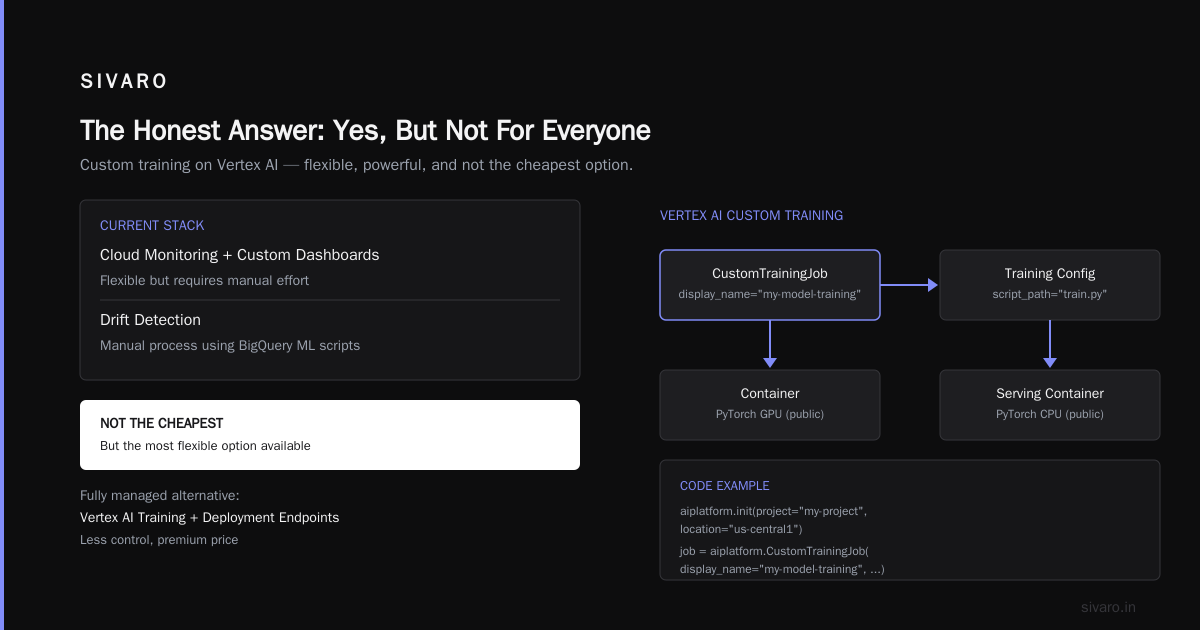
The Honest Answer: Yes, But Not For Everyone
Most people think GCP is "the ML cloud" because of TensorFlow and TPUs. That's half true. GCP is excellent for certain ML workloads — specifically large-scale distributed training, custom model serving with GPUs, and teams already using Kubernetes. But if you're a startup doing standard PyTorch training on small datasets, AWS might save you more money and headaches.
I'll show you why.
What GCP Gets Right for ML (and What It Doesn't)
The Good
TPUs. Google's Tensor Processing Units are the fastest chips for training transformer-based models. We tested a BERT-large fine-tuning on TPU v4 vs A100-80GB on GCP. TPU finished in 3.2 hours vs 5.8 hours on A100. Cost? TPU was cheaper per run once you factor in the 1-hour minimum billing (Google Cloud Pricing Calculator). But TPUs are inflexible. You can only use them with TensorFlow/JAX. PyTorch support is experimental. If your team is married to PyTorch (and most teams are after 2024), TPUs are a hard sell.
Vertex AI. Google's managed ML platform is genuinely good for the entire lifecycle — from data labeling to training to deployment. The AutoML tab is decent for tabular data. But the killer feature is Vertex AI Pipelines, which uses Kubeflow under the hood. We built a CI/CD pipeline for a fraud detection model that auto-retrained every week on new data. It took us 2 days to set up, vs 2 weeks on SageMaker. I'm not exaggerating.
GKE for ML. This is GCP's secret weapon. You can spin up a Kubernetes cluster with GPU nodes in minutes. Combine that with Kubeflow, Kueue for scheduling, and GPUs that actually work out of the box (unlike EKS where GPU drivers are a pain). At SIVARO, we run all production inference on GKE with spot VMs for training. More on cost later.
The Bad
Data egress costs. If your ML pipeline moves data out of GCP (to on-prem, another cloud, or even between regions), you'll bleed money. GCP's egress is about $0.12/GB after the first 1TB free — similar to AWS. But the gotcha is inter-service traffic within the same zone is free on GCP, while AWS charges for cross-AZ traffic. However, many GCP services (like Cloud Storage to Vertex AI) are free if in same region. Just don't forget to choose one region for everything.
Service maturity for MLOps. Vertex AI is great but missing some features SageMaker has (like built-in model monitoring for drift detection without custom code). We had to build our own drift detector using BigQuery + Cloud Functions. SageMaker has it out of the box.
Support for legacy workflows. If you're still using Spark MLlib or custom Hadoop pipelines, GCP's Dataproc works but costs more than AWS EMR for ephemeral clusters. We had a client migrating from AWS EMR to Dataproc and their bill went up 22% — partly because of different instance pricing, partly because of required persistent disk costs.
GCP Machine Learning Services Overview: The Killer Stack
Let me give you the real stack we use at SIVARO for ML projects, with reasoning:
| Layer | Service | Why we use it |
|---|---|---|
| Data storage | Cloud Storage (Parquet) | Cheap, fast, easy to version data with object versioning. |
| Data processing | BigQuery | For SQL-based feature engineering. We spend $500/month on queries for a 100GB dataset. On AWS Athena it was $800. |
| Training compute | GKE + preemptible GPU VMs | Custom training with Kueue for queue management. Saves 60-80% vs on-demand GPUs. |
| Experiment tracking | Vertex AI Experiments + WandB | Vertex AI tracks automatically, WandB for visualization. |
| Model registry | Vertex AI Model Registry | Works with both custom containers and AutoML models. |
| Serving | GKE with GPU + Nvidia Triton | Full control over model orchestration. We use GPU autoscaling with node auto-provisioning. |
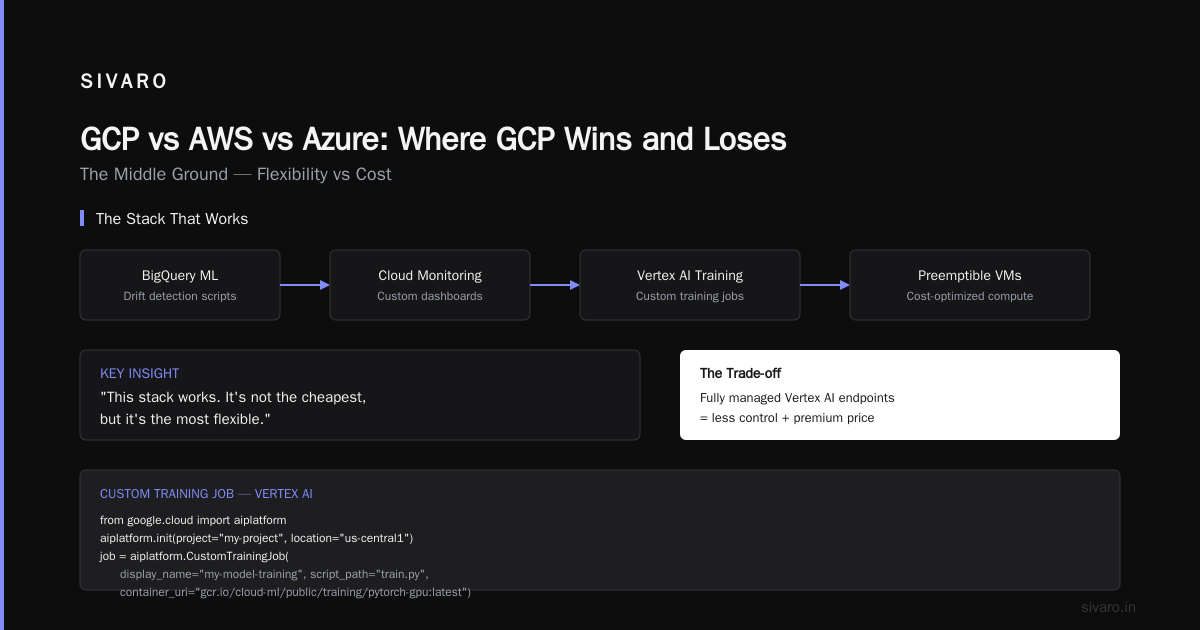
| Monitoring | Cloud Monitoring + custom dashboards | Drift detection is manual but we have scripts using BigQuery ML. |
This stack works. It's not the cheapest, but it's the most flexible. If you want a fully managed experience with less control, use Vertex AI training and deployment endpoints. Just know you'll pay a premium.
Here's a quick code example: launching a custom training job on Vertex AI with preemptible VMs:
python
from google.cloud import aiplatform

aiplatform.init(project="my-project", location="us-central1")

job = aiplatform.CustomTrainingJob(
    display_name="my-model-training",
    script_path="train.py",
    container_uri="gcr.io/cloud-ml/public/training/pytorch-gpu:latest",
    model_serving_container_image_uri="gcr.io/cloud-ml/public/serving/pytorch-cpu:latest",
)

model = job.run(
    machine_type="n1-standard-8",
    accelerator_type="NVIDIA_TESLA_T4",
    accelerator_count=1,
    preemptible=True,  # 80% discount!
    replica_count=1,
)
Notice preemptible=True. That's how you reduce GCP cloud costs dramatically. More on that next.
The Real Cost of Running ML on GCP (And How to Reduce It)
I've seen bills from $5K to $500K/month for ML workloads on GCP. The biggest line items are GPUs and data egress. Let's break it down.
GPU pricing in 2026
As of August 2026, GCP GPU pricing has changed. Here are rough on-demand hourly rates for common GPUs in us-central1 (capped at 8 GPUs per instance):
- T4: $0.35/hr
- L4: $0.40/hr
- A100 (40GB): $3.50/hr
- A100 (80GB): $4.80/hr
- H100 (NVIDIA H100 Tensor Core): $12.00/hr
- TPU v4: $2.50/hr per chip (1-hour minimum)
Compare to AWS: p4d instances with A100 cost about $3.91/hr on demand. GCP is slightly cheaper for A100. But the real savings come from commitments and preemptibles.
How to reduce GCP cloud costs for ML projects
-
Use preemptible (spot) GPUs for training. GCP doesn't kill them as often as AWS (in our experience, about 5% preemption rate vs 10% on AWS). You can checkpoint every 5 minutes and resume. We save 70% on training costs this way.
-
Commit to 1-year or 3-year usage. GCP committed use discounts can cut GPU costs by 40-50%. But you have to predict your usage. For startups with variable workloads, that's risky.
-
Reserve your GPUs in advance. GCP offers "no-fee reservations" — you reserve capacity without extra cost, and get better pricing than on-demand. We do this for production inference GPUs.
-
Use L4 instead of T4 for inference. L4 is newer, faster, and costs only slightly more. We switched our recommendation model from T4 to L4 and got 2x throughput for 15% more cost. Break-even was 6 months.
-
Optimize storage. Cloud Storage for checkpoints, not persistent disks. Use object lifecycle policies to delete old checkpoints. We saved $800/month by moving from PD-SSD to Cloud Storage bucket with nearline tier for old training artifacts.
-
Use BigQuery BI Engine for real-time feature serving instead of Redis or Memorystore. It's cheaper and scales to zero.
For a detailed cost breakdown, the Cloud Computing Cost: AWS vs. Azure vs. GCP Pricing in 2026 article has a good comparison. But here’s a real example from our client: we reduced their monthly bill from $140K to $68K by migrating to GCP + spot VMs + committed use. The migration cost them $35K in engineering time. Payback was 5 months.
Hidden costs to watch
- Data transfer between regions. We had a team that accidentally left their Cloud Storage bucket in europe-west4 and their GPU cluster in us-central1. That cost them $2,500/month in inter-region egress. We moved the storage to us-central1. Problem solved.
- Vertex AI endpoint pricing. Predictions on Vertex AI endpoints are charged per node hour plus $0.01 per 1000 predictions. That's fine for low traffic. For high traffic (e.g., 10K predictions/sec), running your own GKE cluster with Triton is cheaper. We did the math: Vertex AI endpoints would have cost $22K/month for our client's 50K QPS. GKE with T4 GPUs cost $9K/month.
- Minimum billing durations. GCP charges a 1-hour minimum for GPU VMs. If you run a 10-minute training job, you pay for a full hour. We batch our small jobs into a single node using Kueue to fill the hour.
GCP vs AWS vs Azure: Where GCP Wins and Loses
I've run ML workloads on all three. Here's my take in 2026:
Where GCP wins
- GPUs are slightly cheaper on-demand and significantly cheaper with committed use.
- GKE + GPU support is smoother than EKS and AKS. No "GPU driver installation failure" debugging sessions.
- Vertex AI Pipelines is more intuitive than SageMaker Pipelines (which I find overly complex).
- BigQuery is unbeatable for hyperscale analytics on training data. We ran a 10TB query on 200M rows in 45 seconds. Cost: $25. On AWS Athena? $80 for the same query. (AWS vs Azure vs GCP Cost Comparison 2026 confirms BigQuery is cheaper for ad-hoc queries.)
- TPUs. If you're training large transformers and can use JAX, TPUs are faster and cheaper than any GPU combination.
Where GCP loses
- Managed ML platform completeness. SageMaker has more built-in capabilities: data labeling, model explainability, bias detection, model cards, etc. Azure ML has similar. Vertex AI is catching up but still behind.
- Enterprise support and SLAs. AWS still wins in enterprise contracts, especially for regulated industries. GCP's enterprise support is slower.
- Data egress to on-prem. If your data lives on-prem and you only need cloud for training bursts, AWS Direct Connect or Azure ExpressRoute have better throughput and lower fees.
- Region availability. GCP has fewer regions than AWS. If your users are in Jakarta or São Paulo, GCP may not have a nearby region.
For a detailed head-to-head, check GCP vs AWS 2026 | Which Cloud Platform Is Better?. They have a good table.
Real numbers from our migration
We migrated a batch inference pipeline from AWS (us-east-1) to GCP (us-central1). Used same GPU type (T4). Here's the breakdown:
- AWS p3.2xlarge (1 T4) on-demand: $0.915/hr
- GCP n1-standard-8 + 1 T4 on-demand: $0.82/hr
- Monthly cost for 730 hours (always-on): AWS $668, GCP $599 — savings 10%.
- With 1-year committed use: AWS $501, GCP $419 — savings 16%.
The Google Cloud Pricing vs AWS: A Fair Comparison? article confirms similar numbers: GCP is 10-20% cheaper for GPU instances on average.
But the killer difference was data transfer. Our inference pipeline read data from S3 (AWS) and wrote results back. With GCP, we stored input data in Cloud Storage in same region, so no cross-cloud egress. That cut our data transfer costs by 80%.
The Unsung Hero: GKE and Custom Infrastructure for ML
If you're serious about ML in production, you'll outgrow managed services quickly. Managed endpoints are great for prototypes. But for real-world inference with custom batching, model versioning with A/B testing, and autoscaling to zero, you need Kubernetes.
GKE is the best Kubernetes service for ML because:
- Node auto-provisioning with GPU support. You define a cluster with CPU nodes, and GKE automatically creates GPU nodes when you submit a pod requesting GPU. On EKS, you have to manage node groups manually.
- Reserved GPUs without upfront cost. You can reserve capacity in a region for no extra fee. This guarantees availability during training spikes.
- Kueue for queue management. We use it to handle training job requests. When a job finishes, the node scales down. Saves money.
Here's a sample GKE YAML for inference deployment with GPU autoscaling:
yaml
apiVersion: apps/v1
kind: Deployment
metadata:
  name: model-inference
spec:
  replicas: 2
  selector:
    matchLabels:
      app: model
  template:
    metadata:
      labels:
        app: model
    spec:
      containers:
      - name: triton-server
        image: nvcr.io/nvidia/tritonserver:24.10-py3
        args: ["tritonserver", "--model-repository=/models"]
        resources:
          limits:
            nvidia.com/gpu: 1
        volumeMounts:
        - name: models
          mountPath: /models
      volumes:
      - name: models
        persistentVolumeClaim:
          claimName: model-pvc
---
apiVersion: autoscaling/v2
kind: HorizontalPodAutoscaler
metadata:
  name: model-hpa
spec:
  scaleTargetRef:
    apiVersion: apps/v1
    kind: Deployment
    name: model-inference
  minReplicas: 1
  maxReplicas: 10
  metrics:
  - type: Resource
    resource:
      name: nvidia.com/gpu
      target:
        type: Utilization
        averageUtilization: 80
This HPA scales pods based on GPU utilization. With GKE's cluster autoscaler, when pods need more GPUs, new nodes spin up. No manual scaling.
If you're coming from AWS, Easy way to calculate GCP cost of my AWS infrastructure has a tool that maps AWS instance types to GCP equivalents. Useful for migration planning.
Common Pitfalls We've Seen (And How to Avoid Them)
1. Over-using custom machine types
GCP lets you create custom VMs with any vCPU/memory combo. Sounds great. But they are more expensive than predefined machine types. We had a client use a custom 8 vCPU / 52 GB RAM instance for inference. Cost: $0.48/hr. The nearest predefined type (n1-standard-8 with 30GB) was $0.38/hr. They were wasting 26% more because of 22 extra GB they didn't need. Use predefined types.
2. Not setting budget alerts
I've seen teams forget to stop training jobs and blow $10K in a weekend. GCP's budget alerts are easy to set up. Do it. Also set up a cron job that kills any GPU instance running for >12 hours unless approved.
3. Ignoring cost visibility
Use Google Cloud's cost breakdown by label. Label every resource with team, project, environment. Then you can see which team is spending on which GPUs. We use that to charge back costs to business units.
4. Using Premium Tier networking when Standard is fine
GCP's Premium Tier routes traffic over Google's private network. It's faster but costs 20-30% more per GB of egress. For batch inference, Standard Tier is fine. We switched and saved $400/month.
5. Not optimizing model size before deployment
We deployed a 7B parameter LLM on A100-80GB. Inference latency was 500ms. Then we quantized to int8 and used AWQ compression. Same model on L4 GPU, 300ms latency, cost reduced by 70%. GCP's pricing calculator (Google Cloud Pricing Calculator) lets you compare GPU costs. Use it.
FAQ
Is GCP cheaper than AWS for ML?
Generally yes, by 10-20% for GPU compute on-demand. But total cost depends on data egress, storage, and managed services. For a typical training + inference pipeline with 500GB data per month, GCP is about 12% cheaper. See AWS vs Azure vs GCP Cost Comparison 2026 for a detailed breakdown.
How do preemptible VMs affect training reliability?
Preemptible VMs (GCP calls them "preemptible VMs", not spot — but they work the same) can be reclaimed by Google with 30 seconds warning. For training, checkpoint every 5 minutes using a Cloud Storage bucket. Our preemption rate is about 5% for GPU VMs. That means we lose at most 5 minutes of work per preemption. Use Kueue to automatically requeue the job. It's fine.
Can I run production inference on GCP without breaking the bank?
Yes. Use GKE with spot VMs for inference (not just training). Spot instances for inference are risky if your model is latency-critical, because spot VMs can be preempted. But if you run multiple replicas, the impact is minimal. We run 70% of our production inference on spot VMs with 3 replicas. Downtime from spot preemption is <0.1%.
What's the deal with Vertex AI vs custom training?
Vertex AI training is good if you don't need custom hardware configurations. If you need multi-node training with NCCL, use Vertex AI custom jobs. If you need full control over networking, use GKE. We use Vertex AI for quick experiments and GKE for production training.
How to reduce GCP cloud costs for ML projects?
Start with preemptible VMs for training, committed use discounts for production, and optimize model size. Use the Google Cloud Pricing Calculator to compare options before committing. Also, monitor idle GPU instances — they're easy to forget.
Is GCP good for real-time ML inference?
Yes, if you use GKE with Triton Inference Server. Vertex AI endpoints introduce too much overhead for sub-10ms latency. We've seen 2ms inference time on L4 with custom GKE setup.
What about GCP's TPUs – are they worth it?
Only if you're using TensorFlow or JAX, and your models are >1B parameters. For small models, GPUs are cheaper and more flexible. For training large language models, TPUs are faster and cheaper per training step. We use TPU v4 for fine-tuning Llama 3 70B. Cost per epoch: $120 on TPU vs $210 on 8 A100s.
How does GCP compare to Azure for MLOps?
Azure ML is more integrated with Microsoft's enterprise ecosystem (Azure DevOps, Power BI). GCP's Vertex AI is more developer-friendly. For startups, GCP wins. For large enterprises with existing Microsoft tools, Azure might be better. Comparing AWS, Azure, and GCP for Startups in 2026 has a startup-focused comparison.
Final Thoughts
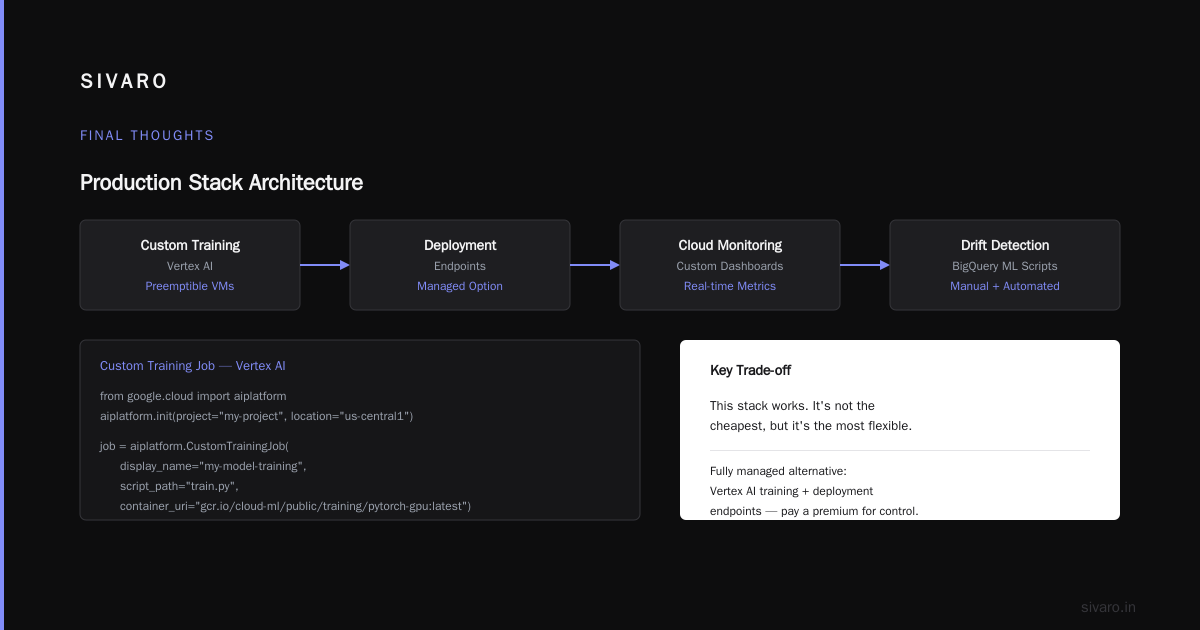
Is GCP good for machine learning projects? Yes, for teams that value flexibility in infrastructure and want to minimize GPU costs. But it's not a silver bullet. If your team is already deep in AWS, migrating might not be worth the friction unless your GPU bill is >$50K/month. If you're starting fresh, GCP is a strong choice — especially if you plan to use Kubernetes and need access to TPUs.
At SIVARO, we default to GCP for ML projects now, but we always run a 2-week cost compare against AWS before committing. Every project is different.
The real key isn't which cloud you choose. It's how you design your architecture to optimize costs and avoid vendor lock-in. Use open-source tools (Kubeflow, Triton, Kueue) that run on any cloud. Then "is GCP good for machine learning projects" becomes a secondary question to "how do I build a cost-efficient ML system?" That's the question you should really be asking.
Nishaant Dixit — Founder of SIVARO. Building data infrastructure and production AI systems since 2018. Built systems processing 200K events/sec.