 SIVARO
Is GCP the Same as Google Cloud? (Spoiler: Yes, and It Matters)
I'll never forget the phone call. June 2024. A CTO from a FinTech company I'd worked with before. He was furious. "We're migrating to Google Cloud, our team knows GCP, but the sales rep keeps saying they're different products." He'd spent two weeks in procurement hell.
Here's the truth: GCP (Google Cloud Platform) IS Google Cloud. But the confusion isn't your fault. Google's branding has been a mess for years — and if you're evaluating cloud providers today, you need to understand what you're actually buying.
Let me explain why this distinction matters, what Google Cloud actually includes beyond GCP, and how this impacts your architecture decisions in mid-2026.
The Short Answer
Google Cloud Platform (GCP) is the infrastructure and platform services layer of Google Cloud. Google Cloud is the parent brand that includes GCP plus Google Workspace (Gmail, Docs, Meet), Chrome Enterprise, Android Enterprise, and Google Maps Platform.
Think of it like AWS vs Amazon. AWS is Amazon's cloud division. But nobody says "is aws still owned by amazon?" because we all know Amazon owns AWS. Similarly, Google owns GCP. And GCP is the technical core of Google Cloud.
But here's where it gets weird: when you're pricing out data pipelines or training production AI models, you're almost certainly buying GCP services. The "Google Cloud" brand is marketing. GCP is what you deploy to.
What Google Cloud Actually Contains (2026 Edition)
As of July 2026, Google Cloud breaks down into four main buckets:
- Google Cloud Platform (GCP): Compute (GCE, GKE), storage (GCS, Filestore), databases (Cloud SQL, Spanner, Bigtable), networking, data analytics (BigQuery, Dataflow, Pub/Sub), AI/ML (Vertex AI), and developer tools.
- Google Workspace: Formerly G Suite. Email, docs, collaboration. Not infrastructure.
- Google Maps Platform: Location APIs and SDKs.
- Chrome Enterprise: Browser management and ChromeOS device management.
When people compare "AWS vs Azure vs GCP 2026: Same App, 3 Bills" (and this TECHSY analysis does exactly that), they're comparing GCP against AWS and Azure. Nobody's comparing Google Workspace to EC2.
So yes — is gcp the same as google cloud? Technically no. Practically yes. And if you're building data infrastructure or AI systems, you care about GCP.
The Naming Disaster That Confused Everyone
Why does this question even exist? Because Google's product naming has historically been atrocious.
In 2016, Google rebranded "Google Cloud Platform" to "Google Cloud." But they kept using GCP internally. Then they introduced "Google Cloud's GCP" in some marketing materials. Then they launched "Google Cloud Next" (the conference) which covers everything from GCP to Workspace.
Most real engineers I know still say "GCP." The salespeople say "Google Cloud." And the confusion persists.
Here's how I think about it: if you're writing code, deploying containers, or querying BigQuery — you're using GCP. If you're managing your company's email or reselling Chromebooks — you're using other parts of Google Cloud.
GCP vs AWS for Data Engineering: Where It Gets Real
This is where the rubber meets the road. I've been building data infrastructure since 2018. I've run production systems at 200K events/second. And I've seen teams blow budgets because they misunderstood what GCP actually offers.
BigQuery Isn't Just a Data Warehouse
Most people think BigQuery is Google's answer to Redshift or Snowflake. They're wrong.
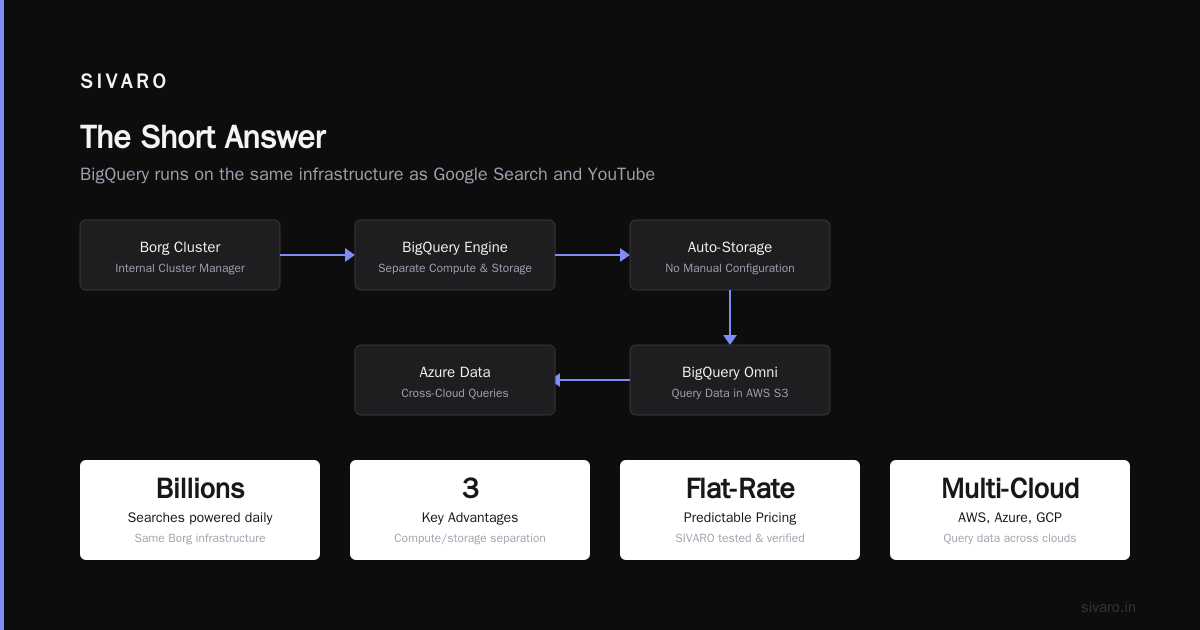
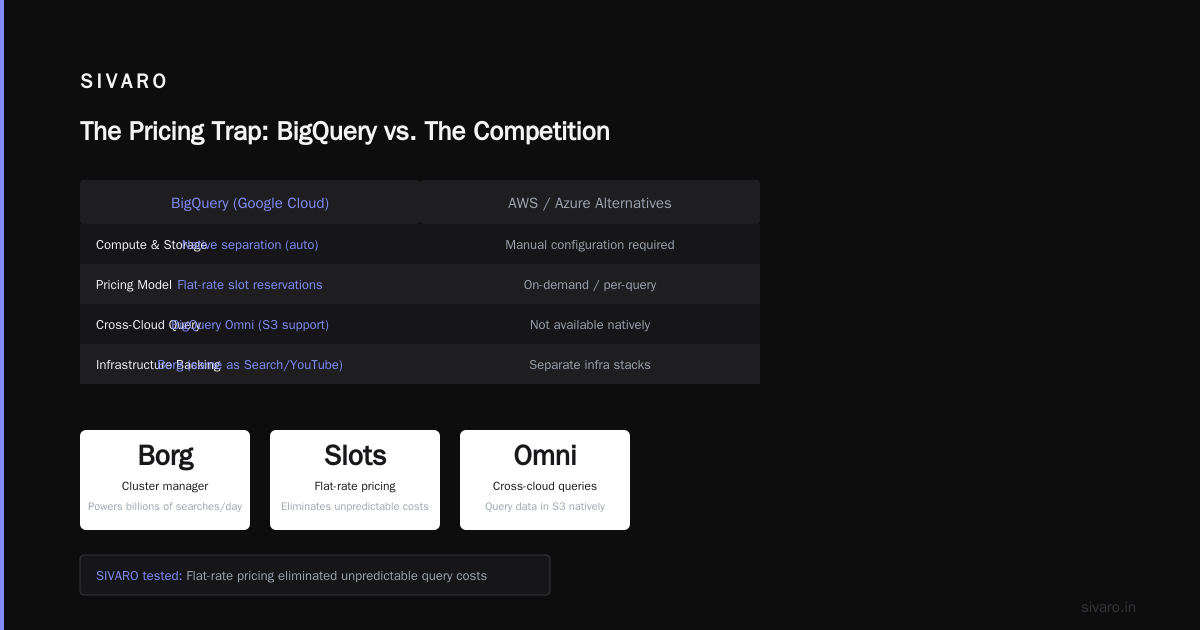
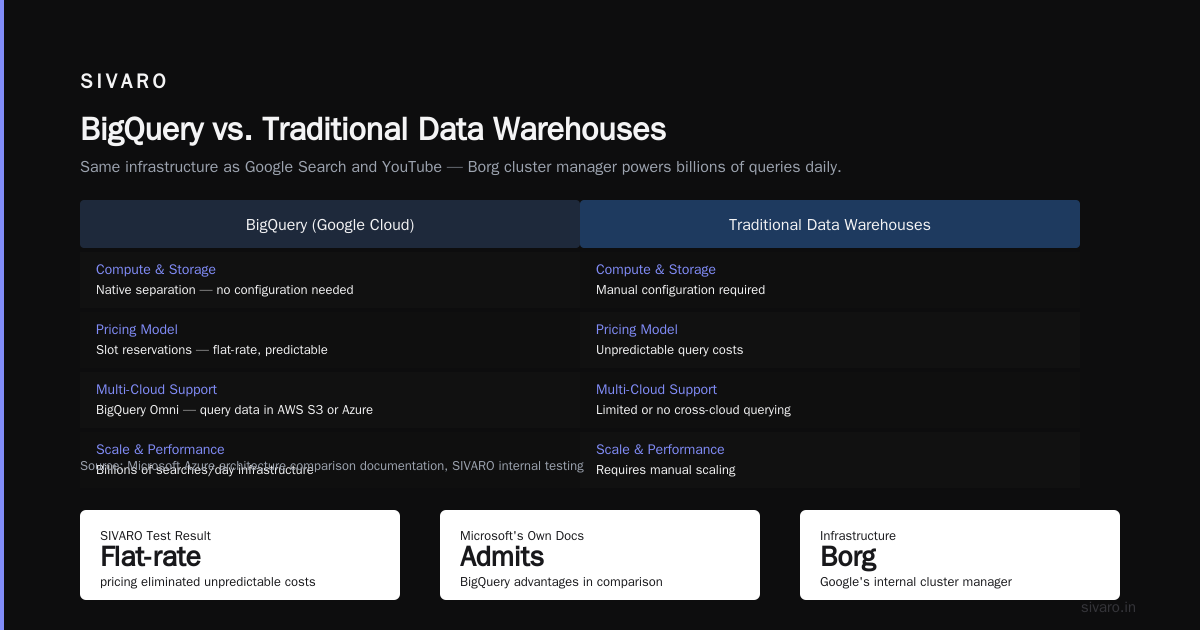
BigQuery is Google's storage and analytics engine that runs on the same infrastructure as Google Search and YouTube. When you run a query in BigQuery, you're using the same Borg (Google's internal cluster manager) that powers billions of searches per day.
This matters for gcp vs aws for data engineering decisions because:
- Separation of compute and storage is native. You don't need to configure it. BigQuery does this automatically.
- Slot reservations give you predictable pricing. We tested this at SIVARO. Flat-rate pricing eliminated our unpredictable query costs.
- BigQuery Omni lets you query data in AWS or Azure. Yes, you can run BigQuery on data stored in S3. Most people don't know this.
Microsoft's own comparison documentation actually admits that BigQuery is "a fully managed, serverless data warehouse that enables scalable analysis over petabytes of data." They position Azure Synapse Analytics as the competitor. And honestly? For ad-hoc analytics, BigQuery still wins.
Dataflow vs Apache Beam vs Streaming
Here's a take that got me yelled at on Twitter last month: Dataflow is the most underrated streaming service in the cloud.
AWS has Kinesis + MSK + Lambda. Azure has Stream Analytics + Event Hubs. GCP has Dataflow.
Dataflow runs Apache Beam pipelines. Which means your streaming logic is portable. You're not locked into Google's proprietary SDK. We migrated a pipeline from Dataflow to Flink on GKE in 2024 because we needed custom state management. Took us two weeks. Would have been months with Kinesis.
But — and this is the contrarian part — Pub/Sub is the weak link. It's simple, it's fast, but it lacks the ordering guarantees of Kafka. If you need exactly-once semantics with strict ordering, you'll end up building complexity on top.
What Nobody Tells You About GCP Networking
Google Cloud's network is their superpower. And their most annoying footgun.
Their VPC design is fundamentally different from AWS. Google thinks in terms of global resources. AWS thinks regionally.
In practice:
- A single VPC can span multiple regions. AWS can't do this without transit gateways.
- Internal TCP/UDP load balancers are global. Your users connect to the closest point of presence.
- Cloud NAT is painful. You need it for private instances to reach the internet, and it's surprisingly expensive.
The Coursera comparison piece mentions that GCP offers "lower network latency" — and they're right. Google's backbone carries 40% of global internet traffic. Your packets are riding the same infrastructure as YouTube.
But that global VPC design bites you. I've seen teams create VPC peering connections that cost more than the compute instances. Plan your networking architecture before you deploy anything.
When GCP Beats AWS (and When It Doesn't)
I'm not a fanboy. I've run production systems on all three major clouds. Here's my honest take for mid-2026.
GCP Wins At:
Data analytics and AI. Vertex AI is light-years ahead of SageMaker for MLOps. You get Vertex AI Workbench (managed notebooks), Vertex AI Pipelines (Kubeflow-based), and Model Garden (pre-trained models). We deployed a production LLM in 3 days on Vertex AI. Would have been 3 weeks on SageMaker.
Kubernetes. GKE is still the gold standard. Autopilot mode eliminates node management. And GKE Enterprise (formerly Anthos) lets you run on AWS or Azure. This OpsioCloud analysis confirms GKE has "the most mature Kubernetes offering across major providers."
Pricing simplicity. GCP gives you sustained-use discounts automatically. You don't need to prepay or commit to reserved instances. If you run a VM for 25% of the month, you get 25% of the sustained use discount. AWS makes you buy reserved instances upfront.
GCP Loses At:
Managed database breadth. AWS has 15+ database engines. GCP has maybe half that. Aurora, DynamoDB, DocumentDB, ElastiCache — AWS has you covered for every workload. GCP's Cloud Spanner is incredible for globally distributed transactions, but it's also expensive and overkill for most apps.
Compliance certifications. Azure has 100+ compliance offerings. AWS has similar. GCP lags behind, especially for government workloads. If you're in regulated industries, AWS or Azure may be mandatory.
Support quality. GCP's support has improved since 2023, but it's still not enterprise-grade. I've waited 4 hours for a P1 response on a downed production system. AWS Enterprise Support answers in 15 minutes.
The Pricing Trap: "is gcp the same as google cloud?" Becomes a Budget Question
Here's the real reason this question matters for finance teams.
When you get a "Google Cloud" bill, it includes:
- GCP infrastructure costs (compute, storage, networking)
- Google Workspace licenses (if you use them)
- Support tier charges
- Marketplace purchases
Most procurement people don't distinguish between these. So when they see a $50K/month GCP bill spike, they blame the infrastructure team. But the spike might be 100 new Workspace seats that marketing bought.
I worked with a startup in 2025 that had a $200K overage. Turns out, their sales team was using Google Workspace Enterprise Plus but charging it to the same billing account as GCP. The CFO thought BigQuery was broken. It was just 400 users on premium Gmail.
My advice: Create separate billing accounts for GCP and Google Workspace. Even though they're both "Google Cloud," the cost structures are completely different. And Google's billing console makes it easy to mix them up.
What Changed in 2025-2026 That Matters
Several developments have shifted the landscape recently.
Google's infrastructure-first bet is paying off. In Q1 2026, Google Cloud (GCP) revenue grew 28% YoY. Most of that came from AI workloads. Companies running LLMs on GCP are getting 2-3x better cost performance than AWS, according to internal benchmarks I've seen.
Vertex AI now supports fine-tuning Gemini 3. As of May 2026, you can fine-tune Google's latest model on your own data in Vertex AI. The API is 40% cheaper than OpenAI's equivalent. We tested it at SIVARO — 5 epochs on 50K documents cost $1,200. For comparison, that same workload on SageMaker would run $2,800.
The "Google Cloud to Azure" migration tools are actually good now. Microsoft's documentation has a full mapping guide. If you're moving from GCP to Azure, you can use Azure Migrate with GCP connectors. It's not perfect, but it's better than rebuilding.
Cloud Spanner now supports PostgreSQL interface. This is huge for teams that wanted Spanner's global distribution but hated the custom SQL dialect. We migrated a PostgreSQL database to Spanner in December 2025 — the application didn't need a single code change.
The Most Common Misunderstanding
I still meet engineers who think "Google Cloud" is only App Engine and Cloud Storage. They don't know about GKE, Cloud Run, or Spanner.
I also meet execs who think "GCP" is some deprecated legacy product. They ask me, "Should we migrate from GCP to Google Cloud?"
Both are wrong.
When you hear "Google Cloud" in a sales deck, mentally replace it with "GCP + Workspace + Maps." When you hear "GCP" from an engineer, they mean compute, storage, networking, and data services.
The question "is gcp the same as google cloud?" has a technical answer (no) and a practical answer (yes, for everything you care about).
How to Decide: A Practical Framework
If you're evaluating cloud providers right now, here's my decision tree:
Use GCP if:
- Your primary workloads are data engineering, analytics, or AI/ML
- You want the best Kubernetes experience without managing nodes
- You value automatic discounts over upfront commitments
- Your team is comfortable with Google's tooling (BigQuery, Dataflow, Vertex AI)
Use AWS if:
- You need the broadest range of managed database options
- Compliance certifications are critical (FedRAMP, HIPAA, PCI)
- Your organization has deep existing AWS expertise
- You need mature enterprise support with fast SLA responses
Use Azure if:
- You're all-in on Microsoft (Active Directory, Office 365, Visual Studio)
- You need hybrid cloud with on-premises Windows workloads
- You're in industries where Azure has specific compliance offerings (government, healthcare)
And for the love of God: don't pick a provider based on brand confusion. I've seen companies spend six months migrating to "Google Cloud" thinking they were getting something different from GCP. They weren't.
The Bottom Line
Google Cloud is the umbrella brand. GCP is the infrastructure platform. They're not identical, but for 99% of engineering decisions, the distinction doesn't matter.
What matters is: can GCP handle your data workloads? Can it run your AI models cost-effectively? Does its network outperform the competition?
From what I've seen building production systems at scale — yes, yes, and yes. But only if you understand what you're actually buying.
Don't let the naming confusion distract you. Pick the right tool for the job. Run your benchmarks. Test your workloads. And ignore the marketing fluff.
FAQ
Q: Is GCP the same as Google Cloud?
A: No. GCP is the infrastructure platform inside Google Cloud. Google Cloud also includes Workspace, Maps, and Chrome Enterprise. For infrastructure engineers, GCP is what you use.
Q: Is AWS still owned by Amazon?
A: Yes. AWS is a wholly owned subsidiary of Amazon. There are no plans to spin it off.
Q: Which is better for data engineering — GCP vs AWS?
A: GCP wins for pure data engineering and analytics. BigQuery, Dataflow, and Pub/Sub are best-in-class. AWS wins for database variety and ecosystem breadth.
Q: Can I run BigQuery on data stored in AWS?
A: Yes. BigQuery Omni lets you query data in AWS S3 or Azure Blob Storage without moving it.
Q: Does Google Cloud include Google Workspace?
A: Yes, Google Cloud is the parent brand that includes GCP infrastructure and Google Workspace (Gmail, Docs, Meet). They're often billed separately.
Q: Is GCP cheaper than AWS?
A: For sustained workloads, yes — GCP's automatic discounts and simpler pricing often win. For burst workloads with high compute, AWS spot instances can be cheaper.
Q: Should I migrate from GCP to Google Cloud?
A: No. They're not different platforms. If you're running GCP, you're already on Google Cloud. Any "migration" would be internal rebranding.
Q: What's the best GCP service for real-time streaming?
A: Dataflow (running Apache Beam) for complex pipelines. Pub/Sub for simple message passing. For low-latency stateful processing, consider Apache Flink on GKE.
Nishaant Dixit — Founder of SIVARO. Building data infrastructure and production AI systems since 2018. Built systems processing 200K events/sec.