 SIVARO

Is Kubernetes Outdated?
Look, I get why you're asking. Every week someone posts a hot take on LinkedIn about how Kubernetes is "too complex" or "being replaced by serverless." I've been running production systems on Kubernetes since 2019, and I'll tell you flat out: Kubernetes isn't outdated. But the way most people use it is.
Here's what we learned building data pipelines at SIVARO. We process about 200K events per second across multiple clusters. We've been through the hype cycles. We've watched teams burn millions on unused nodes, then blame Kubernetes for the bill.
The real question isn't "is kubernetes outdated?" — it's "are you outdated in how you run Kubernetes?"
In this guide, I'll walk you through where Kubernetes stands in mid-2026, where it's still the right choice, where it's not, and how to actually make it work without hating your life.
The Orchestration Layer Is Mature, But The Tooling Is Still Moving
Kubernetes itself hit feature stability around v1.24 in 2022. The API hasn't changed dramatically since. That's a good thing — you don't want your infrastructure platform changing its fundamental contracts every release.
But here's the nuance: the operating model around Kubernetes has changed completely.
In 2023, Karpenter (AWS's node autoscaler) became the default way to think about cluster management. Before that, everyone used Cluster Autoscaler. The difference? Night and day.
Cluster Autoscaler scales based on pending pods — it's reactive. Karpenter evaluates a broader set of constraints: node utilization, spot market prices, instance types, and consolidation opportunities. Understanding Karpenter Consolidation shows how it works: Karpenter continuously asks "can I replace these three nodes with two cheaper ones?" and then does it.
"Wait," you're thinking. "Doesn't that cause disruptions?"
Yes. It can. One engineer wrote about learning this the hard way with Pod Disruption Budgets and Karpenter. You need PDBs configured correctly. Most teams don't bother — they find out during an outage.
So is Kubernetes outdated? No. But running it without modern autoscaling? That's outdated.
Where Ingress Stopped Being The Hard Part
The service mesh wars are over. Istio won. Well, Istio and Linkerd for smaller teams. But the point is: the networking layer stabilized.
What changed in 2024-2025 was eBPF-based CNIs replacing iptables-based ones. Cilium became the default recommendation for anyone starting fresh. Performance went up 40% for network-intensive workloads, and security observability became something you could get for free.
If you're still running kube-proxy with iptables, you're leaving performance on the table. That doesn't make Kubernetes outdated — it means your configuration is.
Same with CSI (Container Storage Interface). The storage API matured. Operators like Rook/Ceph for on-prem or EBS CSI for AWS work predictably. The pain points shifted from "does it work?" to "how fast can we provision?"
Is Kubernetes Reliable? The Honest Answer
Short answer: yes. Long answer: it depends on what you break.
We've run clusters with 500+ nodes for 18 months without a single control plane outage. We've also watched a team accidentally delete their kube-system namespace at 2 AM.
Kubernetes is reliable when you respect its failure modes.
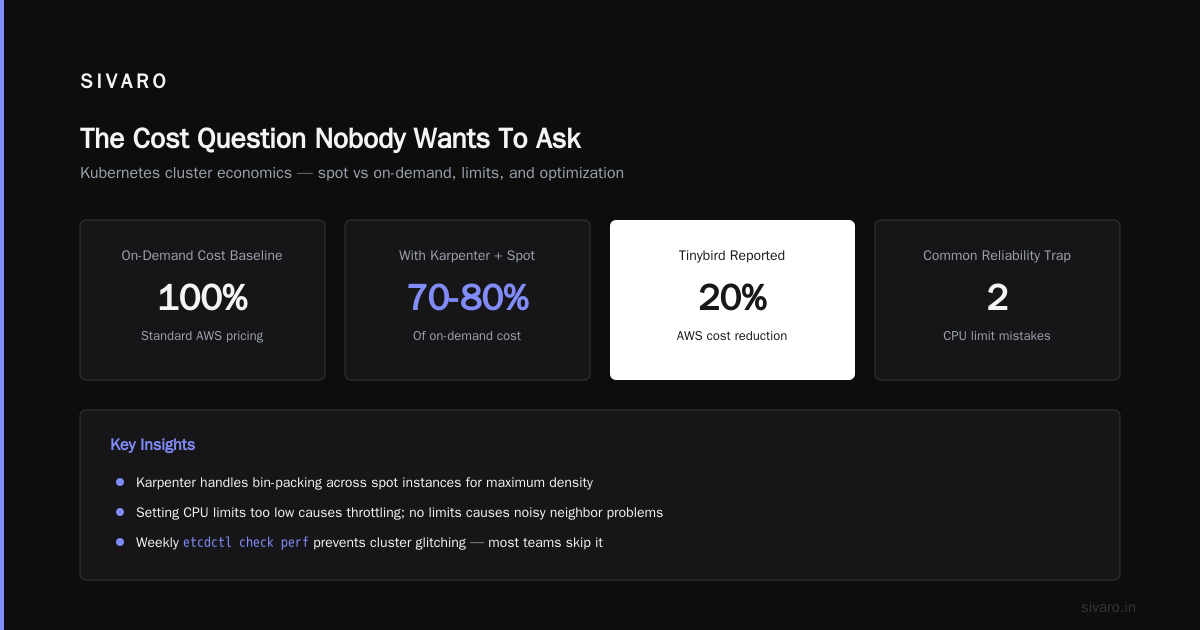
The biggest reliability killer? etcd latency. If your etcd cluster is slow, everything breaks. API server requests hang. Scheduler can't commit. Controller loops fail.
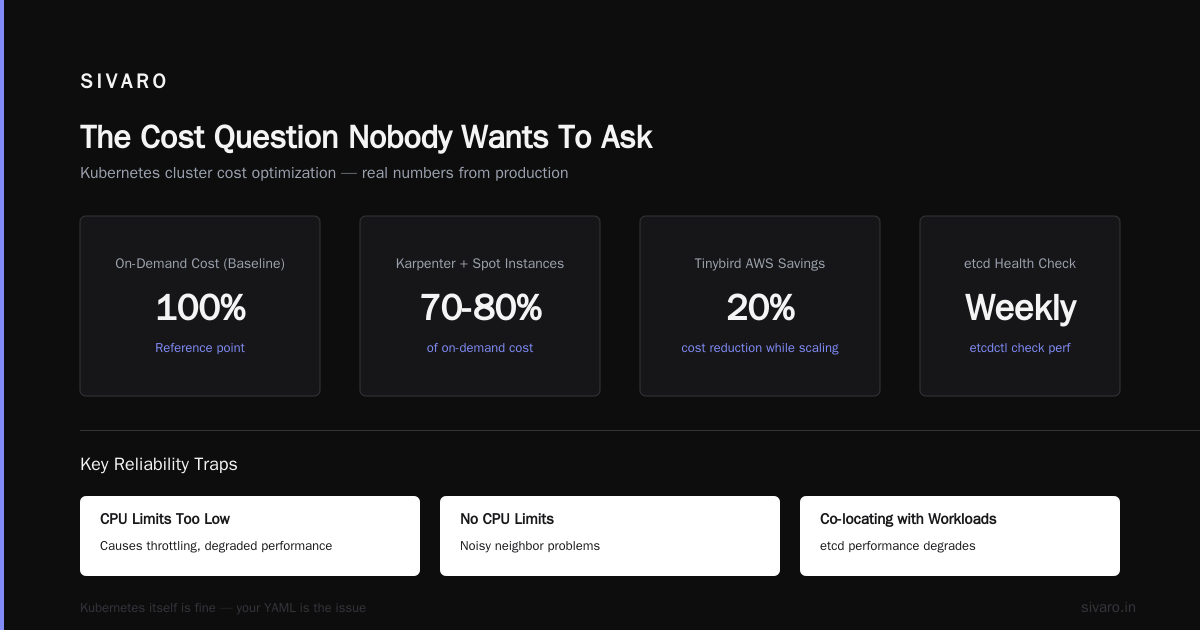
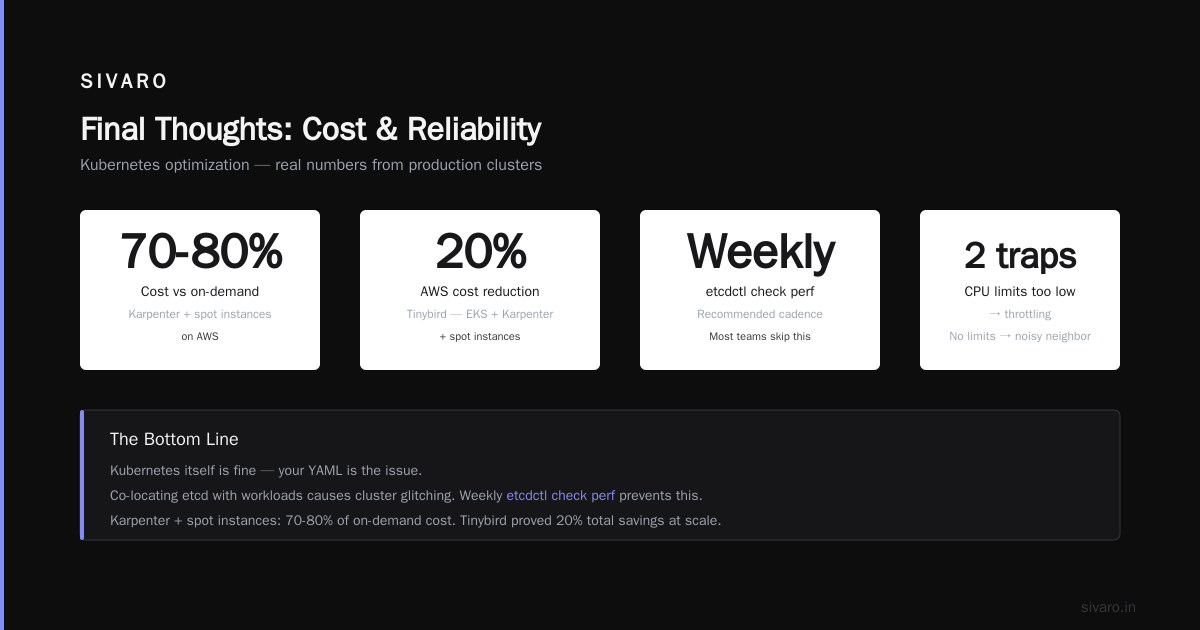
At SIVARO, we run etcd on dedicated instances — no co-locating with workloads. We use etcdctl check perf weekly. Most teams don't. They find out when their cluster starts glitching.
The other reliability trap: resource limits. Setting CPU limits too low causes throttling. Setting no limits causes noisy neighbor problems. Kubernetes itself is fine — your YAML is the issue.
The Cost Question Nobody Wants To Ask
Let's talk about money.
A well-optimized Kubernetes cluster on AWS using Karpenter with spot instances can run at 70-80% of on-demand cost. Tinybird published how they cut AWS costs by 20% while scaling with EKS, Karpenter, and spot instances. Their approach: Karpenter handles bin-packing across spot instance families, and consolidation replaces older nodes with cheaper ones automatically.
The math works because Kubernetes competes on bin-packing efficiency. A typical team running VMs directly leaves 30-40% of CPU idle. Kubernetes (with proper requests/limits) pushes utilization to 60-80%.
But here's the catch: you have to measure it. Most teams don't. They look at the AWS bill, see the EKS cluster fee ($73/month per cluster for the control plane), and blame Kubernetes for their $50K node bill. The nodes aren't Kubernetes' fault. They're yours.
ScaleOps published a 2026 guide to Kubernetes cost optimization that breaks down the three levers: right-sizing requests, using spot instances, and auto-scaling at both pod and node level. If you're not doing all three, you're paying too much.
So is Kubernetes outdated? Financially, it's the most efficient way to run containers at scale — if you optimize. If you don't, you'll pay the "I'm too lazy to set resource limits" tax.
Is Kubernetes CI Or CD?
This always comes up. "Is kubernetes ci or cd?" — it's neither. Kubernetes is a runtime platform. CI/CD runs on Kubernetes, not as Kubernetes.
Although, honestly? The line blurs.
Tools like Tekton and Argo Workflows run CI pipelines as Kubernetes-native workloads. GitOps tools like Argo CD and Flux treat Kubernetes manifests as the source of truth for deployments. So Kubernetes becomes the substrate for your entire delivery pipeline.
But the question itself reveals a misunderstanding. People ask "is kubernetes ci or cd?" the same way they'd ask "is Docker ci or cd?" — it's not a stage, it's the environment where stages execute.
We use GitHub Actions for CI, Argo Workflows for complex pipeline orchestration, and Argo CD for deployment. Kubernetes runs all of them. That's the modern pattern.
Serverless On Kubernetes: The Unsexy Truth
Everyone predicted serverless would kill Kubernetes. It didn't. What happened instead: serverless merged with Kubernetes.
Knative became the standard for running serverless workloads on Kubernetes. AWS Lambda continues to grow, but for any workload that runs longer than 15 minutes or needs GPU, you can't use Lambda. You use Kubernetes with KEDA (Kubernetes Event-Driven Autoscaling).
The pattern that works: use Lambda for simple event processing, use Kubernetes for everything else. The "Kubernetes vs serverless" framing was always wrong. It's "Kubernetes and serverless."
Karpenter actually makes Kubernetes behave more like serverless than people realize. AWS's blog on optimizing compute costs with Karpenter shows how you can treat nodes as ephemeral resources — provisioned on demand, cleaned up when idle. If you use Fargate for your pods, you get truly serverless containers on Kubernetes.
Is that "serverless"? Depends on who you ask. But it works. Customers run Spark jobs, ML training, web APIs — all on the same cluster, all auto-scaled, all without thinking about nodes.
The Complexity Problem (And How We Fixed It)
I won't lie to you. Kubernetes has a learning curve. We hired a senior engineer who took 6 months before they felt comfortable debugging a production issue without help.
But complexity isn't the same as obsolescence. Mainframes are complex. Nobody calls them outdated in the right context — they're still running banking transactions.
The question "is kubernetes outdated?" usually comes from teams that tried it, got burned, and never came back. I've been there. In 2020, our first production cluster had a control plane failure because we put etcd on the same nodes as our workloads. The cluster fell over during a traffic spike. We spent three days recovering.
That wasn't Kubernetes being bad. That was us being stupid.
What changed:
-
We stopped treating Kubernetes as "just another deployment tool." It's a distributed systems platform. You have to learn it like one.
-
We invested in observability before scale. Prometheus, Grafana, Loki, and OpenTelemetry are not optional. If you can't see what's happening, you can't fix what's breaking.
-
We bought support. Seriously. If you're running Kubernetes in production without a support contract (EKS support, or a vendor like SIVARO for self-managed), you're gambling. The API server doesn't care about your feelings.
Where Kubernetes Is Actually Outdated
I'll give credit where it's due. There are situations where Kubernetes is the wrong answer:
You have 3 microservices and a monolithic database. Just use ECS or Fly.io. Kubernetes overhead isn't worth it at that scale. You'll spend more time managing the cluster than building product.
Your team has no DevOps experience. Kubernetes won't teach it to them. Start with a managed platform like Render or Railway. Move to Kubernetes when you outgrow them.
You need single-region sub-10ms latency. Kubernetes adds networking hops. If you're doing high-frequency trading or real-time audio processing, you probably want bare metal or VMs with DPDK. Kubernetes isn't designed for that.
You're running batch jobs that take 2 seconds. The pod startup time (even with better init containers and pre-pulled images) adds overhead. Lambda or Cloud Run will be faster and cheaper for tiny workloads.
But here's the contrarian take: most teams that think they're in these categories aren't.
The "we're too small for Kubernetes" crowd usually has 10 microservices running on manually managed EC2 instances with no autoscaling, no health checks, and manual deployments. They're paying more in operational overhead than they would with a 3-node EKS cluster.
What Changed In 2025-2026
If you haven't touched Kubernetes since 2023, here's what you missed:
Sidecar containers are GA. You can now inject sidecars into pods declaratively. The old istio-sidecar-injector pattern is dead. Istio and Linkerd both support ambient mesh, which removes the sidecar proxy from the data path entirely.
In-place Pod Vertical Autoscaling. VPA can now resize pods without restarting them. This was the biggest gap in Kubernetes autoscaling before 2025. Now you can scale CPU and memory in place.
Kubernetes native AI/ML workloads. Kueue and Volcano handle GPU scheduling and job queuing. The ecosystem for running training jobs on Kubernetes is mature enough that most ML teams don't need separate infrastructure.
Better Windows support. Windows containers still have quirks, but the node stability improved significantly. If you're running .NET Framework applications on Kubernetes, it's viable now.
The Real Answer To "Is Kubernetes Outdated?"
No. But you're probably using it wrong.
The industry moved from "can we run Kubernetes?" to "how do we run Kubernetes well?" The answer involves:
- Karpenter for node management
- KEDA for event-driven pod autoscaling
- Cilium for networking
- Argo CD for GitOps
- Observability from day one
If you're still running Cluster Autoscaler with static node groups, managing your own ingress controller with hand-written HAProxy configs, and manually SSH'ing into nodes to debug failures... you're not running modern Kubernetes. You're running 2018 Kubernetes.
That's not the technology being outdated. That's your approach.
Here's what I tell clients: Kubernetes is like an operating system for your infrastructure. Is Linux outdated? No. But running Red Hat 7 without containers and manual kernel patches? That's outdated. Same thing here.
The technology moves slower now. That's fine. The patterns move faster. Keep up with those.
FAQ
Q: Is Kubernetes dying?
A: No. It's the standard runtime for containerized workloads. The growth rate slowed because adoption plateaued — most organizations that should adopt it already have. It's not dying, it's maturing.
Q: Is Kubernetes CI or CD?
A: Neither. Kubernetes is the runtime environment where CI/CD pipelines execute. Tools like Tekton run on Kubernetes, Argo CD deploys to Kubernetes. Kubernetes is the platform, not the pipeline stage.
Q: Is Kubernetes reliable for production workloads?
A: Yes, with proper setup. etcd health, resource limits, and control plane isolation are the three things that kill reliability. Fix those, and Kubernetes is more reliable than most manually-managed infrastructure.
Q: Should I still learn Kubernetes in 2026?
A: If you work with production systems, yes. It's not going anywhere for at least another decade. But learn modern patterns — Karpenter, KEDA, Cilium — not just "how to run a pod."
Q: What's cheaper — Kubernetes or VMs?
A: Kubernetes is cheaper at scale due to better bin-packing. For a 3-node cluster running 5 services, the complexity might not be worth the savings. For 50 services across 20 nodes, Kubernetes wins on cost and operational overhead.
Q: Is Kubernetes outdated for AI/ML workloads?
A: Less than ever. Kubernetes handles GPU scheduling, data locality, and distributed training well with tools like Kueue and Volcano. Most AI infrastructure at scale runs on Kubernetes.
Q: What's replacing Kubernetes?
A: Nothing, yet. Serverless platforms like AWS Lambda replace specific use cases but can't handle the range of workloads K8s does. The trend is toward higher-level abstractions on top of Kubernetes, not replacing it.
Final Thoughts
Is Kubernetes outdated? The answer depends on your perspective.
If you look at the hype cycle, Kubernetes peaked years ago. It's no longer the shiny new thing. Conferences don't pack rooms with Kubernetes talks anymore. The novelty wore off.
But novelty isn't the right metric for infrastructure. You don't ask "is Linux outdated?" based on whether people still post about it on Hacker News. You ask whether it reliably runs your workloads at a reasonable cost.
Kubernetes does that. It's boring now. That's a feature, not a bug.
The real obsolescence risk isn't Kubernetes itself — it's the way you deploy and manage it. If you're not using modern autoscaling, modern networking, and GitOps workflows, you're running legacy Kubernetes by today's standards. That's what's outdated.
So update your approach. Not your platform.
Nishaant Dixit — Founder of SIVARO. Building data infrastructure and production AI systems since 2018. Built systems processing 200K events/sec.